An appeal overturn rate is the share of appealed denials that are reversed, fully or partly, and for health plans it depends entirely on who is doing the reversing. Medicare Advantage insurers overturned 80.7% of the prior authorization denials appealed to them in 2024, according to KFF's analysis of CMS data. The independent review entity, which sees only the cases plans uphold, reversed about 3% of its decisions in 2026. A high first-level rate says the plan's own denials often do not survive a second look; the question for an appeals and grievances manager is why, and the cheapest way to find out is to replay last year's overturned cases one by one. Botminds' Appeals & Grievances Management is an agentic case management solution that rebuilds each appeal as a cited timeline, and its overturn pattern finder groups decided appeals by policy, service, version and reason.
How often appealed denials are reversed depends on who reviews them, and what was denied
What percentage of Medicare Advantage appeals are overturned?
At the plan level, most of them. KFF's analysis of the data Medicare Advantage insurers report to CMS found that "most appeals (80.7%) were partially or fully overturned in 2024", and that more than eight in ten were overturned in every year from 2019 to 2024 (KFF, January 2026). Only a small share of denials is appealed at all: 11.5% in 2024, out of 4.1 million denied requests among 52.8 million prior authorization determinations.
The rate varies widely between insurers and between services. KFF reported overturn rates from 51.0% for one insurer to 95.5% for another in 2024. HHS-OIG's June 2026 reports, looking at June 2024 requests for post-acute care at 19 Medicare Advantage organizations, found that "when SNF denials were appealed, MAOs overturned 95 percent in favor of the enrollee" (OEI-09-24-00331), while overturn rates were 36% for long-term care hospital denials and 43% for inpatient rehabilitation, with inpatient rehabilitation ranging "by MAO from 14 percent to 86 percent" (OEI-09-24-00330).
At the second level the picture inverts. Every partly or fully upheld Medicare Advantage reconsideration goes automatically to the Part C independent review entity, and in the second quarter of 2026 it decided 79,604 cases on the merits, with 2,116 fully favorable and 282 partly favorable to the appellant: 3.01% (CMS Part C reconsideration appeals data, Q2 2026). In the fourth quarter of 2025 the figure was 3.3%. The plans' own reconsiderations, in other words, overturn most appealed denials, and what they uphold mostly stays upheld.
How is appeal overturn rate calculated?
Divide the appeals decided in the appellant's favor, fully or partly, by all appeals decided on the merits in the same period, and exclude dismissals and withdrawals. That is the convention KFF uses for plan reconsiderations and CMS uses for the independent review entity, and it is the one to use unless you have a reason not to.
CMS's Star Ratings make the second-level version official. The measure "Reviewing Appeals Decisions" is the "percent of appeals where a plan's decision was 'upheld' by the Independent Review Entity (IRE)" out of the upheld, overturned and partly overturned appeals the IRE reviewed, with dismissed and withdrawn appeals excluded (2027 Star Ratings Technical Notes, measure C31). It is the mirror image of an IRE overturn rate, it carries a weight of 2, and for the 2027 Star Ratings, based on 2025 appeals, the cut point for four stars was 98% upheld and for five stars 100%.
Six choices that change your overturn rate before anything clinical does
- Count partly favorable decisions as overturns
KFF and CMS both do. Leaving them out flatters the denial.
- Exclude dismissals and withdrawals from the denominator
A dismissed request was not decided on the merits.
- Report each level separately
Plan reconsideration, independent review entity and beyond measure different populations.
- Split pre-service, payment, Part B drug and expedited
They differ in evidence and in who appeals; the IRE reports them separately.
- Date by decision, and say so
CMS dates IRE measures by the date the IRE received the appeal; pick one convention and keep it.
- Break out by policy, service and reviewer
A plan-wide rate hides the one policy that drives it.
What is a good appeal overturn rate for a health plan?
No regulation sets a target for a plan's own overturn rate, and a low one is not automatically good. A plan that overturned almost nothing on reconsideration would either be denying well or reviewing poorly, and the difference shows up one level later, at the independent review entity. The number that has a formal benchmark is the IRE's: Star Ratings measure C31 rewards plans whose upheld denials the IRE agrees with, and in the 2027 ratings anything below 88% upheld earned one star.
A useful internal target is therefore about the mix, not the level. Overturns caused by new evidence the member could only supply at appeal are the process working. Overturns caused by evidence that was already in the file, by the wrong version of a medical policy, or by a criterion Medicare does not allow are avoidable, and every one of them was a denial that should not have been issued. The goal is to push the avoidable share toward zero, which may or may not move the headline rate.
Why are so many insurance denials overturned on appeal?
Because many of the first decisions were wrong, and some were made on an incomplete file. HHS-OIG's review of a 2019 sample of Medicare Advantage denials found that 13% of the prior authorization denials met Medicare coverage rules (OEI-09-18-00260, April 2022), a finding set out with its sample in the guide to prior authorization denial rates. It named two causes: plans applied clinical criteria that Medicare's coverage rules do not contain, and they denied requests for missing documentation when the records already in the case file supported approval. The second is the pattern traced page by page in the guide to the insufficient documentation denial. On the payment side, 18% of denials met Medicare coverage and billing rules, mostly through reviewers overlooking a document and claims systems that were set up or updated wrongly; the second cause is the subject of the guide to claims system configuration errors.
KFF offers the other side fairly: a high overturn rate may mean the first decision was wrong, or that the first request lacked documents the appeal later supplied (KFF, January 2026). Both happen. The point of a replay is to find out which happened in each of your own cases, instead of arguing from the aggregate.
Does a high overturn rate mean denials were wrong?
Not always, but it means something in the first decision needs explaining. A denial overturned because the member's surgeon sent a new imaging report was correct on the file the plan had. A denial overturned because the same report was already in the file was not. The overturn rate counts both the same way, which is why the cause matters more than the count.
Older data shows how long the pattern has run. During 2014–16, OIG found, Medicare Advantage organizations "overturned 75 percent of their own denials", about 216,000 a year, while beneficiaries and providers "appealed only 1 percent of denials to the first level of appeal" (OEI-09-16-00410, September 2018). When few denials are appealed and most appeals win, the unappealed denials are the plan's real exposure: the same cause sits in cases nobody contested.
How do you analyze overturned appeals? Replay them
Take every reconsideration your plan overturned in the last twelve months, rebuild what the first reviewer had and what the appeal reviewer had, and ask five questions of each case. The answers sort the overturns into causes with owners. The method needs no software; it needs the original files, which is exactly what most appeals departments find hardest to reassemble.
The replay: five questions asked of every overturned appeal
- 1
Was the decisive evidence already in the file at the first decision?
Compare the documents the physician relied on at appeal with what the first reviewer had, page by page, by date received.
- 2
Was it new, and could the first reviewer have asked for it?
For records sent with the appeal, check whether the denial notice said what was missing and whether anyone requested it.
- 3
Was the right medical policy version applied?
Match the date of service to the policy version in force on it, and compare with the version cited in the denial.
- 4
Did the criteria go beyond Medicare's own coverage rules?
For Medicare Advantage basic benefits, check the denial criterion against the NCD, LCD or Medicare rule, or the plan's published internal criteria.
- 5
Was it a coding, billing or system error rather than a clinical one?
For payment cases, look for edits, fee schedules or set-up changes that would deny every similar claim.
Two rules keep a replay honest. First, use the file as it stood on the date of each decision, not as it stands today, or every overturn will look like missing evidence. Second, classify each overturn by its first cause only, so the shares add up to 100% and each has a single owner. Where the records allow, test question 3 by date of service: 422.101(b)(6) allows internal coverage criteria only in limited cases, and a plan that changes its own policy each year should know which version each denial used.
What causes high appeal overturn rates? Five causes, five owners
Each cause belongs to a different part of the plan, which is why overturn rates rarely fall when only the appeals team is asked to fix them. The table shows the five causes the replay produces, who owns each, and the share of overturns each explained on the solution's fictional sample plan over twelve months.
The causes a replay finds, who fixes each, and their share on a sample plan
| Cause of the overturn | Who owns the fix | What the fix looks like | Sample share |
|---|---|---|---|
| Records already in the file | Utilization management | Reviewers see the complete file before denying; denial notices say exactly what is missing | 31% |
| New records sent with the appeal | Utilization management and provider relations | Request missing records before denying; often unavoidable | 27% |
| Wrong medical policy version | Configuration and medical policy | Test denials against the version in force on the date of service | 18% |
| Coding or billing corrected | Claims | Fix the edit or fee schedule, and reprocess similar claims | 15% |
| Criteria beyond Medicare coverage rules | Medical policy committee | Withdraw the criterion or publish its evidence, as 422.101(b)(6) requires | 9% |
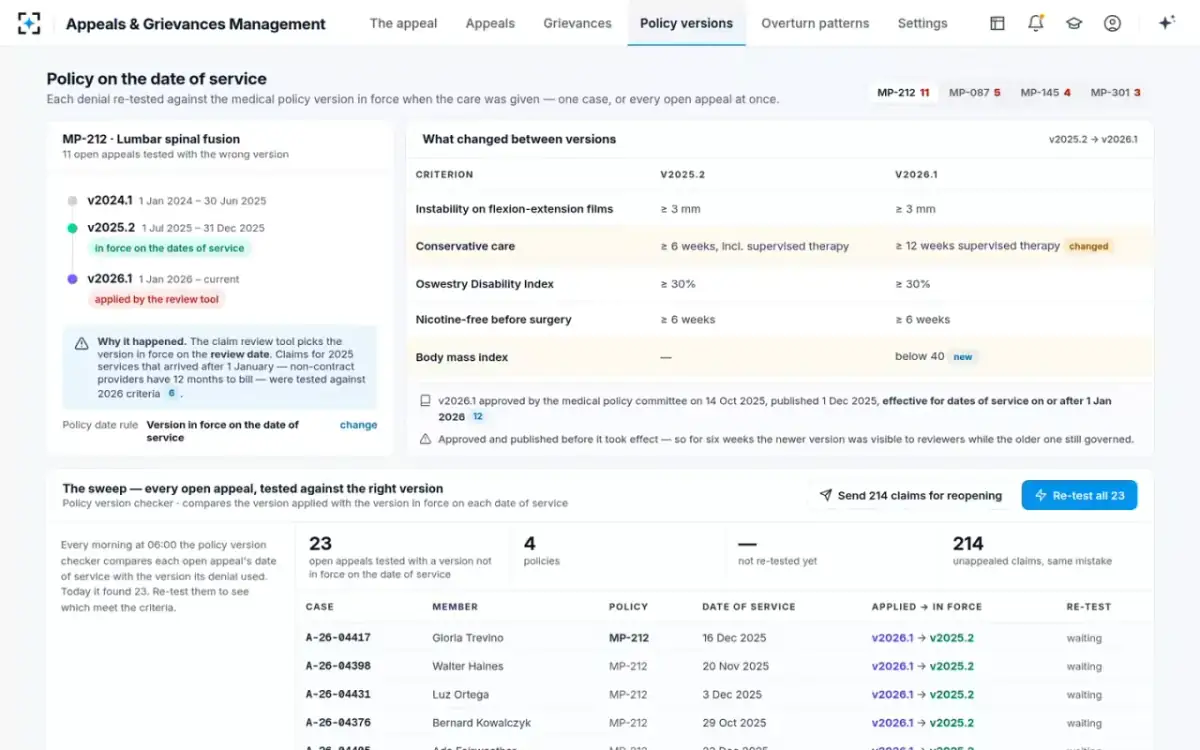
The third row is the one most plans do not look for. A claim reviewed months after the service can be tested against the medical policy that applies on the review date rather than the one in force when the care was given. No federal rule spells out which version a plan must use; it is a question of plan policy and provider contracts, and whatever the rule is, the claims and review systems must apply it consistently. OIG's 2022 finding about systems "not programmed or updated correctly" is the general form of the same problem.
Overturn rate by medical policy and month: four policies jump together
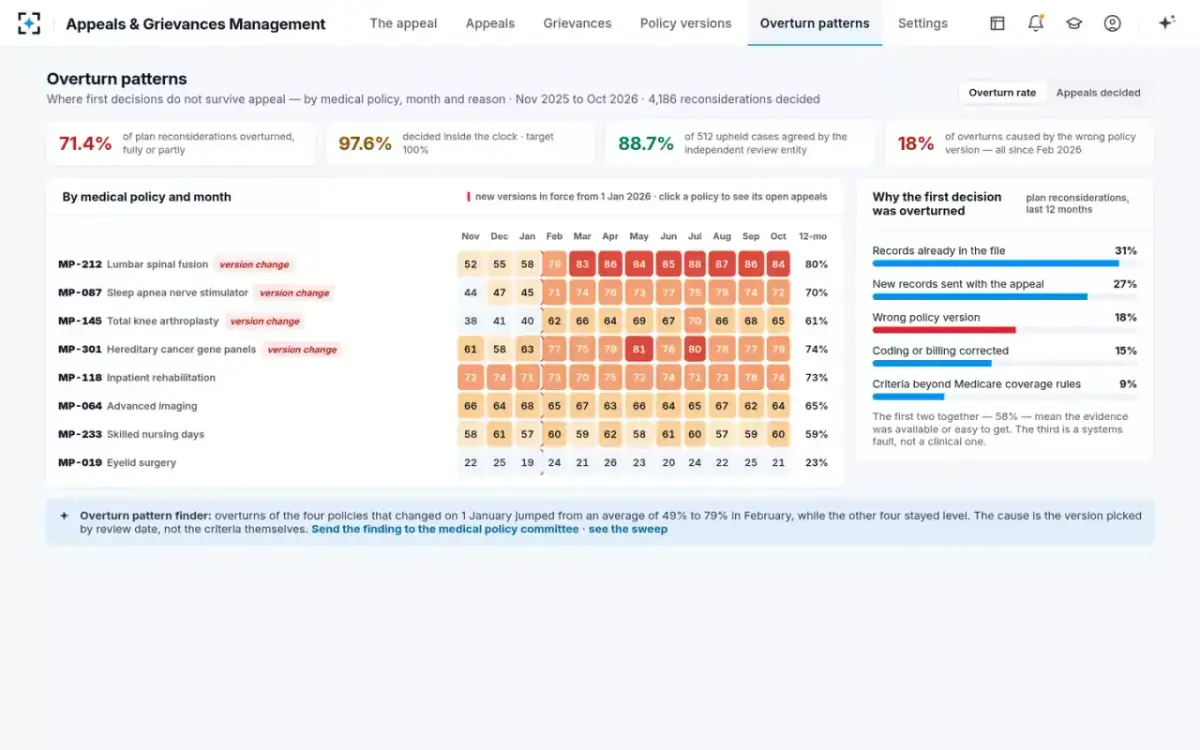
Reading the replay by policy and month
A replay becomes useful when it is cut by medical policy and by month, because causes cluster. In the sample above, four policies that changed on 1 January show overturn rates jumping from February, all with the same cause: the review tool chose the policy version by review date rather than date of service. One fix in the configuration closes all four, and the same check run across open appeals finds the cases still in the queue. On the sample plan that was 23 open appeals tested with a version not in force on the date of service; re-tested, 19 met the criteria under the right one, and 214 unappealed claims with the same error were sent to claims for reopening.
One policy's version history, and why the wrong one was applied
The unappealed claims are the important part. If 11.5% of denials are appealed, as KFF found for Medicare Advantage prior authorization in 2024, then for every denial that was appealed about seven or eight were not, and a cause visible in the overturns is likely to sit in those unappealed denials too. Fixing the cause, and finding those cases, is worth more than winning the appeals.
Where Appeals & Grievances Management fits in an overturn review
The solution does the reading a replay needs on every case rather than a sample. The file rebuilder lays the original determination on a timeline with each event's source page. The new-evidence reader marks what arrived with the appeal and what was already in the file, citing both pages. The policy version checker finds the version in force on the date of service and re-tests each criterion. The overturn pattern finder groups decided appeals by policy, service, reviewer, version and reason each month and writes a short finding for the medical policy committee.
It stops short of the decisions. It never changes a policy or a criterion, and its findings are proposals the committee may reject. Where overturn review sits among a leader's decisions covers how to make it a standing loop, and which tasks agents should and should not take covers the rest of the appeal. To see the patterns on a sample book, start from Appeals & Grievances Management.
Questions people ask
What is the overturn rate for ACA Marketplace appeals?
Much lower than in Medicare Advantage. KFF's analysis of 2024 HealthCare.gov data found that fewer than 1% of denied claims were appealed, and "insurers usually uphold their original decision (66% of appeals were upheld)". KFF also found that only 5% of those denials were for lack of medical necessity, so the appeals that do happen are mostly about other questions.
What does it mean when an appeal is overturned?
The reviewer reversed the denial, fully or partly, so the service is approved or the claim is paid. In Medicare Advantage a plan that reverses a payment denial on reconsideration must pay within 60 calendar days of receiving the request, and one that reverses a service denial must authorize or provide it within 30 days.
Do independent reviewers overturn more denials than plans?
No; they see a different population. The Part C independent review entity reviews only what plans uphold, and reversed about 3% of those in late 2025 and early 2026, while plans themselves overturned 80.7% of appealed prior authorization denials in 2024, according to KFF.
How does overturn rate affect Star Ratings?
Through the IRE, not the plan's own rate. Measure C31, Reviewing Appeals Decisions, scores the share of a plan's appeals the IRE upheld, weighted 2. In the 2027 ratings, four stars needed at least 98% upheld and five stars 100%, so even a few IRE reversals cost a star.
How many overturned appeals should a replay include?
All of them for the last twelve months, if the files can be rebuilt, because causes cluster by policy and month and a sample can miss a cluster. Where volumes make that impractical by hand, take every overturn for the plan's highest-volume policies first.