The five levels of Medicare appeals are: a reconsideration by the plan (or, in Original Medicare, a redetermination by the Medicare contractor); a review by an independent entity; a hearing before an administrative law judge or attorney adjudicator at HHS's Office of Medicare Hearings and Appeals; a review by the Medicare Appeals Council; and judicial review in federal district court. For a Medicare Advantage member the second level is automatic whenever the plan upholds its denial, and the last two depend on the amount in dispute: in 2026 at least $200 for a hearing and $1,960 for court. Health plans run several other appeal paths beside it, for Medicaid, dual-eligible, employer and individual members, and an appeals team's first job is to put each case on the right one. Botminds' Appeals & Grievances Management is an agentic case management solution that sets each case's type, clock and next level from the member's coverage.
Which appeal path applies? Start from the member's coverage
Medicare Advantage (Part C)
- 1Plan reconsideration
- 2Independent review entity, automatic
- 3Hearing: ALJ or attorney adjudicator
- 4Medicare Appeals Council
- 5Federal district court
Medicare Part D drug plan
- 1Plan redetermination
- 2Independent review entity, on request
- 3Hearing: ALJ or attorney adjudicator
- 4Medicare Appeals Council
- 5Federal district court
Original Medicare (Parts A and B)
- 1Redetermination by the Medicare contractor
- 2Reconsideration by a qualified independent contractor
- 3Hearing: ALJ or attorney adjudicator
- 4Medicare Appeals Council
- 5Federal district court
Integrated dual plan
- 1One integrated reconsideration
- 2Medicare benefit: independent review entity, then the Medicare levels
- 3Medicaid benefit: state fair hearing
Medicaid managed care
- 1One plan appeal
- 2State fair hearing (optional external medical review if the state offers it)
Employer group health plan
- 1Internal appeal, one or two levels
- 2External review, if not grandfathered
- 3Court
Individual or Marketplace plan
- 1One internal appeal
- 2External review
- 3Court or state remedies
What are the 5 levels of Medicare appeals?
For a Medicare Advantage member, the regulation lists them in one sentence: appeal procedures "include reconsiderations by the MA organization, and if necessary, an independent review entity, hearings before ALJs, review by the Medicare Appeals Council (Council), and judicial review" (42 CFR 422.561). Each level has a different decision-maker and its own conditions.
The five levels of a Medicare Advantage appeal, with who decides and the 2026 thresholds
| Level | Who decides | How the case gets there | Amount in controversy |
|---|---|---|---|
| 1. Reconsideration | The plan: someone not involved in the denial; a physician with appropriate expertise for medical necessity | Request within 60 days of receiving the denial (presumed 5 days after its date) | None |
| 2. Independent review | The Part C independent review entity, a CMS contractor | Automatic when the plan upholds in whole or part, or misses its deadline | None |
| 3. Hearing | An administrative law judge, or an attorney adjudicator on the record | Written request within 60 days of receiving the independent reviewer's notice | At least $200 in 2026 and 2027 |
| 4. Medicare Appeals Council | The Council, at HHS's Departmental Appeals Board | Request by any party, including the plan | None beyond level 3 |
| 5. Judicial review | A U.S. district court | After the Council denies review or decides | At least $1,960 in 2026; $2,000 from 2027 |
The plan is a party from level 2 onward, and from level 4 it can also be the appellant: "any party to the ALJ's or attorney adjudicator's decision or dismissal, including the MA organization, who is dissatisfied with the decision or dismissal, may request that the Council review" it (422.608). The plan cannot ask for a hearing itself, though: the right to an administrative law judge belongs to parties to the reconsideration "except the MA organization" (422.600).
What is the first level of a Medicare Advantage appeal?
The reconsideration, a fresh look by the plan at its own organization determination. The member, a representative, or a treating physician acting on the member's behalf asks for it in writing (or orally where the plan accepts oral requests, and always for expedited ones) within 60 calendar days of receiving the denial, with receipt presumed 5 days after the date of the notice (422.582). The plan then has 72 hours, 7, 30 or 60 days depending on the case type, and the reconsideration must be done by someone not involved in the first decision, by a physician with appropriate expertise if the denial was for lack of medical necessity.
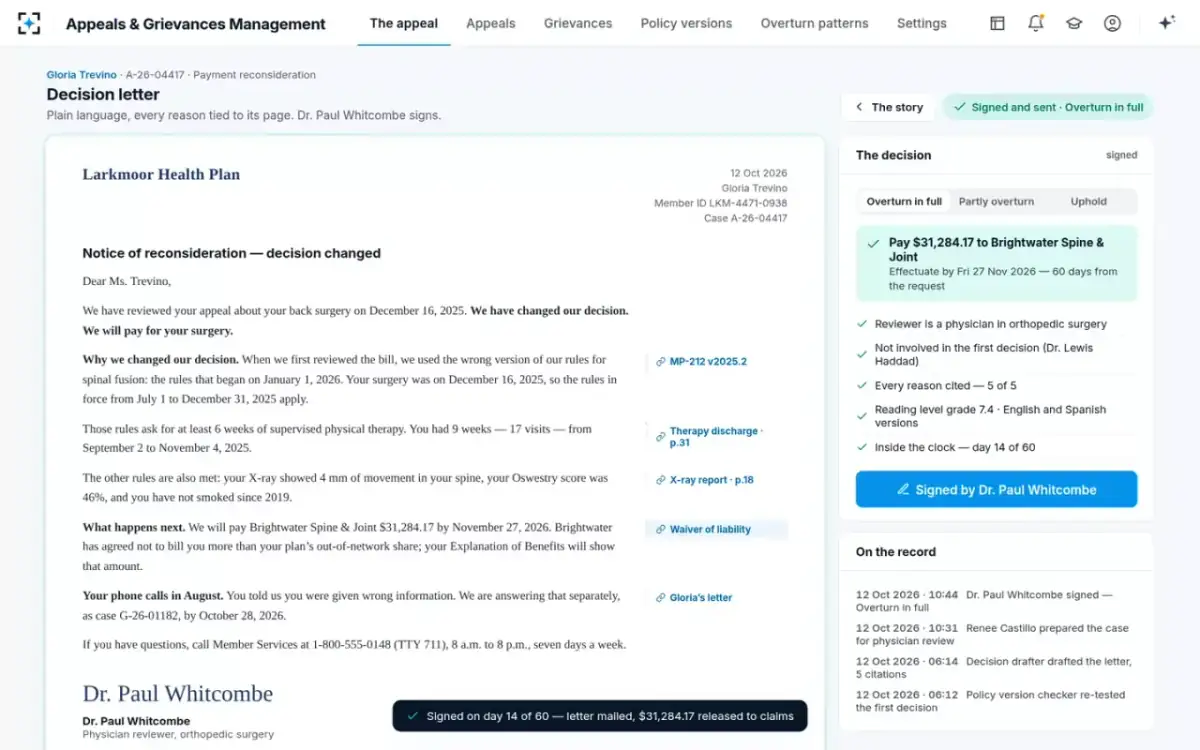
This is the level where most outcomes are settled. KFF found that Medicare Advantage insurers overturned 80.7% of the prior authorization denials appealed to them in 2024, and every case the plan overturns ends here. How long each level takes sets out the clocks in detail.
The first two levels, drawn to scale: the plan's clock, then the independent reviewer's
- Plan reconsideration30 d
- Independent review30 d
- Plan reconsideration60 d
- Independent review60 d
- Plan7 d
- Independent review7 d
Who is the independent review entity?
It is the outside organization CMS contracts to review every Medicare Advantage denial the plan upholds. Under 422.592, when the plan affirms a denial in whole or in part, "the issues that remain in dispute must be reviewed and resolved by an independent, outside entity that contracts with CMS." The plan does not ask for this review and the member does not have to; the plan sends the case file within its own deadline. Since 1 May 2026 the Part C independent review entity has been C2C Innovative Solutions, which took over from Maximus Federal Services for requests received from that date (CMS).
The entity works to the same timeframes as the plan: 72 hours expedited, 30 days for a standard pre-service request, 7 days for a standard Part B drug request and 60 days for payment. It also reviews plan dismissals: a member or non-contract provider may ask it to review a dismissal within 65 calendar days of the plan's dismissal notice. CMS's data show it upholds most of what it sees: in the second quarter of 2026 it received 90,014 reconsideration requests and reversed the plan, fully or partly, in 3.01% of the cases it decided on the merits.
What happens after the IRE denies an appeal?
The member, or another party other than the plan, may ask for a hearing if the amount still in dispute meets the year's threshold, $200 for requests filed in 2026. The request is in writing, filed with the entity named in the independent reviewer's notice "within 60 calendar days of receipt of the notice of a reconsidered determination", with receipt again presumed 5 days after the notice date (422.602). When the plan refuses to provide a service, CMS uses the projected value of the services to compute the amount in controversy. If the amount is too low, the judge dismisses the request.
After the hearing comes the Medicare Appeals Council, which under the Part 405 rules applied to Medicare Advantage "to the extent that they are appropriate" issues a decision within 90 calendar days of a request for review of a hearing decision, or 180 days for a case escalated from the hearing level, unless extended (405.1100). Last comes federal court, if the Council denies review or decides and the amount in controversy reaches the judicial threshold, $1,960 in 2026 and $2,000 for actions filed from 1 January 2027 (422.612). If a higher level reverses the plan, it must pay for, authorize or provide the service within 60 calendar days of the notice, unless it has itself asked the Council for review.
A reversal at level 1: the case ends at the plan
Medicare Advantage vs Original Medicare: the first two levels differ
The last three levels are shared; the first two are not. Original Medicare's first level is a redetermination by the Medicare Administrative Contractor that processed the claim, and its second a reconsideration by a qualified independent contractor, which the beneficiary must ask for. In Medicare Advantage the plan holds the first level and the second is automatic.
The first two levels in Medicare Advantage and in Original Medicare
Medicare Advantage: Reconsideration by the plan; request within 60 days of receiving the denial.
Original Medicare (Parts A and B): Redetermination by the Medicare Administrative Contractor; request within 120 days of receiving the initial determination; generally decided within 60 days.
Medicare Advantage: Independent review entity, automatically, whenever the plan upholds in whole or part.
Original Medicare (Parts A and B): Qualified independent contractor, on request within 180 days; generally decided within 60 days.
Medicare Advantage: Hearing, Council, court, with the same amount-in-controversy thresholds.
Original Medicare (Parts A and B): The same.
Do Medicaid appeals have the same levels?
No. A Medicaid managed care plan "may have only one level of appeal for enrollees" (438.402(b)), after which the member's next step is a state fair hearing, not an independent review entity or a Medicare judge. The member has 60 calendar days from the notice to appeal to the plan; the plan has at most 30 days, or 72 hours expedited; and the member then has between 90 and 120 days, as the state sets, to request the hearing. If the plan misses its deadline, the member is treated as having exhausted the plan's process and may go straight to the hearing (438.408).
A state may also offer an external medical review, but only on the member's option, independent of the state and the plan, free of charge, and without delaying the fair hearing or interrupting continued benefits. Integrated plans for dual-eligible members combine the two programs in a single plan reconsideration, after which a Medicare benefit goes to the independent review entity and a Medicaid benefit to the state fair hearing; integrated appeals step by step covers that path.
How many levels of appeal are there for employer plans?
One or two internal levels, then external review for most plans, then court. A group health plan under the Department of Labor's claims procedure may provide one or two levels of internal appeal; with one level, it must decide a pre-service appeal within 30 days and a post-service appeal within 60 days, and an urgent care appeal within 72 hours (29 CFR 2560.503-1(i)). Members must have at least 180 days from the denial notice to appeal. The final denial must tell the member of the right to bring a civil action under section 502(a) of ERISA.
Non-grandfathered group health plans and insurers must also offer external review under 45 CFR 147.136: through a state process that binds an insurer if the state's law meets the minimum consumer protections, or otherwise through the federal process. The member has four months from the final internal denial to ask, and the reviewer decides within 45 days, or 72 hours when expedited. Disability benefit appeals under ERISA follow their own clocks and are a separate discipline, traced in the guide to the ERISA appeals process.
Individual and Marketplace plans: one internal level, then external review
Insurers in the individual market, including Marketplace plans, "must provide for only one level of internal appeal before issuing a final determination" (147.136(b)(3)), and then the same external review. Members rarely use it: KFF's analysis of 2024 HealthCare.gov data found that fewer than 1% of denied claims were appealed, and that insurers upheld 66% of the appeals they received (KFF, March 2026).
For a plan that sells in several markets, the practical consequence is that the same denied MRI can sit on four different paths depending on the member's card. The intake decision that matters most is not the clinical one; it is which of these trees the case belongs to.
Putting each case on the right path: where the solution fits
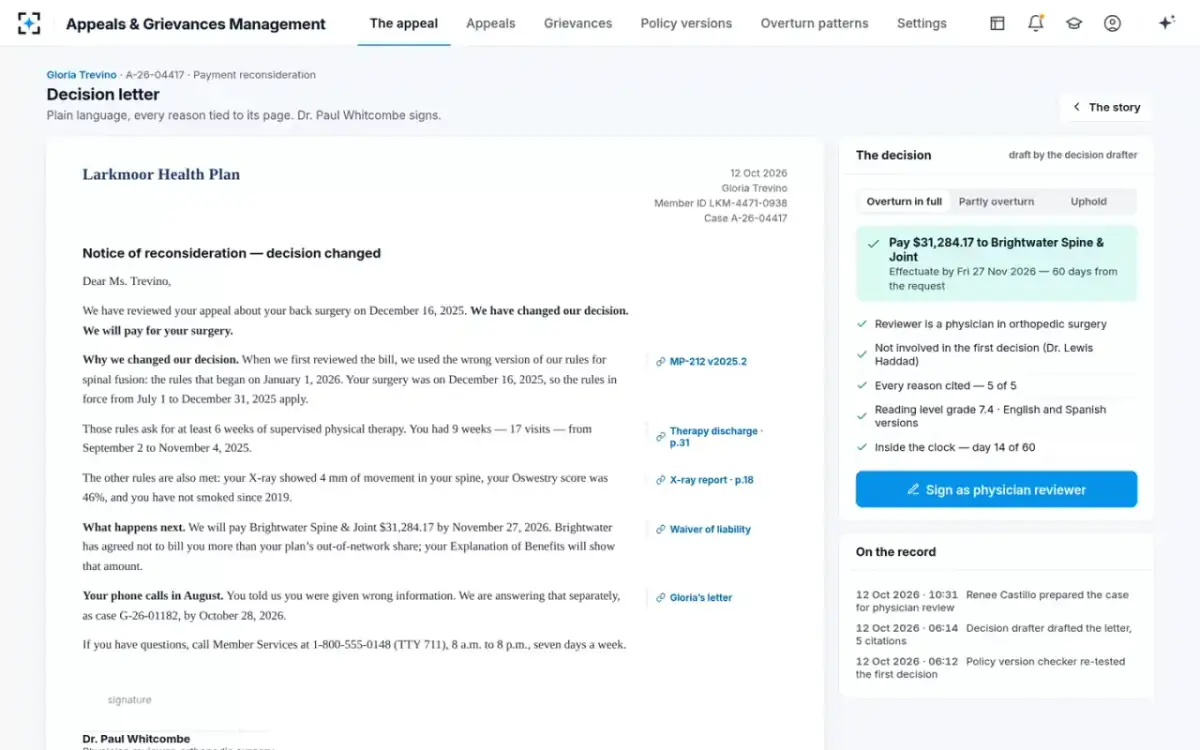
In Appeals & Grievances Management the intake sorter sets each case's type from the member's coverage and the request, so a Medicare Advantage payment appeal starts on a 60-day clock, a Medicaid appeal on the state's clock and an integrated case on 30 days. The decision drafter writes the letter with the next level that applies, and the clock keeper forwards upheld Medicare Advantage cases to the independent review entity before the deadline: 12 hours before it in the sample configuration, or 4 hours for expedited cases.
The letter states what happens next
The solution does not decide which path a member is on when the coverage data is wrong; a person confirms the case type, and agents never dismiss a request or close a case. To see the queue with every product line's clock, start from Appeals & Grievances Management.
Questions people ask
What is the amount in controversy for Medicare appeals?
For requests filed in 2026, at least $200 for a hearing before an administrative law judge and $1,960 for judicial review. CMS's notice of 16 September 2026 sets $200 and $2,000 for requests filed on or after 1 January 2027. The first two levels have no minimum.
Can a Medicare Advantage plan appeal an IRE decision?
Not to a hearing: the right to an administrative law judge belongs to the other parties. The plan can ask the Medicare Appeals Council to review a hearing decision it disagrees with, and may wait for the outcome before effectuating, provided it tells the enrollee and the independent review entity.
Does the member have to ask for independent review in Medicare Advantage?
No. When the plan upholds a denial in whole or in part, or misses its deadline, it must send the case to the independent review entity itself. In Part D the member must ask, except when the plan misses its deadline.
What are the 5 levels of Medicare Advantage appeals?
Plan reconsideration, independent review entity, a hearing before an administrative law judge or attorney adjudicator, the Medicare Appeals Council, and federal district court. The third and fifth levels require a minimum amount in controversy, $200 and $1,960 in 2026.
How long does it take to get through all five levels?
The first two levels have fixed deadlines, at most 120 days together for a payment appeal before any extension. Hearings and Council review follow Part 405 procedures, and court takes as long as litigation does, so a case that goes the distance can last well over a year.