Concurrent review is the review a health plan's UM team carries out while a member is receiving care, most often during an inpatient hospital stay, a skilled nursing facility stay, inpatient rehabilitation or a long-term acute care stay, and also for home health and partial hospitalization. Where prior authorization asks once whether care should start, concurrent review asks repeatedly whether the current level of care should continue: each review weighs the latest clinical notes against the plan's criteria and approves more days, changes the level of care or ends coverage. In Medicare Advantage each of those outcomes is a coverage decision with notice and appeal rights, so a three-week stay can carry several decisions on one member. Botminds' Utilization Management Automation treats every review as its own request on the clock: it gathers what changed since the last review, asks for what is missing, and leaves each decision with a nurse or physician.
One invented 21-day skilled nursing stay, split into the days each decision covered
Days authorized, by decision
- Admission review: days 1–7 · 33%
- First concurrent review: days 8–12 · 24%
- Second review: days 13–17 · 24%
- Third review: days 18–21, then end · 19%
What is concurrent review in healthcare?
Concurrent review is utilization review of care already under way: the plan decides, during the stay or course of treatment, whether continued care at that level is covered. CMS's description in the 2025 rule that clarified it for Medicare Advantage is the most precise available: "Concurrent review involves the evaluation of the appropriateness of the ongoing level of care, including decisions related to the extension of previously approved care." CMS listed the settings: hospitalizations, skilled nursing facilities, long-term acute care hospitals, inpatient rehabilitation facilities, home health, partial hospitalization and intensive outpatient programs.
The same rule ended an argument about status. Some plans had treated decisions made during a stay as outside the appeal rules. CMS's answer, now in regulation, is that a plan's refusal to provide or pay for services made "in connection with a decision made concurrently with an enrollee's receipt of services" is an organization determination, applicable from 1 January 2026. Every concurrent denial in Medicare Advantage therefore needs the same things as a prior authorization denial: physician review if it rests on medical necessity, notice to the enrollee and the provider, and appeal rights.
How often is concurrent review done?
As often as the plan's authorization increments require: no federal rule sets a review interval, so the frequency follows from how many days or visits each decision approves. A plan that authorizes three inpatient days at a time reviews every three days; one that authorizes a skilled nursing stay in weekly blocks reviews weekly.
The increment is also a notice decision. In Medicare Advantage a skilled nursing, home health or comprehensive outpatient rehabilitation service ends, for notice purposes, at the end of each approved block: termination "includes cessation of coverage at the end of a course of treatment preauthorized in a discrete increment, regardless of whether the enrollee agrees that such services should end." Shorter increments mean more reviews and more end-of-coverage notices; longer ones mean fewer decisions but more days approved on older information. The choice belongs in the UM committee's policies, not in individual reviewers' habits.
Review cycles across the invented stay: decisions, notes and the notice that ends it
- Admission reviewDays 1–7
- Review 1Days 8–12
- Review 2Days 13–17
- Review 3Days 18–21
- Hospital records, PT and OT evaluationsAdmission
- Therapy notes from the last 48 hDay 6
- Progress against goalsDay 11
- Discharge plan; notice by day 19Day 16
What is the difference between concurrent review and prior authorization?
Prior authorization decides whether care may start; concurrent review decides whether care already started may continue at the same level. Both are coverage decisions with physician review before a medical-necessity denial, notice and appeal rights in Medicare Advantage. They differ in three practical ways.
First, the evidence: a prior authorization rests on the referral and history, while a concurrent review rests on how the patient is responding, which means notes written since the last decision. Second, the clock: a request to continue care is usually urgent by nature, because the patient is in the bed, and employer plans must decide a request to extend an urgent course of treatment "within 24 hours after receipt of the claim by the plan, provided that any such claim is made to the plan at least 24 hours prior to the expiration of the prescribed period of time or number of treatments". Third, the reporting: CMS's annual collection of Medicare Advantage internal coverage criteria covers prior authorization only and "would not include ICC data for other review types, such as concurrent reviews or payment reviews", so the criteria behind concurrent decisions get less outside scrutiny, and more need for internal discipline.
Concurrent review rules by program
| Program | Is a concurrent denial appealable? | Clock for a continuation request | Ending or reducing care |
|---|---|---|---|
| Medicare Advantage | Yes: an organization determination, with notice to enrollee and provider (42 CFR 422.566(b)(3)) | Standard or expedited organization-determination clocks; urgent requests run on 72 hours | For SNF, home health and CORF services, written notice at least two days before services end, with a fast-track appeal (422.624, 422.626) |
| Medicaid managed care | Yes: a denial, reduction or termination is an adverse benefit determination | The same authorization clocks apply to continuing authorizations (42 CFR 438.210(b), (d)) | Advance notice under the Medicaid fair hearing rules (42 CFR 438.404(c)(1)) |
| Employer plans (ERISA) | Yes: a reduction or termination of an approved course is an adverse benefit determination | 24 hours for an urgent request to extend, if made 24 hours before the course ends | Notice early enough to appeal and get a decision before the reduction or termination |
Who performs concurrent review?
On the plan's side, concurrent review nurses do most reviews and physicians decide any adverse outcome; on the provider's side, hospital and facility utilization review nurses and case managers send the clinical updates and plan the discharge. The two sides meet every review cycle, often by fax or phone, which is why concurrent review is as much a document-exchange problem as a clinical one.
The people in one concurrent review cycle, and what changes with agents
Today
Calls or faxes the facility for updates each cycle, then reads them against criteria close to the end of the approved block.
With agents
Opens each review with the notes since the last decision already gathered and the missing item already requested.
Still theirs: Approving further days within nurse authority.
Today
Receives general requests for "clinicals" and sends large packets to cover every possibility.
With agents
Receives a request for the named document the review turns on, such as therapy notes from the last 48 hours.
Still theirs: The facility’s own discharge planning and the notices it must deliver.
Today
Gets a possible reduction late in the block, when the end-of-coverage notice is already due.
With agents
Gets a possible reduction or end of coverage early enough for a peer-to-peer and a valid notice.
Still theirs: Every partial or adverse decision, with the specific reason.
Today
Learns about a stay that ran past its approval when the claim arrives.
With agents
Sees every open stay by days left in its approved block.
Still theirs: Review intervals, increments and escalation rules.
What documentation is needed for concurrent review?
The documentation is what changed since the last decision: progress and therapy notes, nursing assessments, vital signs and test results, and the discharge plan, measured against the criteria for the current level of care. A concurrent review that relies on a one-paragraph update from the facility is the risk CMS's auditors named in their 2025 report. Their advice to plans was to give reviewers the complete clinical documentation, so that no denial rests on an abbreviated summary of the records (CMS, CY 2025 audit and enforcement report); the guide to medical necessity review quotes the tip and builds the file it asks for.
The practical test for each cycle is whether the file contains the notes that would change the decision. For a skilled nursing stay that usually means the therapy evaluations and the latest progress against functional goals; for an inpatient stay, the physician's daily notes and the reason the patient cannot yet be cared for at a lower level. Asking for exactly those, by name and date range, gets them faster than asking for "updated clinicals".
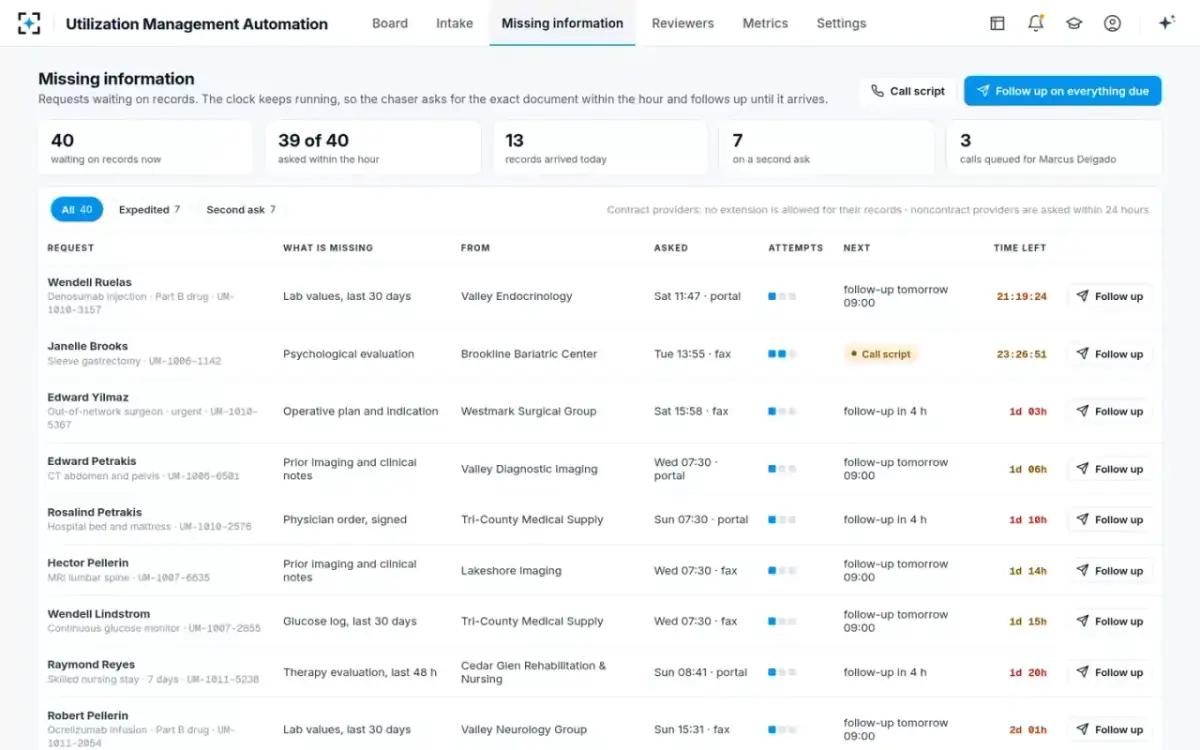
Pends with the named document, the source and the clock, including a 48-hour therapy update
Can an approved inpatient day be denied later?
Not for lack of medical necessity in Medicare Advantage. Since 2026 the protection that covers prior authorization approvals extends to concurrent approvals: if a plan approved care through a prior authorization, a pre-service determination or "a concurrent determination made during the enrollee's receipt of inpatient or outpatient services", it may not later deny that care for lack of medical necessity, and may reopen only for good cause or fraud. For approved inpatient admissions, later clinical information cannot even count as good cause.
CMS explained why in plain terms: "MA enrollees should be able to rely upon an approved inpatient admission made in advance of the receipt of services, or concurrently with the receipt of services, despite changing medical circumstances." For the plan this means each concurrent approval is final for the days it covers, and the place to get it right is the review itself. The rules for the admission decision are set out in the two midnight rule in Medicare Advantage.
An adverse concurrent decision on an inpatient stay can also reach beyond the hospital. CMS noted that because such a decision denies inpatient coverage, it "could also affect an enrollee's eligibility for covered post-hospital extended care services furnished in a SNF", where a plan has not waived Medicare's three-day inpatient stay requirement. A downgrade on day two can cost a member skilled nursing coverage on day five.
The notices that end a stay: two days, and noon the next day
Ending a skilled nursing, home health or outpatient rehabilitation stay in Medicare Advantage takes a valid written notice delivered at least two days ahead, and gives the member a fast appeal. The provider must deliver the standardized notice "no later than two days before the proposed end of the services", signed by the enrollee or a representative to be valid. If it is late or invalid, the plan pays for continued services until two days after a valid notice is received.
The member may then ask an independent review entity for a fast-track appeal, by noon of the day after the notice is delivered, and the burden sits with the plan: "the burden of proof rests with the MA organization to demonstrate that termination of coverage is the correct decision". A concurrent review that ends coverage therefore has to be finished, physician-reviewed if adverse, and handed to the facility in time for the notice, with a file that will stand up before the independent reviewer within a day. That is the cycle that most often goes wrong, because the final review is scheduled for the last day of the block rather than two or three days before it.
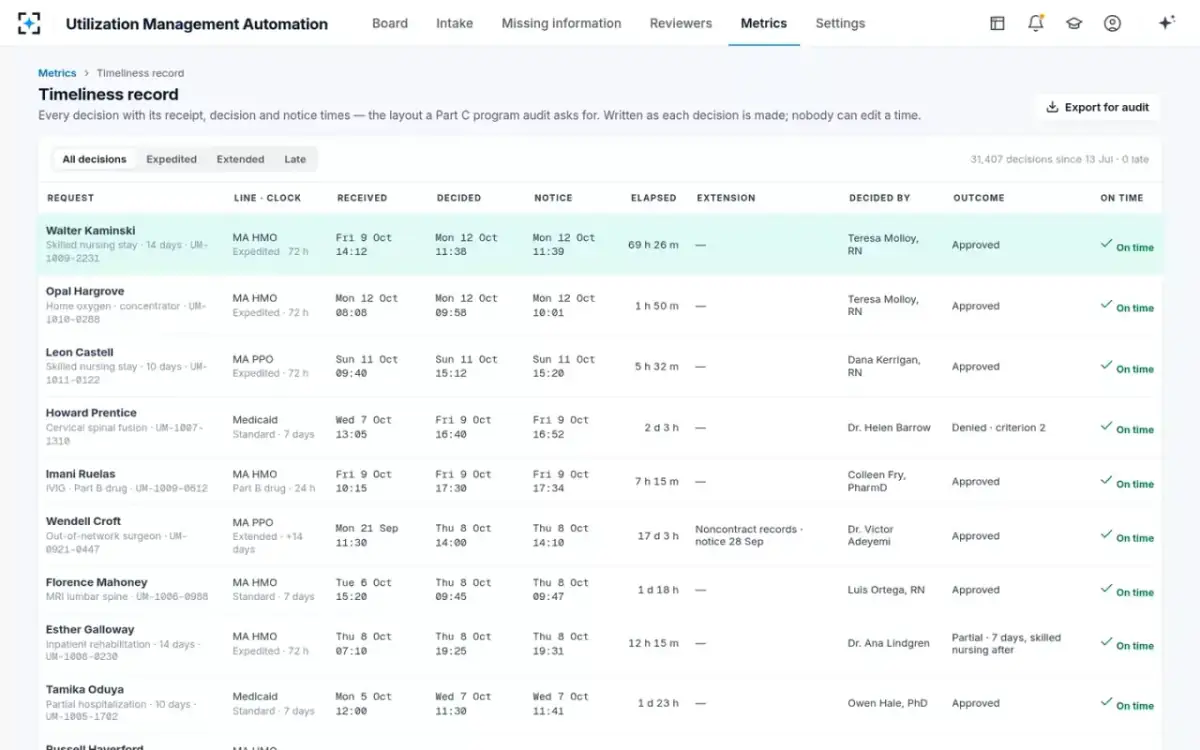
Partial decisions and their reviewers, in the timeliness log
Preparing each day's review before the nurse arrives
Most of a concurrent review cycle is assembly: finding what changed, asking the facility for what is missing, and putting the stay in front of the right reviewer before its block ends. That assembly is where agents help, and the decision is where they stop.
In Utilization Management Automation each continuation is a request on the board with its own clock and its own deadline: the end of the approved block, less the time the plan needs for a decision and, if coverage may end, for a valid notice. The intake reader matches incoming facility faxes to the open stay by member and date. The missing-information chaser asks the facility for the specific update the review needs, such as therapy notes from the last 48 hours, within the hour. The outcome predictor sets out the factors for and against continued care, and the reviewer router sends a possible reduction or end of coverage to a physician early enough for a peer-to-peer and a notice. Nurses approve further days; physicians make every partial or adverse decision.
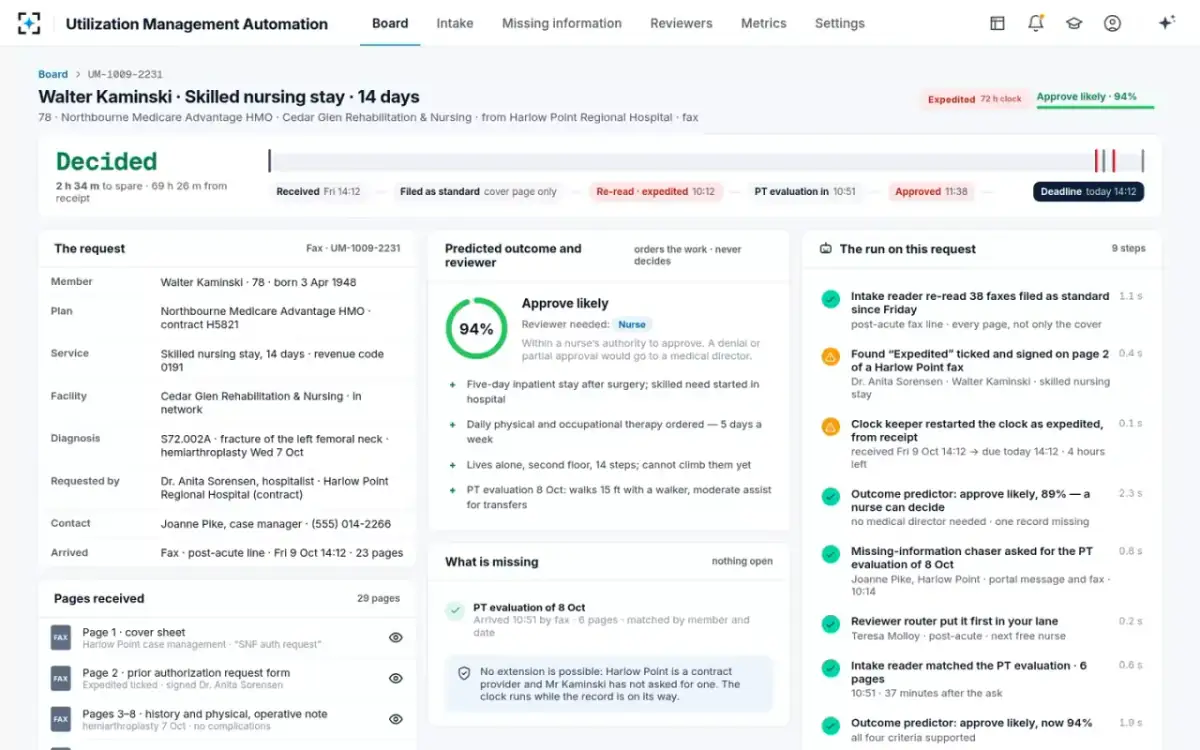
In the solution's sample story, a nurse approves 14 days at a skilled nursing facility with a concurrent review set for day 10: four days before the block ends, enough for a decision and, if needed, a notice two days ahead. Who sits where around those cycles is mapped in the utilization management team, seat by seat.
Approved, with the next review already set
Questions people ask
What is retrospective review?
Retrospective review is utilization review after the care is finished, usually when the claim arrives: the plan checks whether the services billed were covered and necessary. In Medicare Advantage a care decision approved in advance or during the stay cannot later be denied for lack of medical necessity, so retrospective review mainly reaches care that was never authorized.
Is a concurrent review decision appealable?
Yes. In Medicare Advantage a denial made during a stay is an organization determination with notice and appeal rights, and the member or a physician may request an expedited reconsideration. Ending a skilled nursing, home health or outpatient rehabilitation service also carries a fast-track appeal to an independent review entity.
What is concurrent review vs continued stay review?
They are usually the same thing under two names: continued stay review is the concurrent review that decides whether more days at the current level of care are covered. Some plans use concurrent review for the whole process and continued stay review for each decision within it.
Does a pending concurrent review stop the plan's clock?
No. A request to continue care is a request like any other: in Medicare Advantage the standard or expedited clock runs from receipt, and only a permitted extension with written notice adds time. Employer plans must decide an urgent request to extend a course of treatment within 24 hours.
Do concurrent reviews count in the public prior authorization metrics?
The CMS-0057-F metrics count prior authorization requests. Whether a plan's continued-stay decisions are prior authorizations depends on how the plan structures them, so a plan should state its treatment of them with its posted figures; how the metrics are built is set out in the metrics guide.