In utilization management, the medical director is the physician accountable for the clinical accuracy of a health plan's coverage decisions, and the reviewer of last resort before any request is denied for lack of medical necessity. In Medicare Advantage the seat is required by regulation: the plan must employ a licensed physician as medical director, and any expected partial or full medical-necessity denial must be reviewed by a physician or other appropriate professional before it issues. That makes medical director utilization management a question of physician time: since 2026 a plan has 72 hours for an expedited request and seven calendar days for a standard one, and physician minutes spent on requests a nurse could approve are minutes not spent on the ones that need a doctor. Botminds' Utilization Management Automation puts agents on the routing side of that line, and leaves every decision on the physician's side.
Where the agents stop in Utilization Management Automation: the line drawn on one request
Agent
Read and clockReads every page of the request, finds an urgency marker or a physician’s request to expedite, and starts the clock from the arrival stamp.
Never: downgrades a physician’s request to expedite
Agent
ChaseNames the record the decision turns on and asks the provider for it, so the reviewer opens a complete file.
Never: asks for the whole chart, or contacts the member about clinical detail
Agent
Predict and routePredicts approve, partial or denial against the plan’s criteria, shows the factors for and against, and routes a possible denial straight to a physician.
Never: decides, or drafts a denial
A person decides
UM nurseApproves within nurse authority when the record meets the criteria; sends anything doubtful to a physician.
A person decides
Medical director or physician reviewerMakes every partial or full denial with the specific reason, holds the peer-to-peer call, and may approve what the prediction expected to deny.
Agent
LogWrites who decided, when, under which rule and with what notice time.
Never: edits a recorded time
What does a medical director do in utilization management?
The medical director reviews the requests that may be denied, makes or signs every adverse medical-necessity decision, talks to treating physicians, leads the UM committee and answers for the clinical accuracy of the whole program. Medicare Advantage puts the last duty in writing: the medical director is "responsible for ensuring the clinical accuracy of all organization determinations and reconsiderations involving medical necessity", and must be a physician with a current and unrestricted licence in a US state, territory or the District of Columbia.
In a plan of any size the medical director does not review every case personally. Physician reviewers, often part-time and often by specialty, work the physician lane under the medical director's policies, while the medical director handles escalations, the committee, audits and the cases nobody else can decide. That makes the seat as much about allocation as about review: which requests reach a physician, how early, and with what in the file.
The physician side of the UM team, and what each seat keeps
Today
Escalations arrive late in the clock, mixed with requests that never needed a physician.
With agents
Sees the day’s physician workload against physician hours on shift, and which requests are at risk.
Still theirs: Clinical accuracy of every medical-necessity decision; the UM committee; peer-to-peer escalations.
Today
Opens a request a nurse has held for days, often to find the deciding record still missing.
With agents
Receives possible denials first time, with the record requested and the factors for and against.
Still theirs: Every partial or full denial, with the specific reason.
Today
Rebuilds the first reviewer’s reasoning from notes when the provider appeals.
With agents
Sees the timeline of the first decision and every record it rested on.
Still theirs: The reconsidered decision, made without having taken part in the first one.
Today
Sends unsure requests upward by default when the clock is short.
With agents
Approves what the record supports; anything the prediction marks as a possible denial goes straight to a physician.
Still theirs: Every approval within nurse authority.
Does a physician have to review every denial?
In Medicare Advantage, every expected medical-necessity denial must be reviewed by a physician or another appropriate health care professional before it issues; in Medicaid managed care, a denial must be made by someone with the right expertise; employer plans face a clinician requirement at the appeal stage. The Medicare Advantage text is the strictest. If the plan expects to issue a partially or fully adverse medical-necessity decision, a physician or other appropriate professional with expertise in the service and knowledge of Medicare coverage criteria must review the request before the decision issues (42 CFR 422.566(d)). The other side of that line, the approvals a nurse may sign alone, is the subject of the guide to the prior authorization nurse.
The rule says "physician or other appropriate health care professional", so in some fields, such as therapy or behavioral health, the reviewer may be a licensed professional other than a physician. It does not say the reviewer must share the treating physician's specialty. And it covers medical necessity: a denial because the member was not enrolled, or the service is excluded from the benefit, is a different kind of decision. A team that routes by "possible denial" rather than "possible medical-necessity denial" will send its physicians work the rule never required them to do.
Who may deny, by program: the rule that sets the physician's seat
Medicare Advantage: A physician or other appropriate professional with expertise in the field and knowledge of Medicare coverage criteria reviews any expected medical-necessity denial (42 CFR 422.566(d)).
Medicaid managed care and employer plans: Medicaid: the denial is made by an individual with appropriate expertise for the enrollee’s medical, behavioral health or long-term care needs (42 CFR 438.210(b)(3)). For employer plans, no federal reviewer rule at this stage.
Medicare Advantage: A medical director who is a licensed physician is responsible for clinical accuracy (42 CFR 422.562(a)(4)).
Medicaid managed care and employer plans: Set by state contracts for Medicaid plans and by state law for insured commercial plans.
Medicare Advantage: A peer-to-peer, where one happens, is part of the determination and held to the same expertise standard (CMS-4201-F preamble).
Medicaid managed care and employer plans: Medicaid: the plan must consult the requesting provider when appropriate (42 CFR 438.210(b)(2)(ii)).
Medicare Advantage: A physician with appropriate expertise who did not take part in the first decision (42 CFR 422.590(h)).
Medicaid managed care and employer plans: For employer plans, the fiduciary must consult a health care professional with appropriate training and experience (29 CFR 2560.503-1(h)(3)(iii)).
The insurers' voluntary commitments go no further than the rules on this point. In June 2025 health insurers covering most Americans pledged, among six reforms, to "Ensure medical professionals review all clinical denials." CMS described the pledge as voluntary; no independent source yet measures how it has been kept.
Where the agents stop: the line drawn request by request
Agents may read, clock, chase, predict and route; a nurse may approve; only a physician or appropriate professional may deny for medical necessity. Drawn that way, the line is not a policy statement but a set of things the software cannot do: in Utilization Management Automation no agent can issue a denial, draft one, extend a clock or change a reviewer's decision, and every adverse or partial decision is made by a medical director with the specific reason.
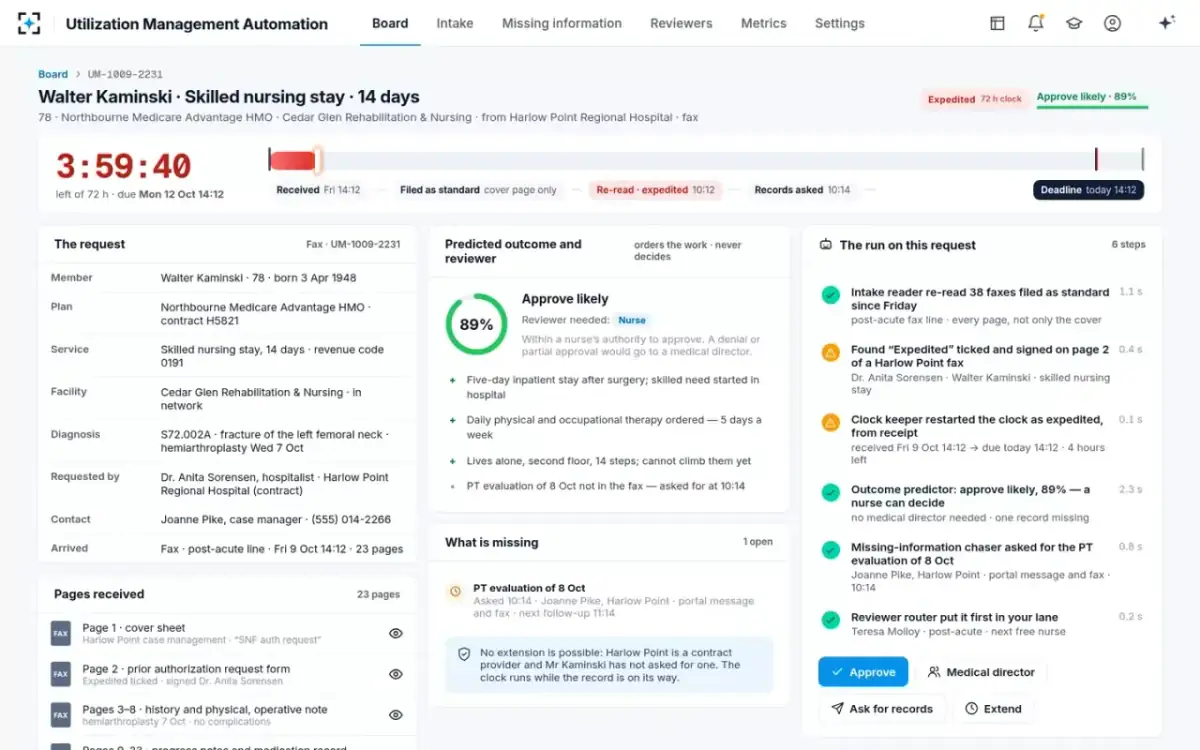
Three decisions sit close to the line and need explicit rules. A prediction of "approve likely" sends a request to a nurse, who may still send it upward; the threshold, 80 percent in the sample plan, is the plan's setting. A prediction of "denial possible" sends a request to a physician first time, and the physician may approve it. And a request where the prediction is unsure goes to the physician lane, because the cost of a wrong routing is asymmetric: a nurse who cannot approve has spent part of the clock, while a physician who approves has spent a few minutes.
One request: the prediction, its factors, and the reviewer it chose
Can AI make utilization management decisions?
No federal regulation authorizes software to deny coverage on its own, and the one federal proposal written specifically about AI in Medicare Advantage coverage was not finalized. CMS's Contract Year 2026 rulemaking had proposed guardrails for AI; in the final rule of April 2025 CMS dropped that provision, while saying it would keep considering future rulemaking (the wording, and what WISeR does instead, is set out in the guide to the WISeR model for prior authorization). What binds a plan instead are the general rules: individual medical-necessity decisions based on the enrollee's own history and notes (42 CFR 422.101(c)(1)) and physician review before a denial.
Where CMS itself uses technology for prior authorization, it keeps the same line. The WISeR model, which tests prior authorization with technology companies in traditional Medicare in six states from 2026 to 2031, leaves every recommendation for non-payment to appropriately licensed clinicians (CMS, WISeR model). The model does not apply to Medicare Advantage, but it shows where CMS draws the boundary when it designs a program itself.
The evidence that AI speeds decisions is also thinner than the marketing. A 2026 systematic review in the Journal of Managed Care & Specialty Pharmacy found 16 eligible studies of AI in prior authorization, and reported that most measured technical accuracy while few showed faster decisions, fewer denials or lower cost (JMCP, September 2026); how to measure those gains on your own requests is laid out in the prior authorization automation pilot guide. A plan should ask any vendor for its own operational measurements, not model accuracy alone.
The sharper risk is subtler than an algorithm denying care. The Senate Permanent Subcommittee on Investigations, in a 2024 majority staff report on post-acute denials in Medicare Advantage, recommended that CMS expand the rules for UM committees so that predictive tools do not have undue influence on human reviewers, and warned about tools used only to approve as well:
"Even if predictive technologies are solely used to approve requests, nurses and doctors reviewing cases may face pressure to rubber-stamp the recommendations of algorithms and artificial intelligence."
U.S. Senate Permanent Subcommittee on Investigations, majority staff report, 17 October 2024
That warning applies to any prediction shown to a reviewer, including the one in this solution. The design answers are concrete: the prediction shows the factors for and against rather than a bare score; it decides which lane a request enters, not what happens in it; and a physician who approves a request predicted for denial is a normal outcome, not an exception to explain. The measure a medical director should watch is the departure rate: how often reviewers decide against the prediction. A rate near zero is not proof of a good model. It may be proof of the pressure the Subcommittee's staff described.
Routing by predicted outcome puts physician time where it is needed
Routing by predicted outcome sends a request to the cheapest reviewer who can decide it, and sends possible denials to physicians before the clock is half gone. The alternative most teams run by default, nurse first and physician when unsure, sends a physician the requests a nurse lacked time to finish as well as the ones that need a doctor.
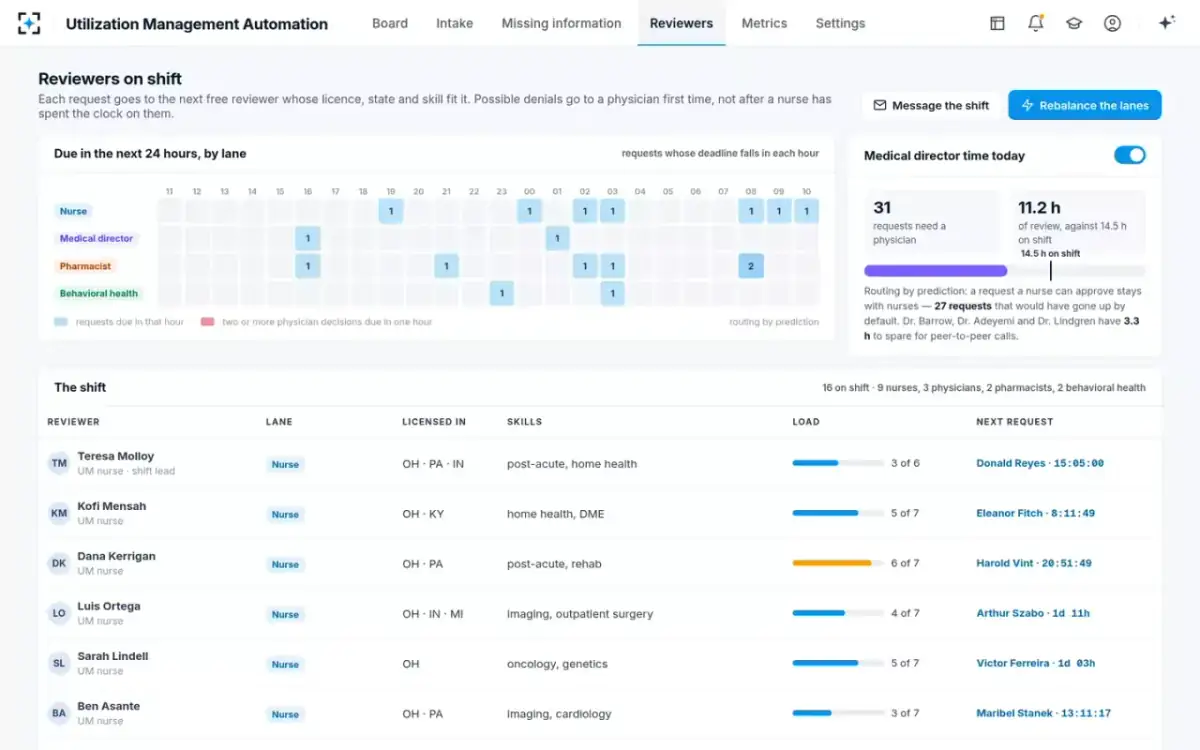
Physician time on one sample shift in Utilization Management Automation
31
requests predicted to need a physician today
11.2h
of physician review, against 14.5 hours on shift
58
requests that would reach physicians with routing switched off
21.0h
of physician review without routing: 6.5 hours short
On the sample shift, routing keeps 27 requests a nurse can approve in the nurse lane, and leaves the three physicians 3.3 hours for peer-to-peer calls. Without it, the same physicians face 21 hours of review in a 14.5-hour shift, and something waits. In practice the thing that waits is usually the peer-to-peer call or the request that arrived last, which is how a physician shortage becomes a late decision.
Medical director time today: physician hours needed against hours on shift
Is a peer-to-peer review required?
Medicare Advantage rules do not set out a peer-to-peer process of their own; where one happens, CMS treats it as part of the coverage decision and holds the plan's reviewer to the same expertise standard. In the 2023 rule that set the physician-review requirement, CMS answered commenters directly: "the P2P discussion is not separate and distinct from an organization determination. Rather, P2P discussions take place during adjudication of an organization determination." The plan physician on the call must therefore have expertise appropriate to the service.
CMS has also noted that plans use the conversation differently. In the 2025 rule on concurrent review it recorded that some plans describe peer-to-peer as solely educational with no bearing on the prior decision, while others use it to supplement or as part of a contract provider's appeal (CMS, 2025). A medical director should be able to say which it is in their plan, because the answer decides whether the call can change a decision and whose clock it runs on. Medicaid managed care is more direct: the plan must consult the requesting provider when appropriate (42 CFR 438.210(b)(2)(ii)).
The reconsideration belongs to a physician who did not decide
When a provider or member appeals a Medicare Advantage denial, the plan must use someone new: nobody who took part in the first decision may conduct the reconsideration (42 CFR 422.590(h)), and if the denial was for lack of medical necessity, the reconsidered decision must be made by a physician with expertise appropriate to the services. For a small physician team this is a scheduling constraint as much as a clinical one: the physician who denied on Monday cannot hear the appeal on Thursday.
Routing has to know the history. A request that returns as an appeal should not reach its first reviewer, and the reconsideration physician should see the first decision's timeline, the records it rested on and the specific reason given. Appeal handling sits with the plan's appeals and grievances team rather than the UM team in most plans; what the UM team owes it is a decision file that can be read without reconstruction.
The medical director on the UM committee
In Medicare Advantage the medical director chairs the committee that decides what the team may apply: a plan that uses UM must establish a UM committee "led by a plan's medical director". The committee must review every UM policy at least once a year against Traditional Medicare's coverage rules and current clinical guidelines, approve only criteria that meet the Medicare Advantage standards, and remove UM from services that no longer warrant it.
The committee is also where the predictive layer belongs. The Subcommittee's staff recommended UM committee oversight of predictive tools, and nothing stops a plan doing that now: the committee can review the nurse-lane threshold, the departure rate and a sample of requests routed each way, and record its decision as it records any other UM policy. That turns a vendor setting into a governed clinical policy with a physician's name on it. How the rest of the team works around the committee is set out in the utilization management team, seat by seat.
How much physician time does a UM shift need?
A shift needs enough physician hours for every possible denial due before the next shift, plus peer-to-peer calls, with the expedited clocks counted in hours. There is no published benchmark for cases per medical director, so the count has to come from the plan's own volume: requests due in the window, the share predicted to need a physician, and the median minutes a physician spends per review.
The sample shift above implies about 22 minutes of physician review per request routed to a physician (11.2 hours across 31 requests, our arithmetic). The plan's own figure will differ by specialty mix. The useful habit is to compute physician demand every morning against physician hours on shift, by lane and by hour, so that a shortfall shows at 10:00 rather than at the deadline. Where it shows, the choices are explicit: bring in a reviewer, move a peer-to-peer, or decide which request waits. For what a missed hour costs once the clock runs out, see prior authorization turnaround time; for the nurse-side review itself, the guide to medical necessity review builds the file criterion by criterion.
Questions people ask
Can a nurse deny a prior authorization request?
Not for medical necessity in Medicare Advantage. Any expected partial or full medical-necessity denial must be reviewed by a physician or other appropriate health care professional before it issues, under 42 CFR 422.566(d). A nurse may approve within the plan's nurse authority and may refer a request upward.
What decisions are reserved for medical directors?
Partial and full medical-necessity denials, reconsiderations of medical-necessity denials (by a physician not involved in the first decision), and in Medicare Advantage the leadership of the UM committee that approves every UM policy. The medical director also answers for the clinical accuracy of all such decisions under 42 CFR 422.562(a)(4).
Can AI deny a prior authorization in Medicare Advantage?
No federal rule permits it, because the physician-review requirement applies to every expected medical-necessity denial whatever tool prepared it. CMS proposed AI-specific guardrails for Medicare Advantage in late 2024 and did not finalize them in April 2025, so the general rules on individual decisions and physician review are the binding ones.
Does the reviewing physician have to be the same specialty as the treating doctor?
Not in all cases. Both the initial-review rule and the reconsideration rule in Medicare Advantage say the reviewing physician need not be of the same specialty or subspecialty as the treating physician, but must have expertise in the field of medicine appropriate to the services at issue.
How should a medical director oversee a prediction model?
Treat its thresholds as UM policy: review them in the UM committee, sample requests routed each way, and track how often reviewers decide against the prediction. The Senate Subcommittee's 2024 staff report warned that reviewers may feel pressure to rubber-stamp a prediction even when it is only used to approve.