A utilization management team is the group inside a health plan that receives requests for coverage before or during care, checks them against the plan's criteria and decides them inside a regulatory clock. It has six working seats: intake coordinators who log each request, UM nurses who approve what meets criteria, physicians who make every adverse medical-necessity decision, pharmacists and behavioral health clinicians in their own lanes, a compliance analyst who keeps the timestamps, and an operations manager who owns the rules. Since 1 January 2026, CMS-0057-F has given Medicare Advantage plans 72 hours for an expedited request and seven calendar days for a standard one, so every hand-off between those seats now spends time the team cannot get back. Botminds' Utilization Management Automation is an agentic workflow built for that problem: agents read, clock, chase and route each request, and the people in the seats keep every decision.
The hard part of running the team is rarely the review itself. It is the time a request spends between seats: in a fax queue before anyone opens it, in a pend before anyone asks for the missing record, and in a nurse's lane when it needed a physician all along. This guide takes the seats one at a time, then counts the waits.
Who sits on a utilization management team, and what changes when agents join it
Today
Watches separate fax lines, the portal and the phone queue, keying each request into the UM platform.
With agents
Sees every arrival already read on every page, matched to the member and clocked from its arrival stamp.
Still theirs: Phone calls with providers, and anything the reader could not match.
Today
Opens requests in queue order, finds the gap in the file, then writes to the provider and waits.
With agents
Takes the request with the least time left that her licence allows, with the missing record already asked for.
Still theirs: Every approval, and the call on whether the file supports the criteria.
Today
Receives requests a nurse was unsure of, often late in the clock, mixed with ones a nurse could approve.
With agents
Receives requests that may be denied, first time, with the factors for and against set out.
Still theirs: Every partial or full denial, peer-to-peer calls, and the clinical accuracy of the program.
Today
Works a shared queue that does not separate a 24-hour Part B drug clock from a 7-day one.
With agents
Gets a lane of their own, ranked by their own clock.
Still theirs: The clinical review in their field.
Today
Rebuilds receipt, decision and notice times from several systems for every audit and every 31 March.
With agents
Exports the timeliness log as decisions are made, and reviews a drafted metrics page.
Still theirs: Sign-off on what the plan publishes and submits.
Today
Finds out about a missed clock from a report after the month closes.
With agents
Owns clock rules, alerts and routing thresholds as versioned settings, and sees breach risk live.
Still theirs: Staffing, escalation and every rule change.
Who is on a utilization management team?
A UM team is intake, nurse reviewers, physician reviewers led by a medical director, specialist reviewers for drugs and behavioral health, a compliance analyst and a manager, with a UM committee above them that approves the criteria they apply. The names vary from plan to plan. The seats do not, because each one exists to satisfy a specific rule.
The rules are clearest in Medicare Advantage, where most federal UM requirements sit. A plan must accept requests by phone as well as on paper, and it "must document all oral requests in writing and maintain the documentation in the case file": that is the intake seat. It must base each medical-necessity decision on the enrollee's medical history, physician recommendations and clinical notes (42 CFR 422.101(c)(1)): that is the nurse's file review. It must have any expected adverse medical-necessity decision reviewed by a physician or other appropriate professional before it issues (42 CFR 422.566(d)): that is the medical director's lane. Medicaid managed care plans answer to a parallel set of rules in 42 CFR 438.210.
Each seat on the team, and the rule that put it there
| Seat | What it owns | The rule behind it |
|---|---|---|
| Intake coordinator | Logs every request from portal, fax, phone and mail; the clock runs from receipt, not from logging | Oral requests count and must be written into the case file (42 CFR 422.568(a)(1), 422.570(c)(1)) |
| UM nurse reviewer | Reviews the request against the plan’s criteria and approves what meets them; asks for what is missing | Decisions on medical history, physician recommendations and clinical notes (42 CFR 422.101(c)(1)) |
| Medical director and physician reviewers | Every expected partial or full medical-necessity denial, before it issues; clinical accuracy of the whole program | Physician or appropriate professional review (42 CFR 422.566(d)); a medical director on staff (422.562(a)(4)) |
| Clinical pharmacist | Part B drug requests, on a shorter clock: 24 hours expedited, 72 hours standard, no extension | 42 CFR 422.572(a)(2), 422.568(b)(3) |
| Behavioral health clinician | Mental health and substance use requests, and the denials they may lead to | Medicaid: a denial by someone with the right expertise (42 CFR 438.210(b)(3)) |
| Compliance analyst | Timeliness data for audits, the 31 March public metrics, the annual criteria submission | 42 CFR 422.122(c); CMS Part C UM annual data submission |
| UM operations manager | Staffing, clock rules, escalation and the delegated vendors the team relies on | The plan answers for a delegate’s decisions (42 CFR 422.562(a)(3)) |
| UM committee (above the team) | Approves every UM policy and criterion before the team may use it; reviews them yearly | 42 CFR 422.137, led by the medical director |
One count is missing from public data: how many people sit in these seats. The Bureau of Labor Statistics has no series for UM nurses or physician reviewers; its nearest category, claims adjusters and examiners, puts only 7 percent of those jobs in health and medical insurance carriers, and it does not count clinicians at all. A plan sizing its team has to work from its own volume, which is the subject of the staffing section below.
What does a utilization management team do with one request?
It moves the request through five seats in order: logged and clocked at intake, reviewed by a nurse, sent to a physician only if a denial is possible, decided, and written into the timeliness data with the notice time. Each seat adds its own wait. The flow below shows the path of a request in Utilization Management Automation, with the agent steps numbered and the people's decisions marked.
One request through the UM team, with Utilization Management Automation doing the waiting work
Agent
Intake readerReads every page of the fax, portal form, phone note or letter; finds member, service, codes and any urgency marker; merges duplicates.
Never: downgrades a physician’s request to expedite
Agent
Clock keeperStarts the clock at the arrival stamp under the plan’s rule for that line of business and ranks the whole queue by time left.
Never: pauses, stops or extends a clock
Agent
Missing-information chaserNames the exact record the decision needs and asks the provider through its own channel, with follow-ups on a set cadence.
Never: contacts the member about clinical detail
Agent
Outcome predictor and reviewer routerPredicts the likely outcome against the plan’s criteria and sends the request to the next free reviewer whose licence and skill fit it.
Never: decides, or drafts a denial
A person decides
UM nurseReviews the file and approves within nurse authority, or passes the request to a physician with her note.
A person decides
Medical director or physician reviewerMakes every partial or full denial, with the specific reason, and holds the peer-to-peer call when one is asked for.
Agent
Metrics reporterWrites receipt, decision and notice times to the timeliness log as each decision is made, for audits and the yearly public metrics.
Never: edits a recorded time, or publishes
Intake: the seat that starts the clock
Intake decides how much clock the rest of the team gets, because every federal clock runs from receipt. The Medicare Advantage standard clock is measured as 7 calendar days after the plan receives the request for an item or service under prior authorization, and the expedited clock is 72 hours from receipt (42 CFR 422.572). A fax that sits unread over a weekend has spent part of the review before any reviewer sees it.
Two intake failures cost the most. The first is a request filed under the wrong clock: a provider ticks "expedited" on page two of a fax, the coversheet says nothing, and the request is filed as standard. A physician's request to expedite binds the plan, so that request was always on a 72-hour clock, whatever the queue said. The second is the duplicate: the same request arrives by fax and through the portal, two clocks start, and the later one is the one people watch.
The intake seat in Utilization Management Automation: every door in one place
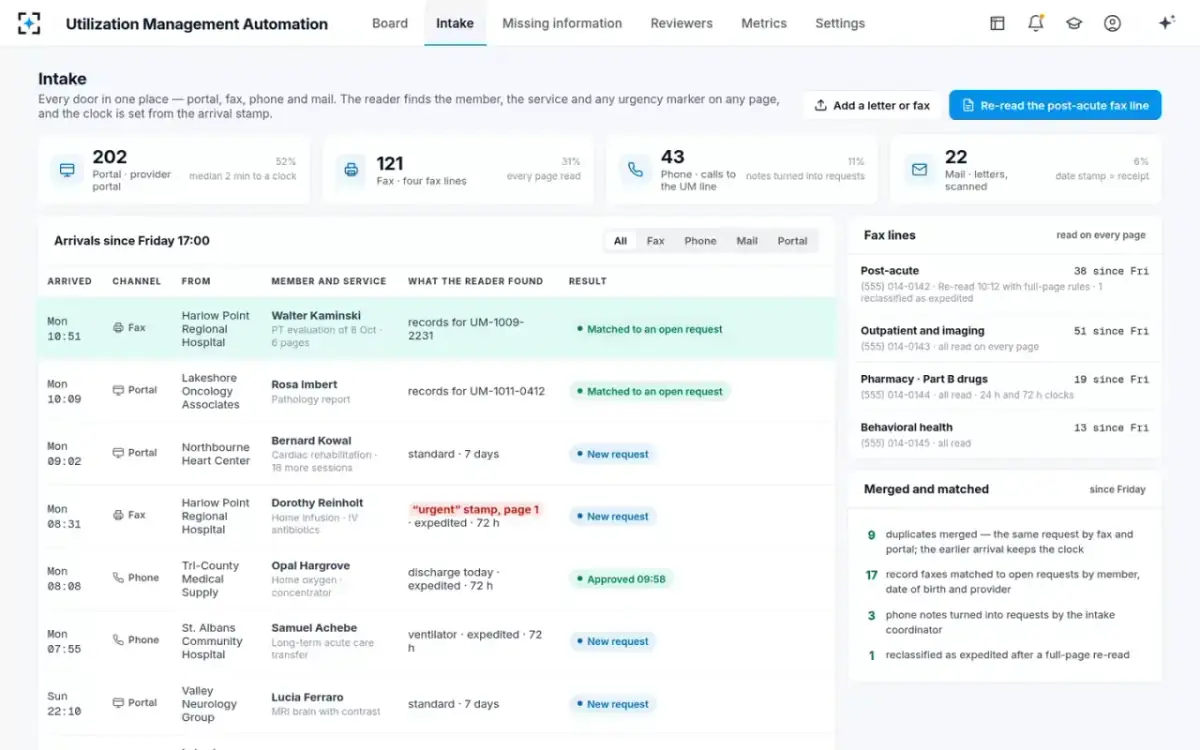
In the sample above, a weekend's arrivals split roughly half portal, a third fax and the rest phone and mail. The mix differs from plan to plan, but fax and phone rarely disappear, and they are the doors where a clock is most often set late. The intake coordinator's job changes from keying requests to handling the exceptions the reader could not match.
How many nurses does a utilization management team need?
There is no federal ratio of nurses to members; the number follows from request volume, the share a nurse must read, the minutes each review takes and the fact that the clocks run seven days a week. A plan can start from volume. Across Medicare Advantage, insurers made 1.7 prior authorization determinations per enrollee in 2024, according to KFF's analysis of CMS data, though the rate ranged widely between insurers.
Sizing nurse reviewers from volume: the arithmetic, with your own minutes
Requests a year
enrollees × requests per enrollee
100,000 × 1.7 = 170,000
Requests a calendar day
÷ 365, because the clocks count calendar days and hours
170,000 ÷ 365 ≈ 466
Nurse reviews a day
× the share a nurse must read (not approved by rule at intake)
your platform’s share
Nurse hours a day
× median minutes per review, only the reading and deciding
your median
Nurses on shift
÷ productive hours per nurse shift, with weekend and holiday cover
the roster
The trap is the minutes. A median handle time taken from a UM platform usually includes the time a nurse spends finding the gap in a file, writing to the provider and re-opening the request when the record arrives. That is waiting work, not review. Strip it out and the same team covers more requests; leave it in and a plan hires nurses to chase faxes.
One sample shift in Utilization Management Automation
16
reviewers on shift: 9 nurses, 3 physicians, 2 pharmacists, 2 behavioral health
214
open requests on one board, ranked by time left
40
of them waiting on records, each already asked for
31
predicted to need a physician today, out of the open queue
The medical director seat and the committee that approves the criteria
The medical director is both a reviewer and the person accountable for the team's clinical accuracy, and in Medicare Advantage also the chair of the committee that approves what the team may apply. Every Medicare Advantage plan must employ one, a physician with an unrestricted licence, responsible for the clinical accuracy of every organization determination involving medical necessity (42 CFR 422.562(a)(4)). What the seat decides and what agents may do around it is set out in medical director utilization management: agents route, doctors decide.
Above the team sits the UM committee. Since 2024 a Medicare Advantage plan may not use any UM policy until the committee has approved it, and the committee must "include a majority of members who are practicing physicians", including at least one independent of the plan and one expert in the care of elderly or disabled people. The Contract Year 2027 final rule removed the committee's health equity member and its annual health equity analysis of prior authorization, effective 1 June 2026 (CMS, 6 April 2026); a team still preparing that analysis can stop.
The committee's output now leaves the building. From 2026 every Medicare Advantage organization submits its internal coverage criteria for services under prior authorization to CMS, first by 30 April 2026 and then every 28 February. CMS told plans to build the file from the internal coverage criteria the UM committee approved for the year, not from past claims (CMS instructions; the submission is walked through in the guide to the Medicare Part C UM annual data submission), which makes the committee minutes the source of a federal submission rather than an internal record.
Pharmacists, behavioral health and the specialist lanes
Specialist lanes exist because some requests run on shorter clocks or need a reviewer with particular expertise. A Part B drug request in Medicare Advantage must be decided within 24 hours if expedited and 72 hours if standard, and neither clock may be extended. A pharmacist working those requests from a general queue sorted by arrival will see some of them only after their clock has gone.
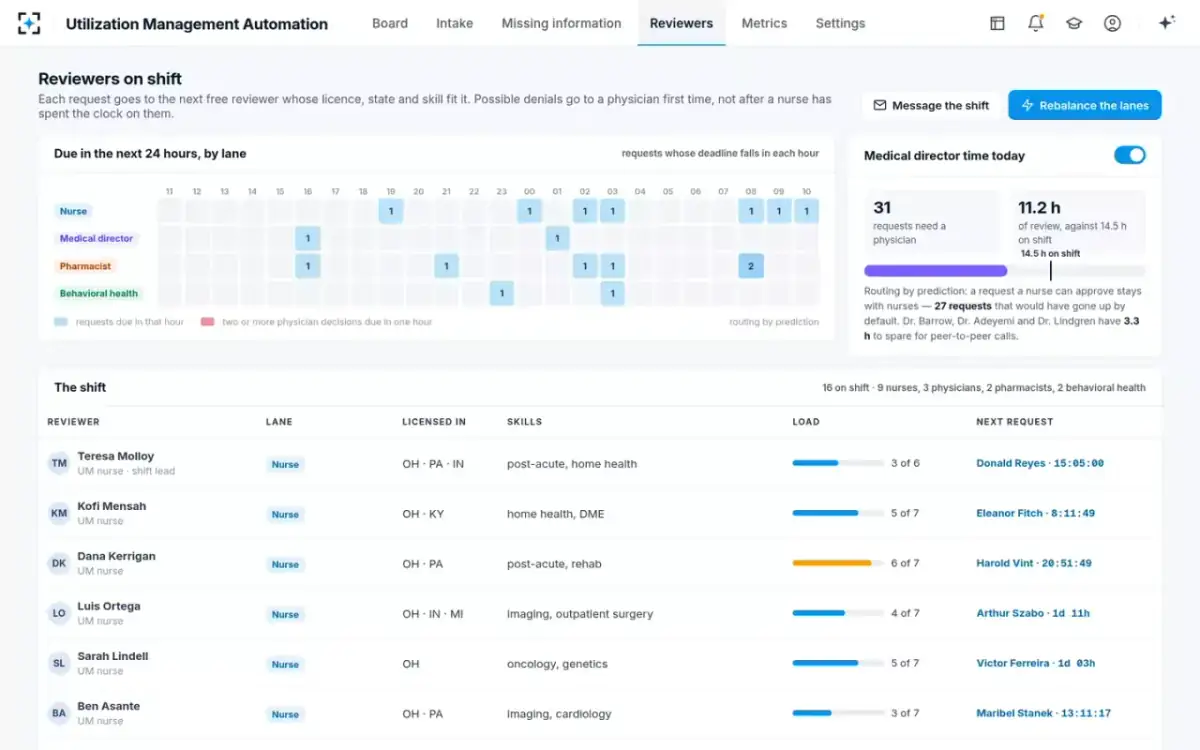
Medicaid managed care sets the expertise test directly: a denial or a reduced authorization must be made by someone with the right expertise for the enrollee's medical, behavioral health or long-term care needs (42 CFR 438.210(b)(3)); the guide to the prior authorization nurse sets out what that leaves a nurse free to decide. Behavioral health, home and community services and long-term care each need a reviewer who meets that test, and a router that knows who does. In Utilization Management Automation the reviewer router assigns each request to the next free reviewer whose licence, state, skill and load fit it, and the sample plan sends Part B drugs to a pharmacist first; both are settings the plan owns, not rules the software imposes.
Reviewers on shift: lanes by licence and skill, and the physician hours they need
Compliance and the manager: the seats that own the clock
The compliance analyst and the operations manager own the team's timeliness: one proves it, the other runs it. CMS's program audits of Part C organization determinations, appeals and grievances "Review compliance with timeframes for processing service requests and post-service claims", and the evidence is a universe of requests with receipt, decision and notice times. The analyst also prepares the public metrics every plan must post by 31 March, which include the average and median time from request to decision (42 CFR 422.122(c)). How one request's timestamps become those published figures is traced in prior authorization metrics reporting.
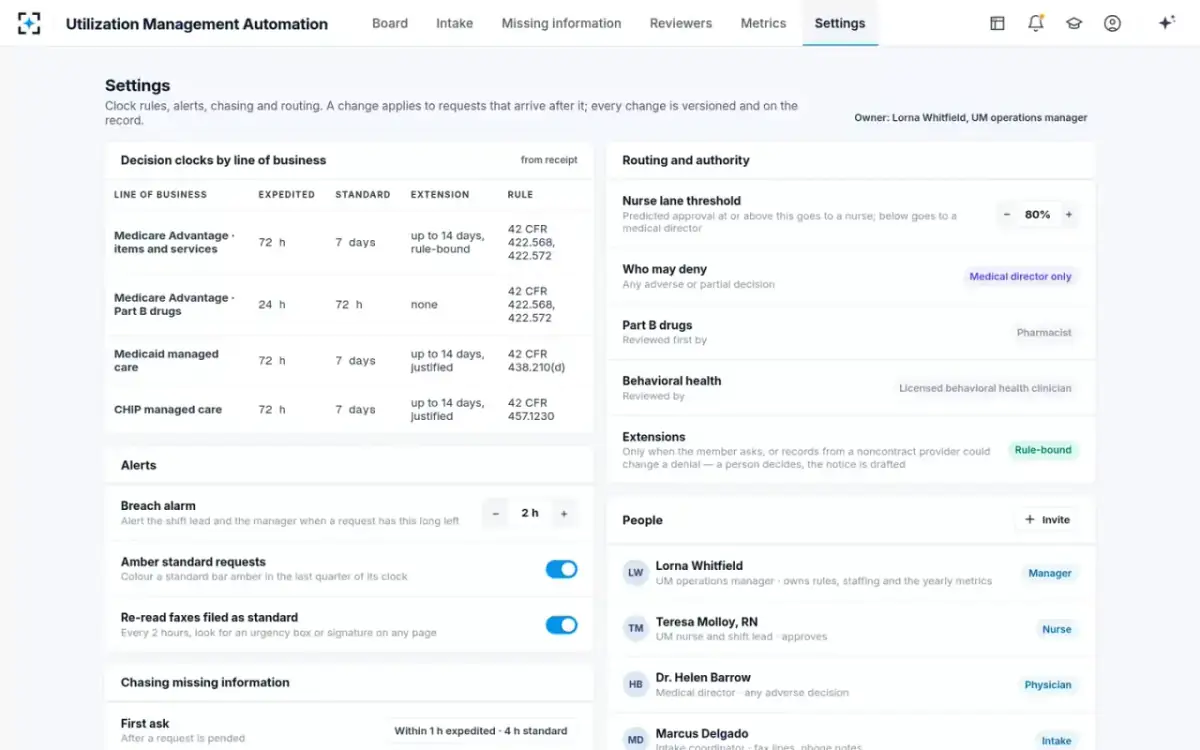
The manager owns everything that sets the clock in motion: which line of business follows which rule, when an alarm goes to the shift lead, how fast a missing record is chased, where the nurse lane ends and the physician lane begins. If those choices live in people's heads, nobody can show an auditor what rule applied to a request last March. In the solution they are settings with an owner, and every change is versioned and applies only to requests that arrive after it.
The manager's settings: clocks by line of business, alerts and authority
Utilization review vs utilization management: one team, two words
Utilization management is the program; utilization review is the act of reviewing one case. The program covers the policies, the criteria the committee approves, the list of services that need prior authorization and the staffing to run it. Review is what a nurse or physician does with a single request, at one of three moments.
Prospective review, usually called prior authorization, happens before the service. Concurrent review happens during it: a hospital stay or a skilled nursing stay is reviewed again as it goes on, and each review is a fresh decision with its own notice duties, as concurrent review explains. Retrospective review happens after the service, usually when the claim arrives. The same team often does all three, and the regulations speak of the program as a whole: Medicare Advantage rules refer to UM policies and procedures, "including prior authorization", approved by one committee.
Where requests wait between seats, and which waits agents take
Most of a request's elapsed time is waiting between seats, not review inside one. Waiting in a channel queue before anyone reads it, waiting in a pend before anyone asks for the record, waiting for the provider to send it, and waiting in a lane where nobody can decide it: none of those is a clinical task, and all of them run against the clock.
Agents can take four of those waits off the team. Reading every page on arrival removes the channel queue and the misfiled expedited request. Asking for the exact missing record within the hour turns a pend into a chase that is already under way. Routing by predicted outcome sends a possible denial to a physician first time, instead of after a nurse has spent half the clock on it. Writing each timestamp as the decision is made removes the compliance analyst's rebuild. The provider's own time to send a record does not disappear; it starts earlier.
What agents should not take is equally clear. No agent in Utilization Management Automation approves, denies, extends a clock or publishes a figure. The nurse approves, the physician denies, the compliance analyst signs the metrics and the manager signs every rule change, which is why the team chart above still has six seats when the agents arrive.
Questions people ask
What does a utilization management nurse do?
A UM nurse reviews a request against the plan's criteria and the member's records, approves it when the criteria are met, asks the provider for anything missing, and passes it to a physician when a denial is possible. In Medicare Advantage a nurse cannot issue an adverse medical-necessity decision: a physician or other appropriate professional must review it first under 42 CFR 422.566(d).
Who supervises utilization review nurses?
Day to day, a UM manager or clinical supervisor runs the nurses' schedule and workload. Clinically, the medical director answers for the accuracy of their decisions: Medicare Advantage rules make the medical director responsible for the clinical accuracy of every organization determination involving medical necessity.
Do utilization management teams work weekends?
They have to cover them. The Medicare Advantage clocks are 72 hours for expedited requests and seven calendar days for standard ones, and CMS has said the regulations do not contemplate business days, so a request faxed on Friday evening is already running on Saturday.
Is the UM committee part of the UM team?
It sits above the team rather than in it. In Medicare Advantage the committee is led by the medical director, must have a majority of practicing physicians, and must approve every UM policy and criterion before the team may use it, reviewing them at least once a year.
What changes for the team when agents join it?
The seats stay; the work inside them changes. Intake handles exceptions instead of keying, nurses take the most urgent request their licence allows with the missing record already requested, and physicians get possible denials first time. Every approval, denial, extension and published figure stays with a named person.