The two midnight rule applies to Medicare Advantage: since 1 January 2024, Medicare Advantage plans must cover an inpatient admission when the admitting physician expects the patient to need hospital care crossing two midnights, as Traditional Medicare does under 42 CFR 412.3, and must also honor that rule's case-by-case exception and its inpatient-only list. What does not apply is the "two-midnight presumption", a review instruction CMS gives its own contractors. And since 1 January 2026, a plan that approves an inpatient admission cannot reopen it on clinical information gathered afterward. For a plan's inpatient UM nurses and medical directors, that turns admission review into a test of what the record showed when the physician admitted the patient. Botminds' Utilization Management Automation reads that record on arrival, sets the clock, chases what is missing and keeps any adverse decision with a physician.
Inpatient admissions in Traditional Medicare and in Medicare Advantage since 2024
Traditional Medicare: Inpatient generally appropriate when the admitting physician expects care to cross two midnights (42 CFR 412.3(d)(1)).
Medicare Advantage: Same criteria apply, by 42 CFR 422.101(b)(2), applicable from 1 January 2024.
Traditional Medicare: Shorter expected stays may be inpatient on the physician’s judgment, supported by the record (412.3(d)(3)).
Medicare Advantage: Applies.
Traditional Medicare: Inpatient regardless of expected length (412.3(d)(2)).
Medicare Advantage: Applies.
Traditional Medicare: A review instruction: contractors generally do not focus review on stays spanning two midnights.
Medicare Advantage: Does not apply. CMS sets no rule on how plans choose admissions to review.
Traditional Medicare: Usually after the stay, when the claim is reviewed.
Medicare Advantage: Before, during or after the stay: prior authorization, concurrent review or payment review.
Traditional Medicare: Reopening rules allow new and material evidence as good cause.
Medicare Advantage: An approved admission cannot be reopened on clinical information obtained after the decision (42 CFR 422.616(e), from 2026).
Does the two midnight rule apply to Medicare Advantage?
Yes, as a coverage criterion, since coverage beginning 1 January 2024. CMS-4201-F, the 2023 Medicare Advantage rule, requires plans to comply with general coverage and benefit conditions in Traditional Medicare law, and names "payment criteria for inpatient admissions at 42 CFR 412.3" as the first example. In the preamble CMS put it without qualification: "we confirm that the criteria listed at 412.3(a)-(d) apply to MA."
CMS acknowledged that 412.3 is written as a Part A payment rule and explained why it still binds a plan: paying for an item or service is one way a Medicare Advantage plan provides a covered benefit. So a plan must cover an inpatient admission when the record supports the two midnight benchmark, the case-by-case exception or an inpatient-only procedure. A plan's internal criteria cannot narrow that, a point the 2023 rule makes about commercial criteria products, below.
What is the two midnight rule?
It is Medicare's test for when a hospital stay should be billed as inpatient rather than outpatient. The text: "an inpatient admission is generally appropriate for payment under Medicare Part A when the admitting physician expects the patient to require hospital care that crosses two midnights." The expectation must rest on clinical factors, and the factors must be in the record.
Three ways an admission meets 42 CFR 412.3, and what the record must show for each
| Path | What qualifies | What the record must show |
|---|---|---|
| Two midnight benchmark | The admitting physician expects hospital care to cross two midnights | The complex medical factors behind that expectation: history and comorbidities, severity of signs and symptoms, current medical needs, risk of an adverse event |
| Case-by-case exception | An expected stay shorter than two midnights where the physician judges inpatient care necessary | The same kinds of factors, supporting the decision to admit |
| Inpatient-only procedure | A surgical procedure Medicare lists as inpatient only (42 CFR 419.22(n)) | The procedure; expected length does not matter |
| Any path | A valid inpatient order | An order by a qualified practitioner with admitting privileges, at or before the admission |
The documentation sentence is the one that decides reviews: "The factors that lead to a particular clinical expectation must be documented in the medical record in order to be granted consideration." A plan reviewer is not asked whether the stay turned out to cross two midnights. The question is whether, at admission, the physician expected it to and recorded why.
Benchmark yes, presumption no
The benchmark is a coverage rule and binds plans; the presumption is a review-selection instruction and does not. In Traditional Medicare, CMS tells its contractors to presume that stays spanning two or more midnights after a formal admission are reasonable and necessary, and generally not to focus medical review on them. CMS-4201-F said plainly that the “two-midnight presumption” “does not apply to MA plans”, and added that "CMS has not established requirements or limits on how MA organizations prioritize medical claims for review akin to the instructions CMS issues to Traditional Medicare contractors."
That leaves plans free to review long stays as well as short ones, before, during or after the stay. CMS confirmed the methods in the same passage: "We confirm that MA plans may still use prior authorization or concurrent case management review of inpatient admissions based on whether the complex medical factors documented in the medical record support medical necessity of the inpatient admission, under either the two-midnight benchmark or the case-by-case exception." The freedom is about which admissions to review. The standard applied in each review is Medicare's.
Can a Medicare Advantage plan use InterQual or MCG for inpatient admissions?
Not to change Medicare's inpatient criteria. A plan may use a commercial criteria product to help build internal criteria only where Medicare's own coverage criteria are not fully established, and 412.3 is a fully established criterion for inpatient admission. CMS addressed the products by name in 2023, after commenters described them as tools often used for inpatient, post-acute and home care reviews:
"Thus, MA plans may not use InterQual or MCG criteria, or similar products, to change coverage or payment criteria already established under Traditional Medicare laws."
CMS, preamble to CMS-4201-F, 12 April 2023
In practice, a product's inpatient screen can organize a nurse's review, but a failed screen cannot be the reason for denial when the record supports the benchmark or the exception. The reason must be stated against 412.3. Where a plan does build internal criteria for a service Medicare has not fully addressed, it must publish them with the evidence and rationale behind them (42 CFR 422.101(b)(6)). OIG's 2022 review of Medicare Advantage denials, from a 2019 sample before these rules took effect, found that plans had applied clinical criteria absent from Medicare's coverage rules, one of the causes of denying services that met those rules (OEI-09-18-00260); the guide to medical necessity review shows how a criterion-by-criterion file exposes that error.
What records support an inpatient admission?
The records that support an admission are the ones that show what the admitting physician knew and expected at the time: the order, the history and physical, the emergency department course, and the factors 412.3 names. A reviewer who reads the discharge summary first is reading the wrong document, because the decision is judged on the expectation, not on the outcome.
What an inpatient admission review should find in the record, in this order
- A valid inpatient order, at or before admission
Signed by a qualified, licensed practitioner with admitting privileges at the hospital. Observation orders and admission orders are different documents.
- The physician’s expectation, in words
An expected length of stay, or a statement that the patient needs care across two midnights, in the admission note.
- The factors behind it
History and comorbidities, severity of signs and symptoms, current medical needs and the risk of an adverse event, each with the evidence in the note, labs or imaging.
- For a shorter expected stay, the exception reasoning
Why inpatient care is necessary although the physician does not expect two midnights, supported by the same kinds of factors.
- Whether the procedure is inpatient only
If it is on Medicare’s list, the expected length does not matter.
- What arrived later, kept apart
Clinical information from after an approval cannot reopen it; mark it as later evidence rather than mixing it into the admission review.
Can an approved inpatient stay be denied later?
Not on the basis of information that arrived after the approval. Two rules close that door. Under 42 CFR 422.138(c), once a plan approves an item or service through prior authorization it may not later deny coverage for lack of medical necessity, and the Contract Year 2026 rule extended that protection to concurrent review decisions. It then added a rule specific to admissions, applicable from 1 January 2026: "If the MA organization approved an inpatient hospital admission under the rules at § 412.3(d)(1) and (3) of this chapter, any additional clinical information obtained after the initial organization determination cannot be used as new and material evidence to establish good cause for reopening the determination."
The reason is the logic of 412.3 itself: the test is the physician's expectation at admission, so later notes cannot change what was expected. CMS kept one narrow path, reopening for obvious error or fraud, and said it expected that to be rare. The burden moves to the front of the review. In CMS's words, "it is incumbent on the MA organization to obtain and review all relevant clinical information to make an organization determination on a request for inpatient hospital admission". A plan that approves quickly on a thin file, intending to look again later, no longer has a later.
Can a Medicare Advantage plan change an inpatient stay to observation?
Only through a proper coverage decision, with physician review, notice and appeal rights, and not on later information about an admission it already approved. In the Contract Year 2026 rule CMS described plans that, after a hospital's notice of admission, reviewed the stay on their own, decided it did not meet inpatient criteria, approved observation instead or told the hospital to bill outpatient, and did not treat that as an organization determination. CMS found that "in many circumstances the MA organization does not inform the enrollee of the concurrent review determination", and the member learned of the change only when outpatient cost-sharing arrived.
The rule now says expressly that a refusal to provide or pay for services made concurrently with the enrollee's receipt of them is an organization determination (42 CFR 422.566(b)(3)). A downgrade from inpatient to observation is therefore an adverse decision: if it rests on medical necessity, a physician or appropriate professional must review it before it issues, and the enrollee and the provider get notice and can appeal. Hospitals separately give every Medicare Advantage inpatient a notice of rights within two calendar days of admission (42 CFR 422.620). How the decisions repeat over a stay is the subject of concurrent review.
Building the inpatient review the rule now expects
An inpatient review that holds up under these rules is front-loaded, record-based and physician-signed when adverse. It reads the order and admission note first, states which 412.3 path applies, asks at once for anything missing from the admission documentation, and sends any expected denial to a physician before a nurse has spent the clock. Since 2026 it also has to be right the first time, because an approval stands.
An inpatient admission review in Utilization Management Automation
Agent
Intake readerReads the notice of admission or request on every page; finds the order, its time, the admitting practitioner and the expected length of stay in the admission note.
Never: treats later notes as part of the admission evidence
Agent
Clock keeperStarts the clock from receipt under the plan’s rule and ranks the review by time left with every other request.
Never: pauses a clock while a hospital is asked for records
Agent
Missing-information chaserAsks the hospital for the specific missing item, such as the history and physical or the ED course, not the whole chart.
Never: asks the member for clinical detail
Agent
Outcome predictor and reviewer routerShows which 412.3 factors the record supports and which are missing; routes a possible denial straight to a physician.
Never: decides, or uses a product screen as the reason
A person decides
Inpatient UM nurseApproves when the record supports the benchmark, the exception or an inpatient-only procedure.
A person decides
Medical director or physician reviewerMakes any adverse inpatient decision, including a change to observation, with the specific reason stated against 412.3.
The predictor's role here is narrow and useful: it lays out the 412.3 factors the record supports, so the nurse reviews against Medicare's test rather than a screen's score. The factors for and against are on every request, and a physician sees them when a request is routed to the physician lane.
Factors for and against, on the request, before the reviewer decides

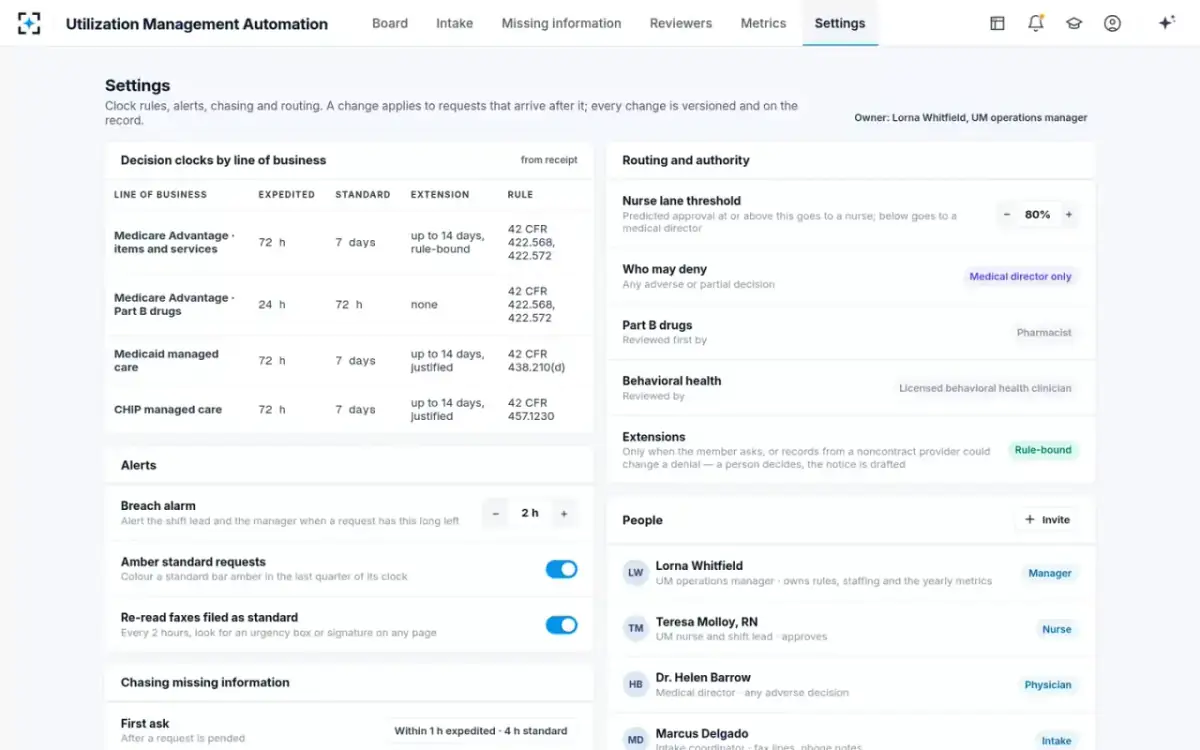
Authority is a setting, not an assumption. In the sample plan, any adverse or partial decision belongs to a medical director, and the nurse-lane threshold that decides which requests a nurse sees first is set by the UM operations manager and versioned when it changes. A plan reviewing inpatient admissions should set the same rule for downgrades to observation.
Who may deny, set by the plan: routing and authority
Why the timing matters most for inpatient reviews is set out in medical director utilization management: when physician time is scarce, the review that waits is often the one the 2026 rule now makes final.
Questions people ask
When did Medicare Advantage have to follow the two midnight rule?
From coverage beginning 1 January 2024. CMS-4201-F, published on 12 April 2023 and effective 5 June 2023, required Medicare Advantage plans to follow Traditional Medicare's coverage criteria, including the inpatient admission criteria at 42 CFR 412.3, for coverage beginning in 2024.
Does the two midnight rule apply to commercial insurance?
Not by federal law. 42 CFR 412.3 is a Medicare rule that binds Medicare Advantage plans through 42 CFR 422.101(b)(2); commercial and Medicaid managed care plans apply their own or the state's criteria unless their contracts or state law adopt Medicare's.
Does the two midnight rule apply to a stay that ends early?
It can. If an unforeseen circumstance such as the patient's death or transfer ends a stay that the physician expected to cross two midnights, the stay may still be treated as inpatient under 42 CFR 412.3(d)(1)(ii).
Who must review a Medicare Advantage inpatient denial?
A physician or other appropriate health care professional with expertise in the relevant field and knowledge of Medicare coverage criteria, before the plan issues the decision, under 42 CFR 422.566(d). That includes a decision made during the stay to deny inpatient coverage or move the patient to observation.
Can a plan reopen an approved admission if the patient recovered quickly?
No, not on that basis. Since 2026, clinical information obtained after the plan approved an admission under the benchmark or the exception cannot be used as new and material evidence to reopen it; reopening for obvious error or fraud remains possible but, CMS said, should be rare.