Prior authorization turnaround time is the time a health plan takes from receiving a request to notifying its decision, and since 1 January 2026 it has a federal ceiling in most government programs: 72 hours for an expedited request and seven calendar days for a standard one in Medicare Advantage, and the same for Medicaid managed care plans from their first rating period starting on or after that date. Marketplace plans on the federal exchanges keep 15 days for standard requests for now, and employer plans follow the ERISA claims rules. The deadline is the easy part. The hard part is that most of an expedited request's hours are spent waiting rather than reviewing, and a plan that does not know where its hours go cannot say what each one costs. Botminds' Utilization Management Automation exists to take the waiting hours out of the clock.
Where an expedited request's 35 hours go when worked by hand across channel queues
What is the required prior authorization turnaround time?
In Medicare Advantage it is 72 hours for an expedited request and seven calendar days for a standard request for a service under prior authorization, both measured from receipt; Part B drugs run on 24 and 72 hours. CMS's summary of the 2024 rule is plain: impacted payers "send prior authorization decisions within 72 hours for expedited (i.e., urgent) requests and seven calendar days for standard (i.e., non-urgent) requests", with Marketplace issuers on the federal exchanges excluded from that change. The table sets out the clocks a UM team actually works to.
Prior authorization turnaround time by line of business, from receipt
| Line of business | Expedited | Standard | Extension |
|---|---|---|---|
| Medicare Advantage, item or service under prior authorization | 72 hours | 7 calendar days (from 1 Jan 2026) | Up to 14 days, on listed grounds, with written notice |
| Medicare Advantage, item or service without prior authorization | 72 hours | 14 calendar days | Up to 14 days, on listed grounds |
| Medicare Advantage, Part B drug | 24 hours | 72 hours | None |
| Medicaid managed care | 72 hours | State-set, no more than 7 calendar days (rating periods from 1 Jan 2026) | Up to 14 days if the enrollee or provider asks, or the plan justifies it |
| Marketplace issuer on the federal exchanges | 72 hours | 15 days (7 calendar days only proposed in CMS-0062-P) | Under the existing claims rules |
| Employer plan (ERISA) | 72 hours for urgent care | 15 days for pre-service claims | One 15-day extension for matters beyond the plan’s control |
Is the 7-day clock calendar or business days?
Calendar days, and the expedited clock runs in hours around the clock. Commenters asked CMS for business days when it set the seven-day standard; CMS refused, and gave an example for the expedited clock: "if a prior authorization request is submitted at 1:00 a.m. on Sunday, a response within 72 hours would mean by 1:00 a.m. on Wednesday. The regulations do not contemplate delays based on business hours or business days."
The operational consequence is weekend staffing. A fax that arrives at 17:00 on Friday has used 64 hours of a 72-hour expedited clock by 09:00 on Monday, and two of a standard request's seven days. A UM department that reads its fax lines only on weekdays is running its expedited clock with a three-day hole in it, whatever its decision times look like once the request is opened.
How long does prior authorization take for Medicare Advantage?
No national average is published. CMS-0057-F requires each Medicare Advantage organization to post its own average and median time to decision for each contract by 31 March, beginning with 2025 data, but CMS does not collect or total the figures, and KFF's analysis of CMS's Medicare Advantage data covers volumes, denials and appeals, not timing. Insurers made 52.8 million prior authorization determinations for Medicare Advantage enrollees in 2024, so the industry's turnaround is visible only plan by plan, on each plan's own page.
What the rules do fix is the ceiling and the measuring points. A plan's posted median should run from the moment it received the request to the moment it decided; how to build that figure without flattering it is traced in prior authorization metrics reporting. On the solution's sample Medicare Advantage contract, the median expedited decision fell from 26.8 hours in the first quarter of 2026 to 17.9 hours in October, after the solution went live in July; those are sample figures, not a customer result.
What happens if a plan misses the prior authorization deadline?
In Medicare Advantage a missed deadline is itself a denial the member can appeal; in Medicaid managed care it is a denial on the day the clock expires. The Medicare Advantage rule: if the plan fails to give timely notice of its decision, "this failure itself constitutes an adverse organization determination and may be appealed." The Medicaid rule puts the timing in the notice requirement: a decision not reached in time "constitutes a denial and is thus an adverse benefit determination", and the plan must send notice on the date the timeframe expires.
So a late hour does not buy a better decision; it converts the request into an adverse determination with appeal rights, a notice to send and, usually, a second review. It also shows up twice in oversight. CMS's Part C audits of organization determinations test compliance with the processing timeframes request by request, and the yearly public metrics put the plan's average and median in front of members and providers.
What counts as an expedited prior authorization?
A request is expedited when applying the standard timeframe could seriously jeopardize the enrollee's life, health or ability to regain maximum function. In Medicare Advantage the plan decides that test when the member asks, but must expedite when a physician makes or supports the request and says the test is met (42 CFR 422.570(c)(2)). If the plan refuses a member's request to expedite, it moves the request to the standard clock, and "The timeframe begins when the MA organization receives the request for expedited determination." The hours spent deciding whether to expedite are not free.
Both errors happen. A physician's ticked box on page two of a fax can be missed, putting a 72-hour request on a seven-day clock. The opposite also occurs: in traditional Medicare's prior authorization program for certain hospital outpatient services, Medicare contractors received 10,658 requests marked expedited in fiscal year 2024 and found the expedited need substantiated in 22.8 percent of them (CMS, FY 2024 program statistics). That program is not Medicare Advantage and runs under its own rules, but it shows that urgency flags need reading, not just counting.
The board in Utilization Management Automation: every open request by time left
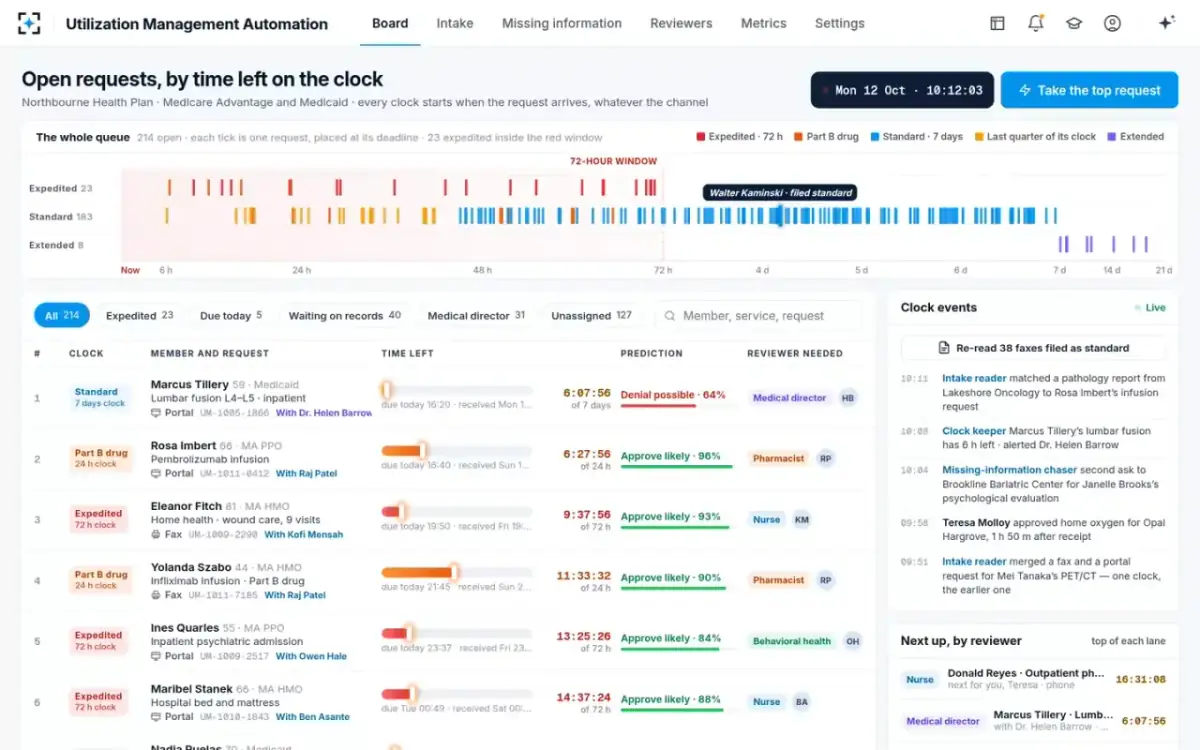
Where an expedited request's hours go
Most of the hours are waits, and only one of the large ones belongs to the provider. In Botminds' estimate above, a 35-hour expedited request spends 6 hours in a channel queue, 9 hours pended before anyone asks for the missing record, 12 hours waiting for the provider, 6 hours waiting for a reviewer who can decide it, and 2 hours in review and notice. The plan controls four of those five stages outright.
The same expedited request, by hand and in Utilization Management Automation
- Channel queue6 h
- Pended, not yet asked9 h
- Provider sends records12 h
- Waits for a reviewer6 h
- Decide2 h
- Read and asked, 1½ h
- Provider sends records8 h
- Reviewer and decision3½ h
The estimate's structure matters more than its numbers. The provider's turnaround on a record request is partly set by how the plan asks: a letter that names the evaluation of 8 October and the page it needs is answered faster than a request for "clinical documentation", and an ask sent at 10:00 is answered before one sent at 16:00. What the plan cannot do in Medicare Advantage is stop the clock while it waits, so every hour before the ask goes out is an hour taken from the reviewer.
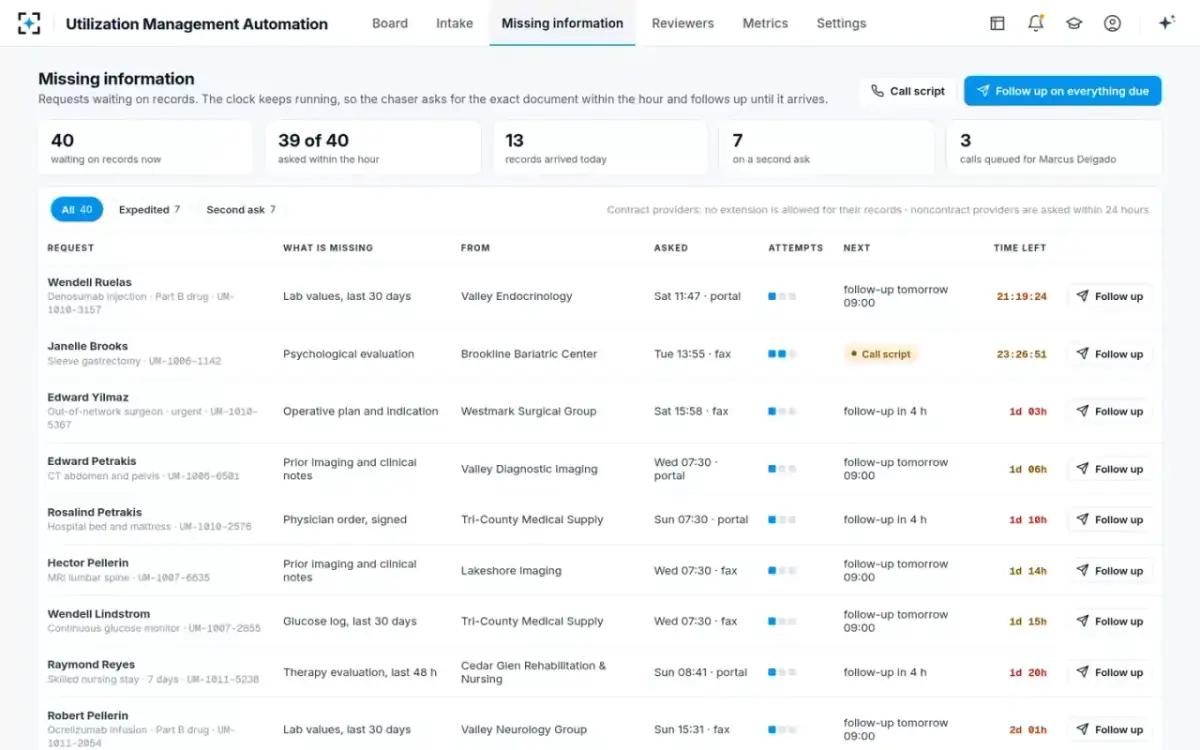
Missing information: what is missing, from whom, and how much clock is left
Pricing each hour: the costs a late hour carries
An hour on the clock has no price until it is the last one. Before the deadline, an hour saved is slack; after it, the request becomes an adverse determination with costs attached. Those costs are real but uneven, so the useful way to price an hour is by the probability that it pushes a request over the line, multiplied by what a late request costs the plan.
What a late prior authorization decision costs, term by term
Rework
late requests × (notice + reconsideration minutes)
A late decision is an adverse determination with appeal rights: a notice to send and often a second review by a different physician.
UM and appeals teams
Audit exposure
late requests found in an audit sample × remediation effort
Part C audits test processing timeframes request by request; findings bring corrective action and, at worst, civil money penalties.
Compliance
Published performance
shift in posted average and median
Every late or extended request lengthens the average the plan posts by 31 March for members and providers to compare.
UM leadership
Care delayed
requests approved late × days the member waited
A skilled nursing or rehab bed held open, a discharge delayed, a treatment postponed: costs the member and the provider carry first.
Members and providers
CMS has put a number on the other side once. In the final rule's illustrative analysis it put the paperwork savings to physician practices and hospitals at a minimum of $15 billion over ten years, built from survey data on how much time practices spend on prior authorization (CMS-0057-F regulatory impact analysis). That figure counts providers' costs, not the plan's, but it frames the scale: on both sides of the request, turnaround is an operating cost, not only a compliance line.
The member's cost is the hardest to see in a plan's own data, because a request approved late looks the same as one approved on time once the claim is paid. KFF's analysis of 2024 Medicare Advantage data found that 80.7 percent of appealed prior authorization denials were partly or fully overturned; each of those is care that was ultimately approved after a delay. Insurers have also pledged, voluntarily, to "Expand real-time responses to minimize delays in care with real-time approvals for most requests by 2027."
Extensions: the hours you may add, and what they cost
An extension adds up to 14 calendar days to a Medicare Advantage request, but only on the grounds the rule lists and with written notice, and never for a Part B drug. The listed grounds for a standard request are that the enrollee asks; that the extension is justified and in the enrollee's interest because evidence from a noncontract provider may change a decision to deny; or that "The extension is justified due to extraordinary, exigent, or other non-routine circumstances and is in the enrollee's interest." The expedited rule mirrors them (42 CFR 422.572(b)).
The third ground was added by CMS-0057-F, and it is not a general pause button: it must be justified, non-routine and in the enrollee's interest, and the plan must explain the reason in writing and tell the member of the right to an expedited grievance. Records slow to arrive from a contracted hospital do not meet the noncontract-provider ground by definition. Every extension also counts in public metric 5 and in the published average, so a plan that extends routinely publishes it.
The clock on one sample request in Utilization Management Automation
72h
expedited clock, from the fax’s arrival stamp on Friday afternoon
4h
left when a full-page re-read found it was filed as standard
37min
from the ask to the missing therapy evaluation arriving
2 h 34 m
to spare at the decision, 69 h 26 m from receipt
How do you reduce prior authorization turnaround time?
Remove the waits the plan controls, in order of size: start the clock and the review at the same moment, ask for missing records within the hour, send each request to a reviewer who can decide it, and watch the whole queue by time left rather than by channel. None of these needs a faster reviewer. Each needs the plan to know, at every moment, which request will be late next.
In Utilization Management Automation each lever is an agent with a limit. The intake reader reads every page of every arrival, so a request is never in a queue unread and a physician's expedite box is found on any page. The missing-information chaser names the exact record and asks the provider through its own channel within the plan's set time, one hour for expedited requests in the sample plan. The reviewer router sends possible denials to a physician first time, which is the subject of medical director utilization management. The clock keeper ranks the board by time left and raises an alarm at two hours left; it never pauses or extends a clock, because only a person may extend, and only where a rule allows.
Decided inside the clock: the timeline of one expedited request
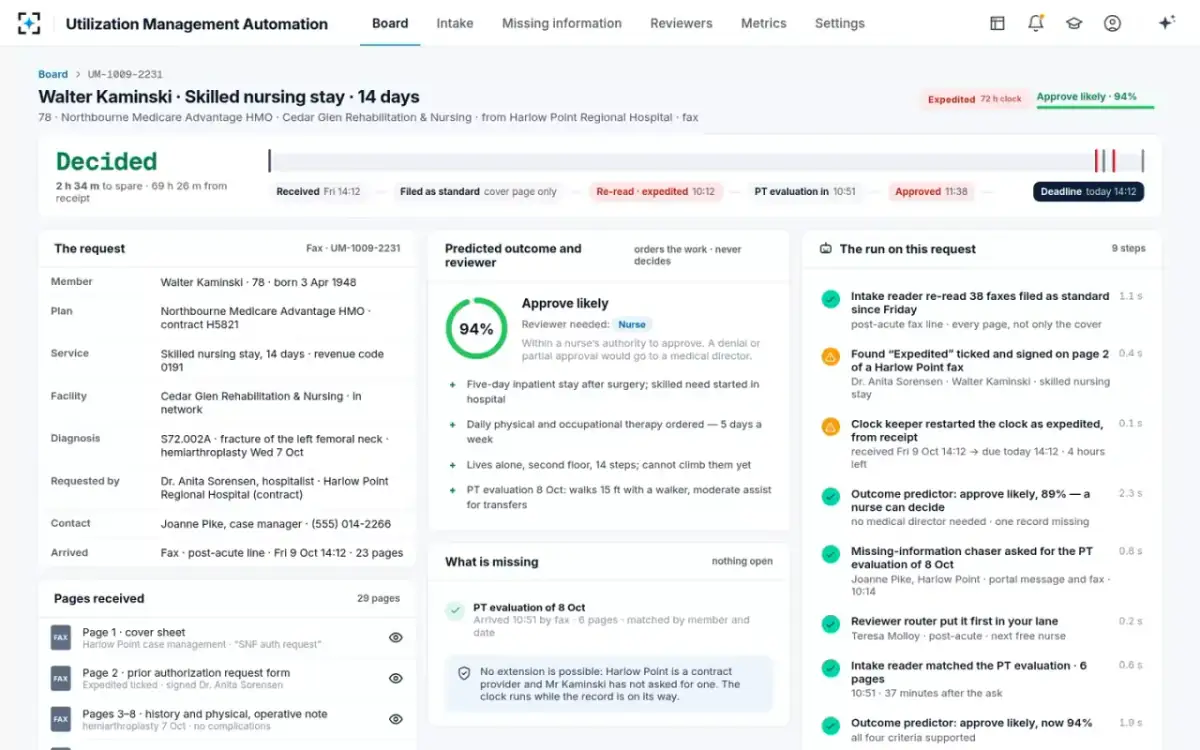
The last lever is the cheapest: decide when the file is complete. In the sample, the missing evaluation arrived 37 minutes after the ask and the nurse approved 47 minutes later. The fast part of a fast decision is almost never the review.
Questions people ask
What is the average prior authorization turnaround time?
There is no national figure. Since March 2026 each Medicare Advantage organization, Medicaid managed care plan and federal-exchange issuer posts its own average and median on its website, but CMS does not collect or total them. Compare plans by reading their posted pages, which must show times in explicit units.
Does the prior authorization clock pause on weekends or holidays?
No. The standard clock in Medicare Advantage and Medicaid managed care is counted in calendar days and the expedited clock in hours, and CMS has said the regulations do not contemplate business hours or business days.
When does the prior authorization clock start?
When the plan receives the request, in any channel: the fax's arrival stamp, the portal's submission time, the call, or the mailroom date stamp. It does not start when a coordinator logs the request into the UM system.
Can a plan extend the 72-hour expedited deadline?
In Medicare Advantage, by up to 14 calendar days on the same listed grounds as a standard request, with written notice of the reasons, except for Part B drugs, whose 24-hour expedited clock may not be extended. In Medicaid managed care, by up to 14 days if the enrollee asks or the plan justifies a need for more information.
Do employer health plans have the same turnaround rules?
No. Employer plans follow the ERISA claims rules: urgent care claims within 72 hours, pre-service claims within 15 days with one 15-day extension, and requests to extend an urgent course of treatment within 24 hours if made at least 24 hours before it ends.