An investment policy statement (IPS) includes nine kinds of clause: purpose and scope, objectives and a return target, asset allocation targets with ranges, authorized and prohibited investments, a liquidity floor, rules for illiquid assets, manager guidelines, watch-list criteria, and roles, reporting and review. What makes the document hard is not writing it but living under it: once a board adopts it, every one of those clauses becomes a standard the fund will be measured against, by its auditors, its regulators and, for an ERISA plan, a court. Botminds' Investment Policy Statement Monitoring reads the statement and each manager agreement into rules cited to their clauses and checks them against custodian holdings every business day, so the investment officer finds a breach the morning it starts rather than at quarter end.
The examples on this page come from a fictional sample: Ridgeline County Employees' Retirement System, a $24.71 billion public pension with three plans and 58 managers, as it runs through the solution in October 2026. The law quoted is current statute and regulation, linked where it appears.
How often the law makes funds write it down, file it and re-read it
17
subsections Florida prescribes for a local retirement plan’s written investment policy
90days
for a Texas public retirement system to file its policy, and each change, with the State Pension Review Board
3years
the longest a UK trust scheme may go before reviewing its statement of investment principles
4years
the review cycle Washington’s State Investment Board sets for its own asset allocation policy
What should be included in an investment policy statement? The short list
The clauses that belong in an investment policy statement are the ones a fiduciary would need to show that the fund was run the way it was meant to be run. That is why statutes that prescribe the contents read like a checklist for an auditor rather than an essay on philosophy. Florida's §112.661 is the most explicit US example: it requires every local retirement system or plan to invest "consistent with a written investment policy adopted by the board," and then names seventeen things the policy must cover, from investment objectives and performance measures to third-party custody, internal controls and the valuation of illiquid investments (Fla. Stat. §112.661).
The UK writes a shorter list for occupational pension trustees. A statement of investment principles "must be in writing" and must cover, among other matters, "the kinds of investments to be held," "the balance between different kinds of investments," "risks, including the ways in which risks are to be measured and managed," "the expected return on investments" and "the realisation of investments" (SI 2005/3378, reg. 2(3)). The two lists agree on the core, and the core is what a monitoring system checks.
The IPS, annotated: nine clauses and the check Investment Policy Statement Monitoring runs on each
1Purpose, scope and who it binds
What it saysWhich plans and pools the statement governs, and that every investment manager is bound by it through its agreement.
The checkEvery mandate maps to a plan and to one manager agreement; an unmapped account is itself an exception.
How oftenEach morning
2Objectives and return target
What it saysThe return the plan needs, over what horizon, against which benchmark, and the risk it will accept to get there.
The checkTotal fund and each sleeve measured against the stated benchmark; the gap reported, not judged, by the software.
How oftenMonthly, quarterly
3Asset allocation: targets and ranges
What it saysA target and a minimum and maximum for each asset class, and who may rebalance inside the band.
The checkToday’s weight against floor and ceiling, with an early-warning margin before either is reached.
How oftenEach business day
4Authorized and prohibited investments
What it saysWhat may be held, what may not, and any issuer, rating or country limits that apply to the whole fund.
The checkEvery holding screened against the list; a prohibited purchase is an active breach on the trade date.
How oftenEach business day
5Liquidity floor and cash needs
What it saysHow many months of benefit payments or grants must sit in liquid assets, and what counts as liquid.
The checkLiquid assets divided by projected net outflows, with capital calls from private funds added.
How oftenEach business day
6Illiquid assets and out-of-range rules
What it saysHow private funds are valued, and what happens when a private allocation drifts out of its band without a new commitment.
The checkBreach classed as active or passive from transactions and price moves; the cure the clause allows is proposed.
How oftenEach business day
7Manager guidelines
What it saysEach manager’s limits: style, size, credit quality, duration, concentration, side letters.
The checkHoldings-based limits per mandate, each cited to its schedule and paragraph.
How oftenEach business day
8Watch list and termination
What it saysWhat puts a manager on watch, what the plan then asks, and what takes it off or out.
The checkPerformance, style, people, organization, regulatory and uncured-breach triggers evaluated.
How oftenDaily and at quarter end
9Roles, reporting and review
What it saysWho approves what, what the committee receives each quarter, and when the statement itself is reviewed.
The checkReview dates and in-between triggers tracked; reports drafted with every figure cited.
How oftenQuarterly, annually
Read down the right-hand column and a pattern appears. Six of the nine clauses can be checked every business day from custodian holdings, because they are numbers: a range, a list, a ratio, a limit. The other three, objectives, the watch list and review, mix numbers with judgement, and a policy that is useful for monitoring says plainly which part is which.
Is an investment policy statement required?
It depends on who you are. For a private-sector ERISA plan, no statute requires a written IPS, but once the plan adopts one, ERISA makes following it a duty: fiduciaries must act "in accordance with the documents and instruments governing the plan insofar as such documents and instruments are consistent with the provisions of this subchapter" (29 U.S.C. §1104(a)(1)(D)). For many public plans, state law does require one; for UK trust schemes, the statement of investment principles is mandatory.
The Department of Labor's current investment-duties regulation shows how far that duty reaches. It describes an investment manager of a pooled vehicle that "may be subject to an investment policy statement that conflicts with the policy of another plan," and says that "Compliance with ERISA section 404(a)(1)(D) requires the investment manager to reconcile, insofar as possible, the conflicting policies" (29 CFR 2550.404a-1(d)(4)(ii)). That text, adopted in December 2022, was still the regulation in force when this guide was written; the Department has listed a rewrite on its regulatory agenda but had not proposed one. The practical reading is simple: an adopted IPS binds, and a manager that cannot comply with two clients' statements has to say so.
Is an investment policy statement required? Four regimes, four answers
| Fund | Is a written policy required? | What the text says |
|---|---|---|
| Private-sector ERISA plan | Not by statute; binding once adopted | Fiduciaries act “in accordance with the documents and instruments governing the plan” (ERISA §404(a)(1)(D)). |
| Florida local retirement system | Yes, with prescribed contents | Investment “must be consistent with a written investment policy adopted by the board”; seventeen subsections follow (§112.661). |
| Texas public retirement system | Yes, filed with the state | The governing body shall “develop and adopt a written investment policy” and file it, and each change, within 90 days (§802.202(d)). |
| UK occupational trust scheme | Yes, reviewed at least every three years | The statement “must be in writing” and is reviewed “at least every three years” and after a significant change (reg. 2). |
Texas adds a detail that matters for anyone who monitors: the policy must be kept "for public review at its main office." A public plan's IPS is therefore a public promise. A breach of it is not only a governance problem but something a member, a journalist or a legislator can read against the quarterly report.
Objectives and the return target: the clause everything else serves
The objectives clause states what the fund is for and what return it needs, and every other clause is a means to it. A pension statement usually names an assumed rate of return and a policy benchmark; Florida goes further and requires the board to determine, for each actuarial valuation, "the total expected annual rate of return for the current year, for each of the next several years, and for the long term thereafter," and file it with the state.
For ERISA plans the regulation supplies the factors an objectives clause should speak to. In a defined benefit plan, appropriate consideration includes "The composition of the portfolio with regard to diversification," "The liquidity and current return of the portfolio relative to the anticipated cash flow requirements of the plan," and "The projected return of the portfolio relative to the funding objectives of the plan" (29 CFR 2550.404a-1(b)(2)(ii)). Those three phrases map almost one for one onto the allocation, liquidity and objectives clauses of a well-built IPS.
What a monitoring system can do with the objectives clause is limited, and honest software says so. It can compute the fund's return against the stated benchmark and show the gap. It cannot decide whether the gap means the target was wrong, the managers were poor or the market was unusual. That judgement belongs to the committee and its consultant.
Asset allocation ranges: why the band matters more than the target
The allocation clause is the most monitored part of any IPS, and the part where the range does the work. A target says where the fund should sit; the minimum and maximum say when someone must act. Washington's State Investment Board explains the trade-off in its own policy: the range "is intended to keep the actual allocation close to the target while minimizing the transaction costs which result from rebalancing" (WSIB Policy 2.10.050).
The width of each band is a policy choice with consequences. Too narrow, and staff rebalance on noise, paying spreads and commissions for a weight that would have come back on its own. Too wide, and the band stops constraining anything. Asymmetric bands are common for illiquid classes, because a private allocation can rise quickly when everything else falls and can only come down slowly; the denominator effect in private equity is the case that tests a band hardest.
Every asset class in the IPS drawn as a corridor, checked against yesterday’s close
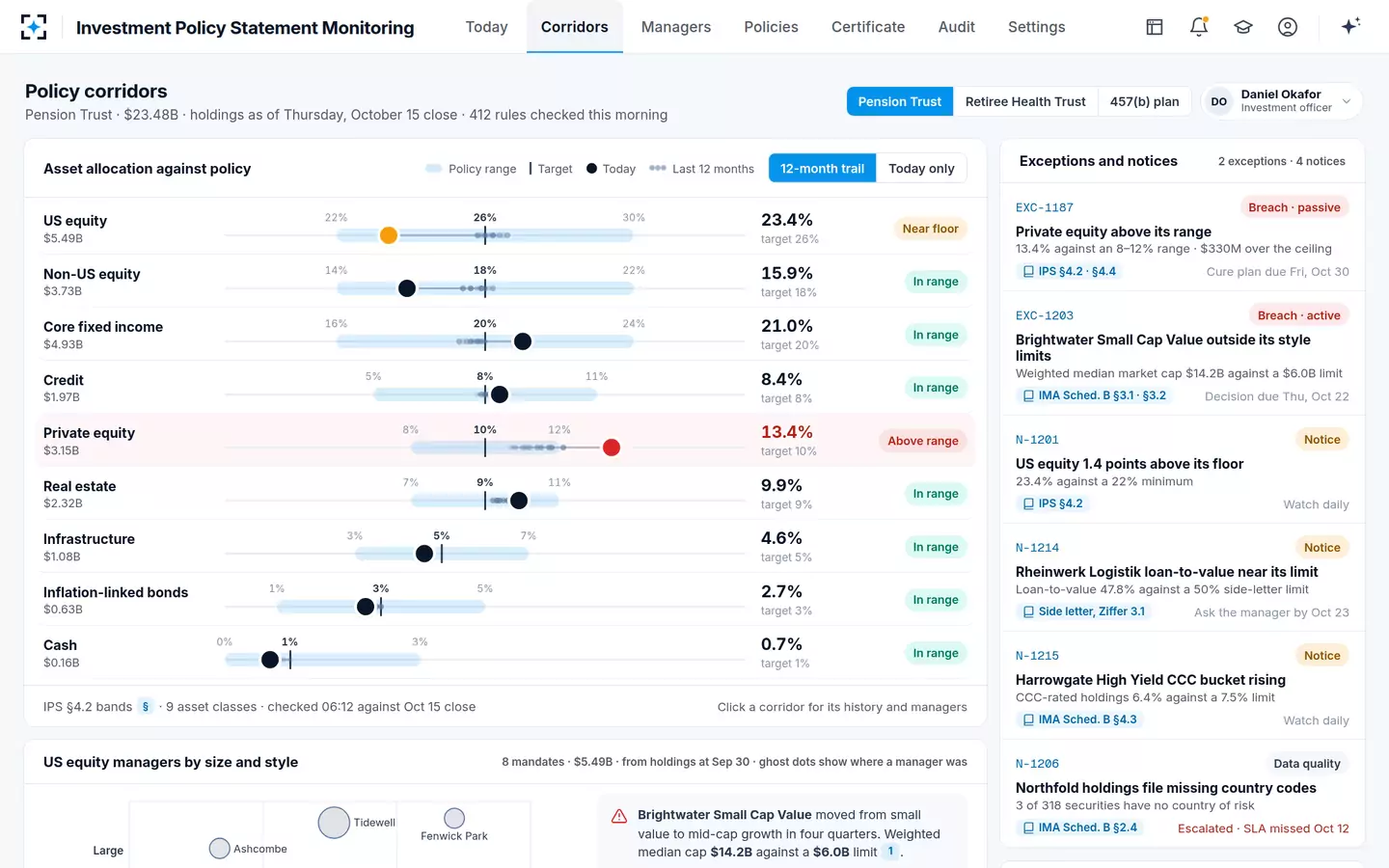
A daily check also needs the clause to say what "today's weight" means. The allocation of a private equity fund is only as current as its last statement; in the sample, the private markets administrator's file is late, so private equity uses June 30 values rolled forward for calls and distributions. A statement that defines how stale valuations are treated saves an argument every quarter.
Prohibited holdings and authorized investments: list what is allowed
The safest way to write the prohibited-investments clause is the other way round: list what is permitted and treat everything else as excluded. Florida does exactly that. The policy "shall list investments authorized by the board," and "Investments not listed in the investment policy are prohibited" (§112.661(5)(a)). A permit list fails closed: a new kind of security has to be approved before it can be bought, rather than slipping through because nobody thought to forbid it.
Most statements still carry a short deny list on top, such as named sectors, issuers or countries, and those need definitions precise enough to code. "Thermal coal" means a revenue threshold from a named data source; "sanctioned" means a named list as of a date. The watch list criteria guide shows the same discipline applied to qualitative triggers.
The investment policy shall list investments authorized by the board. Investments not listed in the investment policy are prohibited.
Florida Statutes §112.661(5)(a), 2026
Manager guidelines: where the policy reaches the portfolio
The IPS governs the fund; manager guidelines govern each mandate, and most daily breaches happen there. Texas makes the link explicit: in a contract with an investment manager, "the governing body shall specify any policies, requirements, or restrictions, including criteria for determining the quality of investments and for the use of standard rating services, that the governing body adopts for investments of the system" (Tex. Gov't Code §802.204(c)).
In practice the guidelines live in a schedule to the investment management agreement, amended by letters and, in pooled funds, by side letters. That is why a monitoring system has to read more than the IPS. In the sample, the exceptions panel cites a small-cap value manager's Schedule B §3.1 (weighted median market cap at most $6.0 billion) and §3.2 (at least 80% in companies under $10 billion at purchase), a German side letter's 50% loan-to-value limit, and a high-yield manager's 7.5% cap on CCC-rated bonds.
A manager’s guideline amendment, read into rules before anyone relies on it
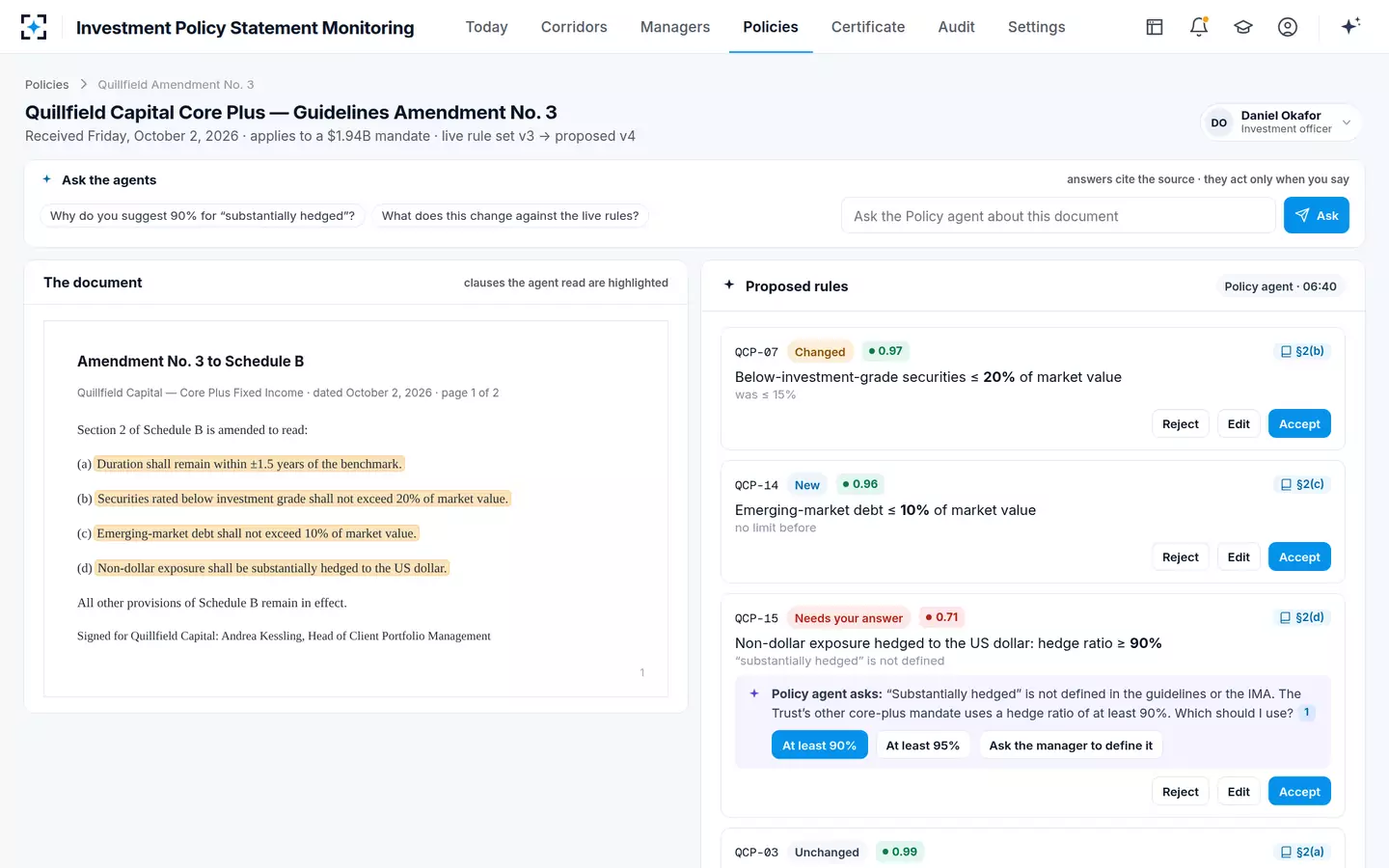
The amendment in that screen shows the most common drafting failure in guidelines: a term that sounds precise and is not. "Substantially hedged" could mean 90% or 95%, and a breach report built on the wrong reading is worse than none. The fix belongs in the document, not the code: define the threshold, or point to the definition in another mandate.
Liquidity, valuation and illiquid assets
The liquidity clause says how much of the fund must be available to pay benefits, and it is the clause a fund discovers it needed in a falling market. Florida requires the policy to structure the portfolio "in such manner as to provide sufficient liquidity to pay obligations as they come due," matching maturities to "known cash needs and anticipated cash-flow requirements" (§112.661(6)). A measurable version states a floor in months of net benefit payments; the sample system holds 14.2 months against a six-month floor, a figure the quarterly certificate cites.
The valuation clause matters as private allocations grow. Florida's subsection (17) requires the policy to "provide for the valuation of illiquid investments for which a generally recognized market is not available," and the board must "verify the determination of the fair market value" for each actuarial valuation. A good IPS also says what happens when an illiquid allocation goes out of range through no action of staff, because the answer for a private fund (wait, pace or sell at a discount) is different from the answer for an index fund.
Watch list, review and reporting: the governance clauses
The governance clauses decide who may change the other clauses, and how often anyone looks. Review cycles vary more than any other provision. UK trustees must review their statement "at least every three years" and "without delay after any significant change in investment policy." Washington's investment board reviews its asset allocation policy at least every four years, has staff and the board review the mix quarterly, and makes staff "responsible for reviewing the asset allocation at least monthly" (WSIB Policy 2.10.050).
The Department of Labor's guidance to plan sponsors gives the reason in plain words: the plan document "serves as the foundation for plan operations," and employers should "periodically review the document to make sure it remains current" (EBSA, Meeting Your Fiduciary Responsibilities). An IPS that has not been read against the portfolio since it was adopted is not a foundation; it is a liability the committee signed.
The sample statement shows a useful pattern: an annual review at the committee's March meeting, plus triggers in between, such as an asset class outside its range for more than ninety days. A daily check makes those triggers real. In the sample, the private equity variance reaches its 90-day review trigger on November 29, and the quarterly certificate says so in advance. Who may approve a change to a range, a manager or the statement itself belongs in the investment committee charter, not buried in the IPS.
How to write an investment policy statement that can be checked every day
An IPS can be monitored daily only if each clause names a number, a source and an owner. The checklist below is what Investment Policy Statement Monitoring needs to read a statement into rules without guessing, and it doubles as a drafting standard: a clause that fails it will also be argued over by the committee, the manager and the auditor.
Eight tests for a clause Investment Policy Statement Monitoring can check, not just read
- Every limit has a number and a unit
“Modest exposure to emerging markets” cannot be checked; “at most 10% of market value” can.
- Every number has a denominator
Percent of the plan, of the asset class or of the mandate, measured at market value, at cost or at purchase.
- Every classification names its source
Market cap, credit rating, country and sector from a named provider, with a rule for split ratings.
- Ranges say who rebalances inside them
Staff within the band, the committee outside it, and what counts as an emergency in between.
- Out-of-range rules separate active from passive
A breach caused by a purchase is cured fast; one caused by markets may be cured by pacing, as the policy says.
- Illiquid valuations have a lag rule
Which statement date counts, and how calls and distributions roll it forward until the next one.
- Watch-list triggers are observable
A manager departure, a style limit broken for a set number of quarter ends, a regulatory action: each tied to evidence.
- Every clause has an owner and a review date
So that the quarterly certificate can say who checked it and when the statement is next due for review.
None of this makes the IPS longer. It makes it shorter, because precise clauses do not need the paragraphs of explanation that vague ones attract. And it changes what the quarterly report can claim: instead of "the fund complied with its policy," the CIO can certify how many rules were checked, on how many positions, with every exception cited to its clause. In the sample, that is 412 rules and 26,368 checks on 14,286 positions for the third quarter of 2026.
To see a statement read into rules and checked against holdings, start from Investment Policy Statement Monitoring.
Questions people ask
How do you write an investment policy statement?
Start from the fund's obligations: the benefits or grants it must pay, when, and the return it needs. Then set allocation targets and ranges, a permit list of investments, a liquidity floor, manager guidelines, watch-list criteria and a review cycle, each with a number and an owner. Florida's §112.661 is a useful outline even outside Florida, because it lists seventeen subjects a public plan's policy must cover.
Does ERISA require an investment policy statement?
ERISA's text does not require a written IPS. It does require fiduciaries to follow the documents governing the plan insofar as they are consistent with ERISA (§404(a)(1)(D)), so an adopted statement binds. The Department of Labor's 2022 regulation, still in force in October 2026, applies that section to a pooled-fund manager facing two plans' conflicting statements.
How long should an investment policy statement be?
Long enough to state every limit and every role, and no longer. Washington's State Investment Board fits its asset allocation policy, with targets, ranges, rebalancing rules, benchmarks and responsibilities, into four pages, with separate policies for each asset class. Length usually comes from explanation that belongs in committee papers, not from rules.
What is the difference between an IPS and a statement of investment principles?
They do the same job under different law. The statement of investment principles is the UK's statutory version for occupational pension trust schemes, and must cover the kinds and balance of investments, risk, expected return and realisation, among other matters. It must be reviewed at least every three years and after any significant change in policy.
Is an investment policy statement public for a public pension?
Often, by law. Texas requires a public retirement system to keep its written investment policy available for public review at its main office and to file it, and every change, with the State Pension Review Board within 90 days. Florida requires the policy to be filed with the Department of Management Services, the plan sponsor and the actuary.