The difference between 3(21) and 3(38) fiduciary services is who makes the investment decisions for an ERISA plan. A 3(21) fiduciary adviser, named after ERISA section 3(21)(A)(ii), "renders investment advice for a fee"; the plan's committee or trustees decide whether to follow it and keep responsibility for the decision. A 3(38) investment manager, defined in section 3(38), has "the power to manage, acquire, or dispose of any asset of a plan," must be a registered adviser, bank or insurance company, and must acknowledge in writing that it is a fiduciary; once one is properly appointed, "no trustee shall be liable for the acts or omissions of such investment manager." What does not move is the duty to choose the manager prudently and to watch it afterwards. The choice between 3(21) and 3(38) is really a choice of what the committee will monitor, and Botminds' Investment Manager Oversight is built to collect, test and document that monitoring.
This is a guide to how the statute and the Department of Labor's own rules divide the roles, not legal advice. Plans should take counsel on their documents.
3(21) adviser vs 3(38) investment manager, row by row
3(21) fiduciary adviser: Section 3(21)(A)(ii): a person is a fiduciary "to the extent" it "renders investment advice for a fee or other compensation."
3(38) investment manager: Section 3(38): a fiduciary with "the power to manage, acquire, or dispose of any asset of a plan."
3(21) fiduciary adviser: The named fiduciary or committee, using the advice.
3(38) investment manager: The investment manager, within its appointment.
3(21) fiduciary adviser: Any person giving advice for a fee; fiduciary only to the extent of the advice.
3(38) investment manager: An SEC- or qualifying state-registered adviser, a bank or a qualifying insurance company.
3(21) fiduciary adviser: Not required by section 3(21).
3(38) investment manager: Must have "acknowledged in writing that he is a fiduciary with respect to the plan."
3(21) fiduciary adviser: Section 402(c)(2): the plan may let a named fiduciary "employ one or more persons to render advice."
3(38) investment manager: Section 402(c)(3): the plan may let a named fiduciary "appoint an investment manager or managers."
3(21) fiduciary adviser: Stays with whoever decided.
3(38) investment manager: Section 405(d)(1): "no trustee shall be liable for the acts or omissions of such investment manager."
3(21) fiduciary adviser: The committee monitors its own decisions and its adviser.
3(38) investment manager: The appointing fiduciary reviews the manager "at reasonable intervals" (29 CFR 2509.75-8, FR-17).
What is the difference between a 3(21) and a 3(38) fiduciary?
A 3(21) fiduciary is a fiduciary because of what it does: ERISA makes a person a fiduciary "to the extent" it exercises discretion over the plan or its assets, "renders investment advice for a fee or other compensation, direct or indirect," or has discretion in administering the plan (29 U.S.C. 1002(21)(A)). An adviser selling "3(21) services" is offering the second limb: advice the plan's own fiduciaries may take or leave. Its fiduciary responsibility covers the advice.
A 3(38) investment manager is a fiduciary because of a status the statute defines precisely. It is a fiduciary, other than a trustee or named fiduciary, "who has the power to manage, acquire, or dispose of any asset of a plan," who is registered as an investment adviser (or is a bank or a qualifying insurance company), and who "has acknowledged in writing that he is a fiduciary with respect to the plan" (29 U.S.C. 1002(38)). "3(38) services" means discretion: the manager picks and changes the investments.
What is a 3(38) investment manager, and what does the appointment change?
The appointment moves the decisions and, with them, the trustees' liability for those decisions. ERISA lets a plan provide "that a person who is a named fiduciary with respect to control or management of the assets of the plan may appoint an investment manager or managers to manage (including the power to acquire and dispose of) any assets of a plan" (29 U.S.C. 1102(c)(3)). Where that is done, "no trustee shall be liable for the acts or omissions of such investment manager or managers, or be under an obligation to invest or otherwise manage any asset of the plan which is subject to the management of such investment manager" (29 U.S.C. 1105(d)(1)).
Two limits follow from the same section. "Nothing in this subsection shall relieve any trustee of any liability under this part for any act of such trustee" (section 405(d)(2)): the act of appointing, and of keeping the manager, remains the trustee's own. And only a 3(38) manager can take the delegation. The Department of Labor's interpretive bulletin asks whether a named fiduciary may delegate management of plan assets to anyone else and be relieved of liability; its answer is "No," because such authority "may be delegated to persons who are investment managers as defined in section 3(38) of the Act" (29 CFR 2509.75-8, FR-15).
Does a 3(38) manager remove liability?
It removes the trustees' liability for the manager's investment decisions; it does not remove the liability for choosing and keeping the manager. The Department of Labor's guide for employers puts the split in plain terms: an employer that appoints a registered investment adviser, bank or insurer as investment manager remains responsible for selecting it, is not liable for its individual investment decisions, and must monitor it periodically to make sure it handles the plan's investments prudently and as the appointment requires (EBSA, Meeting Your Fiduciary Responsibilities, September 2021).
"At reasonable intervals the performance of trustees and other fiduciaries should be reviewed by the appointing fiduciary in such manner as may be reasonably expected to ensure that their performance has been in compliance with the terms of the plan and statutory standards, and satisfies the needs of the plan."
U.S. Department of Labor, 29 CFR 2509.75-8, question FR-17
FR-17 adds that "No single procedure will be appropriate in all cases." That sentence is the reason monitoring evidence matters: the law does not prescribe the method, so the committee has to be able to show that the method it chose was reasonable and that it was followed. The Department's 2022 investment-duties regulation, still the text of 29 CFR 2550.404a-1, leaves the same latitude: it describes what prudence requires, not a monitoring calendar.
Who monitors a 3(38) investment manager?
The fiduciary who appointed it: usually the plan's investment committee or named fiduciary. FR-17 calls this "the ongoing responsibilities of a fiduciary who has appointed trustees or other fiduciaries," and the Department's employer guide describes the routine: "An employer should establish and follow a formal review process at reasonable intervals to decide if it wants to continue using the current service providers or look for replacements," including "Reading any reports they provide," "Checking actual fees charged" and "Asking about policies and practices (such as trading, investment turnover, and proxy voting)" (EBSA guide).
Appointing and monitoring a 3(38) manager, with the evidence gathered between reviews
A person decides
Named fiduciary or committeeAppoints the manager under the plan’s section 402(c)(3) power, after a documented selection process, with written guidelines.
A person decides
Investment managerAcknowledges in writing that it is a fiduciary to the plan, as section 3(38)(C) requires.
Agent
Chaser agentRequests the manager’s periodic reports, certifications and annual questionnaire on schedule; drafts reminders for a person to approve.
Never: sends unapproved messages or changes a due date
Agent
Reader and Cross-check agentsRead each report with its page cited and re-test the guidelines on the plan’s own holdings from the custodian, every business day.
Never: close an exception or contact the manager
A person decides
Committee staffDecide what each difference means, ask the manager to explain, and record the outcome with a reason; a second person checks.
A person decides
CommitteeReviews the manager "at reasonable intervals" on that record, and decides whether to continue, change the mandate or replace it.
This is where a 3(38) arrangement creates work rather than removing it. A committee that used to approve each fund change on a 3(21) adviser's recommendation now approves none of them and must instead satisfy itself, between reviews, that the manager is staying inside its appointment. That is the same problem a fund board faces with its sub-advisers, and the same answer works: specific guidelines, regular reports, and a test of those reports against holdings the plan can see for itself.
3(21) vs 3(38) vs 3(16): the three roles side by side
Section 3(16) is the third number people meet, and it is not an investment role. ERISA defines the plan "administrator" as "the person specifically so designated by the terms of the instrument under which the plan is operated," falling back to the plan sponsor (29 U.S.C. 1002(16)(A)). A "3(16) service" takes on administrative duties, such as filings and notices, not investment decisions.
Three ERISA roles, three different things delegated
| Role | What ERISA says | What the plan still owns |
|---|---|---|
| 3(16) administrator | "The person specifically so designated by the terms of the instrument under which the plan is operated" (or, if none, the plan sponsor) | Choosing and monitoring the administrator; investment decisions are not delegated by this role |
| 3(21) fiduciary adviser | A fiduciary "to the extent" it "renders investment advice for a fee or other compensation" | Every investment decision, the choice to follow the advice, and monitoring the adviser |
| 3(38) investment manager | A registered adviser, bank or insurer with "the power to manage, acquire, or dispose of any asset of a plan," acknowledged in writing | Selecting the manager prudently and reviewing it "at reasonable intervals" |
What the appointment letter and the plan document should say
The paperwork decides whether a 3(38) appointment does what the committee thinks it does. Section 405(d) relieves trustees only where an investment manager has "been appointed under section 1102(c)(3)," so the plan document must contain that power and the appointment must use it. Section 3(38)(C) requires the manager's written acknowledgment of fiduciary status. Beyond those two, the letter should set out what the committee will need in order to monitor: which assets the manager controls, the guidelines it must follow and how each is measured, what it reports and when, how it notifies a breach or a key-person change, its fees, and how either side can end the arrangement.
The Department of Labor's investment-duties regulation adds a practical point. A properly appointed manager may rely on information about the plan "provided by or at the direction of the appointing fiduciary" (29 CFR 2550.404a-1(b)(3)), on conditions the regulation sets. If the committee wants the manager to work to the plan's cash needs, liquidity or restrictions, the committee has to supply them, in writing, and keep them current. For a 3(21) adviser, the letter should define the scope of the advice and say what the committee will receive before each decision, because the committee carries the decision.
How to choose between 3(21) and 3(38) services
Choose by asking which work the committee can do well and evidence: making investment decisions, or monitoring someone who makes them. A committee with investment expertise and time may prefer 3(21) advice and keep the decisions. A committee without them may prefer 3(38) delegation, and then needs a monitoring process strong enough to show it reviewed the manager at reasonable intervals. Fees, the manager's discretion over the fund menu or portfolio, and the plan document's own terms all matter; so does the fact, recorded by the UK competition authority for pension schemes there, that delegation is often bought from the existing adviser without a tender, which is covered in average OCIO fees and what outsourced oversight costs.
What a committee will monitor under each model
- Under 3(21): the advice and its basis
What was recommended, on what evidence, what the committee decided and why; the adviser’s fees and conflicts.
- Under 3(21): the committee’s own decisions
Each fund change approved, with the minute and the reason, because the decision is the committee’s.
- Under 3(38): the appointment and its limits
The written acknowledgment, the guidelines, and the plan provision under which the appointment was made.
- Under 3(38): compliance with the guidelines
The manager’s reports, and the plan’s own test of them on custodian holdings.
- Under 3(38): changes at the manager
People, ownership, regulatory events and Form ADV amendments, compared with what the manager reported.
- Under both: fees actually charged
Against the contract, as the Department of Labor’s guide lists among monitoring actions.
- Under both: a dated record of each review
Who reviewed what, when, on which evidence, and what was decided. FR-17 leaves the method to the plan; the record shows it was reasonable.
Can you switch from 3(21) to 3(38)?
Yes, if the plan document allows a named fiduciary to appoint an investment manager under section 402(c)(3), and the new manager qualifies under section 3(38) and acknowledges its fiduciary status in writing. Where the same firm offers both services, the move can be a change of contract rather than of firm. The committee's records should show the decision to delegate as a fiduciary decision of its own, with the selection process, the guidelines given, and the monitoring the committee will do from then on.
The switch also changes what the committee's files must contain. Under 3(21), the file is mostly minutes of decisions taken on advice. Under 3(38), it is mostly evidence of monitoring: reports received, tests run, questions asked, answers recorded. A committee that moves to 3(38) without building that second file has delegated the decisions and kept the liability for not watching.
Two signatures on every closure in Investment Manager Oversight: the evidence a review rests on
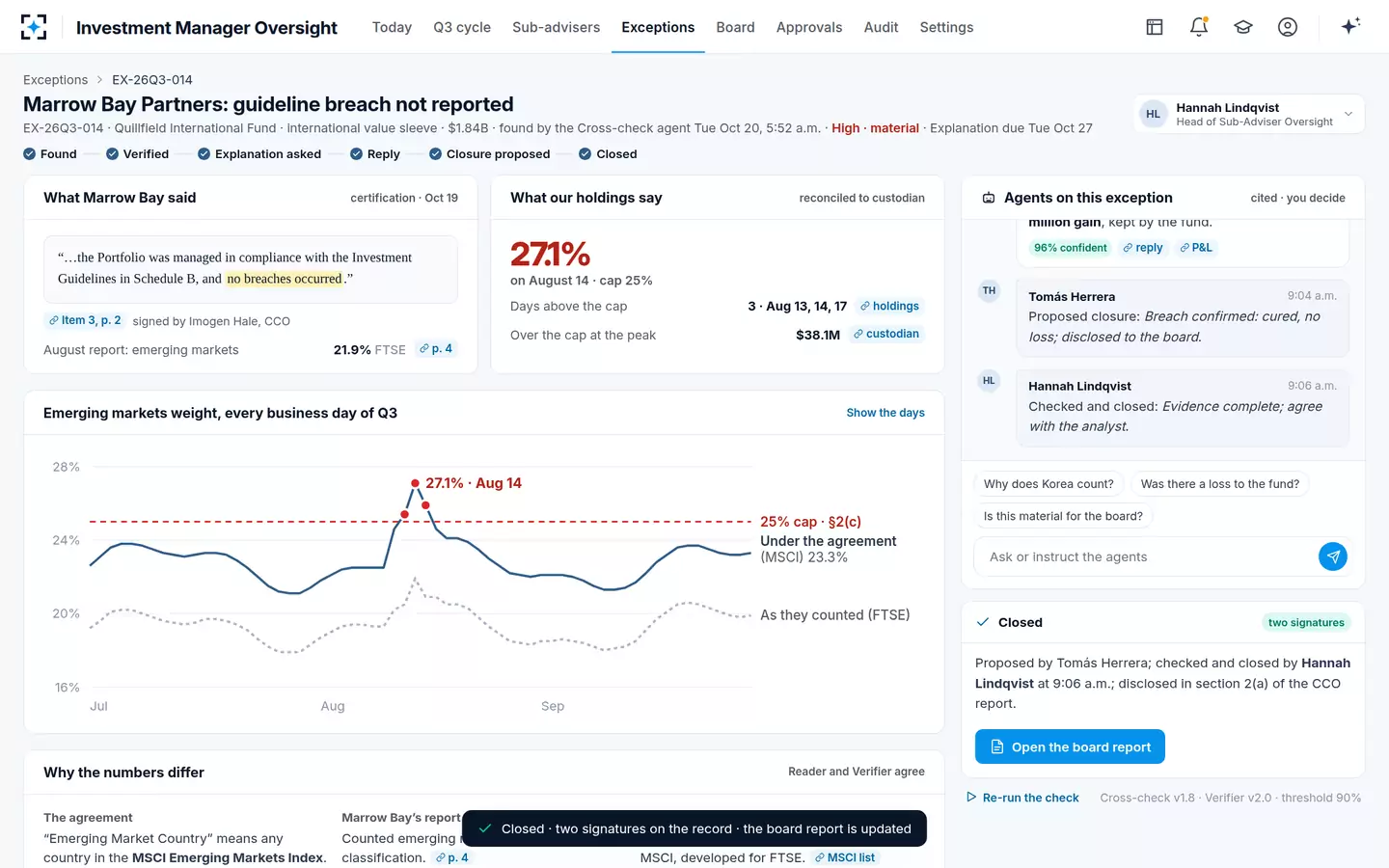
The audit trail is the other half. Every request, reading, test, question, decision and signature is logged with who, what, when, why and the evidence, so that a review "at reasonable intervals" can be shown, not just asserted.
Who decided what, when and on which evidence, in Investment Manager Oversight's audit trail
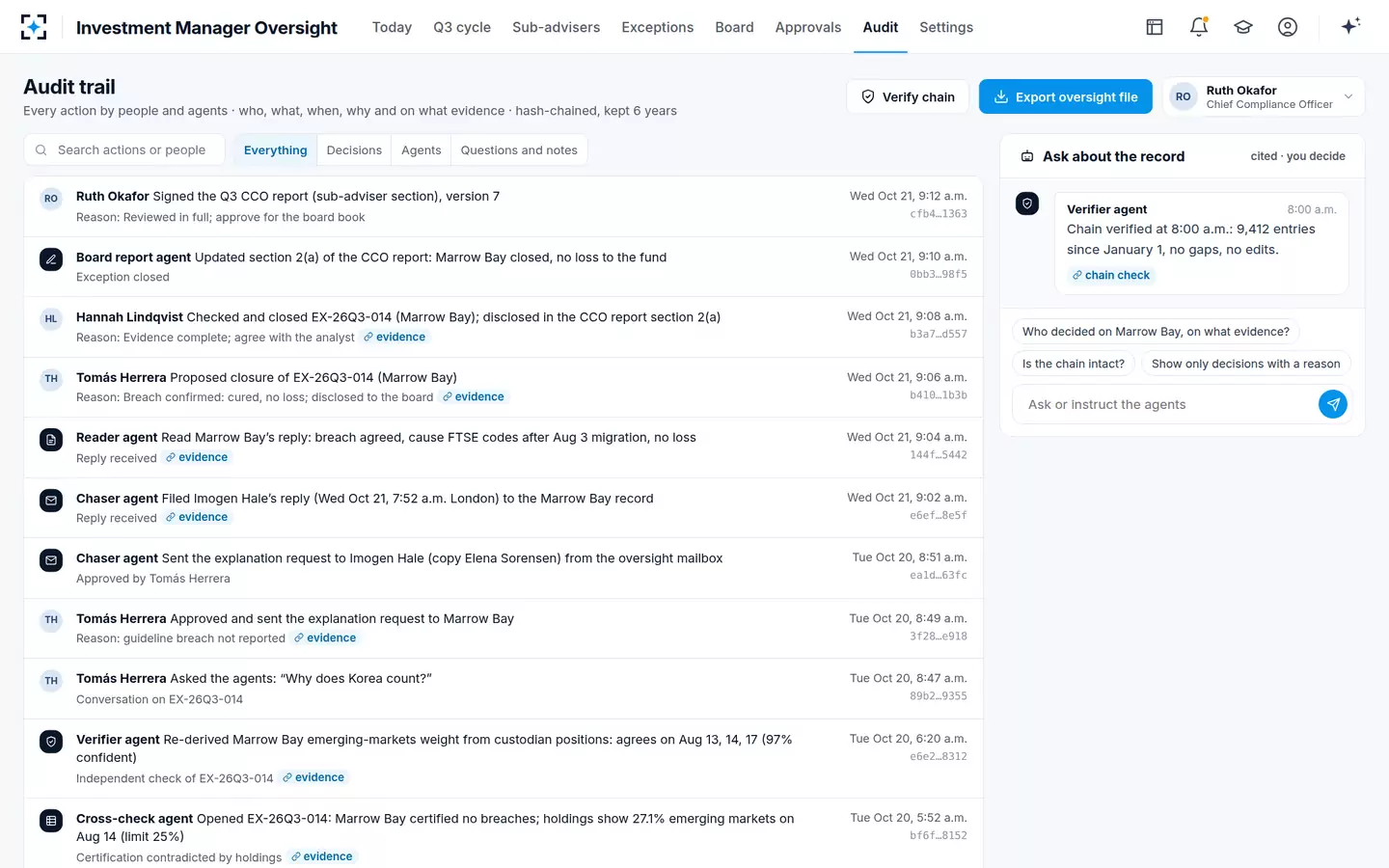
Investment Manager Oversight does not act as a 3(21) or 3(38) fiduciary, give investment advice or decide anything for a plan. It gathers and tests the evidence a committee needs to monitor the managers it appointed or the adviser it relies on, and keeps the record of each review. How to evaluate a fund manager covers the selection step that comes before the appointment.
Questions people ask
Is a 3(38) investment manager always better for the plan sponsor?
Not always. A 3(38) appointment relieves trustees of liability for the manager's decisions under section 405(d)(1), but the sponsor still answers for selecting and monitoring the manager, and a committee that monitors poorly has kept the risk that matters. A 3(21) arrangement suits a committee that wants to keep the decisions and can evidence them.
Does a 3(21) adviser share liability with the committee?
For its advice, yes: ERISA makes it a fiduciary "to the extent" it renders investment advice for a fee. The committee that decides remains responsible for the decision, and fiduciaries can be liable for a co-fiduciary's breach in the circumstances section 405(a) describes.
Can a plan appoint more than one 3(38) manager?
Yes. Section 402(c)(3) allows a named fiduciary to "appoint an investment manager or managers," and each must meet the section 3(38) conditions. Each appointment then needs its own monitoring, which is the same multi-manager problem a fund faces with several sub-advisers.
Is the law on monitoring changing?
The statute is not. The Department of Labor's 2022 investment-duties rule is still the text of 29 CFR 2550.404a-1, its regulatory agenda lists a rewrite, and its March 2026 proposal on selecting 401(k) menu options is not final. Anderson v. Intel Corporation Investment Policy Committee was argued at the Supreme Court on October 6, 2026 and is pending.
Does ERISA apply to public pension plans and endowments?
No. ERISA section 4(b)(1) excludes governmental plans from its coverage, and an endowment is not an employee benefit plan; public plans and endowments follow state law. The monitoring problem is the same, and so is the evidence a board or committee needs.