An investment management oversight analyst, often titled sub-adviser oversight analyst or investment oversight analyst, is the person at a fund group or adviser who collects, reads and tests what each outside investment manager reports every quarter, and turns it into the chief compliance officer's report to the fund board. The work starts the day after quarter end with requests for compliance certifications, guideline reports and questionnaires, and ends weeks later with signed sections in the board book. It is hard because almost every input is written by the firm being overseen, in its own format and sometimes its own language, and because the fund answers for the sub-adviser's mistakes under Rule 38a-1. Botminds' Investment Manager Oversight gives the seat six agents that chase, read, re-test on the fund's own holdings and draft, so the analyst's time goes to the decisions the job actually holds.
Take the solution's sample fund trust, a fictional group whose oversight analyst covers 23 sub-advisers running 38 sleeves with $23.8 billion of assets, as it works through its third quarter. The dates, counts and people below are that sample's; the rules and findings come from the SEC.
One analyst's quarter in the sample fund trust
23
sub-advisers to request, chase, read and test, each with its own agreement
115
steps in the quarter, five per sub-adviser from request to sign-off
26,368
guideline tests run overnight on the trust’s own holdings: 412 guidelines × 64 business days
2
breaches found that the sub-advisers had not reported
What does an investment oversight analyst do?
The analyst runs the fund's evidence that each sub-adviser stayed inside its agreement. That has four parts: getting the documents, reading them, testing them against what the fund can see for itself, and writing up what was found for people who will decide. The first two parts take most of the hours. The last two carry most of the risk.
The SEC never names the role, but its 2003 adopting release for Rule 38a-1 describes its tools. The fund's chief compliance officer should get regular reports from each service provider and special ones when something goes wrong; contracts may oblige providers to certify their compliance from time to time; and the CCO may run, or hire others to run, statistical tests of how each provider does its job (68 FR 74714; the release's own words, tool by tool). In a fund group with more than a handful of sub-advisers, the person who gathers those reports, chases those certifications and runs those analyses is the oversight analyst.
The quarter, week by week
The calendar is set from both ends: the quarter closes on a fixed date, and the board meets on a fixed date, so everything in between is the analyst's to fit. In the sample, requests went out on October 1, certifications were due October 14, the board book was due October 29 and the board met November 12.
Six weeks from quarter end to the board: where the sample analyst's calendar goes
- Requests out, due date13 d
- Reading and re-tests7 d
- Chasing, book built8 d
- Book with the board14 d
Week one is requests. Each sub-adviser receives the same package: the quarterly compliance certification, the monthly guideline reports, notice of policy changes, and, on the anniversary of its agreement, the annual due diligence questionnaire. Week two is the due date and the first chase; in the sample, two items were late, one certification and one annual questionnaire, and one sub-adviser had sent its guideline reports password-protected. Week three is reading, and it is where the quarter used to stall: certifications in one template, guideline reports in another, some in German, French or Japanese.
Weeks three and four are testing and exceptions, which in the sample took one morning for the decisive case because the test had already run overnight. Weeks four to six are sign-off: each sub-adviser's quarter closed by the analyst and checked by a second person, the CCO's section drafted and signed, and the book handed to the board's liaison.
Where the hours go, by hand and with agents
By the solution's own estimate, a sub-adviser's quarter takes about 1.5 analyst days by hand, 12 hours, and the design target with agents is 2 hours. More telling than the total is what the remaining hours are spent on.
Where one sub-adviser's quarter goes: from chasing and reading to deciding
By hand, about 12 hours (estimate)
- Requesting and chasing, 3 h · 25%
- Reading certifications and reports, 4 h · 33.3%
- Comparing with the agreement, last year and Form ADV, 1.5 h · 12.5%
- Logging exceptions, chasing explanations, 2 h · 16.7%
- Board report section and signatures, 1.5 h · 12.5%
With agents, 2-hour target
- Approving requests, 0.25 h · 12.5%
- Checking what was read, 0.5 h · 25%
- Reviewing comparisons, 0.25 h · 12.5%
- Deciding exceptions, 0.5 h · 25%
- Report and signatures, 0.5 h · 25%
Under the target, half of the analyst's remaining time goes to exceptions and the board report, against under a third by hand. That is the point of the change: the hours that disappear are the ones spent finding pages and re-typing figures, and the ones that stay are judgments that cannot be delegated to the firm being judged or to an agent.
How many sub-advisers does an oversight analyst cover?
There is no industry ratio: no regulator or independent study publishes one, and the SEC's rules set duties, not staffing. The useful way to size the seat is from the hours. Multiply the hours one sub-adviser's quarter takes by the number of sub-advisers, add the annual questionnaires that fall in the quarter, and compare it with the hours an analyst has between quarter end and the board book. In the sample, 23 sub-advisers at the 12-hour estimate is about 276 hours, roughly seven weeks of one person's time, squeezed into a four-week window before the book is due. That arithmetic is why oversight teams split coverage by fund range or asset class, and why the reading and chasing are the first things to take off the analyst.
Coverage also scales with how many sleeves and agreements there are, not just firms. A sub-adviser running two sleeves under two guidelines schedules is two sets of tests. The SEC's examiners deal with the same multiplication from the other side: about 800 fund complexes with nearly 15,000 portfolios (risk alert, November 4, 2024).
Which sub-adviser answers get re-tested? The decision the seat really owns
The analyst's most consequential decision is which answers to take on trust and which to test, and the SEC's findings show where untested answers go wrong. Its 2021 review of more than 200 funds listed weak monitoring of whether each fund kept to its own specific investment restrictions, naming concentration limits, caps on alternative investments and limits on lower-rated securities as examples (risk alert, October 26, 2021). Those are exactly the limits written into sub-advisory guidelines schedules.
The sample shows why a certificate is not a test. Marrow Bay, a fictional sub-adviser, certified that "no breaches occurred." The trust's own holdings, reconciled to the custodian, put its international value sleeve at 27.1% emerging markets on August 14 against a 25% cap, above the cap for three days. The analyst asked the agents why; the answer cited the agreement's definition of an emerging market country, any country in the MSCI Emerging Markets Index, against the sub-adviser's own report, which had counted by another provider's classification and left out South Korea, 5.2% of the sleeve. A sample-based review would have found it only if it happened to test that sleeve, that limit and that definition.
The analyst's morning in Investment Manager Oversight: the one difference that matters, first
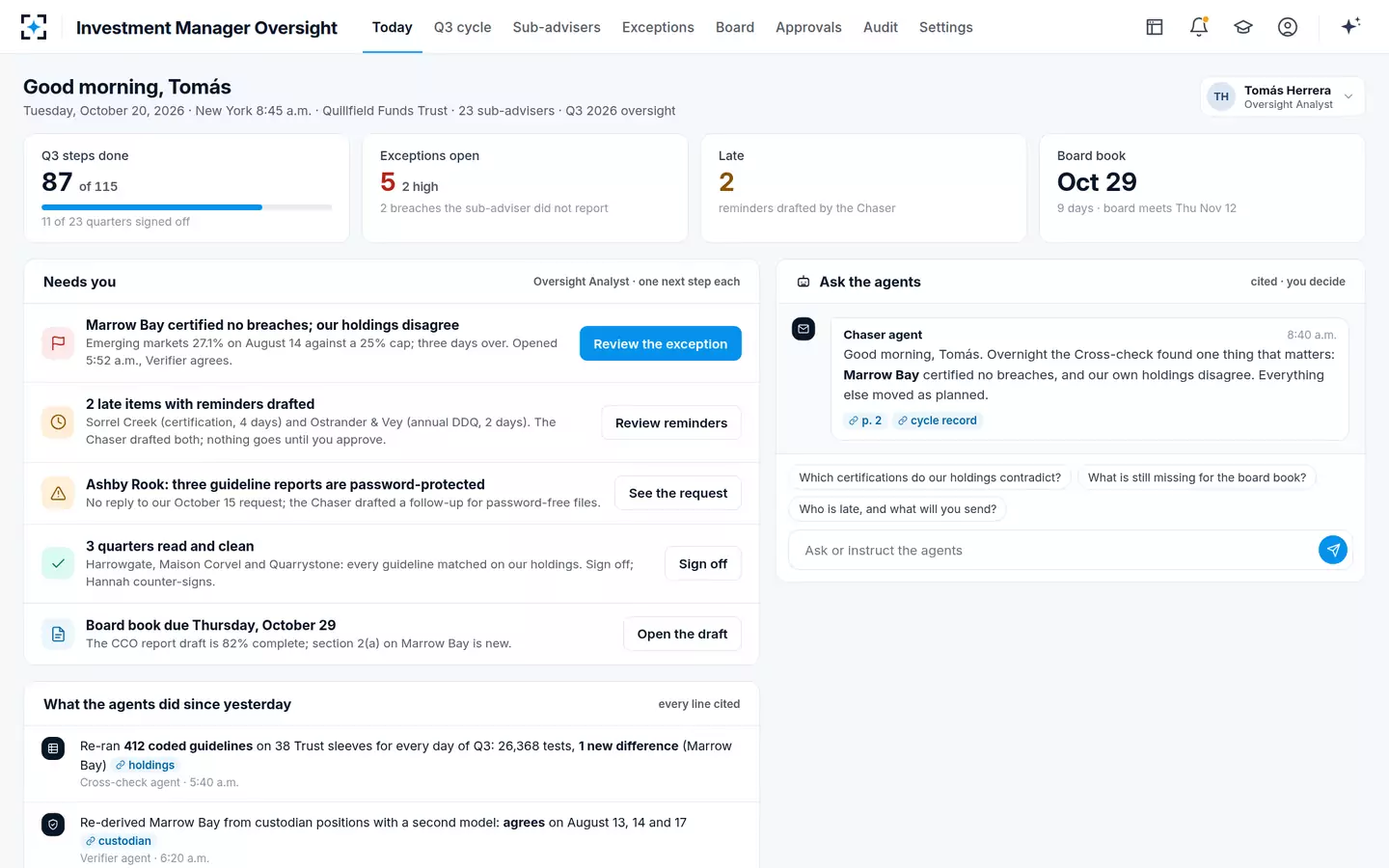
Testing everything changes the analyst's job from choosing a sample to choosing a response. In the sample, the overnight re-test produced four differences out of 26,368 tests: two breaches the sub-advisers had not reported, one reported breach confirmed, and one difference explained because the agreement measures cash on a trade-date basis. Each was a decision about what the difference meant, not about whether to look.
Fund oversight manager, manager research analyst, oversight analyst: three different seats
The titles overlap in job ads, but the seats answer different questions. A manager research analyst asks whether a manager is good enough to hire or keep: process, people, performance, fit. An investment oversight analyst asks whether a hired manager did what its agreement says, quarter by quarter, and documents the answer for the CCO. A fund oversight manager usually runs the oversight team, checks the analysts' closures and owns the relationship with the CCO, sometimes alongside oversight of other providers such as the administrator.
The distinction matters most at the hand-off. Research's view of a manager is forward-looking and qualitative; oversight's is backward-looking and evidential. A key-person departure is news to research and a contradiction to oversight if the quarter's certificate said "no material changes." How to evaluate a fund manager when past returns aren't the test covers the research side.
Five seats around one sub-adviser's quarter
Today
Chases certifications from a tracker spreadsheet, reads every page and mostly takes the sub-adviser’s word.
With agents
Starts from the differences the overnight test found, asks the agents why, approves their emails and proposes each closure with a reason.
Still theirs: Deciding what each difference means and what to ask the sub-adviser.
Today
Counter-signs closures and quarters from a spreadsheet and a paper sign-off.
With agents
Checks each closure on the same evidence the analyst used, closes it or returns it with a reason.
Still theirs: The second signature, and approval of every coded guideline.
Today
Signs a board section re-typed from many files.
With agents
Signs a drafted section where every statement links to its source and every material matter has a disposition.
Still theirs: The judgment of what is material, and the signature the board relies on.
Today
Sees a questionnaire answer contradict a filing only if someone finds time to compare them.
With agents
Approves every escalation’s tone and sees this year’s questionnaire against last year’s, each change cited.
Still theirs: The relationship, and the call on how hard to press.
Today
Collects the CCO’s section with the rest of the board book, in whatever form it arrives.
With agents
Publishes the signed section to the board portal once the CCO has signed.
Still theirs: What reaches the directors, and when.
What the analyst hands the CCO for the board report
The analyst's output is the raw material of the CCO's report, and Rule 38a-1 fixes its minimum content: the operation of each adviser's policies and procedures, material changes to them, changes recommended by the annual review, and every material compliance matter since the previous report (Rule 38a-1(a)(4)(iii)). For each sub-adviser that means a short, sourced account: what was requested and received, what was tested and how, what differed, how each difference was resolved and by whom, what changed in its policies or people, and what is still outstanding.
The sample's CCO section follows that order: scope and results, material compliance matters, other matters, policy changes, outstanding items. Two habits make it defensible. Every statement points to its document, and every material matter carries a disposition before the CCO can sign. What Rule 38a-1 asks the CCO's report to cover sets out the rule's side.
What do examiners ask an oversight team for?
Examiners ask for the evidence, not the policy. The SEC's 2024 list of documents it typically requests from funds includes "Information regarding due diligence on, and oversight of, service providers," the fund's compliance policies with "inventories of compliance risks, testing, and compliance exception reports," the CCO's annual reviews and reports, the fund trade blotter and month-end positions for a period, and "Information regarding tools or systems used to carry out compliance-related oversight functions and reporting" (risk alert attachment, November 4, 2024).
The oversight analyst's file, ready for the document request
- For each sub-adviser and quarter: what was asked, when, and what came back
Requests, reminders and replies with dates, so a late certificate is visible as late.
- The test behind each "no breaches"
Holdings source, the guideline as coded from the agreement, the result and who reviewed it.
- Exception reports with their closure
The difference, the sub-adviser’s explanation, the reason code and both signatures.
- Changes noticed and reported
Policy changes, key-person departures and filing amendments, with where they were first seen.
- The tools used and how they were checked
Which system ran the tests, which version, and how its output was verified.
The SEC's September 2026 alert on advisers' annual reviews adds a warning for anyone tempted to treat certificates as the review: the staff listed as a deficiency advisers that treated compliance training or staff attestations as their annual review (risk alert, September 14, 2026; what that means for quarterly certificates). That alert concerns advisers' own reviews, but the logic carries: a signature is an input to oversight, not oversight. How to make each sub-adviser's file defensible follows the same line for the annual questionnaire.
Twenty-three sub-advisers, five steps each, in Investment Manager Oversight
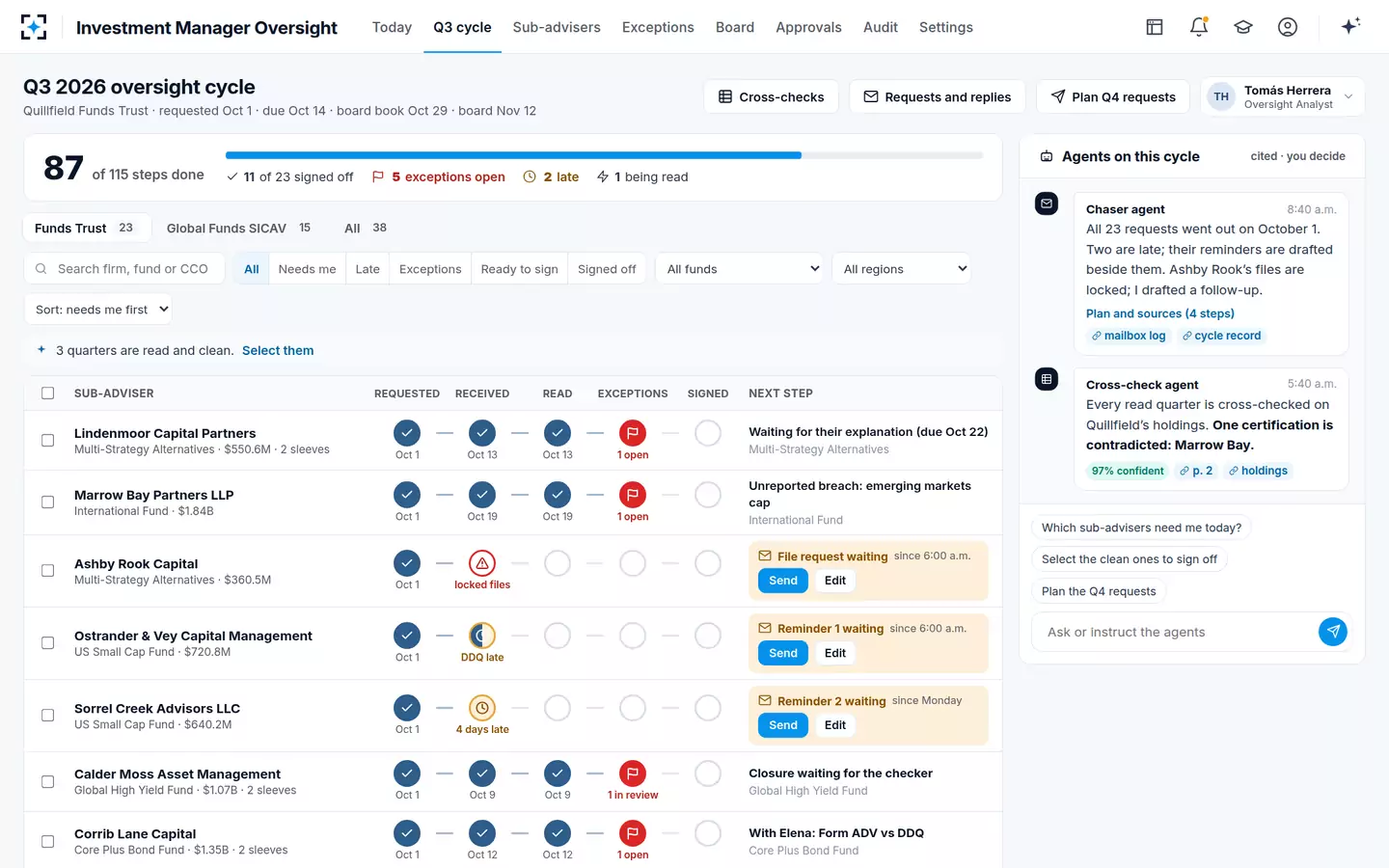
That is the seat Investment Manager Oversight is designed for. The agents take the requests, the reading in any language, the overnight tests and the first draft; the analyst keeps the questions, the explanations and the proposals; the head of oversight checks; the CCO signs.
Questions people ask
Is sub-adviser oversight a compliance job or an investment job?
Usually compliance, sometimes shared. Rule 38a-1 puts the duty in the fund's compliance program and the CCO's report, so most oversight teams report to the CCO; some sit in the adviser's investment management or product teams with a line to compliance. What matters for the board is that the person testing the sub-adviser does not report to the sub-adviser's relationship owner alone.
What skills does an investment oversight analyst need?
Reading contracts precisely, especially definitions in guidelines schedules; working with holdings and index data; and writing short, sourced findings. The decisive skill is knowing which answer to doubt: the sample's breach turned on one definition in one schedule.
How long does a quarter of sub-adviser oversight take?
In the solution's sample, six weeks from requests on October 1 to the board meeting on November 12, with certifications due after two weeks and the board book after four. Botminds estimates about 12 analyst hours per sub-adviser per quarter by hand; the design target with agents is 2.
Does the oversight analyst contact the sub-adviser directly?
Usually, through a shared oversight mailbox, with escalations approved by the relationship manager. In the solution, the Chaser agent drafts every request and reminder from approved templates, reminds on day 1 and day 3 and escalates on day 5, and nothing is sent until a person approves it.
What happens when the analyst finds a breach the sub-adviser did not report?
It becomes an exception: the analyst asks the sub-adviser to explain, proposes a disposition, a second person checks and closes it, and it goes into the CCO's report as a material compliance matter if the fund's policy says so. In the sample, the excess was sold four days after the peak at a gain the fund kept, and the sub-adviser corrected its classifications.