To evaluate a fund manager, judge what you can verify before the hire and keep testing after it: whether its investment process is repeatable and matches what it says, whether the people who run it will stay, whether its compliance program and operations work, whether it can run your mandate inside your guidelines and report against your definitions, and what it will cost in all. Look at past returns last, net of fees and against the right benchmark, because the evidence is that institutions which hire on strong past returns do not earn them afterwards. That evidence comes from 3,400 US plan sponsors, from consultants' recommendations and from two UK regulators. The evaluation does not end at the hire: a fund that appoints a sub-adviser must oversee it every quarter under Rule 38a-1, which is the work Botminds' Investment Manager Oversight takes on, testing each manager's reports against the fund's own holdings. For a plan, the matching discipline after the hire is a watch list written into the policy: mutual fund watch list criteria.
Three bodies of evidence on choosing managers, and the test each one implies
Plan sponsors
3,400 US plan sponsors hiring and firing managers, 1994–2003
Managers were hired after large positive excess returns, which "does not deliver positive excess returns thereafter."
The test it impliesDo not let recent returns choose the shortlist.
Goyal and Wahal, Journal of Finance, 2008
Consultants
Consultants’ recommendations of US active equity funds
Recommendations follow "soft factors" and move flows, but there is "no evidence that these recommendations add value."
The test it impliesAsk what evidence a rating rests on, not who gave it.
Jenkinson, Jones and Martinez, Journal of Finance, 2016
Regulators
UK asset management market study and investment consultants investigation
Little persistence in outperformance; little evidence that consultants’ "buy-rated" products beat benchmarks net of fees; selection’s value lies in screening quality and operational risk.
The test it impliesSpend selection effort on what can be verified: process, controls, fit.
FCA, 2017; CMA, 2018
What the evidence says about hiring on past returns
Institutions that hire managers after strong returns do not keep getting them. Goyal and Wahal examined "the selection and termination of investment management firms by 3,400 plan sponsors between 1994 and 2003," and found: "Plan sponsors hire investment managers after large positive excess returns but this return‐chasing behavior does not deliver positive excess returns thereafter" (Journal of Finance, 2008). The firing side was no better.
"If plan sponsors had stayed with fired investment managers, their excess returns would be no different from those delivered by newly hired managers."
Goyal and Wahal, 'The Selection and Termination of Investment Management Firms by Plan Sponsors', Journal of Finance 63(4), 2008
The UK Financial Conduct Authority reached the same place from fund data: "There is little evidence of persistence in outperformance in academic literature, and where performance persistence has been identified, it is persistently poor performance" (FCA, Asset Management Market Study final report, June 2017). Past returns are not useless; they are simply weak evidence of the thing a selection decision is about, which is future returns net of everything.
Do investment consultants pick better managers?
On average, the evidence says no. Jenkinson, Jones and Martinez studied consultants' recommendations of US actively managed equity funds and found that they "are driven largely by soft factors, rather than the funds' past performance," that they "have a significant effect on fund flows," but that there is "no evidence that these recommendations add value, suggesting that the search for winners, encouraged and guided by investment consultants, is fruitless" (Journal of Finance, 2016).
The UK Competition and Markets Authority tested ratings from eight consultancy and fiduciary management firms over 2006–2015. Gross of fees, "buy-rated" products beat their benchmarks by about 23 basis points a quarter; but "On a net of asset management fees basis, we have found little evidence that buy-rated products significantly outperform their respective benchmarks," though two individual providers did recommend net outperformers (CMA, final report, December 2018, paragraphs 10.95–10.101). The FCA found the same for consultants generally and drew the useful conclusion: what manager selection reliably delivers is a floor on quality and operational risk, not a pick of winners (FCA, chapter 10).
That points the evaluation at the parts a buyer can verify. A consultant's rating is an opinion; a manager's compliance program, its people, its operations and its capacity to run a specific mandate are facts that can be checked.
The investment manager selection process, with returns last
A defensible selection process tests the manager against the mandate it will run, in an order that puts verifiable evidence first. The checklist below is built for a fund hiring a sub-adviser or an institution hiring a separate-account manager; the same tests apply to a fund-of-funds allocator with different documents.
A fund manager selection test that puts returns last
- 1. Fit with your guidelines
Give the manager your draft guidelines schedule and definitions, and ask it to show a representative portfolio tested against them. A manager whose system classifies countries or ratings differently from your agreement will certify by its rules, not yours.
- 2. Process
Is the investment process written down, repeatable and consistent with the strategy the manager markets? Ask how models are validated; untested models were the root of the SEC’s 2018 Transamerica case against a sub-adviser.
- 3. People
Who makes decisions, who replaces them, and how key-person changes are reported. Compare with the Form ADV brochure supplements.
- 4. Compliance program
The CCO, the last annual review under Rule 206(4)-7, exam history and how findings were fixed.
- 5. Operations and controls
Trade errors and their correction, allocation, valuation, custody, business continuity.
- 6. Regulatory history
Form ADV Item 11 and SEC orders, against what the manager tells you.
- 7. Reporting
Can it deliver certifications, guideline reports and notice of breaches on your calendar, with the evidence behind them?
- 8. All-in cost
Fees in basis points with every other cost the mandate will bear.
- 9. Returns, last
Net of fees, against the benchmark your mandate will use, over full cycles, with how much of the portfolio actually differs from the benchmark.
How to evaluate fund manager performance without being misled by it
Read performance as a description of the process, not a forecast. Three questions do most of the work. Is it net of the fees you will pay? Is the benchmark the one your mandate will use, and has the manager earned the return by being different from it? Cremers and Petajisto's Active Share measures that difference as the share of a portfolio's holdings that differ from its benchmark's, and their study of US equity funds reported that the funds most different from their benchmarks outperformed while the least different non-index funds lagged (working paper 2006, published in the Review of Financial Studies, 2009). And is the record consistent with what the manager says it does? A value manager whose returns came from a growth rally is telling you something about its process.
The FCA's study adds a reason to read fees first. In UK retail active funds it found "no clear relationship between charges and the gross performance," and "some evidence of a negative relationship between net returns and charges" (FCA, paragraph 1.12). A fee is the one part of future net performance known on the day of the hire.
What to ask of each kind of evidence about a manager
| Evidence | What it can tell you | What it cannot | Where to check it |
|---|---|---|---|
| Past returns | Whether the process has worked in markets like the past | Whether it will work next; persistence in outperformance is weak | Net of fees, against your benchmark, full cycles |
| Consultant rating | That someone did diligence | That the manager will outperform; ratings follow soft factors | The diligence behind the rating |
| Due diligence questionnaire | What the manager says about itself | Whether it is true | Last year’s answers, Form ADV, your own tests |
| Form ADV | Ownership, assets, affiliations, disciplinary history, as filed with the SEC | Anything since the last amendment | Annual amendment within 90 days of fiscal year end; some items promptly |
| A test against your guidelines | Whether the manager can run your mandate by your definitions | Future compliance, which needs ongoing tests | A representative portfolio, then the live sleeve every business day |
What to test before hiring: operations and compliance
Test whether the manager's controls work, not whether it says they do, because those failures are what end up in front of a board. The SEC's case against four Transamerica entities turned on a sub-adviser's quantitative models: the sub-adviser marketed a "model-driven" process without checking that its models worked; an internal report had warned that it did not "periodically perform independent validation of modeling results" (SEC order IA-4997, 2018). A selection review that had asked to see model validation would have found the gap before the money moved.
For a fund, the bar is set by the SEC's expectation of its CCO once the manager is hired: that she satisfy herself each provider's compliance policies work and are run by competent people (Rule 38a-1 adopting release, 68 FR 74714; the release's words). There is no reason to set a lower bar before the hire than after it. How to test each questionnaire answer against evidence applies equally at selection.
Choosing a sub-adviser for a fund: who decides, and on what record
For a registered fund, selection is not one person's call, and its evidence becomes board material. The adviser proposes the sub-adviser; a majority of the independent directors must approve the sub-advisory contract in person at a meeting held for that purpose (15 U.S.C. 80a-15(c)); shareholders vote on it unless the fund holds a manager of managers order; and the board must approve the sub-adviser's compliance policies on a finding that they are reasonably designed to prevent breaches of the securities laws (Rule 38a-1(a)(2)). Who approves what in a sub-advised fund is laid out party by party in its own guide.
That turns the selection checklist into a record. The materials the board saw when it approved the policies must be kept for at least five years after the end of the fiscal year, the first two in an easily accessible place (Rule 38a-1(d)(2)), and the same evidence becomes the baseline for every later quarter: the guidelines the sub-adviser said it could run, the people it named, the controls it described. A selection file that tested those claims is the first page of an oversight file. How the manager of managers order changes the approval is covered separately.
When should an investment manager be fired?
Fire for the things selection was meant to screen: a breach of the guidelines that reveals a control failure, a change of process or people the manager did not report, a compliance program that does not work, a conflict that was not disclosed. Goyal and Wahal found managers were "terminated for a variety of reasons, including but not limited to underperformance," and that excess returns after terminations were "typically indistinguishable from zero but in some cases positive" (Journal of Finance, 2008). Firing on a weak stretch of returns alone tends to replace one average manager with another, at the cost of a transition.
The evidence for those decisions comes from oversight, not from returns. In the solution's sample, a fictional fund trust with 23 sub-advisers, the quarter's findings that would matter to a keep-or-replace decision were not performance numbers: a breach the sub-adviser had certified away because its system used another index provider's definitions, a restricted-list purchase it had not reported, and a key-person departure its certification omitted. Under the fund's settings, an unreported breach puts the sub-adviser under heightened oversight for two quarters. That is a record a board can act on.
A sub-adviser's own explanation, read and checked in Investment Manager Oversight
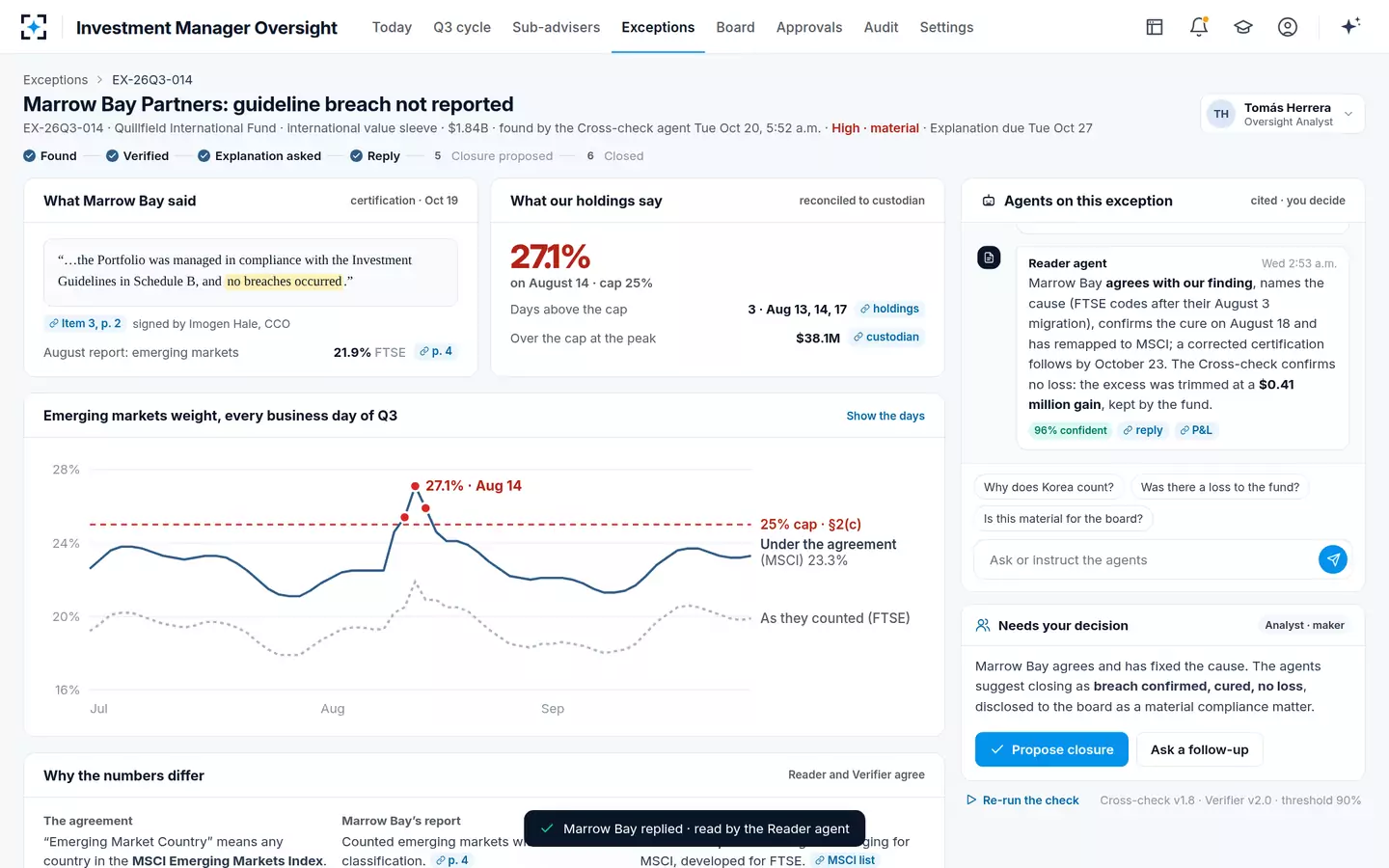
After the hire: evaluation becomes oversight
The day a fund hires a sub-adviser, evaluation becomes a legal duty. Rule 38a-1 requires the fund's compliance program to oversee "each investment adviser," the board to approve its policies and the CCO to report on them at least yearly. In practice that means each quarter's certification, guideline reports and, yearly, a questionnaire, each tested against what the fund can see: its holdings, its agreements, the manager's filings and last year's answers. What a sub-adviser is, and what the fund still answers for, sets out the legal frame.
This year's answers against last year's and Form ADV, in Investment Manager Oversight
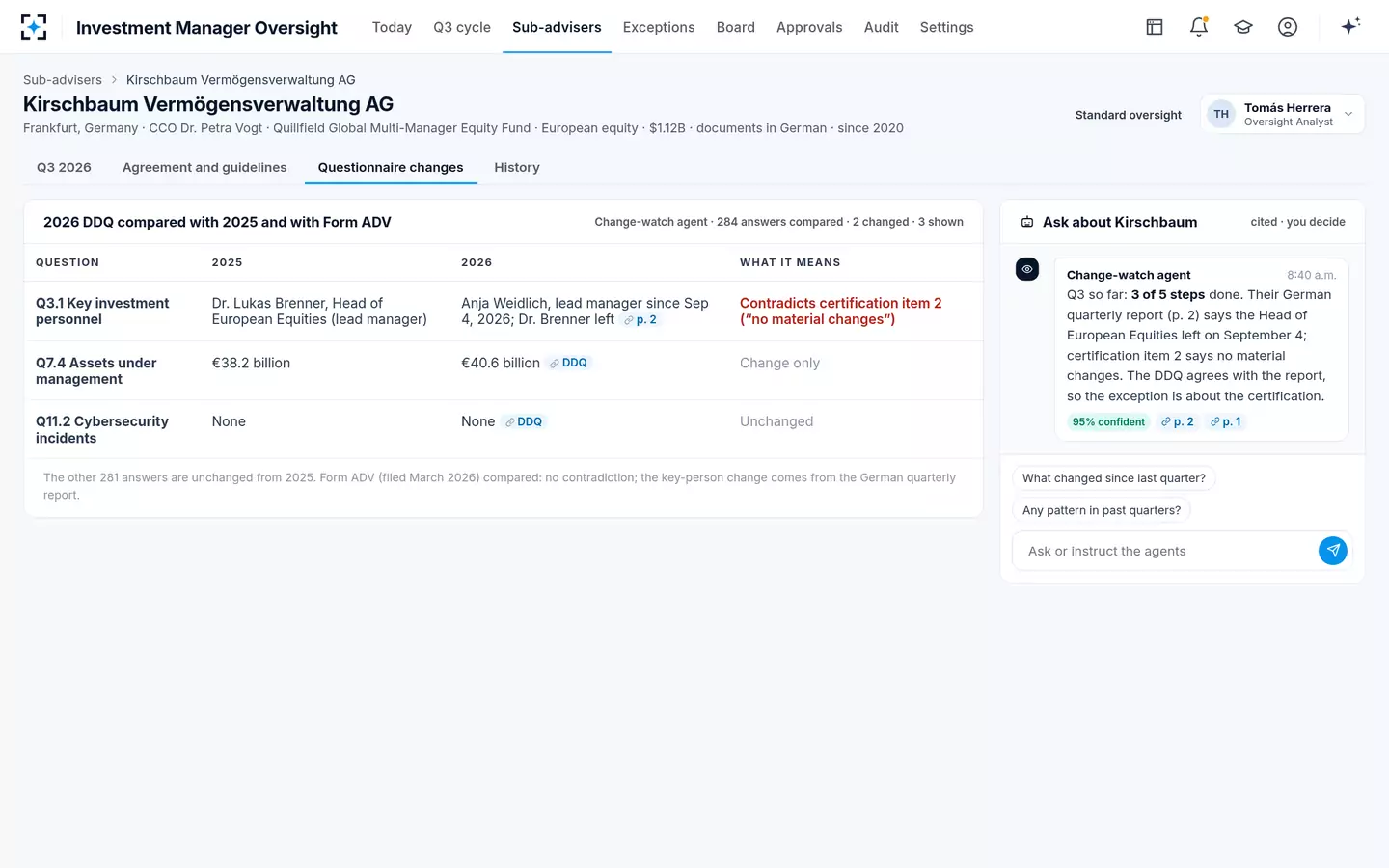
Investment Manager Oversight does not choose managers and keeps no ratings or performance universe. It does the testing that makes a selection decision checkable afterwards: chasing each manager's reports, reading them in their own language, re-running each agreement's guidelines on the fund's holdings every business day, comparing questionnaires with filings and drafting the CCO's report, with an analyst, a second reviewer and the CCO deciding.
Questions people ask
What is the most important factor when choosing an investment manager?
Fit with the mandate you will give it, tested rather than asserted: can it run your guidelines, by your definitions, and report on them on your calendar. Returns matter, but the evidence from 3,400 plan sponsors is that hiring on recent returns does not deliver them afterwards.
How many years of track record should a fund manager have?
Enough to cover the market conditions your mandate will face, and judged against the benchmark you will use, net of fees. No regulator sets a minimum. A long record is weak evidence of future returns, as the FCA noted, but good evidence of how a process behaves under stress.
Does a manager's Form ADV help in selection?
Yes, as a check on what the manager tells you. Form ADV discloses ownership, assets, affiliations, custody and disciplinary history, and must be amended at least yearly, with some items updated promptly. Compare it with the manager's questionnaire before hiring.
Should a fund replace a sub-adviser after a guideline breach?
Not automatically. Look at the cause, the cure, whether the manager reported it, and whether it reveals a control weakness. In the solution's sample, an unreported breach puts the sub-adviser under heightened oversight for two quarters and goes to the board, and the decision to keep or replace stays with the adviser and the board.
Is manager selection worth paying for?
For screening, yes; for picking winners, the evidence is weak. The FCA found selection ensures minimum quality and reduces operational risk, while the CMA found little evidence that consultants' buy-rated products beat benchmarks net of fees.