An asset manager database, also searched as an investment manager database or fund manager database, is a body of information about investment managers and their strategies, mostly supplied by the managers themselves: firm facts, assets under management, strategy descriptions, returns, team biographies, fees and, sometimes, holdings snapshots. It is built for searching and comparing managers, and it is good at that. It is not built for overseeing a manager you have already hired, because oversight asks a different question: did this firm run your money inside your agreement, measured on your holdings, by your definitions? Answering it needs the fund's own holdings, the agreements, the managers' regulatory filings and their periodic reports, joined together. Botminds' Investment Manager Oversight makes that join: agents read each manager's reports and agreements, test them on the fund's holdings and compare them with Form ADV, and people decide and sign.
This page names no database vendor. Examples come from the solution's sample, a fictional fund trust with 23 sub-advisers; rules and research are linked where they appear.
The oversight stack: seven sources, who writes each, and what each cannot tell you alone
Manager database
What it holdsWhat managers report about themselves: firm facts, assets, strategies, returns, team, fees
Who writes itThe manager, to a data provider
What it cannot tell you aloneSelf-reported; not your holdings, not your contract
Regulatory filings
What it holdsForm ADV: ownership, assets, affiliations, custody, disciplinary history, brochures
Who writes itThe manager, to the SEC, under updating rules
What it cannot tell you aloneFiled on its own calendar; months can pass between amendments
Agreements and guidelines
What it holdsEach sub-advisory agreement, its guidelines schedule and definitions
Who writes itNegotiated; signed by both sides
What it cannot tell you aloneUsually a PDF, not a set of tests
Holdings and trades
What it holdsDaily positions and trades per sleeve, reconciled to the custodian
Who writes itPortfolio accounting and the custodian
What it cannot tell you aloneRarely joined to the agreement that governs each sleeve
Reference data
What it holdsIndex constituents and country classifications, issuer ratings, prices
Who writes itIndex, ratings and pricing providers
What it cannot tell you aloneThe right source differs by agreement
Compliance system
What it holdsFirm rules and the restricted list
Who writes itThe fund’s compliance team
What it cannot tell you aloneBuilt for the firm’s own trading, not for testing a sub-adviser’s report
Mailbox and documents
What it holdsCertifications, guideline reports, questionnaires, replies
Who writes itThe managers, in their own formats and languages
What it cannot tell you aloneUnstructured; read by hand
What data does an asset manager database hold?
Commercial manager databases hold what managers submit, organised for comparison: firm ownership and assets, strategy descriptions, composite or fund returns against benchmarks, risk statistics, team and key people, fees, vehicles offered and, in some cases, periodic holdings. Some add fields drawn from public regulatory filings, and their own research notes. The common feature is that the core data starts with the manager, whose incentive is to present itself well.
Researchers who work with such data correct for that. When the UK Competition and Markets Authority tested whether consultants' "buy" ratings outperformed, it analysed manager returns from a commercial database and reported sensitivities including "an alternative approach for correcting for backfill bias," the distortion that comes from managers adding their history after a good run (CMA, final report, December 2018, paragraph 10.99). A database is a fair starting point for comparing managers; it is a weak one for checking them.
Is there a free database of investment advisers?
Yes, for regulatory facts. The SEC publishes monthly files on registered investment advisers which, in its words, "contain information about investment advisers who are registered with the SEC" and are "a subset of the information" filed, with "The majority of the data fields" drawn from Form ADV: identifying information, the advisory business, financial industry affiliations, custody, control persons and disclosure information on disciplinary history (SEC, Information about Registered Investment Advisers and Exempt Reporting Advisers). The SEC's Investment Adviser Public Disclosure site shows each adviser's filings one at a time.
The scale is large. As of December 2025, "there were 16,442 investment advisers registered with the Commission," reporting "$177.0 trillion in total regulatory assets under management" (SEC proposed custody rule, 91 FR 63870, October 6, 2026). The data is authoritative in one sense: the adviser filed it with the SEC under rules that set when it must be updated. Its limit is timing. An annual updating amendment is due within 90 days of the adviser's fiscal year end, with some items amended promptly between (Form ADV General Instructions), so a filing can trail events by months.
One sample quarter's oversight, measured in the things a database does not hold
23
sub-advisory agreements, each with its own guidelines and definitions
412
guidelines coded from those agreements, each with clause and page
7,284
positions in the fund’s own holdings, reconciled to the custodian each morning
26,368
tests of what the sub-advisers reported, run on those holdings in one quarter
Can a manager database replace due diligence?
No. A database tells you what a manager says about its strategy and results; due diligence and oversight test what it says against what you can see independently. Research on the Form ADV filings hedge funds briefly had to make found that the operational-risk information in them did not change where investors put their money; the authors concluded investors either lacked the information or treated it as immaterial (Brown, Goetzmann, Liang and Schwarz, Journal of Finance, 2008). Information that sits in a database or a filing does nothing until someone joins it to a decision.
The SEC's examiners look for the join, not the data. The typical first request to a fund asks for its diligence on and oversight of service providers, its compliance testing and exception reports, and its "trade blotter" and positions (risk alert attachment, November 4, 2024; the request list in full). A subscription to a manager database answers none of those requests. Building a defensible file for each sub-adviser covers what does.
What systems does an oversight team use?
Most oversight teams already have every source they need; what they lack is the join. The solution's sample connects to the systems a fund group typically runs: the oversight mailbox, where requests go out and reports come in; portfolio accounting and the custodian, for daily holdings and trades; the compliance system, for firm rules and the restricted list; index, ratings and pricing data; a regulatory filings feed for Form ADV and SEC filings; and the CRM, document management and board portal. Without a join, the analyst is the integration: downloading a report from the mailbox, opening the agreement, pulling holdings into a spreadsheet, looking up a classification, typing the result into a tracker and, weeks later, into the board report.
The same question answered two ways: is this sleeve inside its emerging markets cap?
The analyst as integration: Open the certificate from the mailbox; read "no breaches."
The sources joined: Read on arrival, quoted with its page, in its original language.
The analyst as integration: Find the agreement PDF; find the guidelines schedule; find the cap.
The sources joined: The cap is already a coded test, with its clause and page, approved by a person.
The analyst as integration: Hope someone remembers the agreement names MSCI, not another index provider.
The sources joined: The classification source is set per agreement, so the test uses the agreement’s index.
The analyst as integration: Export positions for the quarter-end date into a spreadsheet.
The sources joined: Every business day of the quarter, reconciled to the custodian.
The analyst as integration: Quarter-end weight under the cap; the three days above it in August are never seen.
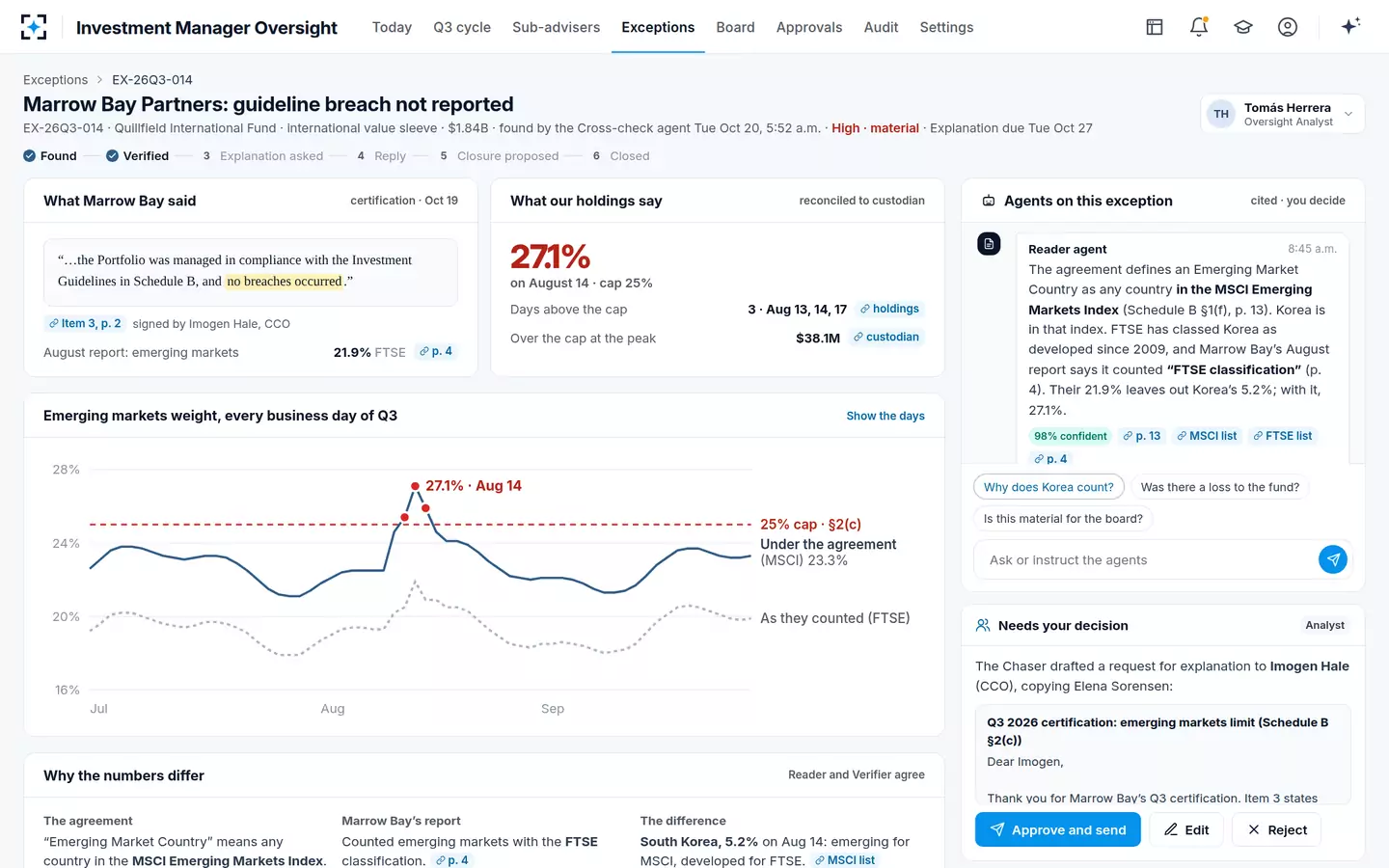
The sources joined: 27.1% on August 14 against a 25% cap, three days above; an exception opens and a second model re-derives it.
The analyst as integration: A tick in the tracker.
The sources joined: The certificate, the test, the difference, the reply and two signatures, linked to the board report.
Where the people are the integration: one quarter, step by system
A stack map is most useful when it counts the hand-offs. The table follows one sub-adviser's quarter through the steps the solution's own estimate times, and marks where a person carries data from one system to the next. By hand, every step but the first involves copying something from one place to another; the estimate puts the whole at about 12 analyst hours per sub-adviser per quarter.
One sub-adviser's quarter by hand: the steps, the systems, and what a person carries between them
| Step (estimated hours by hand) | Systems touched | What the person carries |
|---|---|---|
| Requesting and chasing (3 h) | Mailbox, tracker spreadsheet, contact list | Due dates and status, typed into the tracker from emails |
| Reading certifications and reports (4 h) | Mailbox, document store, the agreement PDF | Each figure and statement, read off a PDF or scan, some in other languages |
| Comparing with the agreement, last year and Form ADV (1.5 h) | Agreement, last year’s questionnaire, the SEC filing | Answers side by side, by eye |
| Logging exceptions and chasing explanations (2 h) | Tracker, mailbox, holdings export, reference data | Positions pulled into a spreadsheet; classifications looked up; the result typed into the log |
| Board report section and sign-offs (1.5 h) | Word processor, tracker, board portal | Every figure typed again into the report |
The table explains why a better database rarely shortens a quarter. Most of the hours sit in reading and re-keying documents the managers send and in pulling the fund's own holdings into a test, and none of that is done by a source of manager data. It is done by the analyst, or by software that reads documents and runs the tests where the data already lives.
How do certifications and holdings tests connect?
Through three keys, each of which has to be maintained. Each sleeve is tied to its account at the custodian and to the agreement that governs it, so holdings can be tested against the right rules. Each guideline is tied to its clause and page, so a test result can be traced to the contract. And each certificate statement is tied to the tests it summarises, so "no breaches" can be compared with the tests' answer for the same period. In the sample, the second key mattered most: the agreement's definition of an emerging market country, any country in the MSCI Emerging Markets Index, decided whether South Korea counted.
Why a country counts, answered from the agreement in Investment Manager Oversight
The fourth join is to filings. When the sample's annual questionnaire from a German sub-adviser named a new lead manager, the solution compared it with the firm's Form ADV and its quarterly certification. The questionnaire and the firm's own German report agreed; the certification, which said there had been no material changes, did not. None of the three documents was wrong in isolation. The contradiction existed only in the join.
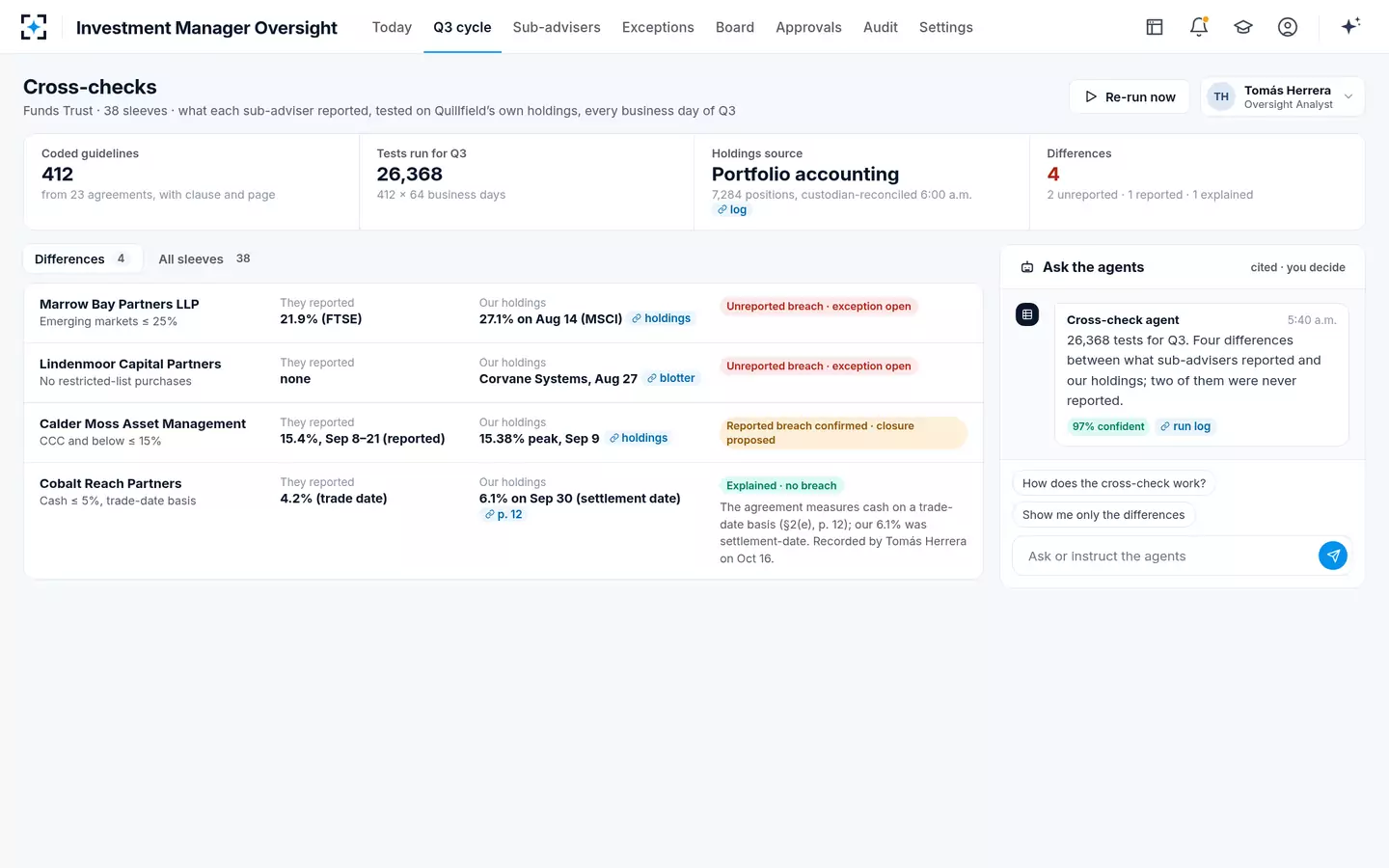
Each manager's reported figures, tested on the fund's own holdings in Investment Manager Oversight
What to check before buying another data source
Map the stack first. The question to put to any new source, a manager database included, is which oversight question it answers that the fund's own records do not. For selecting managers, a database can answer several. For overseeing the ones already hired, the answers usually come from the fund's own contracts, holdings and the managers' filings, and the missing piece is the work of joining them.
Before buying another data source for manager oversight
- Write down the questions oversight must answer
Did each manager stay within its guidelines, by the agreement’s definitions? What changed at the firm? What did it report, and was it true?
- Mark which layer answers each
Holdings, agreements, filings, reports, reference data or the manager database. Most answers sit in the first four.
- Check whose words each source contains
Self-reported data can describe; it cannot verify the manager that supplied it.
- Check the join keys
Sleeve to account to agreement; guideline to clause; certificate statement to test; manager to its SEC registration.
- Check the reference data each agreement names
One sub-adviser’s cap may use MSCI, another’s FTSE; the test must use the right one.
- Count the re-keying
Every figure typed twice, from report to tracker to board report, is a place an error can enter.
- Ask what the examiner will see
The oversight file, testing and exception reports, not a subscription.
Where Investment Manager Oversight fits in the stack, and where it does not
Investment Manager Oversight is not a manager database and does not rate, rank or select managers; it keeps no performance universe. It reads what each hired manager sends, in the language it arrives in, codes each agreement's guidelines into tests a person approves, re-runs them on the fund's own holdings every business day, compares questionnaires with last year's and with Form ADV, and drafts the CCO's report from the joined evidence. Rule 38a-1 asks a fund to oversee "each investment adviser" (17 CFR 270.38a-1); Investment Manager Oversight is built for that word, each. For the selection side, see how to evaluate a fund manager.
Questions people ask
What is the difference between an asset manager database and a fund database?
An asset manager database is organised around firms and their strategies, often including institutional separate accounts and composites; a fund database is organised around registered funds and their share classes. For oversight, the useful distinction is different: whether the data was reported by the manager or produced by the fund itself from its own holdings and contracts.
Where can I find SEC data on investment advisers?
The SEC publishes monthly files of registered and exempt reporting advisers' Form ADV data on its website, and its Investment Adviser Public Disclosure site shows each adviser's current filing. Exempt reporting advisers file only some items, which the SEC lists as Items 1, 2, 3, 6, 7, 10 and 11.
Does a manager database show a manager's guideline breaches?
No. Guideline breaches are measured against a specific client's agreement, so only the client, or the manager reporting to it, can know them. In the solution's sample, two of four differences found in one quarter were breaches the managers' own certifications had not reported.
How many registered investment advisers are there?
As of December 2025, 16,442 investment advisers were registered with the SEC, reporting $177.0 trillion in regulatory assets under management, according to the SEC's October 2026 custody rule proposal.
Can a fund rely on a data provider's classifications in its tests?
Only if they are the classifications its agreements name. The sample's breach arose because a sub-adviser's system applied one index provider's country codes to a cap the agreement defined by another's; the fund's test was right because it used the agreement's source.