A manager of managers exemptive order is SEC relief, granted fund by fund under section 6(c) of the Investment Company Act, that lets a fund's investment adviser, subject to the board's approval, hire unaffiliated sub-advisers and materially amend their contracts without the shareholder vote section 15(a) otherwise requires. In return the fund accepts conditions: shareholders approve the structure once, the prospectus says sub-advisers can change without a vote, shareholders receive an information statement after each change, and the board is independent. The order does not lighten oversight; it concentrates it. The adviser, in the SEC's words, "will hire, evaluate, allocate assets to and oversee the Subadvisers," and every hire now rests on the adviser's and the board's judgment rather than a proxy vote. Botminds' Investment Manager Oversight is built for the team that has to evidence that judgment each quarter.
The rules and conditions on this page come from the statute, the SEC's own notices and its 2003 rule proposal, linked where they appear. Screens show the solution on sample data about fictional firms.
Hiring a new sub-adviser, with and without a manager of managers order
Without the order: A majority of independent directors under section 15(c), then shareholders under section 15(a).
With the order: A majority of independent directors under section 15(c). No shareholder vote.
Without the order: A proxy statement and a meeting; the contract needs the vote of a "majority of the outstanding voting securities" as section 2(a)(42) defines it.
With the order: An information statement describing the new sub-advisory agreement, sent within 90 days under the conditions the SEC described in 2003.
Without the order: Any sub-adviser, affiliated or not.
With the order: Unaffiliated sub-advisers. The 2026 notice: relief "will not extend to any subadviser that is an affiliated person" of the trust, a fund or the adviser.
Without the order: Set by the contract the shareholders approve.
With the order: The 2003 proposal would have barred any change that increases the fund’s total advisory fee without a vote.
Without the order: Who the sub-advisers are.
With the order: Who they are, and that the adviser can change them without shareholder approval.
Without the order: The adviser and the board, with shareholders as a backstop on each hire.
With the order: The adviser and the board alone, between annual renewals.
What is a manager of managers exemptive order?
It is an order exempting a fund from one sentence of the Investment Company Act for one kind of contract. The SEC's most recent notice of such an application, for GreenFi Funds Trust in February 2026, states the whole purpose in a line: "The requested exemption would permit an investment adviser to hire and replace certain subadvisers without shareholder approval" (91 FR 8285). The notice describes the structure the relief assumes. The adviser is "responsible for the overall management of the Fund's business affairs," may delegate "the day-to-day portfolio investment management of the Fund" to unaffiliated sub-advisers "subject to the supervision and direction of the Adviser," and "The primary responsibility for managing the Fund will remain vested in the Adviser."
A manager of managers fund is the product built on that structure. The SEC's 2003 description still fits: funds "whose investment advisers do not directly manage a portfolio of securities," whose advisers instead "supervise one or more subadvisers," hiring, supervising "and, when appropriate, discharging" them, and often allocating assets among them (68 FR 61720). Many, the SEC noted then, were sponsored by insurance companies as funding vehicles for variable annuity and variable life contracts; multi-manager mutual funds and ETFs use the same structure today, as the 2026 notice shows.
Why does a sub-advisory contract need a shareholder vote at all?
Because Congress wrote the vote into the Act for advisers and sub-advisers alike. Section 15(a) requires every advisory contract, including one signed with the fund's adviser rather than the fund, to be in writing and approved by a shareholder vote (15 U.S.C. 80a-15(a); why the sub-adviser is caught by the same words). The majority is a defined term: 67% of the shares present at a meeting where more than half are present, or more than 50% of all outstanding shares, whichever is less (section 2(a)(42)). Collecting it means a proxy statement, solicitation and a meeting.
The SEC has been candid that this was deliberate. "The Congress that enacted section 15(a) anticipated subadvisory arrangements, and concluded that shareholders should have a role in the selection of subadvisers," its 2003 release says, quoting testimony from 1940 that a management contract "is personal, that it cannot be assigned, and that you cannot turn over the management of other people's money to someone else" (68 FR 61720). Sponsors answered that the vote stopped them firing weak sub-advisers quickly and that a sub-adviser is "closely analogous" to a portfolio manager the adviser could hire without asking anyone. The orders are the compromise between those two positions.
A compromise made one order at a time
1995
the year the SEC dates its manager of managers orders from: "Since 1995 we have issued over 100 orders"
100+
fund complexes offering manager of managers funds in 2003, by the SEC’s count
$400bn
at least, held by manager of managers funds in 2003: "more than 400 billion dollars," by the SEC’s estimate
0
rules adopted to replace the orders: proposed Rule 15a-5 never entered the Code of Federal Regulations
What conditions come with manager of managers relief?
The conditions trade the shareholder's vote for disclosure and for a stronger board. The current notices summarise them in one sentence: they provide "among other safeguards, appropriate disclosure to Fund shareholders and notification about subadvisory changes and enhanced Board oversight to protect the interests of the Fund's shareholders" (91 FR 8285). The full list sits in each fund's own application. The SEC's 2003 proposal, written to codify the orders it had issued, sets out the ones the orders had in common and says which the orders already contained.
Conditions the SEC's manager of managers orders have carried, as the SEC itself described them
- Shareholders approve the structure once
Before relying on the order, an existing fund’s shareholders authorise the adviser to enter into sub-advisory contracts without further votes. "This condition also has been included as a condition to our orders."
- An information statement after every new sub-adviser
Describing the agreement and what a proxy statement would have said. The 2003 proposal set the window at 90 days; "This condition has been included in our exemptive orders."
- The prospectus says it
Disclosure that the adviser, with board approval, can retain and discharge sub-advisers without a shareholder vote.
- An independent board
Independent directors are a majority, are nominated by independent directors and, if they hire counsel, use independent counsel; the orders "have typically included" these requirements.
- No affiliated sub-advisers
Relief covers unaffiliated sub-advisers, "a key element of our exemptive orders" given the conflicts in hiring a sister company. The 2026 notice repeats the limit.
- The adviser supervises
The orders "do require the principal adviser to supervise its subadvisers"; the 2003 proposal would have written the duty into the advisory contract.
- Profitability reported to the board
Where an order allows aggregate disclosure of sub-advisory fees, the adviser gives the board, "no less frequently than quarterly," its profitability on each fund, and the expected effect of each hiring or firing.
What must shareholders be told when a sub-adviser changes?
They are told after the fact rather than asked before it. Under the conditions the SEC described, when the adviser enters into a new sub-advisory contract the fund furnishes shareholders, and files with the SEC, an information statement that "describes the subadvisory agreement, and contains other information that would have been provided in a proxy statement had a vote been held," within 90 days (68 FR 61720, note 42). The prospectus has said from the start that this can happen.
That shifts the shareholder from voter to reader, and it shifts the evidence burden onto the record behind the board's approval. If shareholders cannot vote down a new sub-adviser, the board's file is the only place their protection is visible: why this firm, what diligence was done, what guidelines it accepted and how it will be watched. The SEC's 2003 release put the logic plainly: the board "plays an important role in the selection and oversight of the fund's subadvisers," and because the rule "would permit a fund board to approve subadvisory contracts without the shareholder vote that the statute otherwise requires," the fund had to adopt governance practices "that strengthen the role of the independent directors."
Manager of managers vs fund of funds: two different structures
A manager of managers fund hires outside firms to run its own portfolio; a fund of funds buys shares of other funds. The difference matters for oversight. In a manager of managers fund the sub-adviser trades securities the fund owns directly, in an account the fund's custodian holds, so the fund can test every position against the sub-advisory agreement. In a fund of funds the acquiring fund owns fund shares; the underlying fund's manager answers to that fund's own board, and the acquiring fund's limits are those of section 12(d)(1) of the Act and Rule 12d1-4, which lets an acquiring fund exceed those limits on conditions (17 CFR 270.12d1-4).
Four documents decide what a manager of managers fund must prove
The order
A notice of application, then an order, under section 6(c)
Exempts the fund from section 15(a) for sub-advisory contracts only. The adviser’s own contract still needs shareholders.
The conditions
Written into the application the order grants
Shareholder approval of the structure, disclosure, an information statement after each change, an independent board, limits on affiliated sub-advisers.
The duty
Stated in the notice itself
The adviser "will hire, evaluate, allocate assets to and oversee the Subadvisers, including determining whether a Subadviser should be terminated."
The test
Examiners, from fiscal 2027
The fiscal 2027 priorities name funds relying on exemptive orders, and whether they comply with them, as an exam focus.
Where the relief moves the oversight load
Relief removes a vote and leaves every other duty where it was, so the work it saves at hiring time reappears as evidence the adviser and board must keep. Each sub-adviser is still an investment adviser to the fund under Rule 38a-1. The fund's compliance program must still oversee each adviser's compliance, the board must still approve each one's policies, and the chief compliance officer must still report on their operation at least yearly (17 CFR 270.38a-1; the four duties in full). Each sub-advisory contract still needs a majority of independent directors under section 15(c) and yearly renewal after two years; the annual renewal and its board book are the territory of 15(c) Board Reporting.
What changes is the tempo. A fund that can replace a sub-adviser at a board meeting will, over time, have more sub-advisers, more transitions and more first quarters, each one a new agreement whose guidelines must be coded and tested from the first day the sleeve trades. The oversight team's calendar fills with the parts no vote ever covered: onboarding questionnaires, guideline schedules, certifications from firms the team has not worked with, and the reconciliation of a sleeve handed from one manager to the next.
What examiners will check in a fund that relies on the order
Examiners will check that the fund has kept the order's promises, and they have said so. The SEC's examination priorities for fiscal 2027 list, among areas of focus for registered funds, those that rely on exemptive relief:
Examiners will look at "RICs that operate in reliance on exemptive orders, including their implementation and compliance with such orders."
SEC Division of Examinations, Fiscal Year 2027 Examination Priorities (October 2026)
That line turns the order's conditions into an exam checklist. A fund relying on manager of managers relief should be able to show, for each change of sub-adviser, the board approval, the information statement and its date, the prospectus language in force, the independence of the directors who voted, and the adviser's ongoing supervision of the sleeve. Most of that is board and legal paper. The last item is the oversight team's, and it is the one that has to be produced every quarter.
Evidence of supervision, quarter by quarter
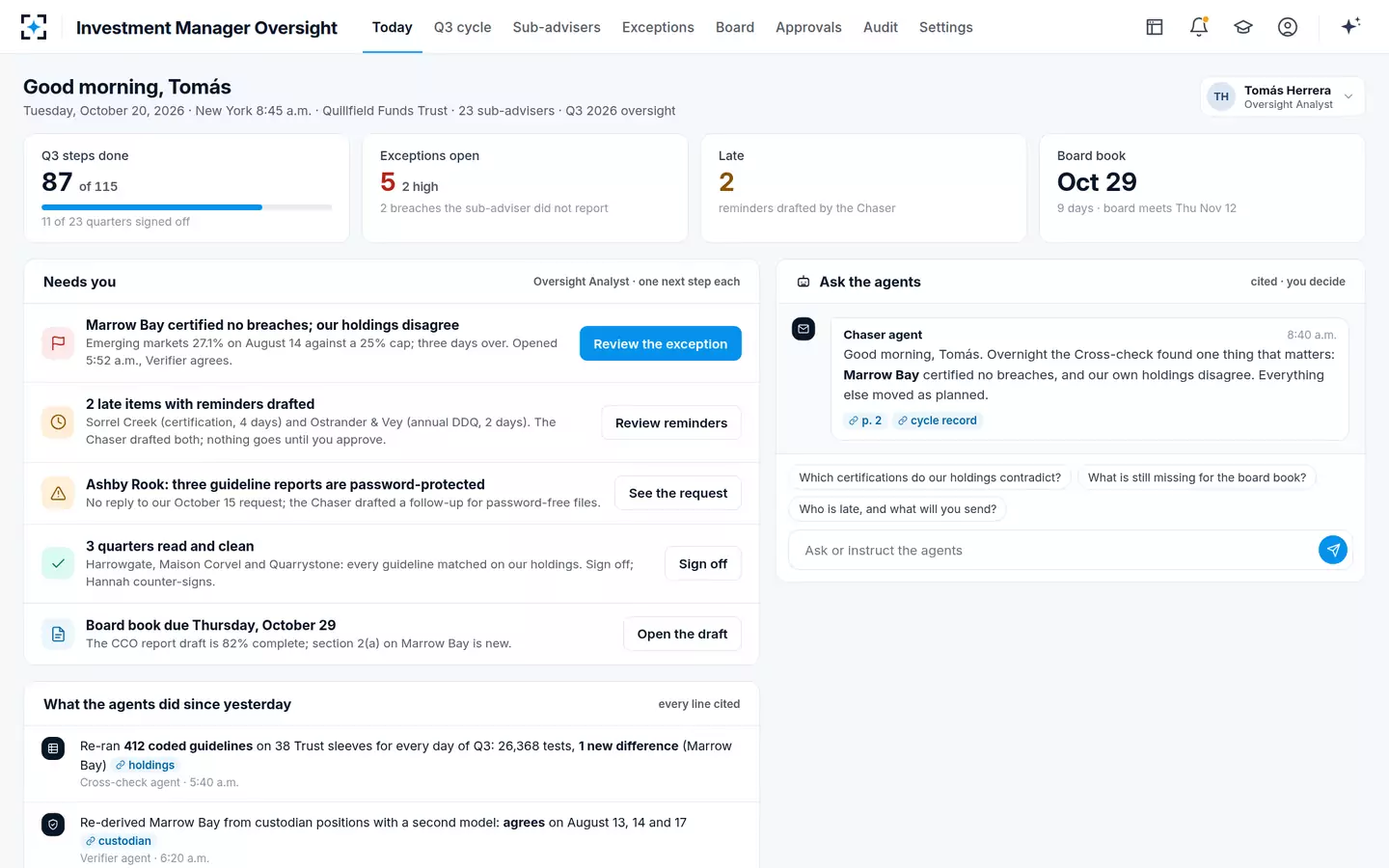
Supervision is evidenced the same way for a sub-adviser hired by vote or by order: requests, reports, tests, exceptions and a report to the board. In the solution's sample, a fictional fund trust with 23 sub-advisers across 38 sleeves, every agreement's guidelines are coded with clause and page and re-tested on the fund's own holdings every business day, so a new sub-adviser's sleeve is tested from its first day rather than its first certificate. How the quarterly compliance certificate is chased and re-tested is set out separately.
The analyst's morning in Investment Manager Oversight: one next step for each open item
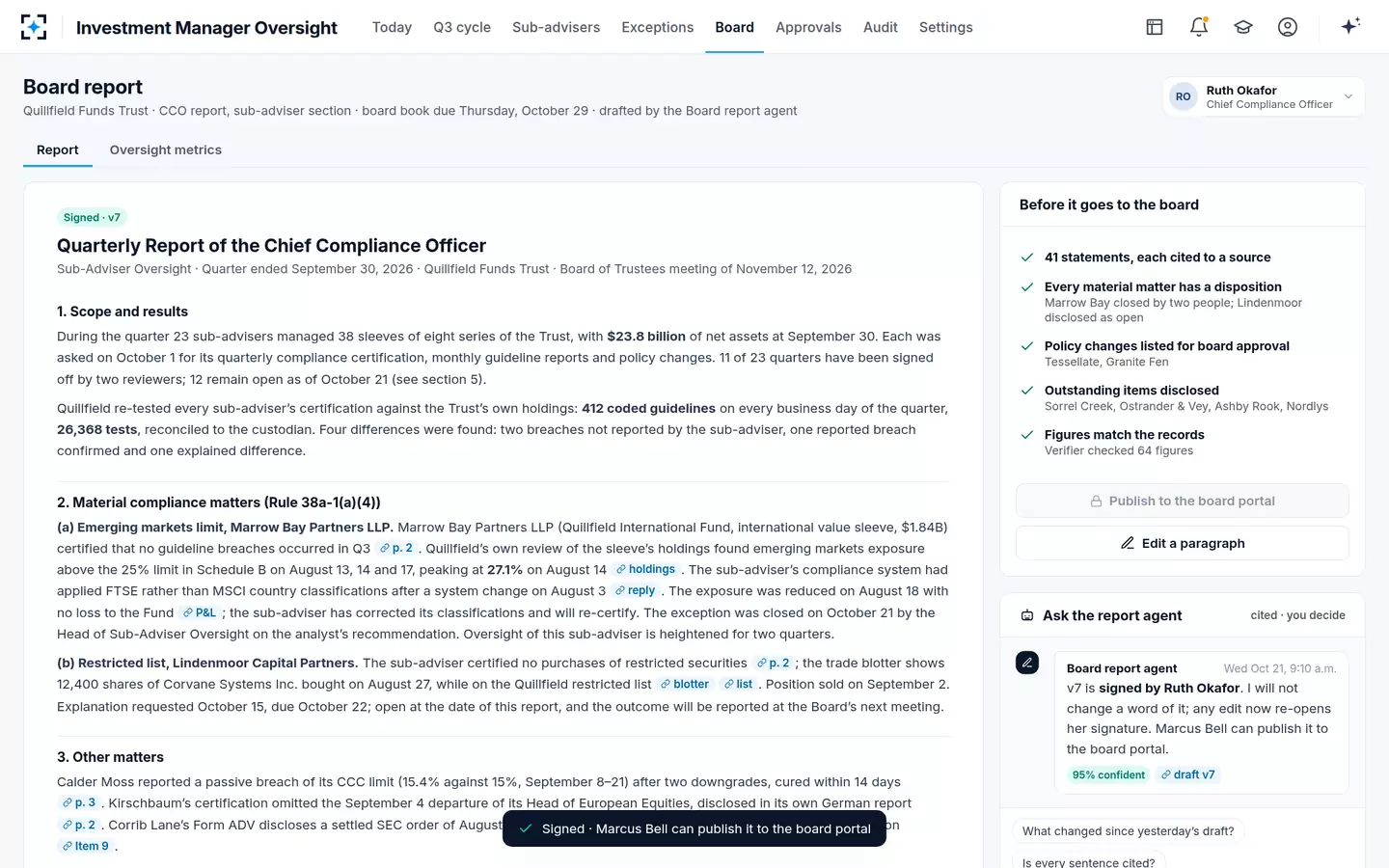
The CCO's section of the board report is where the record comes together. In the sample, it lists scope and results, each material compliance matter with its disposition, other matters, sub-adviser policy changes to report, and outstanding items, and each statement links to its source. A board that has given up a shareholder vote on each hire is entitled to that much.
The CCO's sub-adviser section in Investment Manager Oversight, every statement cited, signed before the board sees it
Botminds' Investment Manager Oversight does not draft exemptive applications, information statements or prospectus language; those belong to fund counsel. It keeps the part of the order's promise that falls to the oversight team, proof that the adviser oversees each sub-adviser, current every business day.
Questions people ask
Is a manager of managers order the same as manager of managers relief?
Yes. "Relief" is the exemption; the "order" is the SEC document that grants it after a notice of application is published in the Federal Register. The notice states that an order "will be issued unless the Commission orders a hearing," so most applications become orders without one.
Does the relief cover affiliated sub-advisers?
Generally not. The SEC's 2003 release called the exclusion of affiliated sub-advisers "a key element of our exemptive orders," because an adviser "may have substantial economic incentives to hire and refrain from discharging" an affiliate. The 2026 GreenFi notice keeps the limit; the same 2003 release records an order that extended relief to wholly-owned sub-advisers of the adviser.
Can the adviser raise fees by changing sub-advisers?
Not without shareholders, under the conditions the SEC described. Its 2003 proposal would have barred any new or modified sub-advisory contract from "directly or indirectly increasing the management fees charged to the fund," preserving the statutory vote on fee increases; a sub-adviser could be paid more if the difference came out of the adviser's fee.
Does the board still renew each sub-advisory contract every year?
Yes. The order removes the shareholder vote on new and amended sub-advisory contracts, not the board's duty under section 15(c) to approve them or the yearly continuance after the first two years. The SEC's 2024 risk alert lists "not timely reviewing advisory and sub-advisory agreements" among board deficiencies.
Was the 2003 manager of managers rule ever adopted?
No. Rule 15a-5 was proposed on October 29, 2003 and does not appear in the Code of Federal Regulations; funds still apply for individual orders, as the February 2026 notice for GreenFi Funds Trust shows. The SEC has said it will examine funds' compliance with the orders they rely on.