A sub-adviser due diligence questionnaire, usually called the DDQ, is the annual set of questions a fund or its adviser sends each sub-adviser about its people, assets, compliance program, regulatory history, operations and controls, and it is one of the main documents a fund's chief compliance officer relies on to oversee that sub-adviser under Rule 38a-1. Its weakness is built in: every answer is written by the firm being overseen. A file is defensible when each material answer sits beside the evidence that confirms or contradicts it: last year's answer, what the sub-adviser has filed with the SEC on Form ADV, and what the fund's own holdings show. Botminds' Investment Manager Oversight reads each questionnaire in its original language, compares every answer with last year's and with Form ADV, and flags each contradiction with the page it came from, so the people deciding work from evidence rather than assurances. An allocator deciding whether to invest uses a different questionnaire, covered in the operational due diligence questionnaire.
The examples come from the solution's sample data, a fictional fund trust with 23 sub-advisers. Rules, forms and findings are the SEC's own, linked where they appear.
One sub-adviser's due diligence questionnaire, mapped from answer to evidence
Key investment personnel
The answer claimsWho runs the money, and whether that changed
Test it againstLast year’s answer; the brochure supplement (Form ADV Part 2B); the quarter’s certification; the sub-adviser’s own reports
What the sample foundHead of European Equities left September 4; the certification said "no material changes." Contradiction.
Regulatory and disciplinary history
The answer claimsThat nothing new happened
Test it againstForm ADV Part 1A Item 11, which must be amended promptly when it becomes inaccurate; SEC orders and releases
What the sample foundOne sub-adviser’s Form ADV disclosed a settled SEC order; reported to the board as an other matter.
Assets under management
The answer claimsSize and capacity
Test it againstForm ADV Item 5 at the last annual amendment; last year’s answer
What the sample found€38.2bn to €40.6bn: a change, not a contradiction.
Guideline compliance in the year
The answer claimsThat the sleeve stayed inside its limits
Test it againstThe fund’s own holdings, tested every business day with the agreement’s definitions
What the sample foundTwo breaches in the quarter that the sub-advisers had not reported.
Compliance program and policy changes
The answer claimsThat the program works and what changed
Test it againstThe adviser’s annual review under Rule 206(4)-7; policy documents received; what the CCO must report under Rule 38a-1(a)(4)
What the sample foundA code of ethics and a valuation policy amended; both listed in the CCO’s report.
What is a sub-adviser due diligence questionnaire for?
It is the fund's yearly structured look at the sub-adviser as a firm, alongside the quarterly look at the sleeve. No rule names it. Rule 38a-1 requires the fund's compliance program to oversee each adviser's compliance and the fund to review each adviser's policies at least once a year (17 CFR 270.38a-1); the questionnaire is how most fund groups gather what that review needs. The sample sends it on the anniversary of each sub-advisory agreement, so the review lands before the board's yearly renewal of that contract.
A sub-adviser questionnaire is not the same document as an allocator's operational due diligence questionnaire, though the sections overlap. The allocator's version asks whether to invest in a manager's fund and leans on the manager's own operations; the fund's version asks whether a manager it already hired is running its sleeve as agreed and must feed a report to a board. The allocator's side has its own guides, on the operational due diligence questionnaire and how to test a review of one and on a checklist that verifies rather than asks, and the two files should share evidence when a firm sits on both lists.
What goes into a sub-adviser due diligence questionnaire?
A sub-adviser questionnaire covers the firm, the people, the process, the controls and what changed, and each section should ask for a document behind the answer where one exists. The table sets out the sections a sub-adviser questionnaire should cover and the evidence that makes each one testable; the right column is what turns a questionnaire from a form into a file.
The sections of a sub-adviser due diligence questionnaire, and the evidence to ask for with each
| Section | What it asks | Evidence to request with it |
|---|---|---|
| Firm and ownership | Legal entity, owners, changes of control, affiliates | Organisation chart; Form ADV Schedules A and B; notice of any transaction that could assign the contract |
| People | Portfolio managers, analysts, compliance staff, departures and arrivals | Brochure supplements (Form ADV Part 2B); the succession plan for each named manager |
| Assets and capacity | Assets in the strategy and the firm; capacity limits | Form ADV Item 5 figures; the firm’s capacity policy |
| Investment process | How decisions are made, models used, risk limits | Model validation records; the process as written, not as marketed |
| Compliance program | The CCO, policies, the last annual review and its findings | Summary of the last Rule 206(4)-7 annual review and the corrective actions taken |
| Regulatory history | Examinations, deficiency letters, actions, litigation | Form ADV Item 11 answers; SEC orders; the response to the last exam letter |
| Trading and operations | Allocation, best execution, trade errors, reconciliations | Trade error log for the sleeve; allocation policy |
| Valuation | Pricing sources, overrides, fair value process | Override and stale-price reports for the fund’s holdings |
| Continuity and cybersecurity | Business continuity, incidents, vendor dependencies | Test results; incident history; the last independent assessment |
| Changes since last year | Material changes to policies, people, systems and ownership | The changed policy text, dated, so the fund’s CCO can report it |
Two sections deserve more weight than templates usually give them. The investment process section should ask how models are validated, because the SEC's 2018 case against four Transamerica entities turned on a sub-adviser that sold model-driven strategies without first checking that the models worked (SEC order IA-4997; how that failure travelled up to the adviser). And the changes section should ask for text, not a yes or no, because the fund's CCO must report material changes to each adviser's policies to the board, and cannot report a change described only as a minor update.
How do you verify a DDQ answer?
You verify an answer by finding a source the sub-adviser did not write for you, or one it wrote under a legal duty, and comparing. Three sources do most of the work. Last year's questionnaire turns every answer into a change or a non-change, which is where contradictions surface. Form ADV is the sub-adviser's own filing with the SEC, made under rules that set when it must be updated. And the fund's own holdings and trades, reconciled to its custodian, test every claim about compliance with the guidelines.
The evidence that questionnaires need checking is old and consistent. A peer-reviewed study of 444 due diligence reports from a hedge fund diligence firm found misrepresentation about past legal and regulatory problems in about one report in five, and incorrect or unverifiable statements on other topics in more than a quarter (Brown, Goetzmann, Liang and Schwarz, Journal of Financial Economics, 2012; NBER working paper 15529). The SEC's examiners make the same point about funds' oversight from the other side: they found funds that never checked their advisers' and sub-advisers' policies for consistency with the contracts and with what the providers had represented (risk alert, November 4, 2024). A representation is what the questionnaire collects; consistency is what the file must show.
What changed since last year's DDQ?
The most productive single test is the year-on-year comparison, because a sub-adviser rarely contradicts itself on purpose and often does so by omission. In the sample, the solution's Change-watch agent compared 284 answers in one German sub-adviser's 2026 questionnaire with its 2025 answers and its Form ADV. Two had changed. One was assets under management, a change with no contradiction. The other was key investment personnel: the 2025 lead manager, the Head of European Equities, had left on September 4, 2026, and his successor was named.
This year's questionnaire against last year's and Form ADV, in Investment Manager Oversight
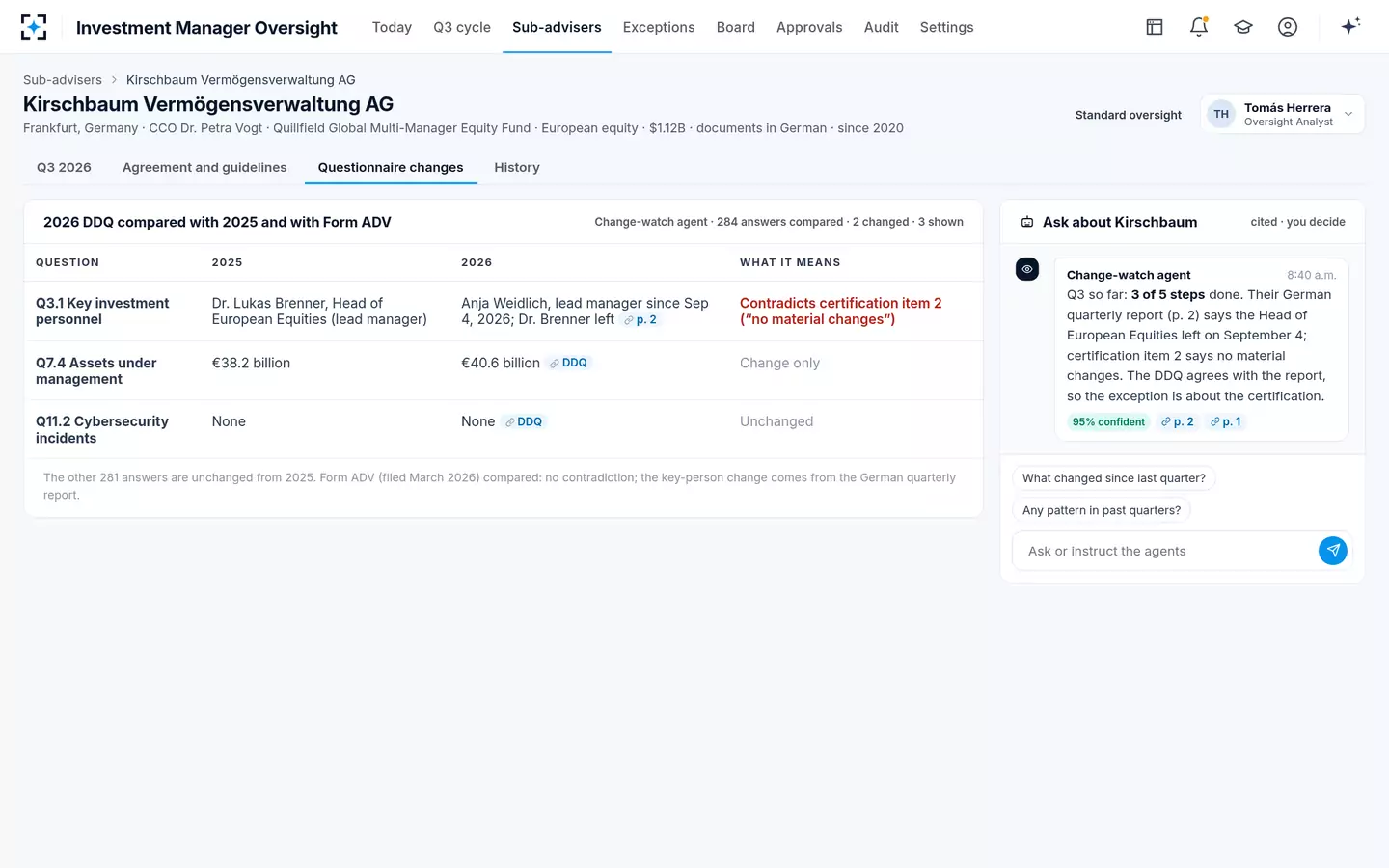
The contradiction was not in the questionnaire. It was between two documents the same firm signed: the questionnaire, which disclosed the departure, and the quarterly certification, which said there had been "no material changes." Neither document, read alone, looked wrong. Only the comparison showed that one of them was. The finding went into the CCO's report as an other matter.
Form ADV: what the sub-adviser has already told the SEC
Form ADV is the strongest outside check on a questionnaire, because the sub-adviser files it under rules that set deadlines for updating it. The SEC's instructions require an annual updating amendment "within 90 days after the end of your fiscal year" and, between annual amendments, prompt amendments when certain items change (Form ADV General Instructions). The SEC publishes monthly files of registered advisers' Form ADV data, which it describes as "a subset of the information" filed (SEC, Information about Registered Investment Advisers).
When a sub-adviser must update Form ADV, and which questionnaire answers each update tests
| Form ADV content | When it must be updated | Questionnaire answers it tests |
|---|---|---|
| All items in Parts 1A and 2, including Schedule D | Annual updating amendment within 90 days after fiscal year end | Assets under management (Item 5), financial industry affiliations (Item 7), private funds advised (Schedule D) |
| Part 1A Items 1, 3, 9 and 11 (identity, form of organization, custody, disciplinary history) | Promptly, if the information "becomes inaccurate in any way" | Regulatory and disciplinary history; ownership and structure |
| Part 1A Items 4, 8 and 10 (successions, participation in client transactions, control persons) | Promptly, if the information becomes "materially inaccurate" | Changes of control, conflicts in trading, who owns the firm |
| Part 2A brochure | Promptly, if materially inaccurate; summary of material changes each year | Strategy, fees, conflicts, disciplinary information |
| Part 2B brochure supplements (the people) | Promptly, "if any information in them becomes materially inaccurate" | Key investment personnel |
The table also shows where Form ADV cannot help. A questionnaire filed in October and a Form ADV last amended in March can disagree legitimately; a key person who left in September may not yet be in a brochure supplement. The comparison is therefore a list of questions, not a verdict: a mismatch is either a filing the sub-adviser owes, an answer it should correct, or a timing difference it can explain, and the file should say which.
Testing the compliance answers on the fund's own holdings
Every questionnaire asks some version of "were there any breaches of the investment guidelines this year?" The defensible answer is not the sub-adviser's. It is the fund's own test of the sleeve against the agreement's guidelines, with the agreement's definitions, on every business day. In the sample, the solution re-ran 412 guidelines coded from 23 agreements on 64 business days, 26,368 tests, against holdings from portfolio accounting reconciled to the custodian. It found four differences between what sub-advisers reported and what the holdings showed.
Cross-checks in Investment Manager Oversight: what each sub-adviser reported, beside the fund's own holdings
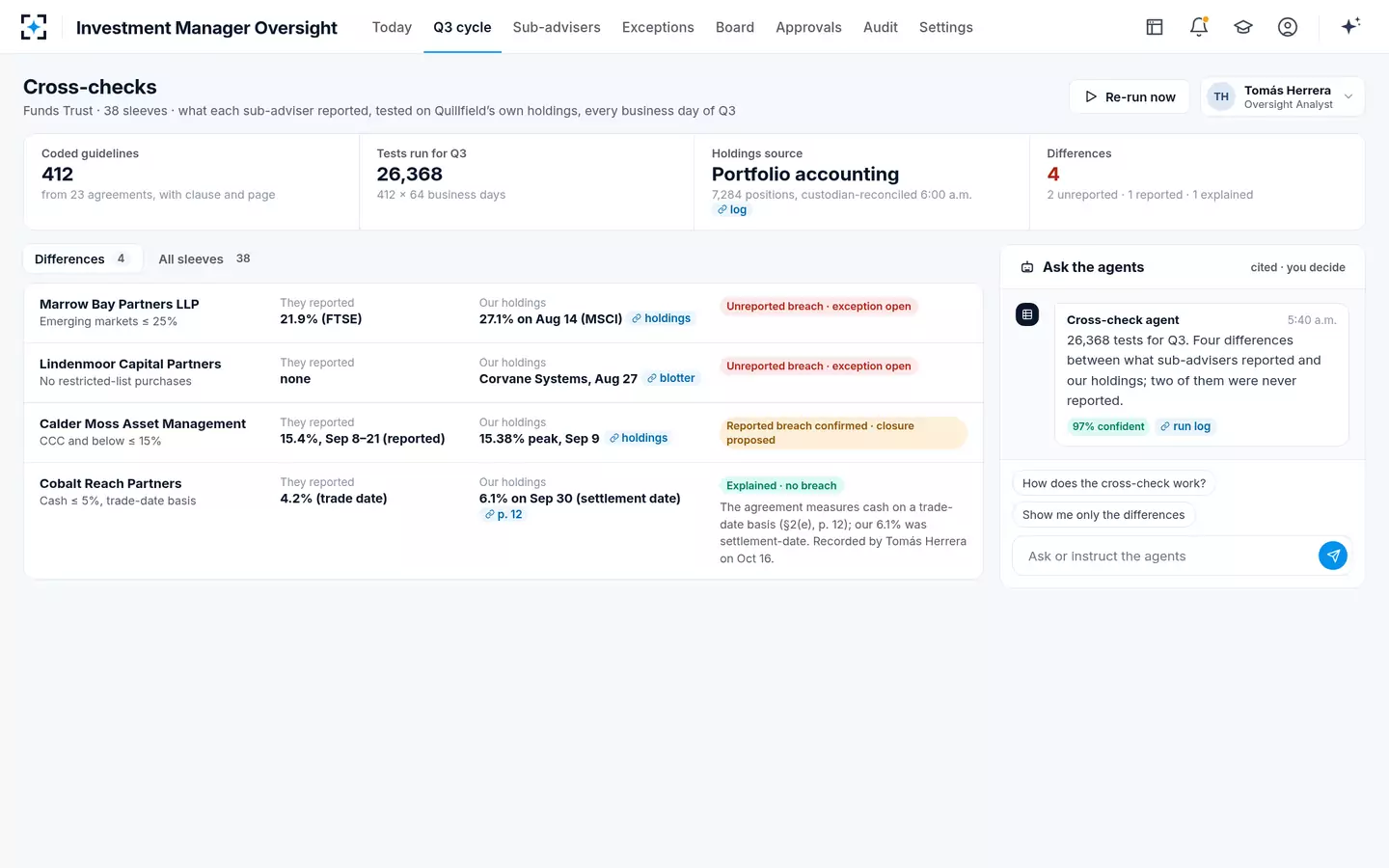
The fourth row is the reason the file needs the agreement as well as the holdings. The fund's first figure for one sub-adviser's cash was 6.1%, over a 5% cap; the agreement measures cash on a trade-date basis, where the sub-adviser's 4.2% was right. A test that ignores the agreement's own definitions generates false breaches as readily as it finds real ones, and a file full of explained false alarms is not much more defensible than one with no tests at all.
A questionnaire filed, and a file that would hold up
Filed: This year’s answer, read and initialled.
Defensible: This year’s answer against last year’s, the brochure supplement and the quarter’s certification, with each difference resolved.
Filed: "None" accepted.
Defensible: "None" checked against Form ADV Item 11 and SEC orders, with the date of the filing compared.
Filed: The sub-adviser’s statement that there were none.
Defensible: The fund’s own daily test, the agreement clause behind each guideline, and every difference closed by two people.
Filed: Attachments saved to a folder.
Defensible: Each change listed, with what it changes, and carried into the CCO’s report as Rule 38a-1(a)(4) requires.
Filed: Whatever an analyst could read.
Defensible: Every answer quoted from the original language, with the page, beside a translation.
Filed: One reviewer.
Defensible: A maker and a checker, each with a reason recorded.
The investment manager due diligence process, from questionnaire to board report
The questionnaire is one step in a yearly cycle that ends in the CCO's report, and each step has an owner. In the solution's sample the agents do the sending, reading and comparing; people decide what a contradiction means and sign.
One sub-adviser's annual questionnaire through Investment Manager Oversight
Agent
Chaser agentSends the questionnaire on the anniversary of the sub-advisory agreement, from an approved template, and drafts reminders if it is late.
Never: sends without approval or moves the due date
Agent
Reader agentReads the answers and attachments in their original language and quotes each answer with its page.
Never: takes a figure from the translation
Agent
Change-watch agentCompares every answer with last year’s and with Form ADV and regulatory filings, and lists contradictions and policy changes.
Never: rates the sub-adviser
A person decides
Relationship manager and analystDecide what each contradiction means, ask the sub-adviser to correct or explain, and record the outcome with a reason.
A person decides
Head of sub-adviser oversightChecks the same evidence and signs off the sub-adviser’s year.
Agent
Board report agentCarries changes and findings into the CCO’s draft, each statement cited.
Never: signs or publishes
A person decides
Chief compliance officerSigns the report; any edit after signing re-opens the signature.
What will an examiner ask for in sub-adviser due diligence?
An examiner asks to see the diligence and the follow-through, not the blank questionnaire. The SEC's typical first request to a fund asks for its diligence on and oversight of service providers, the CCO's annual reviews and reports, the fund's compliance risk inventories, testing and exception reports, and, under board governance, "Information regarding service provider relationships and related information provided to the board" (risk alert attachment, November 4, 2024; the rest of the list, and who assembles it). A file that holds the questionnaire, the comparisons, the tests and the resolutions answers all four from one place.
The adopting release of Rule 38a-1 also sets the standard a file will be judged against. The CCO should take steps to satisfy herself that each service provider's compliance policies are effective and run by competent people (68 FR 74714). Competent people is exactly what a key-person answer is about, and assuring oneself is more than receiving an assurance. What else Rule 38a-1 expects of the CCO is set out in full elsewhere.
An investment manager due diligence checklist for each sub-adviser's file
- The questionnaire as received, in its original language
With the date it arrived and the version of the template it answers.
- Every answer compared with last year’s
Changes listed; unchanged answers confirmed as unchanged, not skipped.
- Personnel, ownership and disciplinary answers compared with Form ADV
Including the brochure supplements, with the filing date beside the answer date.
- Compliance answers compared with the fund’s own tests
Guideline breaches, restricted-list purchases and trade errors, from holdings and the blotter.
- Contradictions resolved, each with its source
An answer corrected, a filing owed, or a timing difference explained, and who decided.
- Policy and people changes carried forward
Into the CCO’s report and, where the fund’s policy says so, to the board.
- A second reviewer
Who checks the same evidence and records a reason.
Botminds' Investment Manager Oversight does the reading and comparing: the Reader quotes every answer with its page in the original language, the Change-watch agent compares answers with last year's and with Form ADV and flags contradictions, and the Cross-check agent tests the compliance answers on the fund's own holdings. It never rates a sub-adviser; the analyst decides what each finding means and a second person checks. The analyst's quarter shows where this fits in the calendar.
Questions people ask
How often should a sub-adviser DDQ be sent?
No rule sets a frequency. Yearly fits the rule's rhythm, because Rule 38a-1 requires the fund to review each adviser's policies at least annually and the board renews each sub-advisory contract yearly after the first two years. In the solution's sample, the questionnaire goes out on the anniversary of each agreement, with a lighter quarterly certification in between.
Can a fund accept a sub-adviser's standard industry questionnaire?
As a base, yes; as the whole file, no. Standard templates describe the firm, but not the fund's own agreement, guidelines and definitions, so a fund-specific supplement should ask how the sub-adviser measures each guideline and which classification, rating and pricing sources its systems apply.
Is an asset manager due diligence questionnaire the same as a sub-adviser DDQ?
The questions overlap, but the purpose differs. An asset manager questionnaire used in manager selection supports a decision to hire; a sub-adviser questionnaire supports ongoing oversight of a manager already hired and feeds the CCO's report to the fund board.
Can a sub-adviser's DDQ answers be in another language?
Often they are, along with its reports. In the solution, the Reader shows the original page beside an English rendering and takes every figure from the original, never from the translation; a second model renders the page again and compares figure by figure.
Should a contradiction between a DDQ and a certification go to the board?
It goes into the CCO's report if the fund's materiality policy says so. Rule 38a-1 requires the report to address each material compliance matter, defined to include a violation of the adviser's policies or "a weakness in the design or implementation" of them; in the sample, the key-person omission was reported as an other matter.