An operational due diligence questionnaire, or DDQ, is the long set of questions a fund manager answers about how it runs the fund: its structure and service providers, custody and cash controls, valuation, compliance, people, technology and continuity. The industry versions are the AIMA questionnaire for hedge funds and the ILPA questionnaire for private equity, and many allocators add their own. Every answer in it is a claim, and research on third-party reviews shows a meaningful share of them are wrong: in 444 hedge fund due diligence reports, the checker found misrepresentation of past legal and regulatory problems at 21% of funds and incorrect or unverifiable statements on other topics at 28% (Brown, Goetzmann, Liang and Schwarz, NBER working paper 15529). So the question for a head of ODD is not whether a review reads the questionnaire but how many of its wrong answers the review catches. The way to find out is to plant known errors in past files and count. This page sets out that test, the errors worth planting and how to score it, with Botminds' Operational Due Diligence as the worked example. A fund's annual questionnaire to a sub-adviser it already employs is a different document, covered in the sub-adviser due diligence questionnaire.
Examples from the solution use its fictional sample data, an allocator called Quillfield Capital and its approved managers. The test design is our method; nothing on this page is a measured result from a customer.
How often each kind of manager error turned up in 444 due diligence reports
What is an operational due diligence questionnaire?
It is the manager's written account of its own operations, answered once and then reused for many allocators. A full DDQ covers the firm and its ownership, the fund structure and every service provider, how assets are held and cash is moved, how positions are valued and by whom, compliance and regulatory history, key people, trading and allocation, information security and business continuity. The AIMA questionnaire is the common starting point for hedge funds, the ILPA questionnaire for private equity; an allocator's own questionnaire usually adds the questions its house standard needs.
Reuse is what makes it efficient for managers and risky for allocators. An answer written for one allocator in January is often sent unchanged to the next in August. If an administrator changed in March, or a principal left in May, the questionnaire says so only if someone remembered to update it. In the sample, the fictional Fernhill Macro Fund's questionnaire, dated August 14, still said no service provider had changed in three years, five months after its administrator had.
How often are DDQ answers wrong?
Often enough that a review which only reads them is unreliable. Brown, Goetzmann, Liang and Schwarz sorted the managers by how forthcoming they were about past legal and regulatory problems. In 6% of cases the manager disclosed a problem and the checker found more; in 9% the manager disclosed none and the checker found some; 23% disclosed everything there was to disclose. The authors' summary is blunt: "It is remarkable that 15% of funds intentionally or unintentionally misstated material facts to the DD company even when they knew that the company was hired to verify this information" (NBER working paper 15529).
What a questionnaire alone would have missed
15%
of funds misstated material facts to a checker they knew would verify them
10%
looked clean on their own disclosures and questionnaires, but had legal or regulatory problems
41%
of funds in the sample had some legal or regulatory problem
The second figure is the one that matters for the questionnaire itself. The authors found that "10% of funds would have been classified as non-problem funds based on the information disclosed voluntarily to the DD company and through any precompiled due diligence questionnaires, but were found to be problem funds after background checks by the DD company." One fund in ten looked clean on paper and was not. A review that stops at the questionnaire passes them.
Regulators see the same pattern from the other side. SEC examiners found private fund advisers that "did not value client assets in accordance with their valuation processes or in accordance with disclosures to clients" (SEC OCIE risk alert, June 23, 2020). A questionnaire answer about valuation is a disclosure; whether practice matches it is a separate fact.
The seeded-error test: plant contradictions in past files and count the catches
The only way to know what a review catches is to give it errors you already know about. Take a set of closed reviews whose answers you trust. In a copy of each file, plant one or two contradictions of known types between the questionnaire and the documents that should expose them. Then run the review process (your analysts, an outside firm, or software) over the altered files and the untouched ones, and record what it finds.
Four rules keep the test honest. Plant errors the way real ones occur: in the evidence, not in a highlighted paragraph. Mix altered and untouched files so the reviewer cannot assume every file has a problem. Keep the answer key with someone outside the review. And count three things: errors caught, false alarms raised on clean files, and how long each catch took. A process that catches every planted error but flags half the clean files is not finished either.
Operational Due Diligence already runs a related test whenever an agent changes: in the sample configuration, every proposed new version or threshold runs on 40 past signed reviews and its differences go to the Head of ODD before anything changes. Seeding known errors into those 40 files turns a comparison into a measure, and it is the test we would propose for any pilot.
Which errors to plant, and where
Plant the errors that real reviews find, in the places they hide. The table pairs each with the document that should expose it and what a catch looks like.
Contradictions worth planting in a past review, and what counts as a catch
| Planted error | Where to plant it | What a catch looks like |
|---|---|---|
| Service provider changed, questionnaire not updated | A note in the audited accounts naming a new administrator from a mid-year date | Contradiction raised on the administrator, citing the note and the questionnaire answer |
| Key person departed | A regulator’s register showing the person no longer approved; questionnaire still lists them | Finding or observation on key people, citing the register |
| Valuation practice differs from the questionnaire | A valuation policy clause letting the portfolio manager override prices without prior approval | Policy contradiction against the questionnaire’s valuation answer |
| Undisclosed regulatory history | An enforcement record for a principal, with the disclosure section answered “none” | Contradiction on regulatory history, citing the record |
| Signing mandate differs | The administrator’s description of cash signatures not matching the questionnaire | Contradiction on cash controls |
| Stale test dates | A continuity test record older than the date the questionnaire gives | Observation citing both dates |
| Wrong controls report | A SOC 1 report in the data room for a provider the fund has left | Flag that the report does not cover the current provider |
| Auditor not as stated | Audited statements signed by a firm other than the one the questionnaire names | Contradiction on the auditor, with a confirmation proposed |
Weight the mix toward what is common. The research says statements that turn out incorrect or unverifiable and undisclosed legal or regulatory history are the most frequent problems, so a test set of 40 files with a dozen planted errors should carry several of each, plus at least one provider change and one valuation contradiction, the two that most often change a rating.
How to score the test: catches, false alarms and time
Score it like any detection test. The catch rate is planted errors found divided by planted errors. The false-alarm rate is clean files flagged divided by clean files. Time to catch is how long after the file opened the contradiction was raised. A third number is often forgotten: whether the catch cited the right document. A reviewer who flags the administrator for the wrong reason has been lucky, not right.
Caught or missed: how to mark a seeded-error test
Counts as missed: Administrator marked verified from the questionnaire and Form ADV
Counts as caught: Contradiction raised, citing the audited note and the provider’s reply
Counts as missed: Policy summarised without comparing it with the questionnaire
Counts as caught: Policy clause cited against the questionnaire’s answer
Counts as missed: Biography accepted from the pitch book
Counts as caught: Register checked; departure raised with the date
Counts as missed: Report noted as received
Counts as caught: Report flagged as covering a former provider
Counts as missed: A finding with no support in the documents (a false alarm)
Counts as caught: No finding, or only observations the evidence supports
Run the same test on the current process before buying anything. If a team of analysts catches seven of twelve planted errors in a quarter of the files, that is the bar a tool or an outside firm must beat, on the same files, under the same rules.
What is a DDQ red flag?
A red flag is an answer that cannot be reconciled with an outside source, or a refusal to let anyone try. The research gives a ranked list. In the Brown study, 14% of funds or their administrators "refused to answer DD company questions"; 11% had "switched a major data vendor in the last 3 years", which the authors note "may also be a red flag as the fund may have been dropped by the vendor due to data inconsistency"; and managers whose questionnaire said one thing and whose administrator said another appear throughout.
Questionnaire answers that should send an analyst to a second source
- No service provider changed in three years
Check two years of audited notes; changes are disclosed there.
- An answer the administrator will not confirm
A refusal from the provider is itself a finding.
- A recent change of data vendor, pricing source or auditor
Ask why, and ask the former provider.
- Dates that do not match
A test, a policy version or an appointment dated differently in two documents.
- Disclosure sections answered “none”
Search the regulators’ records for the firm and each principal.
- Valuation described in the questionnaire, not in the policy
Read the policy clause that decides who has the last word.
Patterns no single questionnaire shows
Some errors are only visible across managers. When one administrator loses several clients in a year, every manager it serviced deserves a look, and a questionnaire answered by one of them will not say so. In the sample, the Monitoring agent noticed that Calder Fund Services had administered 23 approved managers in January and that three had moved away this year, as had Fernhill under initial review; two of them, Fernhill and Saltmarsh, had not told the allocator. Saltmarsh's change on May 1 was not in its August questionnaire update.
One provider, every manager that uses it: a pattern across questionnaires
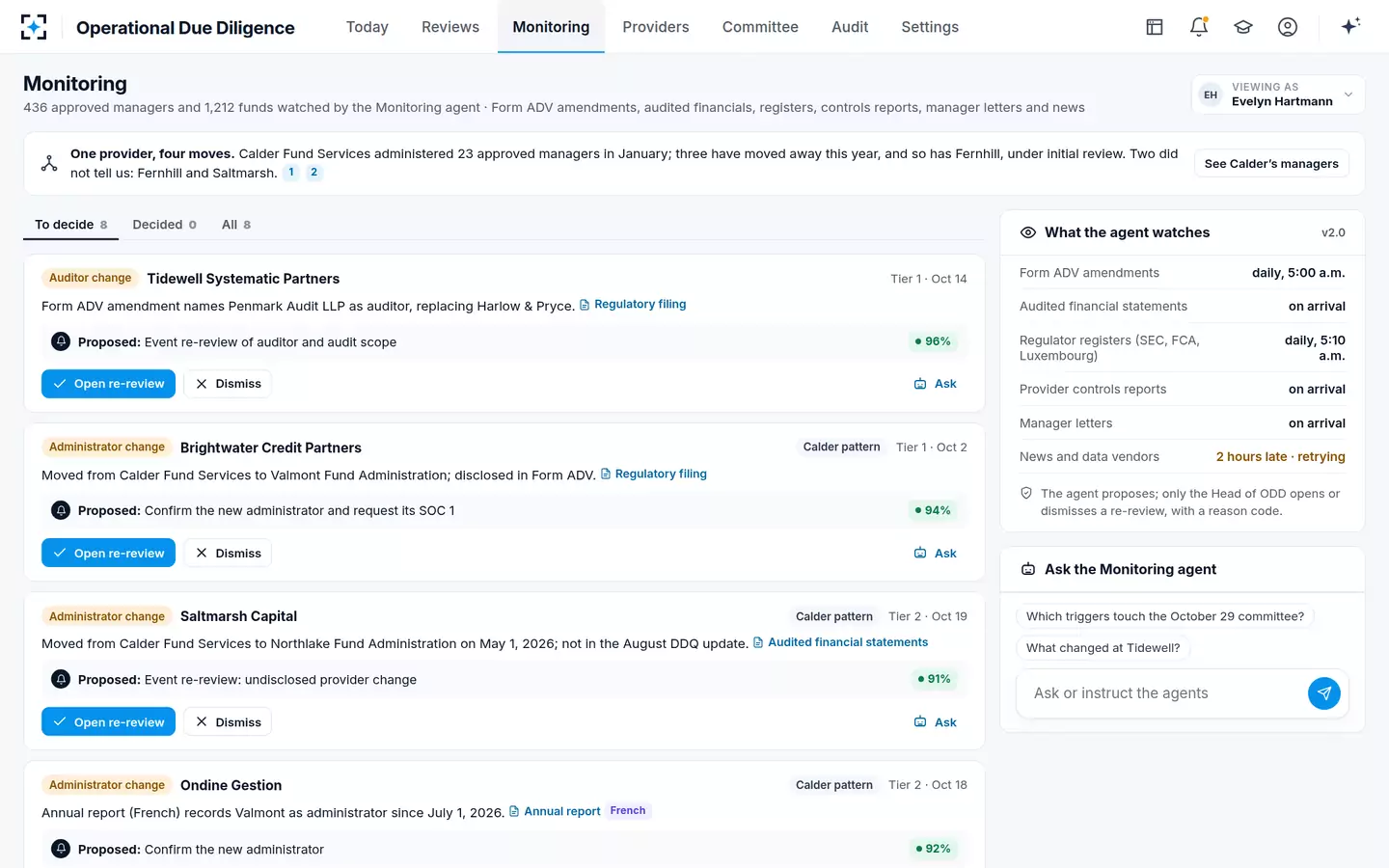
A seeded test can include this too: plant the same provider change in three files from different managers and see whether the review connects them. The verification-first checklist lists the source that exposes each kind of error; the limits on what the agents may decide explain why a pattern becomes a proposal, not a review opened automatically.
Due diligence questionnaire template: what to add so answers can be checked
A questionnaire template can make checking easier. For every answer that names a provider, a person or a date, ask the manager for the evidence pointer as well: the provider's legal entity and regulator reference, the date the appointment began, the page of the audited accounts that records it, and consent for the allocator to contact the provider directly. Ask for the date each section was last updated, not just the date the document was signed.
None of that makes the answers true. It makes them testable, which is what lets an analyst, an outside firm or an agent check the questionnaire against something the manager does not control. To run a seeded-error test on your own closed reviews, start from Operational Due Diligence.
Questions people ask
What is the AIMA operational due diligence questionnaire?
It is the standard due diligence questionnaire published by AIMA, the hedge fund industry association, which managers complete once and share with many investors. It covers the firm, the fund, service providers, operations, compliance and technology. It standardises the questions; it does not verify the answers.
What is the difference between a DDQ and an ODD review?
The DDQ is the manager's account; the ODD review is the allocator's test of it. A review reads the questionnaire, then checks its answers against audited accounts, service providers' own replies and regulators' registers, and records where they agree and where they do not.
How often should a manager update its due diligence questionnaire?
At least annually and whenever something material changes, such as a service provider, a key person or a policy. Because managers reuse questionnaires across investors, an allocator should check the date each section was last updated and test the answers most likely to go stale.
How many planted errors does a useful test need?
Enough to see a rate, not an anecdote: for example a dozen planted contradictions across 40 closed files, mixed with untouched files so false alarms can be counted. The 40-file size matches the set of past signed reviews the sample allocator uses to test every new agent version.
Can a manager refuse to answer DDQ questions?
It can, and a refusal is information. In the Brown study, 14% of funds or their administrators refused to answer some of the due diligence firm's questions. An unanswered question should appear in the report as such, not be filled from the manager's marketing material.