The hedge fund fraud cases that matter most to an allocator are the ones where the evidence was available and nobody checked it. Bernard Madoff's Ponzi scheme survived for years although, as the SEC's inspector general found, the agency never verified his trading through an independent third party. The Bayou funds produced audited financial statements for years from an accounting firm their own chief financial officer had set up. Allianz Global Investors' Structured Alpha strategy sent institutional investors risk reports whose loss figures had been altered by hand. Each case failed at a specific, ordinary check: confirm the trades or holdings with the custodian, confirm the auditor exists and is independent, get the numbers from a source other than the manager. Those are the checks an operational due diligence review exists to run. This casebook takes each case from the regulator's own record, sets out what was claimed and what was true, and names the check. Botminds' Operational Due Diligence is built around those checks: its agents test each manager claim against a source the manager does not control, and nothing is sent, signed or funded until a person approves it.
The case facts come from SEC orders, press releases and inspector-general reports, and from peer-reviewed research, linked where they appear. The solution's examples use fictional sample data.
Three cases in the SEC's own records
6
substantive complaints about Madoff the SEC received between 1992 and 2008
$400million+
Bayou attracted from investors while reporting modest, steady profits
114
institutional investors sold Allianz Structured Alpha, including pension funds
Hedge fund frauds list: three cases in the regulators' own records
The cases below are chosen because the regulator's own documents show exactly where the check failed, not because they are the only ones. Read each row as a test an allocator can run on any manager today.
Three hedge fund fraud cases: what was claimed, what was true, and the ODD check that catches it
| Case | What investors were told | What was true | The check that catches it |
|---|---|---|---|
| Madoff (exposed December 2008) | Consistent returns from a basic strategy, with trades executed and assets held through his firm | No independent party had verified the trading; his auditor, a related party, had done no audit work | Confirm holdings and trades with the custodian or clearing firm directly; confirm the auditor’s independence and engagement |
| Bayou (collapsed August 2005) | Modest, steady profits, with annual financial statements carrying an independent audit opinion | The fund lost money from trading; the audit firm was a sham set up by its own chief financial officer | Confirm the auditor exists, is registered and actually did the audit; search public records for links to the manager |
| Allianz Structured Alpha (charged May 2022) | Risk reports showing modest losses under crash scenarios | The portfolio managers had altered the reports; the strategy lost billions in March 2020 | Get risk and performance data from a source the portfolio managers do not control, and reconcile it |
What red flags did Madoff show?
Many, and they were written down. The SEC's inspector general found that between June 1992 and December 2008 the agency received six substantive complaints raising significant red flags about Madoff's hedge fund operations. One, from a hedge fund manager who had done due diligence on two Madoff feeder funds, listed concerns including that the strategy "was not duplicable by anyone else", that returns had no correlation to the equity markets, that accounts were typically in cash at month end, and that "the auditor of the firm was a related party to the principal" (SEC OIG, Report OIG-509, executive summary, August 31, 2009).
The checks that would have settled it were independent confirmations, and the record shows each one going wrong in a different way. Examiners sought records from the Depository Trust Company, an independent third party, but "sought copies of such records from Madoff himself." One request did reach a financial institution Madoff said cleared his trades; it replied that there was no transaction activity in his account for the period, and "the response did not raise a red flag for the Assistant Director", who assumed the trades had gone through a foreign broker-dealer.
"Had they sought records from DTC, there is an excellent chance that they would have uncovered Madoff's Ponzi scheme in 1992."
SEC Office of Inspector General, Report OIG-509 (2009)
The auditor allegation was never examined either. After the confession, a staff attorney assigned to investigate Madoff's accountant, David Friehling, "within a few hours of obtaining the work papers, he determined that no audit work had been done." For an ODD review the lessons are three: request confirmations from the custodian or clearing firm yourself, never through the manager; reconcile every reply, especially one that says nothing happened; and treat a small, related or unknown auditor as a finding to resolve, not a footnote.
What was the Bayou hedge fund fraud?
Bayou was a Connecticut hedge fund group whose principals invented its performance and its audits. According to the SEC's findings, the fund lost money from trading almost from the start; by 1997 its principals were fabricating performance in account statements, newsletters and year-end financial statements; and in 1998, "realizing that the funds could not withstand an independent audit", they dismissed the fund's auditor and the chief financial officer, Daniel Marino, wrote "independent" audited statements and an opinion letter on the stationery of a firm called Richmond-Fairfield Associates (SEC, Advisers Act Release No. 2871, April 22, 2009). Bayou attracted over $400 million before it collapsed in August 2005, issuing redemption checks from overdrawn accounts.
The deception was checkable from public records. The same SEC order notes that "Marino was listed as Richmond-Fairfield’s registered agent in New York State public records", and that state accountancy board records showed the firm registered in October 2000 under Marino's name and personal address. Bayou also told one due diligence consultant three different stories about who its auditor was. The consultant reviewed the audited statements each year, noticed the discrepancy, and never contacted any of the named firms; what that case teaches buyers of outsourced due diligence is set out in its own guide.
The ODD check is short. Confirm the auditor with the auditor, at an address found independently. Check that the firm is registered and, where it applies, subject to inspection; Form ADV asks advisers to state both for each private fund. And search public records for any link between the auditor and the manager's people. What a manager's Form ADV says about its auditor is the place to start.
What happened with Allianz Structured Alpha?
Allianz Global Investors U.S. sold an options strategy called Structured Alpha to about 114 institutional investors, including pension funds for teachers, clergy, bus drivers and engineers. In May 2022 the SEC charged the firm and three former portfolio managers with concealing the strategy's downside risks; the strategy lost billions after the March 2020 market crash (SEC press release 2022-84, May 17, 2022).
The method was the risk report itself. According to the SEC, "Defendants reduced losses under a market crash scenario in one risk report sent to investors from negative 42.1505489755747% to negative 4.1505489755747% -- by simply dropping the single digit 2." In another case they cut a one-day loss "from negative 18.2607085709004% to negative 9.2607085709004% -- this time by cutting the number 18 in half." The firm admitted its conduct violated the securities laws and agreed to pay more than $1 billion to settle the SEC's charges, including a $675 million civil penalty; with its parent it agreed to over $5 billion in restitution to victims.
For operational due diligence the lesson is about where numbers come from. A risk or performance report produced by the portfolio managers, however detailed, is the manager's claim. The checks are to obtain the same figures from a party the portfolio managers do not control, such as the administrator or an independent risk function, at dates the allocator chooses, and to reconcile them; and to ask who can edit a report between the system that calculates it and the investor who receives it.
How do fund valuation failures happen?
Usually quietly, through the hard-to-value book and the fees calculated on it. SEC examiners have reported private fund advisers whose failure to value holdings as disclosed "led to overcharging management fees and carried interest because such fees were based on inappropriately overvalued holdings" (SEC OCIE risk alert, June 23, 2020). The incentive runs one way: a higher mark raises the fee, flatters the track record and discourages redemptions.
The ODD check is to find out who sets the prices that do not come from a market, who can override them, and who finds out when they do. That question has its own guide: the hedge fund valuation policy review works through it, including an SEC case where a fund founder manipulated a third-party pricing service.
What the cases share: unknown auditors, self-reported numbers, unreconciled replies
Read together, the cases describe one weakness: numbers and documents that came from the manager were treated as if they came from someone else. Academic work on hedge fund operational risk points the same way. Brown, Goetzmann, Liang and Schwarz, studying 444 due diligence reports, observe that "Major fraud cases, such as Bayou and Madoff, involved smaller, unknown auditors" (NBER working paper 15529). Bollen and Pool, studying hedge funds later charged by regulators, found that "funds charged with misappropriation, overvaluation, misrepresentation, or Ponzi schemes trigger the performance flags at a higher frequency than other funds", flags built from suspicious patterns in reported returns (Review of Financial Studies, 2012).
Return patterns are a signal for a closer look, not proof; Madoff's own red flags included returns that were too smooth. The proof comes from the confirmations. That is why the cases translate into a short list of checks rather than a long list of warning signs.
Where each case's check failed, and how an ODD review runs it
What happened: Depository records were requested from Madoff himself.
The ODD check: Confirm holdings and trades with the custodian or clearing firm directly, at an address from a register.
What happened: A clearing firm said there was no activity; nobody followed up.
The ODD check: Reconcile every reply to the claim it tests; an empty reply is a contradiction.
What happened: An opinion letter on unknown stationery was accepted.
The ODD check: Confirm the engagement with the audit firm; check its registration and public records.
What happened: Three different auditor names over two years went unreconciled.
The ODD check: Every contradiction stays open until an independent source settles it.
What happened: Risk reports came from the people whose risk they described.
The ODD check: Obtain risk and performance figures from a party the portfolio managers do not control.
What could operational due diligence have caught?
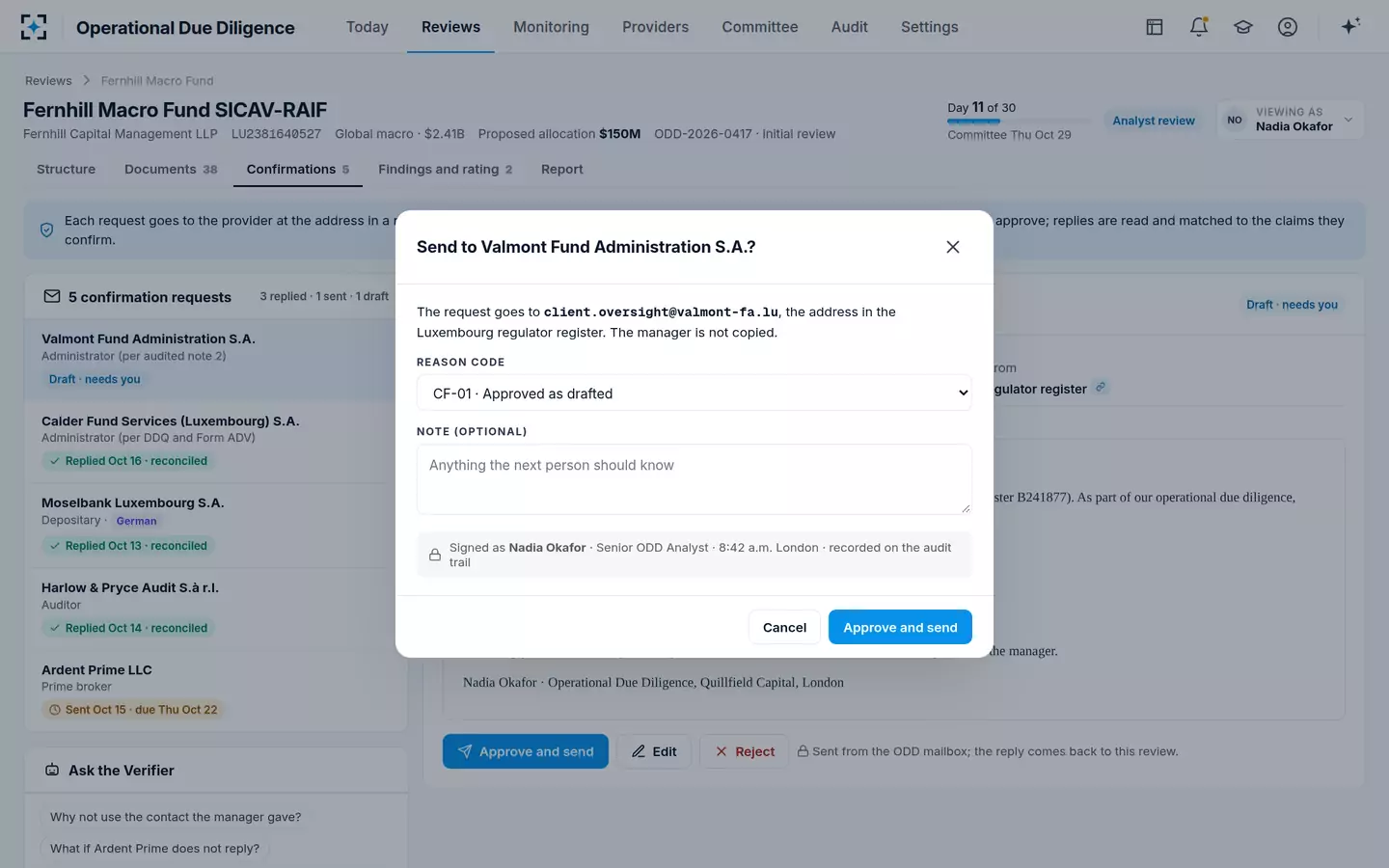
Each failure in this casebook was a step a review could take and did not. In Operational Due Diligence the steps are built into how a review runs. The Verifier agent checks each claim against a source the manager does not control and drafts confirmation requests using contacts from a regulator's register, never contacts the manager supplied; the analyst approves each request before it is sent; and replies are reconciled to the claims they test, so a reply that contradicts the manager becomes a contradiction on the structure map, not a document in a folder.
Confirmations go to the provider directly, and each reply is reconciled
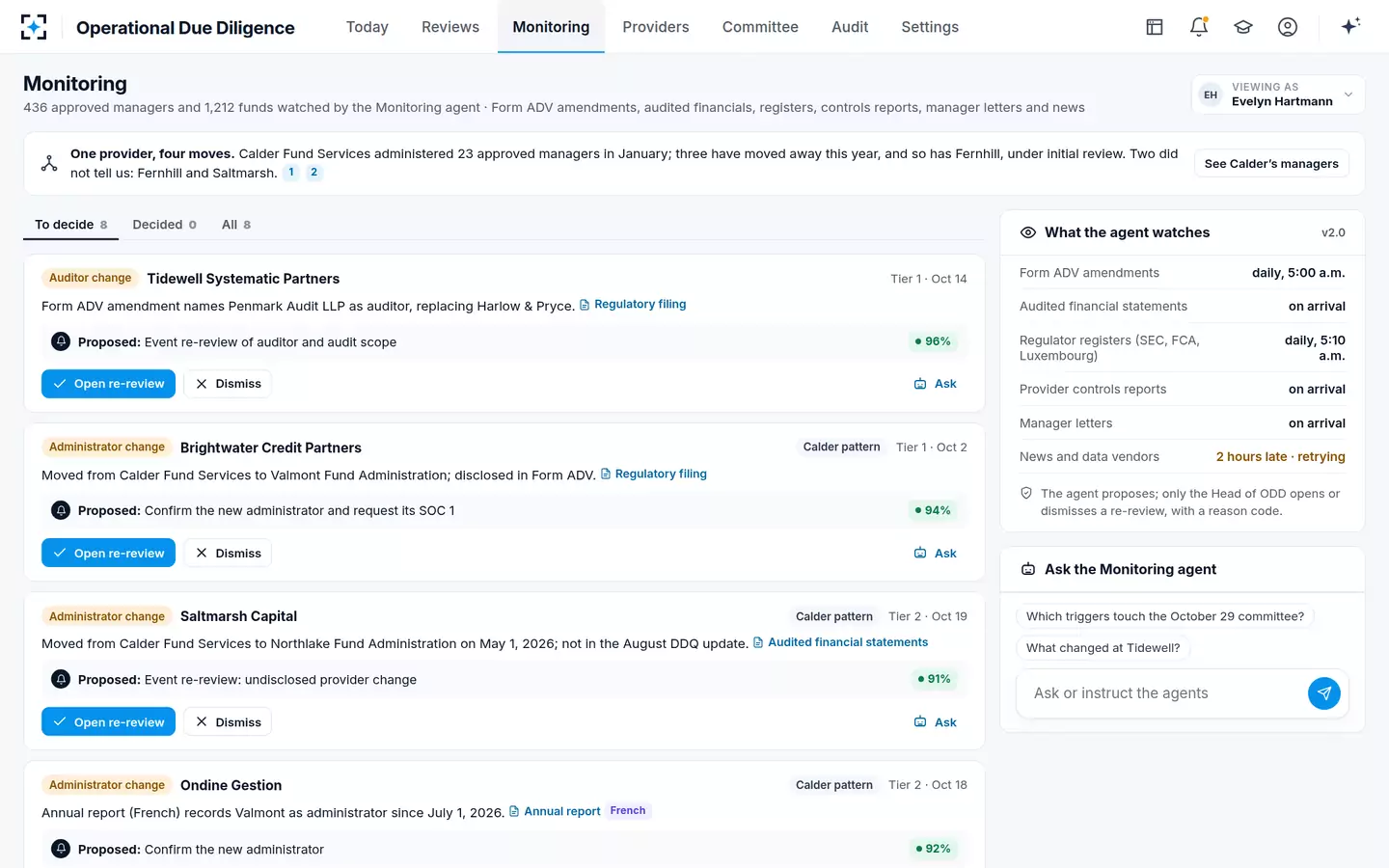
Some patterns only show across managers. In the sample, the Monitoring agent noticed that one fund administrator had lost four of the managers the allocator follows in a year, two of whom had not said so, and proposed a re-review for each. A provider whose clients are leaving is worth a question to every manager that still uses it.
One provider, every approved manager that uses it
Turning the casebook into checks
Six checks the fraud cases teach, for every manager review
- Confirm assets with the custodian or depositary yourself
At an address from a regulator’s register, with the manager not copied. Madoff’s examiners asked Madoff.
- Reconcile every reply, including one that says nothing happened
A clearing firm’s “no activity” reply about Madoff was received and ignored.
- Confirm the auditor exists, is registered and did the audit
Bayou’s auditor was its own CFO’s firm; public records showed it.
- Treat a small, unknown or related auditor as a finding
Resolve it with evidence before the rating, not in a footnote.
- Get risk and performance figures from someone other than the portfolio managers
Allianz’s risk reports were edited before they reached investors.
- Ask who can change a price, a report or a statement before investors see it
Valuation and reporting are where the incentive to shade numbers is strongest.
None of these checks requires suspicion. They are the same requests whether the manager is honest or not, which is what makes them fair to managers and useful to allocators. To run them on your own managers, with every reply reconciled and every decision signed, start from Operational Due Diligence.
Questions people ask
What red flags did investors miss with Madoff?
The SEC's inspector general lists them: returns too consistent for the strategy, an options volume nobody could see in the market, a strategy no one else could replicate, accounts in cash at month end, and an auditor who was a related party. The decisive check, confirming trades and holdings with an independent third party, was never completed.
How did Bayou fake its audits?
Its chief financial officer wrote the audited financial statements and opinion letters himself, on the stationery of a firm called Richmond-Fairfield Associates, after Bayou dismissed its real auditor in 1998. New York public records listed him as the firm's registered agent.
What did Allianz Global Investors pay over Structured Alpha?
More than $1 billion to settle the SEC's charges, including a $675 million civil penalty, and, together with its parent Allianz SE, over $5 billion in restitution to victims, according to the SEC's May 17, 2022 press release. Its US arm was also disqualified from advising US registered funds for ten years after its guilty plea.
Can return patterns reveal hedge fund fraud?
They can raise the odds. Bollen and Pool found that hedge funds later charged with fraud triggered performance flags built from suspicious return patterns more often than other funds. A flag justifies closer checking; only independent confirmation of assets, trades and audits settles it.
What is a feeder fund, and why did it matter with Madoff?
A feeder fund pools investors' money and invests it in another fund or manager. Madoff feeder funds run through the inspector general's report: the hedge fund manager whose complaint reached the SEC found his red flags while doing due diligence on two of them, and SEC staff later asked a clearing firm for trades done on behalf of particular feeder funds. That is why allocators that invest through feeders need to look through to the underlying manager's custody and audit.