A hedge fund valuation policy sets out how every position in the fund is priced for the net asset value: which sources are used for listed and over-the-counter instruments, how hard-to-value positions are modelled and by whom, how a price that looks wrong is challenged, what the valuation committee approves, and who may override a price the process produced. Reviewing one comes down to the last of those. A policy can name a reputable administrator, an independent valuation agent and a committee, and still let the portfolio manager replace a price and tell the committee afterwards. Because fees, track records and redemptions all run off the reported value, that clause decides whether the rest of the policy matters. The review therefore maps the path each price takes from its source to the net asset value, finds every point where someone can change it, and checks the questionnaire's description against the policy's text. Botminds' Operational Due Diligence does that reading with a Policy agent that compares the valuation policy with the house standard and the questionnaire and flags where they disagree; in a sample review it found exactly such an override.
The sample is fictional: Fernhill Macro Fund SICAV-RAIF, a Luxembourg global macro fund reviewed by an allocator called Quillfield Capital. Regulatory and research sources are linked where they appear.
The sample fund's hard-to-value book, and the clause that governs it
6.8%
of net asset value in Level 3 positions, mainly emerging-market currency options and illiquid sovereign bonds
$164.0million
the value of that Level 3 book
§6.3
the policy clause that lets the portfolio manager override a Level 3 price and report it afterwards
How are hedge funds valued? The path a price takes
Every price in a hedge fund's net asset value travels a path from a source to the books, and the review's first job is to draw it for each asset class. Listed positions usually take an exchange price. Over-the-counter instruments take an evaluated price from a pricing service or quotes from brokers. Positions with no observable market are valued by a model or an outside valuation agent, using inputs someone supplies. Along the way the administrator loads and checks prices, anyone with standing can challenge one, a valuation committee approves methods and exceptions, and somewhere the policy says who may override a result.
A price's path to the net asset value, and the question to ask at each step
Market or pricing service
Exchange prices for listed positions; evaluated prices from a pricing service or broker quotes for the rest.
AskWhich source for which asset class, and who chose it?
Administrator
Loads prices, applies the policy’s hierarchy, flags stale or moved prices.
AskDoes it source prices itself, or receive the manager’s?
Valuation agent or model
Values the hard-to-value book (Level 3) with a documented method and inputs.
AskWho appointed it, and who supplies its inputs?
Price challenge
A price that looks wrong is challenged with the source, with evidence and a time limit.
AskWho can challenge, and how many challenges succeeded last year?
Valuation Committee
Approves methods, exceptions and Level 3 prices; minutes record each decision.
AskWho votes? Is the portfolio manager a member?
Override
Someone replaces the price the process produced.
AskWho may override, before or after the committee, and who is told?
The map makes the review concrete. For each step, the analyst writes down what the policy says, what the questionnaire says, and what an independent source (the administrator's description, the valuation agent's engagement letter, the audited fair value note) says. The policy is the controlling text; the questionnaire is the manager's description of it; the independent sources show which one describes practice.
What should a hedge fund valuation policy contain?
Enough that two people applying it to the same position would reach the same price, and that anyone reading it can tell who decided. The checklist is what a reviewer should be able to find, by section, in a good policy. Where a section is missing, the questionnaire's answer on that point is unsupported.
What a hedge fund valuation policy should contain, section by section
- A pricing hierarchy for each asset class
Which source first, which fallback, and when a model is used.
- Methods and inputs for hard-to-value positions
The model, who supplies each input, and how often the method is tested against sale prices.
- Oversight of pricing services and valuation agents
How each is chosen, monitored and replaced, and its engagement terms.
- A price challenge process
Who may challenge, how, with what evidence, and how it is recorded.
- The valuation committee’s membership and powers
Who votes, the quorum, what needs its approval, and how conflicts are handled.
- Override rules
Who may override, whether approval comes before or after, and how overrides are reported.
- Stale and unchanged price checks
How long a price may go unchanged before it is reviewed.
- Error and restatement procedures
What happens when a net asset value proves wrong, and who is told.
The model is a rule written for registered funds, not hedge funds. SEC Rule 2a-5 defines what determining fair value in good faith requires of a registered fund or business development company: assessing valuation risks "including material conflicts of interest", establishing and applying methodologies, testing them, and "Overseeing pricing service providers, if used, including establishing the process for approving, monitoring, and evaluating each pricing service provider and initiating price challenges as appropriate" (17 CFR 270.2a-5). A private fund is not bound by it. As a benchmark for what a policy should cover, it is the clearest text a regulator has written.
Who sets prices for Level 3 assets?
Whoever the policy says, and the review should name that person or firm for every Level 3 position. Level 3 positions are those valued with significant inputs that cannot be observed in a market, so the price depends on a model and on the assumptions fed into it. The candidates are the manager's own valuation team, an outside valuation agent, or the administrator using inputs the manager supplies. Each can be sound. Each can also leave the portfolio manager effectively setting the price, through the inputs, the choice of agent or an override.
The research shows why it matters. Brown, Goetzmann, Liang and Schwarz describe what happens when a fund holds illiquid positions: "managers may supply their own estimates of the hard-to-value security price. This method has obvious potential for operational risk or downright fraud, if employed by an untrustworthy manager" (NBER working paper 15529). Cassar and Gerakos, studying how hedge funds actually price positions, found that "funds using less verifiable pricing sources and funds that provide managers with greater discretion in pricing investment positions are more likely to have returns consistent with intentional smoothing" (Review of Financial Studies, 2011).
The same study contains a caution reviewers should take seriously: "Traditional controls, however, such as removing the manager from the setting and reporting of the fund's net asset value and the use of reputable auditors and administrators, are not associated with lower levels of smoothing." The names of the providers are not the control. The control is who can change a price, and whether anyone independent sees it happen.
Should portfolio managers sit on the valuation committee?
Not as voting members on the prices of what they manage. SEC examiners have flagged weak controls "where portfolio managers are permitted to provide input – as voting members of the valuation committee – on prices of securities in funds they managed" (SEC Division of Examinations risk alert, October 26, 2021). For registered funds, Rule 2a-5 goes further: the valuation designee must reasonably segregate fair value determinations from portfolio management "such that the portfolio manager(s) may not determine, or effectively determine by exerting substantial influence on, the fair values ascribed to portfolio investments" (Rule 2a-5(b)(2)).
Portfolio managers know their positions best, and a policy can use that knowledge without giving them the vote: they can supply information, propose a price with evidence, or challenge one through the same process as anyone else. What the review should find is that the committee decides with the portfolio manager out of the room for the vote, and that the minutes show it.
Portfolio manager input on prices: acceptable and not
A finding: Votes on the prices of positions he or she manages
Acceptable with records: Attends to give information; recused from the vote, and the minutes show it
A finding: May replace a Level 3 price and report it to the committee afterwards
Acceptable with records: May propose a price with evidence; the committee approves before it is used
A finding: Supplies the model inputs, with no independent check
Acceptable with records: Inputs sourced or tested by the valuation agent or a control function
A finding: Challenges only prices that look too low
Acceptable with records: Challenges go through one process, recorded, whoever raises them
What is a price challenge, and who can raise one?
A price challenge is a formal request to a pricing service, broker or valuation agent to reconsider a price, with the evidence for a different one. A policy should say who may challenge, how quickly the source must respond, and how the outcome is recorded, and a reviewer should ask for the log of last year's challenges: how many, by whom, how many changed the price, and in which direction. A log with only upward challenges from the front office is a finding.
Examiners treat oversight of pricing sources as part of the valuation programme. The 2021 risk alert lists, among the compliance practices it looked for, processes and controls that "provide for due diligence and oversight of pricing vendors that provide evaluated prices for portfolio holdings" (SEC risk alert, 2021). The reason is visible in the SEC's own cases.
"Velissaris executed the overvaluation scheme by altering inputs and manipulating the code of a third-party pricing service"
SEC press release 2022-29 (February 17, 2022), on charges against Infinity Q's founder
In that case the SEC alleged that the founder and chief investment officer of Infinity Q Capital Management overvalued fund assets by more than $1 billion, and that he created "backdated minutes of valuation meetings that never occurred" (SEC press release 2022-29). The pricing service was a third party; the inputs and the configuration were not independent of him. A review that stops at the pricing service's name would have recorded an independent price.
The override clause: where a valuation review is won or lost
Read the override clause first, and compare it word for word with the questionnaire. In the sample review, Fernhill's questionnaire, §7.4, said the Valuation Committee approves every Level 3 price. Its valuation policy, version 4.2, §6.3, let the portfolio manager apply his own price when he considered the independent valuation agent's price not representative, and report it to the Valuation Committee only afterwards. The chief investment officer, who manages the portfolio, sits on the committee.
The Findings agent drafted that as finding F-2, rated Medium under the house standard (which rates a post-hoc override as Medium while Level 3 is under 15% of net asset value), with the evidence linked: the policy sections, the questionnaire section and the French audited financial statements' fair value note. Its condition, C-2, is an amended policy requiring Valuation Committee approval before any Level 3 override is used, with the chief investment officer recused. The Review agent's one note on the draft added the size of the Level 3 book, $164.0 million or 6.8% of net asset value, to the finding.
The override, as a cited finding with its condition
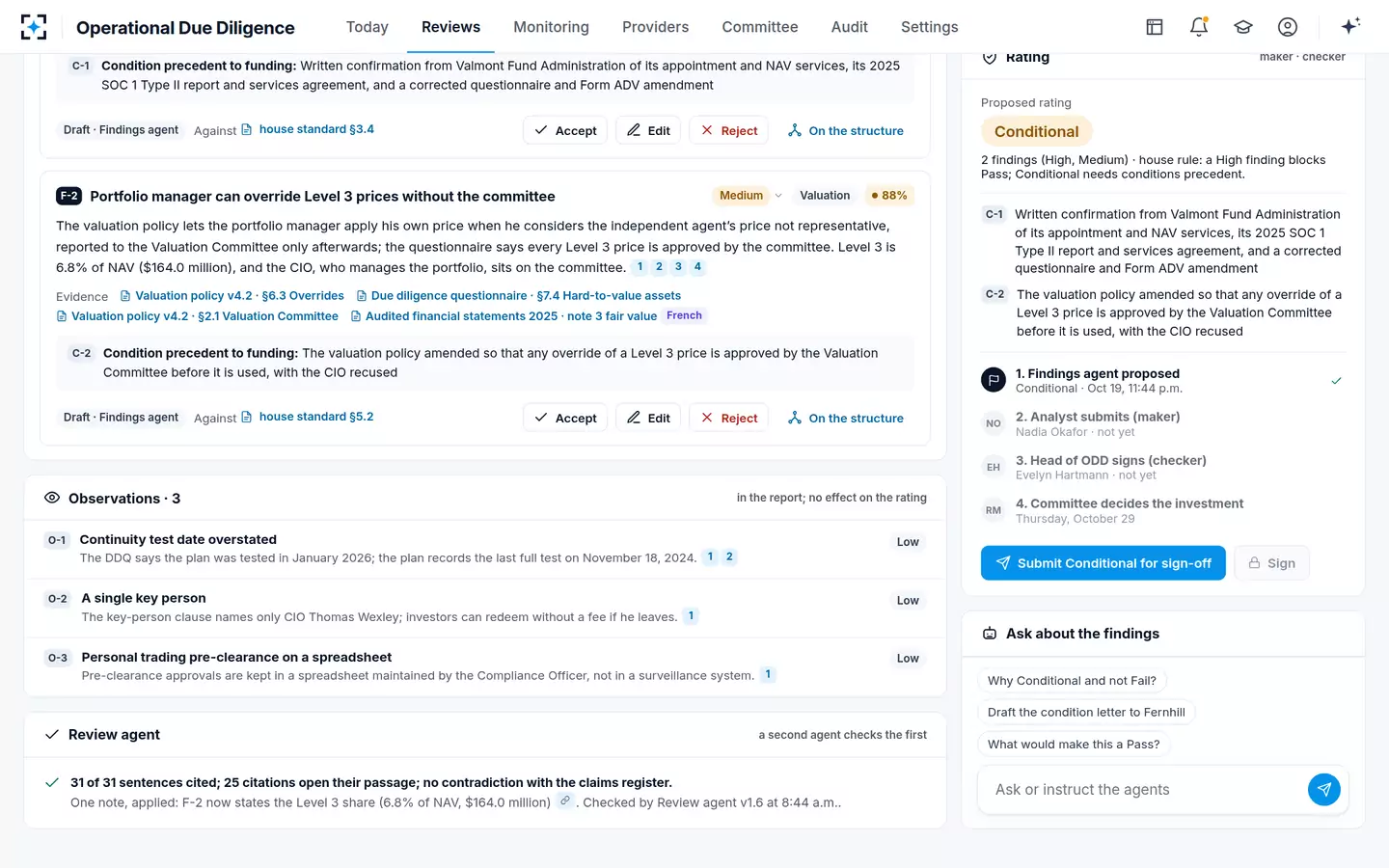
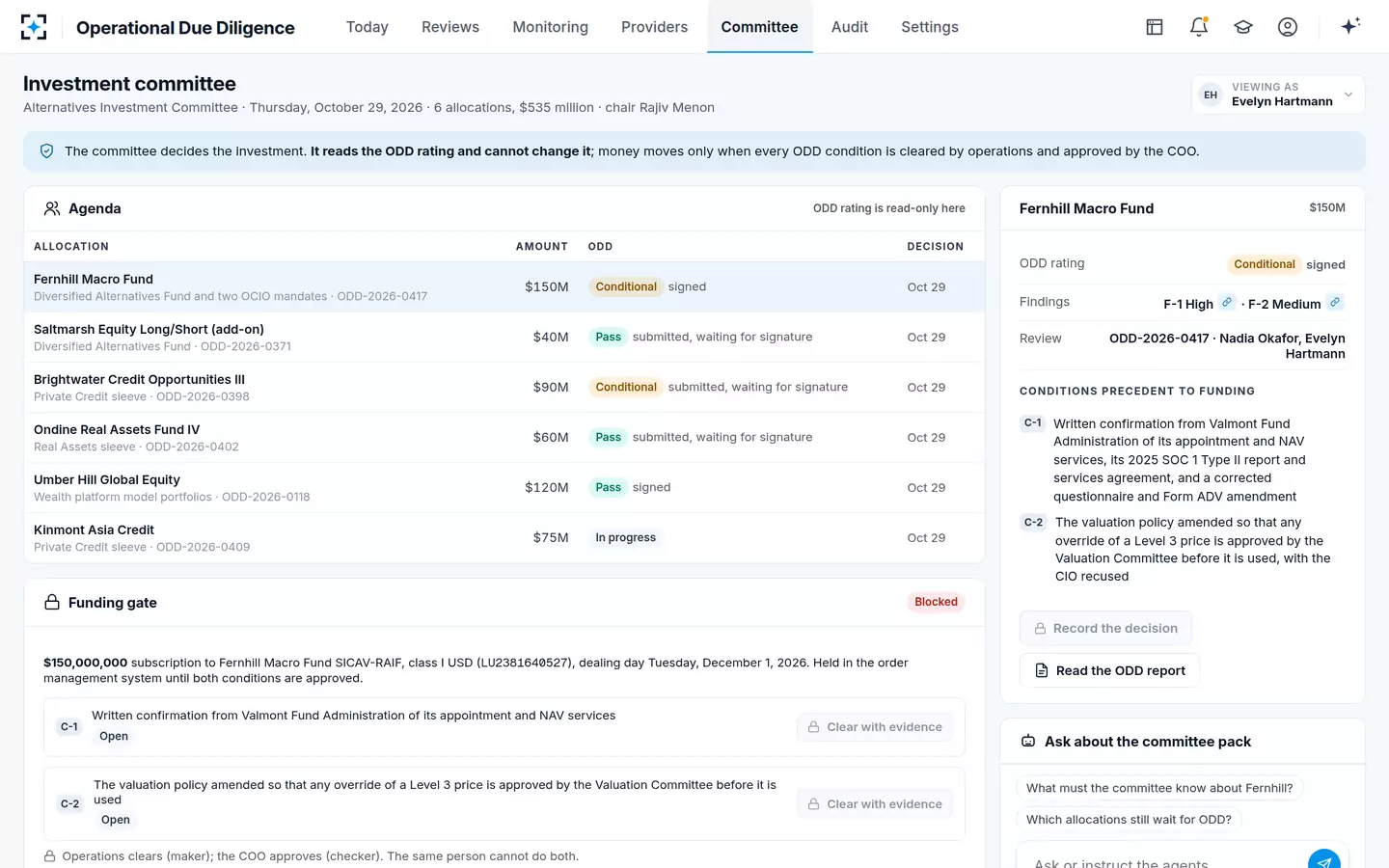
A Medium finding does not stop an allocation on its own; the condition does its work before funding. In the sample, the $150 million subscription is held in the order management system until operations clears C-2 with the amended policy as evidence and the chief operating officer approves the clearance. How that finding reads in the final report is shown in the annotated report.
The money waits for the amended policy
What did the SEC find on private fund valuation?
That practice and disclosure often part company. Examiners' 2020 observations on private fund advisers included advisers that did not value assets as their own processes and disclosures said, in some cases overcharging fees as a result; the 2021 observations on registered funds flagged portfolio managers voting on the prices of their own funds' securities. For fiscal 2027 the Division of Examinations says adviser examinations will again look at whether advisers "assessed the reasonableness of their valuation processes and methodologies" (SEC, Examination Priorities, FY2027).
Form ADV gives a reviewer one more cross-check. For each private fund, Schedule D question 27 asks what percentage of the fund's assets was valued during the last fiscal year by an unrelated person such as an administrator, counting only assets where that person carried out the valuation procedure and its value was the one used for subscriptions, redemptions and fees (Form ADV Part 1A). Reading Schedule D against the questionnaire explains how to use it; a high filed percentage beside a policy that permits manager overrides is a question for the manager.
How are hard-to-value assets audited, and what does the review add?
The auditor tests the fund's fair values for the financial statements, and the notes disclose how they were measured. A reviewer should read the fair value note in full, in the fund's own language: the share of assets in each level of the hierarchy, the valuation techniques and significant unobservable inputs for Level 3, and any movement into or out of Level 3 during the year. Then compare the note with the policy and the questionnaire. In the sample, the French audited financial statements' note 3 was part of the evidence for F-2.
The review adds what the audit does not: who can change a price between audits, how often they did, and whether the policy, the questionnaire and practice agree. That is where Operational Due Diligence's agents start and where its people decide.
How Operational Due Diligence reviews a valuation policy
Agent
Intake agentReads the valuation policy, questionnaire, audited fair value note and valuation agent’s engagement letter, each in its own language.
Never: Decide what is material
Agent
Policy agentReads the policy against the house standard and flags where it contradicts the questionnaire, such as a post-hoc override.
Never: Rate; it flags
Agent
Findings and Review agentsDraft the finding with severity and a condition; check every sentence is cited.
Never: Sign, send or edit another agent’s draft
A person decides
ODD analystAccepts, edits or rejects the finding with a reason, and submits the rating.
A person decides
Head of ODD, then operations and the COOThe Head of ODD signs the rating; operations clears the condition with the amended policy, and the COO approves before funding.
To see a valuation policy read against your own house standard and questionnaires, start from Operational Due Diligence; the hedge fund fraud cases show what happens when numbers produced by the manager are treated as independent.
Questions people ask
What does a hedge fund valuation policy example look like?
A typical policy has sections for the pricing hierarchy by asset class, methods for hard-to-value positions, oversight of pricing services and valuation agents, price challenges, the valuation committee, overrides, stale price checks and error procedures. In the sample fund's version 4.2, the finding sat in one sentence of §6.3, the override clause.
Who is responsible for valuation in a hedge fund?
The fund's governing body and the manager it appoints, as the offering documents set out, usually through a valuation committee, with an administrator calculating the net asset value and sometimes an independent valuation agent for hard-to-value positions. Responsibility and influence can differ, which is why the review maps who can actually change a price.
Does SEC Rule 2a-5 apply to hedge funds?
No. Rule 2a-5 applies to registered investment companies and business development companies. It is still a useful benchmark for a hedge fund valuation policy, because it spells out the functions good-faith fair valuation requires, including overseeing pricing services, initiating price challenges and keeping portfolio managers from effectively determining fair values.
How often are hedge funds valued?
At least as often as the offering documents let investors subscribe or redeem, with the administrator calculating the net asset value at each dealing date; the sample fund's next dealing day is December 1, 2026. Hard-to-value positions may be revalued less often, which is why the policy's stale price rules and the timing of overrides matter.
Is a portfolio manager override always a finding?
An override approved by the committee before use, with evidence and the portfolio manager recused, can be good practice. An override applied first and reported afterwards, or one the questionnaire does not disclose, is a finding; how severe depends on the house standard and the size of the book it touches.