AI due diligence tools for fund manager reviews read a manager's data room, extract the claims it makes about its operations, compare them with outside sources, and draft the requests, findings and report an analyst would otherwise write by hand. The way to judge one is by its limits. An agent that may collect, read, cross-check and draft saves an operational due diligence team days per review. An agent that may also rate a manager, waive a finding, write to a service provider unasked or release a subscription has taken a decision the allocator will have to defend without having made it. Botminds' Operational Due Diligence is built on that line: seven agents, each with a job and with things it may never do, and every rating, confirmation and release of money left to a named person with a reason code. This page sets out those limits agent by agent, what the SEC says it will look at when firms use such technology, and the questions to ask any vendor before buying.
The examples come from the solution running on fictional sample data, a review of a Luxembourg macro fund by an allocator called Quillfield Capital. Settings such as confidence thresholds are the sample allocator's configuration.
Seven agents, and the decisions none of them can take
7
agents, each with written limits on what it may do
0
agents that can sign a rating, contact a provider unasked or release money
85%
confidence below which the Findings agent asks the analyst (sample setting)
40
past signed reviews every new agent version is tested on first
What do AI due diligence tools actually do in a manager review?
They do the reading and the cross-referencing, which is most of the hours. In a manual review an analyst reads a questionnaire, an offering memorandum, two years of audited accounts and a dozen policies, often in more than one language, draws the fund's structure by hand and writes to each service provider. An AI tool can read every page in its own language overnight, list what is missing, draw the structure from the documents and registers, and match each claim to the sources that confirm or contradict it.
In the sample review, that overnight pass produced a structure of 10 entities and 146 claims sorted into 137 verified, 5 single source and 4 contradictions, from 38 documents and 2,146 pages in English, French and German. What it did not produce was a decision. The contradictions went to the analyst's queue with the pages open beside them, and the proposed rating went to a person to accept or reject.
That distinction is also how the work is described inside the SEC. The Division of Examinations writes that firms now use generative tools for work from research and drafting to portfolio management and compliance monitoring, and that in its own examinations the technology is "supplementing, but not replacing, staff judgment" (SEC, Examination Priorities, Fiscal Year 2027, October 2026). The SEC's document calls the technology "super intelligence (SI)"; its full wording on firms' use is quoted in a research guide.
The test that matters: what each agent may do, and may never do
Ask a vendor for a table like this one. For each agent, it should name the job, the decisions it may not take, and what happens when it is unsure. A tool that cannot fill in the third column has not decided where its authority ends.
Seven agents in Operational Due Diligence: the job, and what each may never do
| Agent | What it does | What it may never do |
|---|---|---|
| Intake | Collects the data room; classifies each document by type, language, pages and date; reads it in its own language, with OCR for scans; lists what is missing and drafts the request. | Accept a document from an unverified sender. Decide what is material. |
| Structure | Draws the operating structure from the offering documents, the questionnaire, the audited financials and the registers: entities, roles, providers, jurisdictions, dates. | Add an entity without a source. |
| Verifier | Checks each claim against a source the manager does not control; drafts confirmation requests with contacts from the regulator’s register; reconciles the replies. | Contact a provider without the analyst’s approval. Use contact details the manager supplied. |
| Policy | Reads the valuation, allocation, personal trading, cyber and continuity policies against the house standards and finds where they contradict the questionnaire. | Rate. It flags. |
| Findings | Drafts findings with severity and conditions precedent to funding, proposes the rating, drafts the cited report and the condition letter. | Sign or send. Below 85% confidence it asks the analyst. |
| Review | Checks the draft: every sentence cited, every citation opens its passage, no sentence contradicts a verified claim. | Edit the draft. It returns it with notes. |
| Monitoring | Watches approved managers through Form ADV amendments, audited financials, registers, controls reports, letters and news; proposes re-reviews; finds patterns across managers sharing a provider. | Open a review on its own. The Head of ODD accepts or dismisses. |
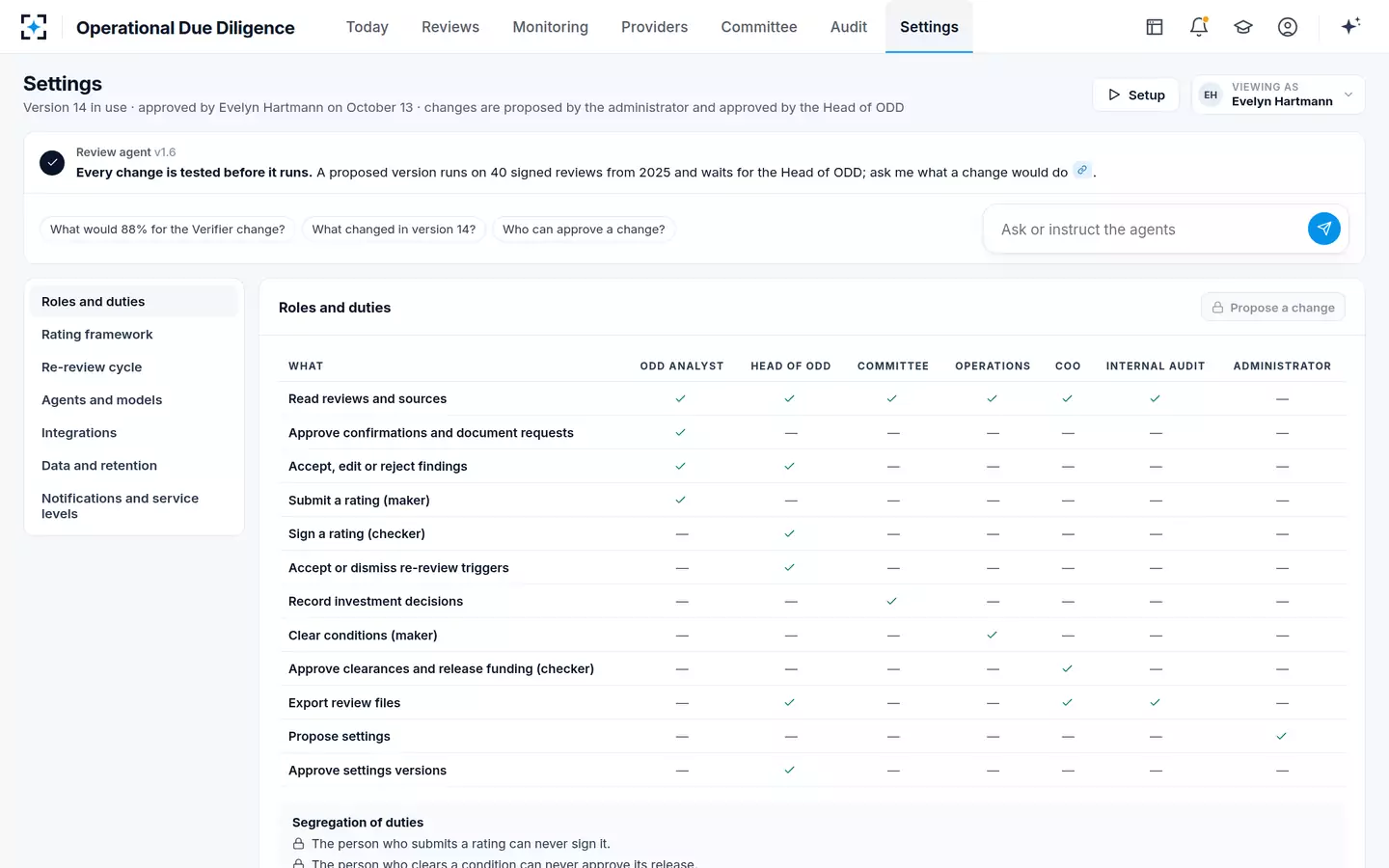
Three of those limits do most of the work. The Verifier may not write to a provider without the analyst's approval, and may never use a contact the manager supplied, because a confirmation routed through the party being checked is not a confirmation. The Findings agent may propose a rating but not sign it. And the Monitoring agent may propose a re-review but not open one, because a review opened is a manager told it is under scrutiny, and that is a relationship decision.
Can AI rate a fund manager?
It can propose a rating; it should not give one. A rating is an allocator's opinion on whether to trust a manager with client money, and it has to be owned by someone who can explain it to a committee, an auditor and, if it goes wrong, a regulator. What an agent can usefully do is apply the house rules mechanically and show its working: in the sample, a High finding blocks Pass, Conditional needs conditions precedent to funding, so with one High and one Medium finding the Findings agent proposed Conditional and said why.
The chain after that proposal is all people. The analyst submits the rating; the Head of Operational Due Diligence signs Pass, Conditional or Fail with a reason code; the person who submits can never sign; the investment committee reads the rating and cannot change it; operations clears each condition with evidence and the chief operating officer approves the release, and the same person cannot do both.
One review through Operational Due Diligence: what agents do, and where people decide
Agent
Intake agentReads the data room in every language; lists what is missing.
Never: Decide what is material
Agent
Structure and Verifier agentsDraw the structure; check each claim; draft confirmations from the regulator’s register.
Never: Contact a provider unasked
A person decides
ODD analystApproves each confirmation; accepts, edits or rejects each finding with a reason.
Agent
Policy, Findings and Review agentsFlag policy gaps; draft findings, rating and report; check every citation.
Never: Sign, send or edit another agent’s draft
A person decides
ODD analyst, then Head of ODDThe analyst submits the rating; the Head of ODD signs it with a reason code.
A person decides
Committee, operations and COOThe committee decides the investment; operations clears conditions; the COO releases the money.
Who may do what, written down as settings
What do regulators expect when AI is used in due diligence?
The same obligations as without it. The SEC's examination priorities for fiscal 2027 say the Division is stepping up its work on how SI tools shape outcomes and whether firms using them still meet existing obligations, which it calls "technology-neutral" (SEC, Examination Priorities, FY2027). For an allocator that is itself an adviser, the due diligence it owes clients does not change because a tool did the reading.
The priorities also put firms' policies for monitoring their own SI use, in fraud detection, back-office work and other functions, among the things examiners will look at first. Translated into an ODD team's terms: write down what the agents do, who checks them, how a new version is tested before it runs, and how an override is recorded. The sample allocator's answer to each is a setting: limits per agent, a confidence threshold below which the agent asks, a test of every new version on 40 past signed reviews, and a reason code on every override.
How do you verify a manager's AI claims?
Treat them like any other claim in the questionnaire: ask what the system does, who checks its output, and what evidence shows it works, then test the answer against something the manager does not control. The SEC has already brought cases where the claim was the problem. In March 2024 it settled charges against two advisers, Delphia (USA) and Global Predictions, for false and misleading statements about their use of artificial intelligence, with $400,000 in total civil penalties (SEC press release 2024-36, March 18, 2024). The Director of Enforcement's message at the time was that a firm claiming to use AI in its investment process must make sure the claim is not false or misleading; the AI-washing cases are collected in a research guide.
The SEC's examiners frame the test in three parts when they review automated investment tools: are the firm's claims fair and accurate, do its operations and controls match what it told investors, and does the algorithm's advice fit each investor's profile or stated strategy (FY2027 priorities; the three tests in the SEC's words, applied to an automated rebalance). An ODD analyst can borrow the first two directly: compare what the questionnaire and marketing say the system does with the policies, the model governance documents and, where possible, a demonstration on the manager's own data.
Questions for a manager that says it uses AI
- What decisions does the system make, and which does it only inform?
Trading, allocation, valuation, compliance monitoring: each answer changes what you check.
- Who reviews its output before it is used?
A named role, and the evidence of the review: a log, a sign-off, an exception report.
- How was it tested before it went live, and after each change?
Ask for the test results, not the policy that says there are tests.
- Where is it described to investors?
Offering documents, Form ADV brochure, marketing. The descriptions should match each other and the practice.
- What happens when it fails?
The fallback, who is told, and one example of it happening.
- Which outside parties depend on it?
If the administrator or a pricing service relies on its output, the control sits with the manager.
When must an agent stop and ask?
When it is unsure, and the threshold should be a setting the allocator owns, not a constant inside the product. In the sample configuration the Findings agent asks the analyst below 85% confidence; each agent's threshold can be set between 70% and 99%, and a new value is first run against 40 past signed reviews so the Head of ODD can see what would have changed before approving it.
A lower threshold means fewer questions and more drafts that need rework; a higher one means more questions and fewer surprises. The right level is the one a team can show it tested. Testing a review process by planting known errors describes how to measure what a setting catches before trusting it.
The audit trail: proving who decided
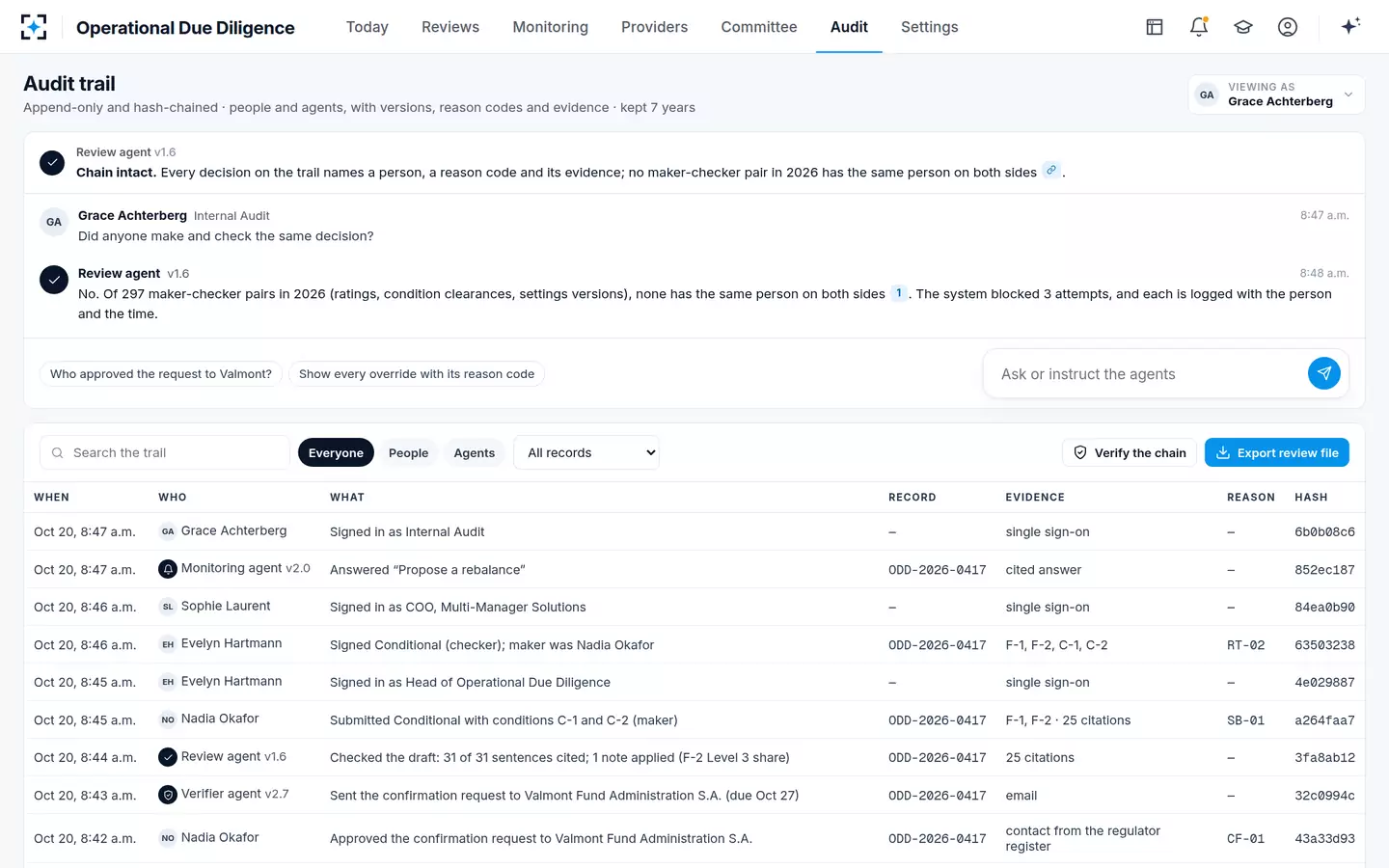
Every agent action and every human decision should land on a trail that cannot be edited afterwards, with the version of the agent, the reason code and the evidence. In the sample, the trail is append-only and hash-chained, kept seven years and exportable as one review file. Internal Audit can ask it in plain words whether anyone made and checked the same decision; the answer in the sample was that none of 297 maker-checker pairs in 2026 had the same person on both sides, and that the system had blocked three attempts.
The trail answers Internal Audit's question with a count
AI due diligence software: questions to ask before you buy
Buy on limits, evidence and fit. A demonstration on the vendor's data shows what the tool can read; a pilot on your own closed reviews shows what it gets right. The checklist below is the one we would put to any vendor, including us.
Eight questions for any AI due diligence software
- What may each agent never do?
In writing, per agent, enforced by the system rather than by a policy document.
- Does every claim open its source?
The page, in its own language, beside any translation.
- Where do confirmation contacts come from?
A regulator’s register, never the manager’s documents, and never sent without approval.
- Who signs, and can the same person submit and sign?
The answer should be no, enforced.
- How is a new version tested?
On your past reviews, with the differences shown before anyone approves it.
- What does it do when unsure?
A threshold you set, below which it asks.
- Can Internal Audit export one complete review file?
Every action, person and agent, with versions, reasons and evidence.
- What does it need from you?
Your house standard, rating rules, questionnaires, past signed reviews and system connections.
Where AI due diligence tools fall short
They are only as independent as their sources, and some sources do not exist yet. A tool can match a claim against a register only for jurisdictions whose registers it reads; the sample configuration connects to the SEC, FCA and Luxembourg registers, so a manager elsewhere needs those sources added. A scan the tool cannot read stays unread: the sample's overnight pass flagged one. And a reply that has not arrived cannot be reconciled, so a prime broker that has not answered leaves its claims single source however fast the reading was.
Nor do the tools replace the parts of ODD that are conversations: the on-site meeting, the follow-up call when a reply is evasive, the judgment that a finding is High rather than Medium. Botminds' Operational Due Diligence fits allocators reviewing external managers across hedge funds, private equity, private credit, infrastructure and real assets, and works alongside the research management system, CRM, document management and order management system an ODD team already uses. What a team needs to bring before day one covers the set-up; to see the agents and their limits on your own past reviews, start from Operational Due Diligence.
Questions people ask
Are AI due diligence tools accurate enough to rely on?
Rely on the evidence they show, not on their conclusions. A tool that cites the page behind every claim lets an analyst check any answer in seconds; one that summarises without citations has to be trusted. Measure accuracy on your own closed reviews before going live, and set a confidence threshold below which agents ask.
Can AI due diligence tools read documents in other languages?
The better ones read each document in its own language and show the original beside the translation. In the sample review the agents read 38 documents, 31 in English, 4 in French and 3 in German, and the contradiction that changed the rating was in a French audit note.
Will regulators accept an AI-assisted operational due diligence review?
The SEC describes advisers' obligations as technology neutral: the due diligence owed to clients is the same whoever does the reading. What examiners can be expected to look for is how the tools are supervised, which is why written agent limits, version testing and a complete audit trail matter.
Do AI tools replace ODD analysts?
They replace hours, not the role. In our estimate for one initial review, agents take most of about eight analyst days of collecting, reading and drafting down to about two, but every confirmation, finding and rating still needs the analyst, and every signature someone more senior.
What is AI washing, and why does it matter in due diligence?
AI washing is claiming to use artificial intelligence in ways a firm does not. The SEC fined two advisers $400,000 in total in March 2024 for such claims, so a manager's description of its AI is a representation to verify like any other.