Automatic portfolio rebalancing is software that brings accounts back to their model, after drift or a model change, without a person building each trade. The useful question for a firm choosing it is not whether trades are generated automatically, but whether every account can be traced from the decision to the order, with the reason it differs from the model, because that is what SEC examiners test: whether algorithms "lead to advice or recommendations consistent with investors’ investment profiles or stated strategies". Botminds' Model Portfolio Rebalancing runs the work overnight with eight agents that each leave a written reason, and stops at two places only people pass: approval and release.
The trace below is one model change at the solution's fictional sample firm, Quillfield Private Wealth: its people, accounts, times and counts are sample data from the solution. Regulator texts are quoted and linked where they are used.
One model change through Model Portfolio Rebalancing, timestamped
Mon 4:30 p.m.
WhoModel Portfolio Committee
What happenedApproves MC-2026-118: Balanced Growth 60/40, version 14 to 15. Sell 2.0% Arclight, buy 2.0% two-year Treasury, 1,240 accounts, by Wed 4:30 p.m.
What it leavesThe minute, cited by page
Mon 4:41 p.m.
WhoRebalance Planner
What happenedFans the change out to every account on the model and starts proposing trades with the Tax, Restriction and Cash agents.
What it leaves—
Overnight
WhoRestriction agent
What happenedApplies every client rule, the firm restricted list and the insider list. 25 accounts held or substituted: 13 defense screens, 9 insiders, 2 pledged, 1 funds-only trust.
What it leavesEach hold with its clause and a re-propose date
Tue 6:05 a.m.
WhoTax agent
What happenedChooses lots household-wide. 87 accounts adjusted to avoid wash sales; the Bergströms sell 286 shares of a 2023 lot and keep a 2025 loss lot until 6 Nov.
What it leavesA reason beside every lot sold or kept
Tue 6:31 a.m.
WhoChecker
What happenedRe-runs every proposed portfolio on a second model. Disagrees on 31-0915, a trust that may hold government bonds only through funds; it moves to Restricted and buys the approved substitute fund.
What it leavesThe disagreement and its resolution
Tue 6:47 a.m.
WhoRebalance Planner
What happened1,108 accounts straight through; 132 grouped by why each must differ. 2,464 orders proposed. Nothing has gone to trading.
What it leavesPlan and sources, eight steps
Tue 7:02 a.m.
WhoCash agent
What happenedAsks client service to confirm 14 withdrawal dates that are not certain in the CRM.
What it leavesThe question, and later the answer
Tue 8:31 a.m.
WhoOrder agent
What happenedDrafts 1,240 account rationales as order memoranda.
What it leavesA rationale per account
Tue 8:40–8:50 a.m.
WhoPortfolio manager
What happenedAsks why 40-1187 is held; tests a $50,000 gain budget as a what-if; sends the tax group back for a re-read, which the Checker re-runs; approves four groups, 1,226 accounts.
What it leavesQuestions, answers, send-back, approval with a reason code
Tue 8:51 a.m.
WhoHead of Model Portfolios
What happenedReleases order file OF-118-1, 2,436 orders, $34.42M each side, as the second signature required over $25M.
What it leavesThe release
Tue 8:52 a.m.
WhoOrder agent
What happenedBuilds the file into blocks by security for the trading desk, client names masked.
What it leavesEvery block traced to approved accounts
What automatic portfolio rebalancing should mean
It should mean that the mechanical work is automatic and the paper trail is complete, not that nobody looks. Fanning a change out to 1,240 accounts, applying restrictions, choosing lots and sizing buys to cash are mechanical once the rules are known. Deciding that a group of trades is right, and releasing money to the market, is not. The trace above automates the first and keeps people in the second.
The written reason is the part that most automation leaves out. A conventional rebalancer produces orders and a list of error codes; the reason an account differs from the model lives with whoever worked the exception. In the sample run, the Order agent wrote a rationale for each of the 1,240 accounts, cited to its sources, and stored it with the account's orders. When the portfolio manager asked why account 40-1187 was held, the answer quoted the clients' letter.
The sample run in four numbers
14hours
the agents worked, Monday 4:41 p.m. to Tuesday 6:47 a.m.
1,240
accounts traced, each with a written rationale
132
accounts grouped by why each must differ
0
orders sent before a person approved and another released
What does automatic rebalancing check?
Five things for every account, in order: the client's restrictions, the household's tax lots, the account's policy bands, its cash, and a second, independent pass over the result. In the sample run each check produced its own group. The Restriction agent held or substituted 25 accounts; the Tax agent adjusted lots in 87; six accounts whose trust policy statements cap fixed income at 40% would have breached it, and bought a US equity fund instead; 14 accounts had withdrawals that made the full Treasury buy unaffordable. The remaining 1,108 went straight through. A fund runs the equivalent of the first check on every order against its prospectus and guidelines, which is pre-trade compliance.
The second pass matters most because it is the one most automated systems lack. The Checker re-ran every proposed portfolio on a second model, independently, against every rule, band and list, and disagreed once: the Delacroix Family Trust may hold government bonds only through funds, so a direct Treasury purchase broke its document. The account moved to Restricted and bought the approved substitute fund. A disagreement blocks its group from approval until a person resolves it.
Who does what in an automatic rebalance in Model Portfolio Rebalancing
Agent
Drift agentChecks every account against its bands at 6:00 a.m. and proposes a drift run.
Never: trades or widens a band.
Agent
Rebalance PlannerFans a model change out to every account and groups them by why each differs.
Never: sends an order or approves.
Agent
Restriction, Tax and Cash agentsApply client rules and lists, choose lots household-wide, size buys to cash after withdrawals and T+1 settlement.
Never: override a restriction, give tax advice, move cash or assume a withdrawal date.
Agent
CheckerRe-runs every proposal on a second model and escalates every disagreement.
Never: resolves its own disagreement.
A person decides
Portfolio managerQuestions the agents, approves each group with a reason code or sends it back with an instruction.
A person decides
Second signerReleases the order file: the Head of Model Portfolios over $25M or 1,000 accounts, otherwise a second portfolio manager, never the approver.
Agent
Order agentBuilds blocks for the desk after release; reconciles fills with portfolio accounting.
Never: releases a file or sends before the signatures.
Who approves automatic rebalancing trades?
A portfolio manager approves, and a different person releases. In the sample firm the portfolio manager approves each group with a reason code, or sends it back to its agent with a written instruction; nobody approves their own proposal. An order file over $25 million or 1,000 accounts is released by the Head of Model Portfolios as a second signature; under that, by a second portfolio manager, never the approver. The trader sees nothing until release.
The send-back is the part worth testing in any system that calls itself automatic. In the sample, the portfolio manager sent the 87-account tax group back with the instruction "Re-read the client letters received since Monday before you propose." The group showed as re-planning and could not be approved; the Tax agent re-planned, the Checker re-ran all 87 on the second model, and the group came back. Approval of the other groups did not wait.
How are restricted accounts handled?
They are held or substituted, with the reason and the date they can trade, and they never trade the restricted security. Of the 25 restricted accounts in the sample, 13 had defense screens and hold Halvern Microsystems in place of Arclight, so they sold Halvern instead; 9 belonged to Arclight insiders in a blackout and were held, each with a date to re-propose; 2 were pledged to a credit line; one trust could hold government bonds only through funds. The restriction is applied from the client's own document, and the agents never lift or override one.
Ambiguity is routed to people, not resolved by guessing. Where the Restriction Reader's confidence that it read a document correctly falls below 90%, it asks client service; below 50%, a person reads the document. Why that matters under Rule 3a-4 is the subject of its own guide.
What happens when a data feed is late?
The accounts the feed affects wait, and a person decides. On the same morning, a second change, MC-2026-119 on the Global Equity 90/10 model, was missing the held-away file that carries the households' outside IRAs and spouse accounts. Without it the Tax agent cannot see purchases that would turn a loss sale into a wash sale, so three households were held out of the tax group until the file arrives or a portfolio manager proceeds with a recorded reason.
That is the behaviour to ask any automated rebalancer about. A system that proceeds on stale data and reports success has produced the failure the SEC described in 2021, when it observed "rebalancing errors and other trade errors at firms that lacked adequate oversight of their automated platforms" (SEC Division of Examinations risk alert, November 9, 2021). What the held-away feed is for is set out with the wash sale rule itself.
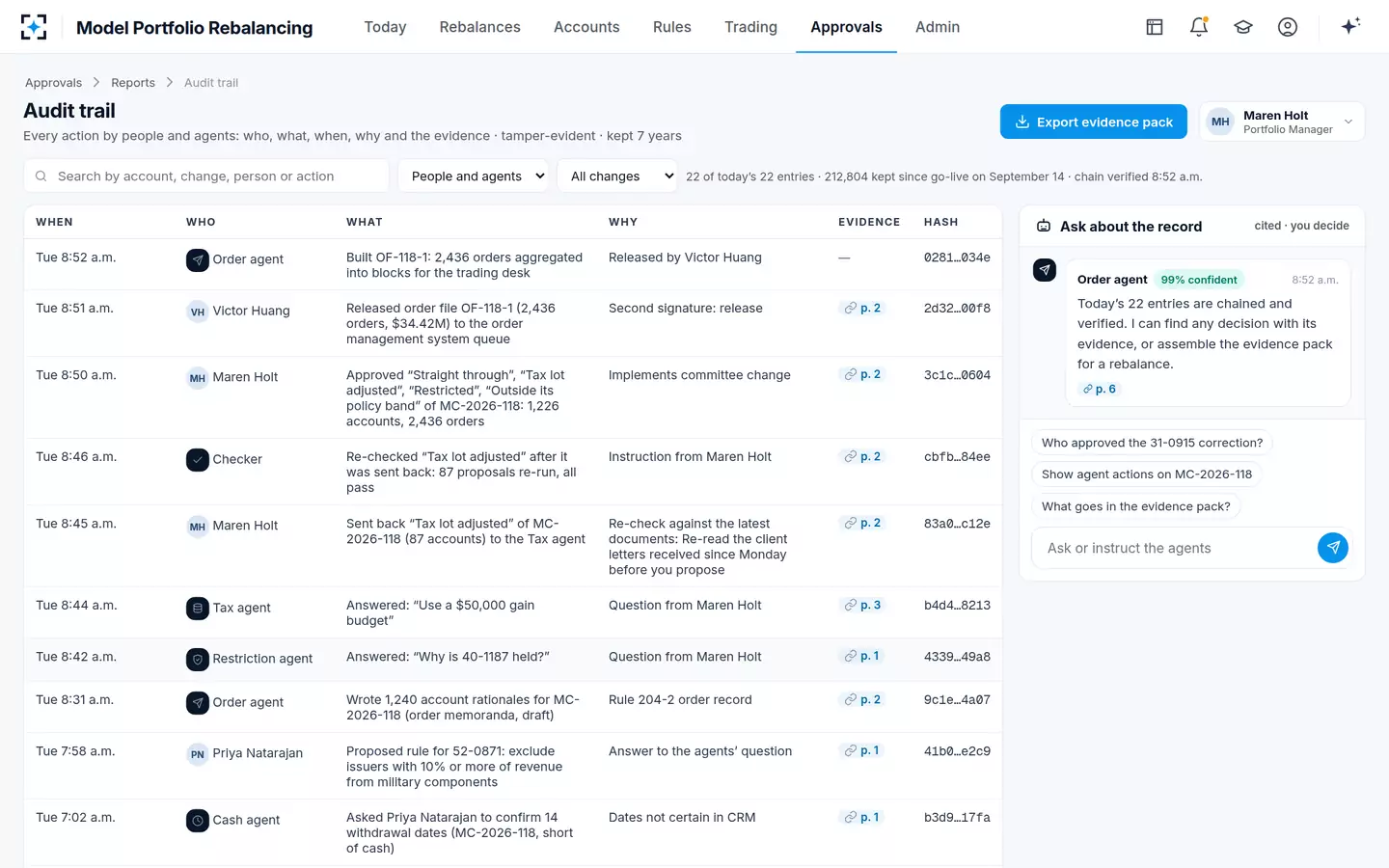
Every step by people and agents, chained on one trail
What do regulators look at in automated advice?
Whether the automation does what the firm says, for each client. In its fiscal 2027 examination priorities, published in October 2026, the SEC's Division of Examinations says reviews of automated investment advisory services will generally assess whether "(1) representations are fair and accurate; (2) operations and controls are consistent with disclosures made to investors; and (3) algorithms lead to advice or recommendations consistent with investors’ investment profiles or stated strategies" (SEC, FY2027 Examination Priorities). The same document says registrants are building what the SEC calls "super intelligence" into their businesses (the Division's wording, and what else is known about adoption).
The fiduciary standard does not change for software. The SEC's 2019 interpretation says plainly: "This Final Interpretation also applies to automated advisers" (84 FR 33669). And FINRA's 2016 review of digital advice tools listed effective practices for automatic rebalancing, beginning with "explicitly establishing customer intent that the automatic rebalancing should occur" and including "developing policies and procedures that define how the tool will act in the event of a major market movement" (FINRA, Report on Digital Investment Advice, March 2016).
The 2021 risk alert also described how automated platforms fail: some advisers lacked written policies for "the operation and supervision of their automated platforms, increasing the risk of algorithms producing unintended and inconsistent results", whether from coding errors or from code that could not handle unusual market conditions (SEC risk alert, 2021). A trace like the one above is the evidence that answers that finding: what the system did, for which account, on what data, and who let it through.
Where automatic stops in Model Portfolio Rebalancing
The agents propose, explain and check; they never send an order, release an order file, move cash, contact a client or lift a restriction. In Botminds' Model Portfolio Rebalancing those limits are part of each agent's definition, not a configuration a user can switch off, and the bands, thresholds and approval limits that govern them are settings that change only with a logged reason.
The released order file, in blocks by security, for the desk
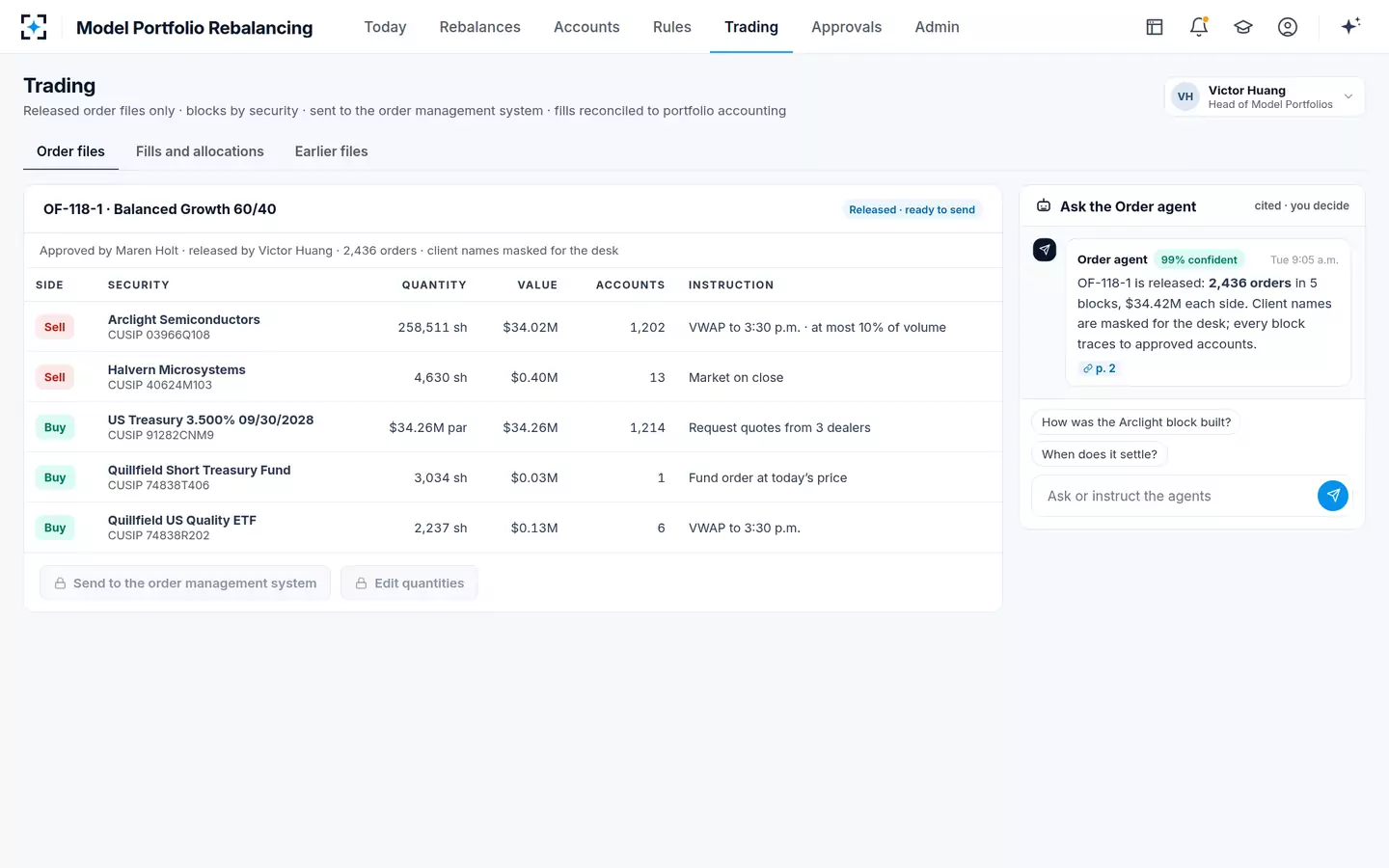
The design choice is deliberate. An overnight run that ends with orders already at the desk saves an hour and removes the one point where a person who knows the clients can stop something. An overnight run that ends with five groups and a plain reason for each saves most of the day and keeps that point. The sample run reached the desk at 8:52 a.m. on Tuesday, inside a deadline of Wednesday at 4:30 p.m.
What to ask anyone selling automatic rebalancing
Eight questions for an automatic portfolio rebalancing demonstration
- Show one account, end to end
From the model change to the order, with every rule, lot and cash decision and its source.
- Where do the restrictions come from?
From a table someone keyed, or from the client documents, with the clause quoted?
- Is the wash-sale check household-wide?
Including IRAs, Roth IRAs, spouse accounts and accounts held at other custodians.
- What checks the checker?
Is there an independent second pass, and does a disagreement block approval?
- What happens on bad or late data?
Does the system hold affected accounts and say so, or proceed and report success?
- What happens in a major market move?
FINRA’s practice: written procedures that define how the tool will act.
- Who can approve, who can release, who can trade?
And can any one person do two of them?
- What is kept, and for how long?
Rationales per account, approvals, versions of the rules and agents, at least the five years Rule 204-2 requires for order memoranda.
A firm comparing systems on those questions will find they sort the market into a few distinct approaches; portfolio rebalancing software, three approaches compares them on one model change.
Questions people ask
What is automated portfolio rebalancing?
Software that brings accounts back to their model, after drift or a model change, without a person building each trade. In a discretionary program it should also apply each client's restrictions and tax position and leave a reason for every account that differs from the model.
Can AI rebalance a portfolio?
AI agents can do the reading and arithmetic: turn client documents into rules, choose lots and size trades, and explain each account. In the sample run they proposed every trade; a portfolio manager approved and a second person released, which keeps the decision with people the firm supervises.
Does automatic rebalancing happen in my IRA?
If the IRA is on a model, yes, and sales inside it generally have no tax effect. Its purchases still matter: an IRA purchase within 30 days of a loss sale in a taxable account makes that sale a wash sale.
How often does automatic rebalancing run?
It depends on the program. In the sample firm drift is checked against bands every morning at 6:00 a.m., and a model change is implemented within two business days of the committee. FINRA's 2016 report lists disclosing whether rebalancing is scheduled or triggered by drift thresholds as an effective practice.
What happens if an automatic rebalance makes a mistake?
That depends on whether the mistake is caught before release. In the sample run an independent Checker caught a proposal that broke a trust's rule before anyone approved it. After execution, it is a trade error, handled under the firm's correction policy (Trade Error Management), and the SEC's 2021 risk alert notes advisers that omitted disclosure of how trade errors are handled.