Portfolio rebalancing software takes a model portfolio and a set of accounts and proposes the trades that bring each account to the model, after drift or a model change. Firms choose among three approaches: spreadsheets with the custodian's tools, rule-based rebalancing software driven by tables of restrictions and settings, and agent-based systems that read client documents, choose trades and explain every account that differs. All three can do the arithmetic. What separates them is what happens to the accounts that must not follow the model, and whether the firm can show, for each one, why. Botminds' Model Portfolio Rebalancing is an agent-based system: it reads restrictions from client documents, checks wash sales across the household, groups every exception by its reason, re-checks each proposal on a second model, and leaves approval and release to people.
No vendor is named on this page. The comparison describes approaches, the hours are Botminds' estimates for one change across about 1,200 accounts, and product figures come from the solution's fictional sample firm, Quillfield Private Wealth. Regulator texts are quoted and linked.
Three approaches to portfolio rebalancing software, on the same model change
Where client restrictions come from
Spreadsheet and custodian toolsThe analyst’s memory and the files on the shared drive
Rule-based rebalancing softwareA restriction table someone keyed; the software knows only that
Agent-based: Model Portfolio RebalancingRead from the client’s documents, each rule tied to its clause, confirmed by people
Wash sales across the household
Spreadsheet and custodian toolsChecked by hand, if at all
Rule-based rebalancing softwareUsually the account or the firm’s own accounts; held-away IRAs only with a feed
Agent-based: Model Portfolio RebalancingEvery account in the household, held-away IRAs and spouse accounts included
Lot selection
Spreadsheet and custodian toolsCustodian default or a manual pick
Rule-based rebalancing softwareA standing lot order, sometimes with an optimizer
Agent-based: Model Portfolio RebalancingPer sale, against the window, the holding period and the gain budget, with a reason per lot
Exceptions
Spreadsheet and custodian toolsFound by eye
Rule-based rebalancing softwareA grid of error codes
Agent-based: Model Portfolio RebalancingAccounts grouped by why each must differ, in plain words
A second check
Spreadsheet and custodian toolsA colleague, sometimes
Rule-based rebalancing softwareRarely independent of the first
Agent-based: Model Portfolio RebalancingEvery proposal re-run on a second model; a disagreement blocks approval
What is kept
Spreadsheet and custodian toolsThe spreadsheet
Rule-based rebalancing softwareOrders and error codes; the reasons, if anyone writes them
Agent-based: Model Portfolio RebalancingA rationale per account with its sources, on a hash-chained trail
One model change, team hours (estimate)
Spreadsheet and custodian toolsNot estimated here
Rule-based rebalancing softwareAbout 45 by hand around the software
Agent-based: Model Portfolio RebalancingAbout 5
What portfolio rebalancing software has to do
It has to take one decision, the model, to many accounts, each with its own rules, and leave evidence that each account was handled correctly. The arithmetic is the small part: target weight times account value, minus what is held, rounded to a minimum trade. The large part is everything that makes an account different: client restrictions, tax lots, policy bands, cash, insiders, pledges, and the household's other accounts.
Regulators describe the job in the same terms. The SEC's 2021 sweep of advisers using automated platforms found policies that did not assess whether "(1) algorithms were performing as intended; (2) asset allocation and/or rebalancing services were occurring as disclosed" (SEC risk alert, November 9, 2021). Software that cannot show what it did for each account cannot answer either question.
Spreadsheets and custodian tools: cheap, flexible, and the record is the person
A spreadsheet rebalancer works for a small book and an analyst who knows every client. Positions come from the custodian, weights are computed in a sheet, trades go back through the custodian's tools. Everything the analyst knows about a client's restrictions, recent purchases and cash is applied by hand, which means it is applied as well as that analyst remembers it on that day.
It breaks on three things: scale, people and evidence. A model change across a thousand accounts is days of work; the analyst's knowledge leaves when the analyst does; and the reasons for exceptions live in cell comments or nowhere. The 1997 Rule 3a-4 adopting release warned that, without records made at the time, compliance with the safe harbor's restriction and contact conditions would be close to impossible to show (62 FR 15098; what those records are).
Rule-based rebalancing software: fast arithmetic, blind to what was never keyed
Rule-based rebalancers are the established answer: models, accounts, restriction tables, tolerance bands, lot orders and sometimes tax optimizers, all as settings. They are fast and consistent, and for accounts whose rules are fully keyed they are correct. The limit is in the table. The software knows the restrictions someone typed into it, the lots in the accounts it can see, and nothing in the client's letters, policy statements or other custodians.
The sample firm's first full read of its client documents measured that limit: 2,673 restrictions written down in documents but never keyed into the old table, and 412 keyed rules with no document behind them. A rebalancer driven by that table would have traded against the first set and enforced the second. Its exception grid would also have shown error codes, not reasons, leaving the analyst to rebuild the reasons by hand, which is where Botminds' estimate puts most of the 45 hours.
What a first read of client documents found that the table did not hold
41,280
client documents read: agreements, policy statements, trust documents, letters, emails, CRM notes
2,673
restrictions written down but never keyed into the old table
412
keyed rules with no document behind them, sent to compliance
Agent-based rebalancing: read the documents, explain every account, check twice
Agent-based rebalancing moves the reading and the explaining into software, and keeps the decisions with people. In Botminds' Model Portfolio Rebalancing eight agents divide the work: one reads client documents into rules, one checks drift, one fans out model changes, one chooses tax lots household-wide, one applies restrictions and lists, one sizes buys to cash, one re-checks every proposal on a second model, and one writes each account's rationale and builds the order file after release.
Its risks are different, and a buyer should test them. A model that reads documents can misread one, so the reader's confidence decides what happens: at 90% or above it proposes a rule for one-click confirmation; from 50% to 90% it asks client service; below 50% a person reads the document. A model can also be wrong about a trade, which is why the Checker runs independently and an open disagreement blocks approval. And no agent can send an order, release a file, move cash or lift a restriction.
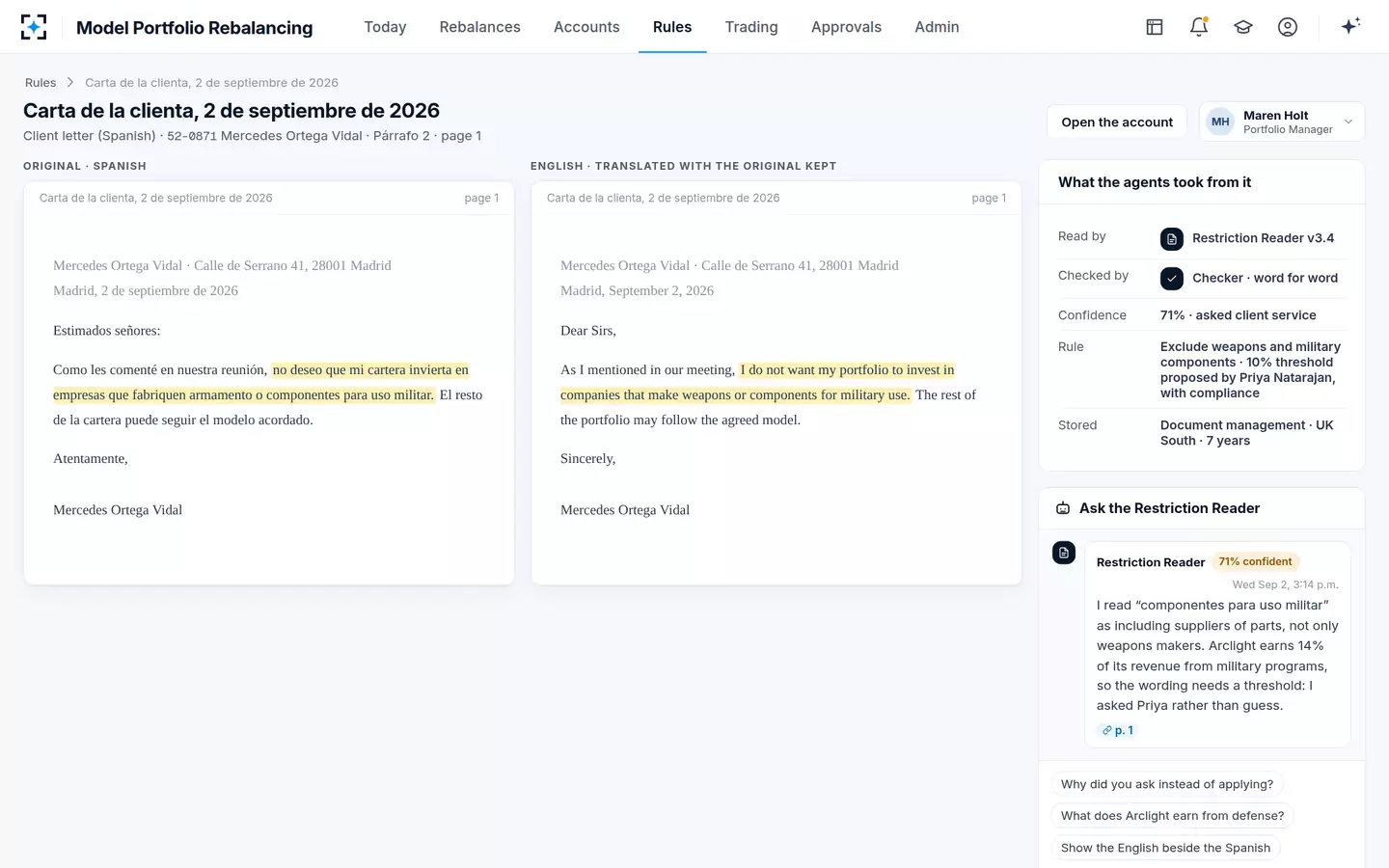
A client letter read in Spanish, with a question back instead of a guess
Can rebalancing software read client restriction letters?
Rule-based software cannot; it reads tables. Agent-based software can, and the question to ask is how it shows its reading. In the sample, each proposed rule quotes the client's sentence, names the document, the page and the date, and carries a confidence score; a letter in another language is shown beside its translation. Compliance approves the clause, not a paraphrase, and a phone note that contradicts a signed policy statement is never applied on its own.
The value is not only speed. The 2021 SEC risk alert found model programs that did not let clients impose reasonable restrictions or obstructed them, and Rule 3a-4's safe harbor depends on honouring them. A restriction that never left the letter is the failure no rule-based system can see.
What examiners and FINRA expect of any rebalancing software
Whatever the approach, a firm must be able to explain it and show it works. FINRA's 2016 report on digital advice tools says firms should be able to answer: "Are the methodologies tested by independent third parties?" "Can the firm explain to regulators how the tool works and how it complies with regulatory requirements?" and "Is there exception reporting to identify situations where a tool’s output deviates from what might be expected" (FINRA, Report on Digital Investment Advice, March 2016). Its effective practices include "testing the output of the tool on a regular basis to ensure that it is performing as intended".
"Until April 2021, Betterment lacked policies and procedures reasonably designed to ensure necessary communication between its compliance personnel, who review disclosures, and its engineers, who design and update its algorithms."
SEC order, In the Matter of Betterment LLC, Advisers Act Release No. 6288 (April 18, 2023)
The Betterment case is the warning for every approach. Software changes, and when the people who change it and the people who describe it to clients do not talk, disclosures go stale and clients lose money they were promised. A rebalancing system's settings, thresholds and agent versions should change only with a logged reason and an approval, and should be replayed on past model changes before they apply. In the sample firm, changes to an agent, its model or its instructions go through a change request compliance approves.
What should a rebalancing software pilot test?
A pilot should run the candidate on one past model change, with the client documents behind its accounts, and compare the result account by account with what the firm actually did. A demonstration on clean sample data tests the arithmetic, which every approach gets right. A replay on the firm's own messiest change tests what matters.
Eight things a rebalancing pilot on one past model change should measure
- Accounts placed and explained
Every account in the model either straight through or in a group with a plain reason; none unexplained.
- Restrictions found against the table
How many restrictions in the documents the table lacked, and how many table entries have no document.
- Household wash sales caught
Including the held-away IRAs and spouse accounts; compare with the 1099-Bs and the actual trades.
- Lots chosen and why
Realized gains by type against what the firm actually realized on the day.
- Cash shortfalls found before trading
Accounts that would have been overdrawn after settlement, against the custodian’s actual notices.
- Second-check disagreements
What the independent check caught, and whether each catch was right.
- Seeded errors
A handful of planted cases, from a misplaced restriction to a spouse’s purchase, with known answers.
- Hours and the record
Team hours against the firm’s own count, and whether an examiner could follow one account end to end.
The seeded cases matter because a pilot on real data only finds the errors that happened to be in it. Ten test cases from the SEC's tax-loss harvesting orders are a ready-made set for the tax side.
Where Model Portfolio Rebalancing fits, and where it does not
It fits a firm that runs discretionary model portfolios across many accounts, whose client rules live in documents, and whose households hold accounts on several models or at several custodians. It sits beside the systems the firm already runs: positions, lots, cash and prices from portfolio accounting; order files to the order management system after release, fills back for reconciliation; pending activity and held-away accounts from the custodians; documents from document management and the CRM; the firm's restricted, insider and substitute lists.
It is not an order management system, a portfolio accounting system or a custodian, and it does not replace them. It does not trade: a portfolio manager approves and a second person releases. It does not give tax advice to clients. It cannot check purchases in accounts the firm has no feed for, and it holds affected households when a feed is late rather than guessing. For a self-directed investor rebalancing one account, it is far more than the job needs.
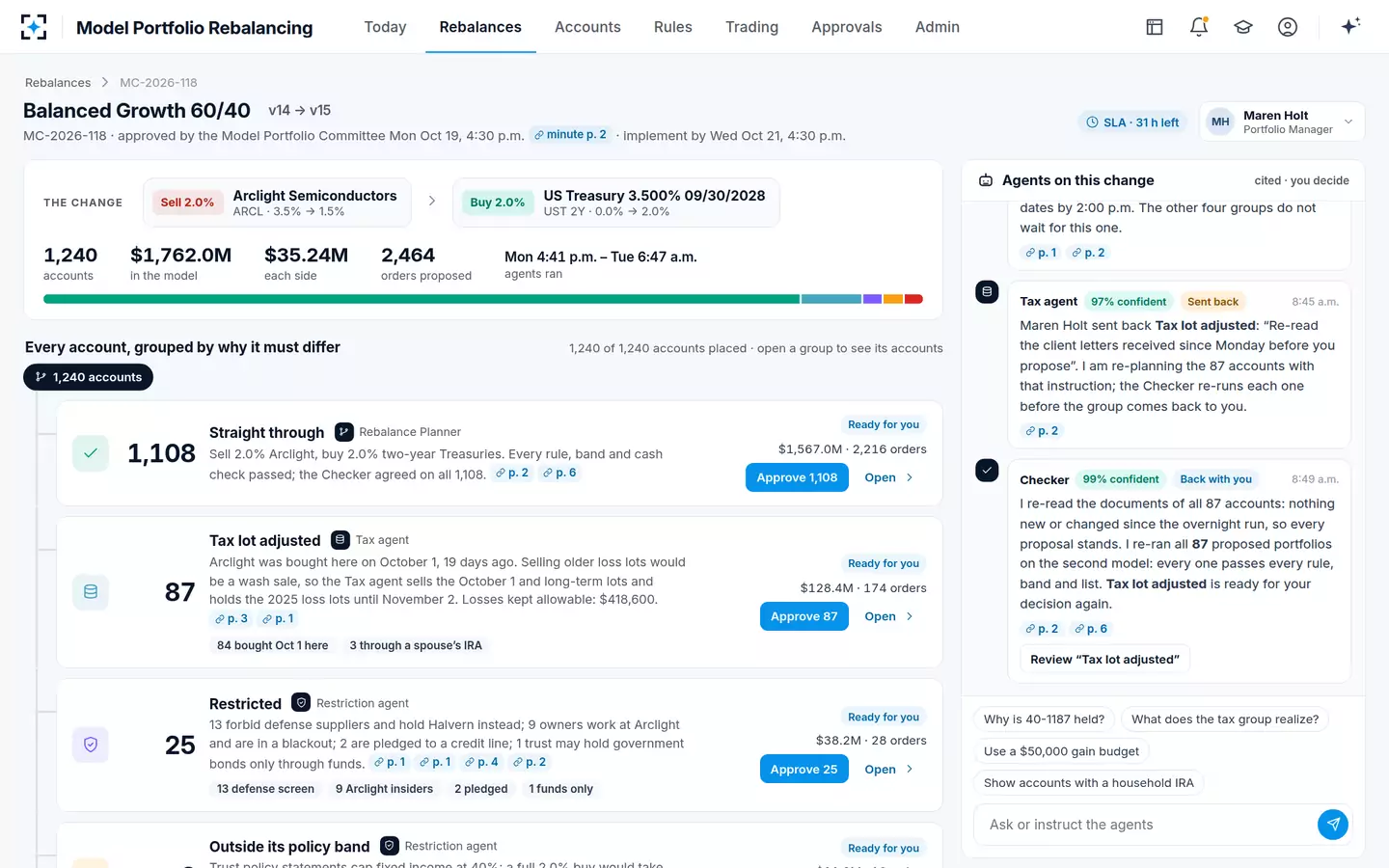
A group sent back with an instruction, re-planned and re-checked
How long does it take to switch rebalancing systems?
It depends on the data more than the software, so the honest first step is a pilot rather than a promise. The work that takes time in any switch is the same: mapping models and accounts, connecting positions, lots and cash, connecting the held-away feed, and, for an agent-based system, the first full read of the client documents, whose findings, like the sample firm's 2,673 unkeyed restrictions, need people to confirm. Vendors don't publish comparable switch times; a pilot on one past model change will show the firm its own.
A pilot on one past model change, as we would run it
- Choose and exportWeek 1
- Read documents; confirm rulesWeek 2
- Replay; plant errorsWeek 3
- Compare; decideWeek 4
The decision at the end is narrow and evidence-based: on the firm's own change, did the candidate find every exception, explain it, catch the planted errors, and leave a trail an examiner could follow? One model change traced overnight shows what that trail looks like in Model Portfolio Rebalancing.
Questions people ask
What is the best portfolio rebalancing software?
The one that handles the firm's exceptions correctly and can prove it. For a small book, spreadsheets may do; for many accounts with rules in documents and households across custodians, the test is whether the software finds every restriction, checks wash sales household-wide and explains each account, on a replay of the firm's own past model change.
What is a portfolio rebalancing tool?
Software that compares accounts with their target model and proposes trades to close the gap. Simple tools do the arithmetic for one account; rebalancing systems for advisers apply restrictions, tax lots, bands and cash across thousands of accounts and produce order files for a trading desk.
Is portfolio management software for financial advisors the same as rebalancing software?
Not quite. Portfolio management systems usually cover accounting, performance and reporting; rebalancing software proposes trades to keep accounts on their models. Many firms run both, and Model Portfolio Rebalancing reads from the accounting system rather than replacing it.
What records should rebalancing software keep?
At least the order memoranda Rule 204-2(a)(3) requires, marked as discretionary where they are, kept for five years under Rule 204-2. A firm relying on Rule 3a-4 also needs evidence that each client's restrictions were offered and honoured, and a firm that wants to answer examiners quickly keeps a reason for every account that differs from its model.
Can a spreadsheet rebalancer be good enough?
For a small number of accounts with few restrictions and one custodian, yes, if the analyst records the reasons. It stops being good enough when model changes take days, household purchases sit at other custodians, or the reasons for exceptions cannot be produced for an examiner.