A portfolio implementation analyst takes a model portfolio change approved by an investment committee and turns it into correct orders for every account that follows the model, then sees those orders to the trading desk. The trades themselves are the easy part. Most of the work is the accounts that must differ from the model: a client who forbade a sector in a letter, an insider in a blackout, a lot that would create a wash sale with a spouse's IRA, a trust whose policy caps bonds, a withdrawal due on Friday. Those rules live in documents, not in the rebalancing system, so the analyst spends the day finding them. Botminds' Model Portfolio Rebalancing gives that day to eight agents overnight, groups every account by why it must differ, and leaves the analyst and the portfolio manager the decisions.
The day below is set at the solution's fictional sample firm, Quillfield Private Wealth: 46 models, 15,384 discretionary accounts. Its people and figures are sample data, and the hours are Botminds' estimates for one model change across about 1,200 accounts, by hand and with the solution. Labour statistics come from the Bureau of Labor Statistics.
Where one model change's hours go, by hand and with the agents
- Model2 h
- Restrictions vs documents16 h
- Lots, wash sales8 h
- Cash4 h
- Exception grid12 h
- Approval3 h
- Review5 h
What does a portfolio implementation analyst do?
The analyst is the person between the model and the money. When the committee approves a change, the analyst loads the new model version, runs the rebalancer across every account on the model, works the exceptions, gets the result approved and hands an order file to the traders. In between, the job is to make each account follow the model as closely as its own rules allow, and to be able to say, for any account that does not, why not.
Titles vary: portfolio implementation analyst or associate, rebalancing analyst, trade and rebalancing analyst. The Bureau of Labor Statistics does not count the role separately; it falls within financial analysts, the occupation whose sample titles in the government's O*NET database include investment analyst and portfolio manager (O*NET 13-2051.00). In a model program the analyst is the operational half of the portfolio manager's job.
The occupation the role sits in, by the government's count
$103,570
median annual pay for financial analysts, 2025
443,100
financial analyst jobs in the US, 2025
7%
projected employment growth, 2025–35, much faster than average
The day after a model change, hour by hour
Monday at 4:30 p.m. the sample firm's Model Portfolio Committee approved change MC-2026-118: Balanced Growth 60/40 moves from version 14 to 15, selling 2.0% of Arclight Semiconductors and buying 2.0% of a two-year Treasury note, across 1,240 accounts worth $1,762.0 million, to be implemented by Wednesday at 4:30 p.m. By hand, Tuesday goes like this.
7:30. Read the committee minute, load version 15, run the rebalancer. It returns about 2,500 proposed orders and a grid of accounts flagged by error code: restricted security, insufficient cash, band breach, tax warning. 8:30 to 1:00. Restrictions. For each flagged account and a sample of the clean ones, open the advisory agreement, the policy statement, the trust document and the client's letters, because the restriction table holds only what someone keyed. 1:00 to 3:00. Tax lots: pull lots for the accounts with recent Arclight purchases and the households with outside IRAs, and decide which lots to sell. 3:00 to 4:30. Cash: confirm pending withdrawals with client service, resize buys. 4:30 onward. The exception grid again, with the reasons written down for the accounts that will not follow the model, for the portfolio manager's review on Wednesday morning.
Where the analyst's hours go on a model change: mostly on accounts that must differ
By hand, 45 hours
- Restrictions · 36%
- Exception grid · 27%
- Lots · 18%
- Cash, minute and approvals · 19%
Why does an account differ from its model?
Because the client, the law or the account's cash says it must. On the sample change, 1,108 of 1,240 accounts could follow the model exactly; 132 could not, for four kinds of reason. Each kind lives in a different place, which is why finding them takes the day.
The four reasons an account differed on one model change, and where each lives
| Reason | Accounts | What it was | Where the rule lives |
|---|---|---|---|
| Restricted | 25 | 13 defense screens, 9 Arclight insiders, 2 accounts pledged to a credit line, 1 trust that may hold government bonds only through funds | Client letters, agreements, the insider list, pledge agreements, trust documents |
| Tax lot adjusted | 87 | 84 bought Arclight in the account on 1 October; 3 households bought it in a spouse’s IRA elsewhere | Portfolio accounting lots and the custodians’ held-away feed |
| Outside its policy band | 6 | Trust policy statements cap fixed income at 40%; the full Treasury buy would breach it | Investment policy statements |
| Short of cash | 14 | A withdrawal due within days; the buy is sized to leave the cash | CRM notes and client service |
Each line also has a rule behind it. Rule 3a-4, the safe harbor discretionary model programs rely on, requires each account to be managed within any reasonable restrictions the client imposes, which makes the first line a legal question, not a preference (the rule in plain words). The second line is the wash sale rule, which counts purchases in the client's IRA and by a spouse; the household test works through it. The third is a document the client signed. The fourth is settlement arithmetic.
T+1 and the cash: why a buy can overdraw an account
Most US securities trades now settle one business day after the trade: Rule 15c6-1 bars broker-dealers from contracts providing for payment and delivery "later than the first business day after the date of the contract" unless otherwise agreed (17 CFR 240.15c6-1). A model change that sells and buys on the same day is self-funding in total, but not in every account: an account with a withdrawal leaving tomorrow, or a cash floor in its policy statement, can end the day overdrawn on paper.
The sample shows the scale. The Navarro Charitable Remainder Trust has a $180,000 distribution due on Friday; the model change would have it buy $62,400 of Treasuries. Sized to keep the distribution funded, the buy is $11,200. Fourteen accounts were in that position, and the analyst's job is to find them before the trade, not after the custodian's overdraft notice.
The order memorandum: what the analyst's work leaves in the books
Every order an adviser places leaves a required record. Rule 204-2 requires "A memorandum of each order given by the investment adviser for the purchase or sale of any security", showing its terms, who recommended it, who placed it and for which account, and "Orders entered pursuant to the exercise of discretionary power shall be so designated" (17 CFR 275.204-2(a)(3)). Those books are kept for at least five years, the first two in an appropriate office.
The rule asks for the order, not the reasoning. But the reasoning is what a portfolio manager, a client or an examiner asks for when an account did not follow the model, and by hand it usually lives in the analyst's spreadsheet notes, if anywhere. The 1997 Rule 3a-4 adopting release recognized that a manager need not judge each trade's fit for each client separately before trading a model (62 FR 15098); the exceptions are where the individual determination is made, and where the record is thinnest.
What skills does a portfolio implementation analyst need?
The job rewards four kinds of fluency, and only one of them is about markets. Reading documents precisely: a trust's cap on fixed income and a client's ban on weapons makers are rules with edges, and the edges decide trades. Tax mechanics: lots, holding periods, the 30-day window either side of a loss. Settlement and cash: what clears when, and what the custodian will do with an overdraft. And the systems: portfolio accounting, the rebalancer, the order management system, and the gaps between them.
The judgement that ties them together is knowing when to stop and ask. A client's wording that could be read two ways, a held-away file that arrives late, a withdrawal date nobody has confirmed: the right move each time is a question to the person who knows, before an order exists.
With agents: what the analyst keeps, and what moves
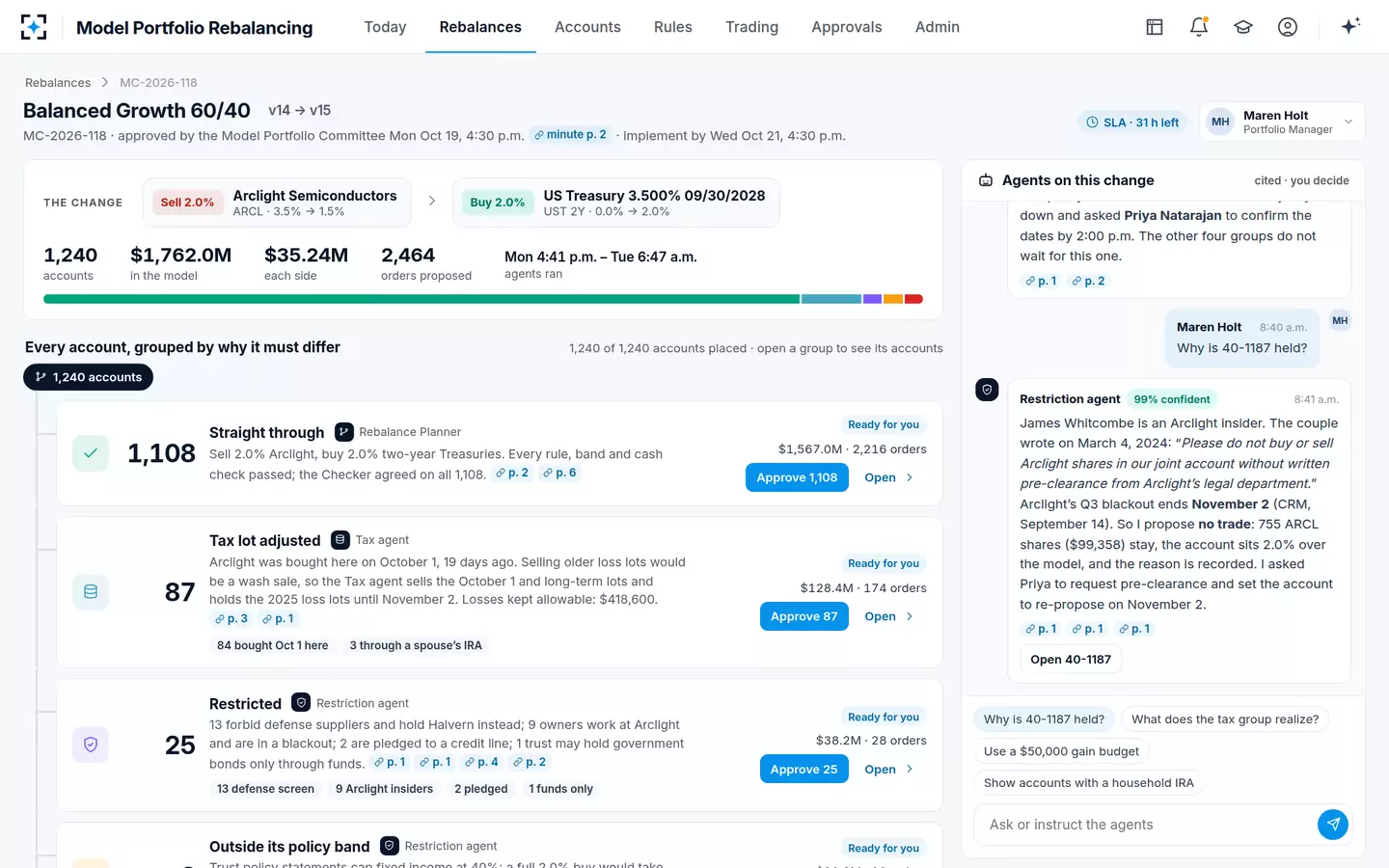
In Botminds' Model Portfolio Rebalancing the overnight run does the reading and the arithmetic. On the sample change the agents ran from Monday 4:41 p.m. to Tuesday 6:47 a.m.: the Restriction Reader had already turned the client documents into rules, each tied to its clause; the Rebalance Planner fanned the change out and grouped the 132 exceptions by reason; the Tax agent chose lots across each household; the Cash agent sized buys to withdrawals and asked client service to confirm 14 dates; the Checker re-ran every proposed portfolio on a second model and caught one proposal that broke a trust's rule.
Model Portfolio Rebalancing on the implementation desk: who does what once the agents work overnight
Today
Runs the rebalancer, opens documents for flagged accounts, picks lots, chases cash, writes reasons into a spreadsheet.
With agents
Reviews five groups with a reason each, questions any account, resolves what the agents asked about.
Still theirs: Every judgement call on wording, dates and data quality.
Today
“Show me why an account is different, not 2,000 rows that are.”
With agents
Approves group by group with a reason code, or sends a group back with an instruction.
Still theirs: The approval, and any short-term gain above an account’s budget.
Today
“If a client wrote it down, the rebalancer should know it.”
With agents
Answers the agents’ questions on wording, withdrawals and pre-clearance; proposes restriction changes.
Still theirs: The client relationship and every restriction proposal.
Today
“I sign off on what the rule says, with the clause in front of me.”
With agents
Approves each restriction change with the quoted clause, its source and the agent’s confidence beside it.
Still theirs: The decision on what a client’s words mean.
Today
“Give me a clean block, not a surprise at 3:45.”
With agents
Sees only released order files, already in blocks by security.
Still theirs: Execution.
What moves is the searching: the hours spent opening documents to find a rule, matching lots by hand, chasing a date. What stays is the part that needs a person. In the sample, the Restriction agent held account 40-1187 because the client is an Arclight insider in a blackout, and quoted the clients' letter of 4 March 2024 when the portfolio manager asked why.
The portfolio manager asks why an account is held; the answer quotes the letter
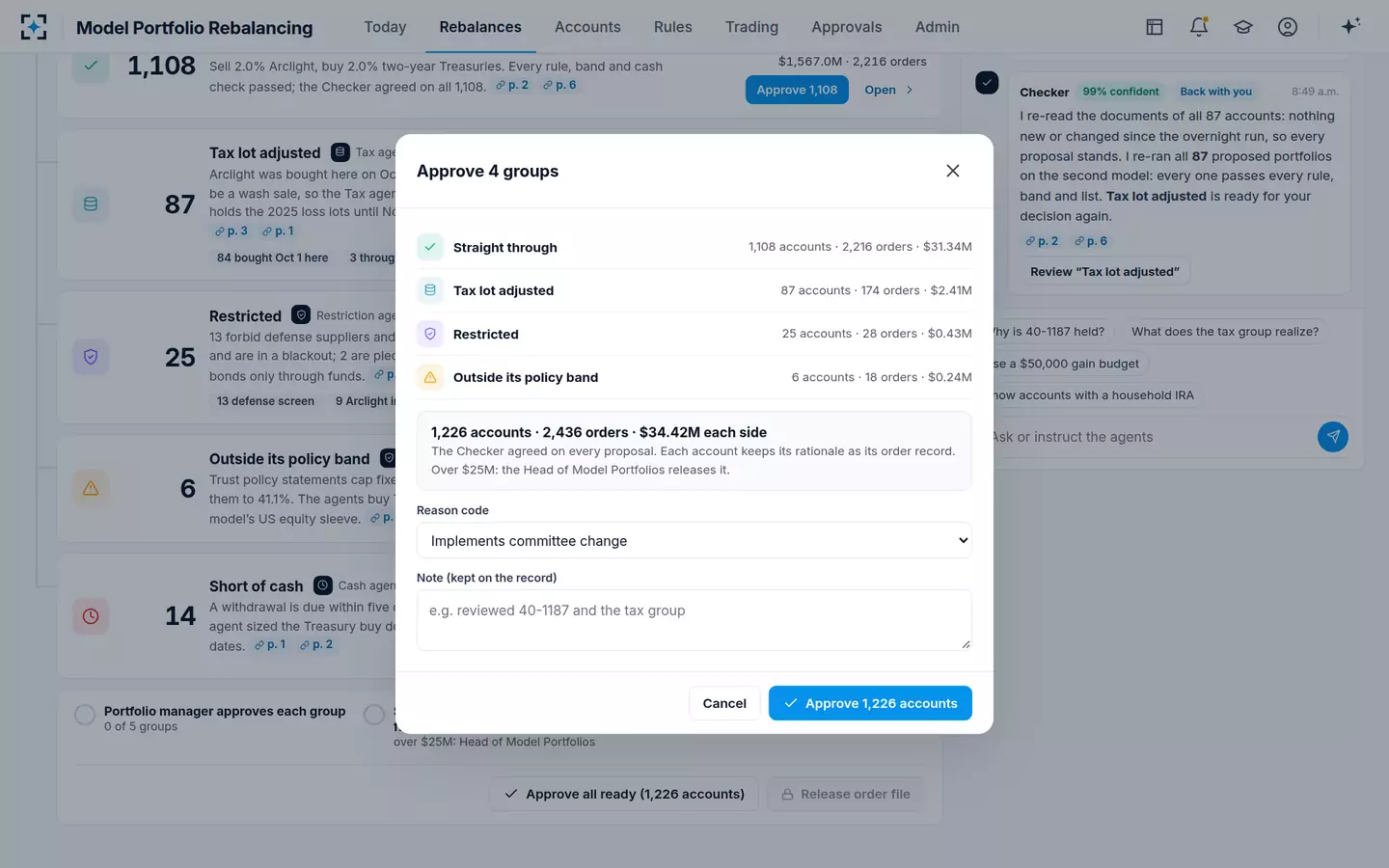
Approval stays in people's hands. The portfolio manager approved four ready groups together, 1,226 accounts and 2,436 orders, with a reason code; the 14 short-of-cash accounts waited for client service to confirm withdrawal dates. Because the order file was over $25 million, the Head of Model Portfolios released it as a second signature, and only then did the desk see it. The overnight run, step by step traces one account through the same night.
Approving by group, with the reason code that goes on the record
Questions people ask
What does a portfolio implementation associate do?
The same work under a more junior title: loading model changes, running the rebalancer, working exceptions and preparing order files for approval. Firms use associate, analyst and rebalancing analyst for overlapping roles; the BLS counts all of them within financial analysts.
How long does it take to implement a model change?
The sample firm gives itself two business days from committee approval. Botminds estimates the work by hand at about 45 team hours for a change across roughly 1,200 accounts, most of it on restrictions, exceptions and tax lots, against about 5 hours with the solution's agents doing the overnight run.
What is the difference between a portfolio manager and an implementation analyst?
The portfolio manager decides: what the account holds, which exceptions are acceptable, and whether a group of trades is approved. The implementation analyst makes the decision executable: correct orders for every account, the exceptions found and explained, and the order file built for the desk.
How much does a portfolio implementation analyst make?
The BLS does not publish pay for the title. The occupation it falls in, financial analysts, had a median annual wage of $103,570 in 2025, and pay for implementation roles varies with the firm and the size of the program.
What records does a model rebalance have to keep?
At minimum, a memorandum of each order under Rule 204-2(a)(3), marked as discretionary where it is, kept at least five years. Firms relying on Rule 3a-4 also need the client contact and restriction records the 1997 adopting release says are needed to demonstrate compliance.