How often you should rebalance your portfolio depends less on a date than on drift: the SEC's investor guide describes two accepted approaches, rebalancing on a calendar such as every six or twelve months, or whenever an asset class moves more than a pre-set percentage from its target, and says either works best when done relatively infrequently. For a firm running model portfolios across thousands of accounts, the better answer is to check often and trade rarely: compare every account with its model daily against tolerance bands, and trade only the accounts outside them. Botminds' Model Portfolio Rebalancing does that check each morning, proposes a drift run for the accounts outside their bands, and leaves the decision to a portfolio manager.
The sample figures come from the solution's fictional sample firm, Quillfield Private Wealth; the drift arithmetic is illustrative. The research is linked where it is used, and one paper is a working paper that has not yet been peer reviewed; it is labelled where it appears.
A year on one model: four calendar dates, or a trade only when drift crosses a band
- Unchecked; all trade 31 MarQ1
- Unchecked; all trade 30 JunQ2
- Unchecked; all trade 30 SepQ3
- Unchecked; all trade 31 DecQ4
- Checked daily; all inside bandsJan–May
- Equity rally: only accounts outside traderun 1, May
- Rate move: only those outsiderun 2, Oct
How often should you rebalance your portfolio?
Often enough to keep risk where the client agreed it should be, and no more often than drift requires. The SEC's Beginners' Guide to Asset Allocation, Diversification, and Rebalancing sets out both camps: "Many financial experts recommend that investors rebalance their portfolios on a regular time interval, such as every six or twelve months," while "Others recommend rebalancing only when the relative weight of an asset class increases or decreases more than a certain percentage that you’ve identified in advance" (SEC, Beginners' Guide).
The guide's verdict covers both: "In either case, rebalancing tends to work best when done on a relatively infrequent basis." It also names the costs that make frequent trading expensive: investors should ask whether their rebalancing method will set off trading fees or taxes. For a taxable account those consequences are the whole question, which is why whether rebalancing is a taxable event gets its own guide.
What rebalancing is for: risk, not return
Rebalancing exists to hold the portfolio at the risk the client chose. The SEC's investor site gives the canonical example: a portfolio set at 60% stocks that rises to 80% after market gains no longer has the risk the investor signed up for; selling stocks or adding to other asset categories is how you "reestablish your original asset allocation mix" (Investor.gov, Asset Allocation). The same page adds the behavioural point: by trimming winners and adding to laggards, "rebalancing forces you to buy low and sell high".
Households, left alone, do some of this themselves. Studying the complete portfolios of Swedish households, Calvet, Campbell and Sodini found active rebalancing "which on average offsets about one half of idiosyncratic passive variations in the risky asset share", and that "Wealthy, educated investors with better diversified portfolios tend to rebalance more actively" (NBER Working Paper 14177, published in the Quarterly Journal of Economics, 2009). A model program exists to do the other half, consistently.
Threshold rebalancing strategy: what tolerance bands are
A threshold, or band, strategy sets a tolerance around each target weight and rebalances when a weight leaves it. Bands can be absolute (a 40% target with ±3 points trades below 37% or above 43%) or relative (±10% of the target trades below 36% or above 44%), and they can be set per holding, per asset class and for cash. A daily check against bands is not daily trading: most days, nothing is outside.
Regulators have seen both approaches in automated programs. FINRA's 2016 review of digital advice tools found that "One firm uses a bright line threshold of 3 percent portfolio drift to initiate a rebalancing. Portfolio drift is monitored daily," while "another firm’s investment management committee determines the allowable drift on an ad hoc basis in response to market events" (FINRA, Report on Digital Investment Advice, March 2016). Its list of effective practices includes, where a firm uses drift thresholds, "disclosing what the thresholds are and whether the thresholds vary by asset class".
Rebalancing tolerance bands: the common designs and what each catches
| Band design | How it works | What it catches | What it misses |
|---|---|---|---|
| Absolute, per asset class | Trade when equity or bonds move more than a set number of points, such as ±3 | Broad shifts in risk after market moves | A single holding that runs far from target inside a calm asset class |
| Absolute, per holding | Trade when one holding moves more than a set number of points, such as ±1 | Concentration in one fund or stock | Nothing much; but it fires more often |
| Relative | Trade when a weight moves more than a set share of its target, such as ±25% | Drift in small positions, where points are too blunt | Large drift in big sleeves, unless the share is small |
| The "5/25" combination | Trade at 5 points absolute or 25% relative, whichever comes first | Big sleeves by points, small ones by share | Concentration below 5 points in a large sleeve |
| Cash band | Keep cash between a floor and a ceiling | Cash drag, and accounts that cannot fund withdrawals | Nothing about risk assets |
What is the 5/25 rule for rebalancing?
The 5/25 rule says to rebalance a holding when it moves 5 percentage points from its target or 25% of its target, whichever comes first. On a 40% sleeve, 25% of target is 10 points, so the 5-point trigger binds; on a 4% sleeve, 25% is one point, so the relative trigger binds. The combination keeps large sleeves from drifting far in points and small ones from doubling unnoticed.
It is a heuristic, and its numbers are conventions. What matters for a model program is that the bands are written down, applied the same way to every account on the model, and disclosed in the terms FINRA's report describes. A band that a committee widens after a market move, or that differs by account without a recorded reason, is a calendar in disguise.
How is portfolio drift calculated?
Drift is the current weight minus the target weight, where the current weight is the holding's market value divided by the account's total. It is measured per holding, per asset class and for cash, and compared with the band for each. A rally in one holding moves every other weight too, because the total rises.
Drift after a rally on an illustrative 80/20 model: the holding band fires first
The example shows why per-holding bands matter in a model. The asset-class view says equity is 2.1 points over, inside a ±3-point band, so nothing happens. The holding view says one fund is 4.6 points over and the rest of equity 2.5 points under: the allocation inside equity has shifted toward a single market. A rebalancer that checks only asset classes would leave it there until the next quarter.
What predictable rebalancing costs: the market-impact evidence
Rebalancing that the market can predict is rebalancing someone else can trade ahead of. A 2025 NBER working paper by Harvey, Mazzoleni and Melone, not yet peer reviewed, studies the institutions that "engage in trillions of dollars of regular portfolio rebalancing, often based on calendar schedules or deviations from allocation targets", and finds that when stocks are overweight, funds' selling leads "to a decrease in equity returns of 17 basis points over the next day" (NBER Working Paper 33554).
"Importantly, we estimate that current rebalancing practices cost investors about $16 billion annually – or $200 per U.S. household."
Harvey, Mazzoleni and Melone, NBER Working Paper 33554 (2025, revised 2026; working paper, not peer reviewed)
The paper's concern is predictability and size: "the predictability of these trades enables certain market participants to profit by front-running the orders of large institutional funds." A model program is a small version of the same pattern, many accounts trading the same securities in the same direction on known dates. Our reading for a model program, not the paper's prescription: avoid mass trades on fixed dates when only drift requires a trade, and trade only the accounts that need it.
Three numbers on rebalancing frequency, from regulators and research
6–12months
the calendar interval many experts recommend, per the SEC investor guide
3%
one firm’s bright-line drift trigger, checked daily, in FINRA’s 2016 review
$16bna year
estimated cost of current rebalancing practices to investors (working paper)
Does rebalancing increase returns?
Not reliably, and that is not its purpose. In a trending market, a portfolio left alone drifts toward the asset that is rising, and rebalancing sells some of it; whether that adds or subtracts return depends on what happens next. The SEC guide's framing is risk: rebalancing ensures "your portfolio does not overemphasize one or more asset categories, and you’ll return your portfolio to a comfortable level of risk."
What rebalancing reliably does is control two things a client can hold an adviser to: the risk profile agreed in the investment objective, and the costs, trading and tax, of keeping it there. Bands are better than dates at both, because they trade when the risk has actually changed and not otherwise.
Monitoring frequency is a fiduciary question
For a registered adviser running discretionary model accounts, "how often" is also a legal question. The SEC's 2019 interpretation of the adviser's duty of care includes "the duty to provide advice and monitoring at a frequency that is in the best interest of the client, taking into account the scope of the agreed relationship", and where the adviser has an ongoing relationship for a periodic asset-based fee, "the adviser's duty to provide advice and monitoring will be relatively extensive" (Commission Interpretation Regarding Standard of Conduct for Investment Advisers, 84 FR 33669).
That favours frequent checking, not frequent trading. An adviser who looks at drift once a quarter has to explain the eleven weeks in between; one who checks daily and trades only when bands are crossed can show both the monitoring and the restraint. The second is also easier to disclose plainly, as the SEC's investor bulletin on robo-advisers asks investors to find out: "How often is your account rebalanced?"
How Model Portfolio Rebalancing checks drift every morning
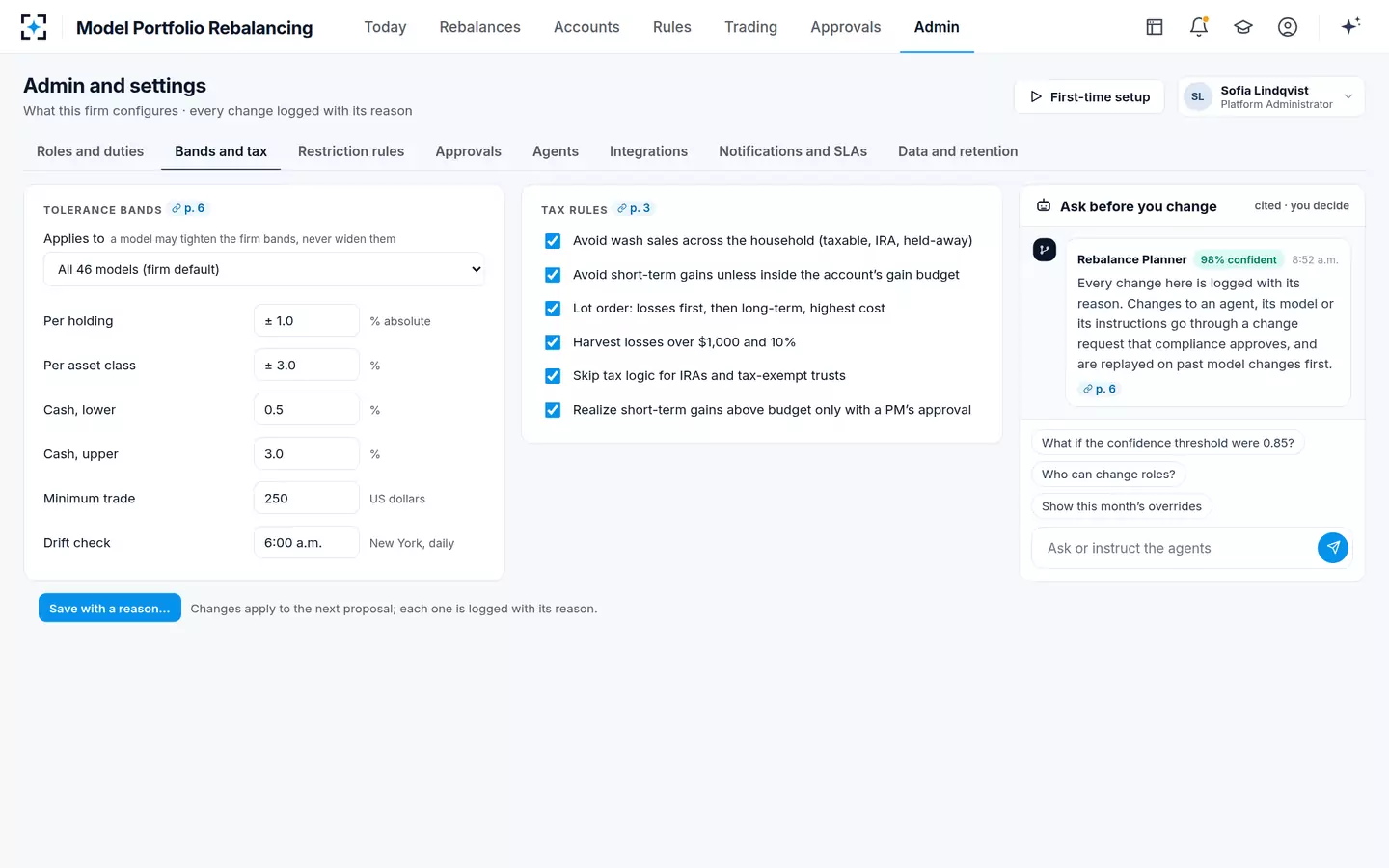
In Botminds' Model Portfolio Rebalancing the Drift agent compares every account with its model at 6:00 a.m. New York each day, against bands the firm sets: in the sample firm, ±1.0 point per holding, ±3.0 points per asset class and cash between 0.5% and 3.0%. A model may tighten the firm's bands, never widen them. The Drift agent proposes a drift run for accounts outside their bands; a portfolio manager schedules it. It never trades and never widens a band.
Rebalancing tolerance bands in Model Portfolio Rebalancing, as settings
On the sample firm's Tuesday, 214 accounts were outside a band, 164 of them on the Growth 80/20 model after a rally in US large caps. The Drift agent proposed a drift run for Thursday; the portfolio manager decides whether it goes. The other 15,170 accounts were checked and found inside their bands.
The morning check: 214 accounts outside their bands, a drift run proposed
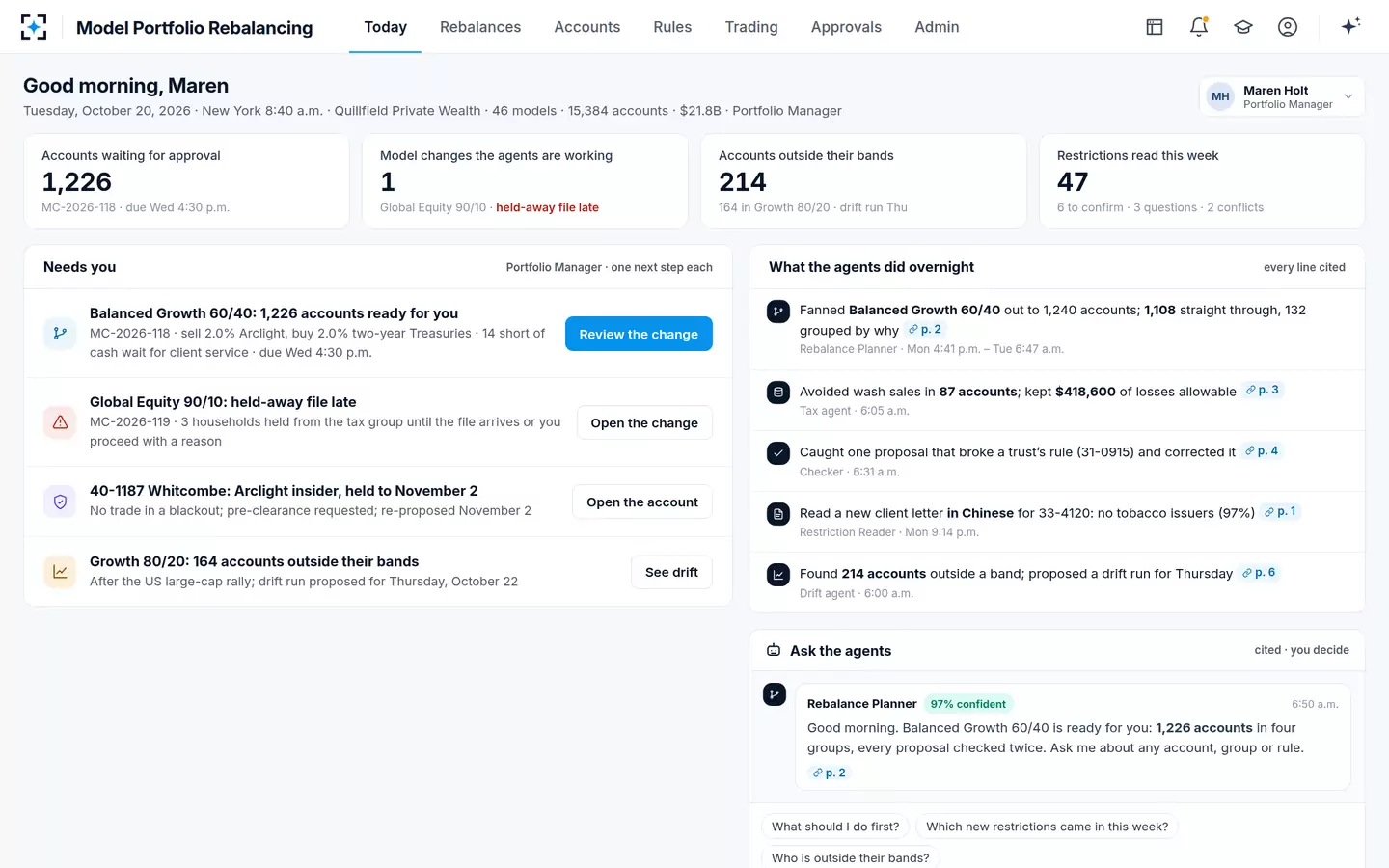
The same bands apply when a model changes. A committee change moves the target, so every account is suddenly outside a band by the size of the change, and the overnight run that follows takes each account from the new target to an order, with the reason it differs.
Questions people ask
How often should you rebalance a 401(k)?
The SEC's investor guide gives the same two options for any portfolio: a regular interval such as six or twelve months, or whenever an asset class drifts past a percentage set in advance. Trades inside a 401(k) trust generally do not create taxable gains, so the costs to weigh are mostly trading costs and the risk of drift between checks.
What is the optimal rebalancing frequency?
No single frequency is optimal for every portfolio; the SEC guide says only that rebalancing "tends to work best when done on a relatively infrequent basis". In practice the useful distinction is between checking frequency, which can be daily, and trading frequency, which bands keep low.
Is it better to rebalance by calendar or by threshold?
Calendar rebalancing is simple and easy to disclose, but it ignores drift between dates and trades accounts that have not moved. Threshold rebalancing trades only when risk has shifted, and FINRA's 2016 report describes it in use with daily monitoring. Many programs combine them: a daily check against bands with a periodic review.
What rebalancing bands should a model portfolio use?
Bands are a firm's decision and should be written down, disclosed and applied consistently. FINRA's report lists disclosing the thresholds, and whether they vary by asset class, as an effective practice. The sample firm uses ±1.0 point per holding and ±3.0 points per asset class.
Does rebalancing too often cost money?
Yes: each trade carries costs and, in a taxable account, may realize gains. The SEC guide tells investors to weigh whether a rebalancing method will set off trading fees or taxes, and a minimum trade size keeps small breaches from generating trades not worth their cost.