Yes, the wash sale rule applies across different accounts. Section 1091 of the Internal Revenue Code disallows a loss when the taxpayer acquires substantially identical stock within 30 days before or after the sale, and it never mentions accounts: a purchase in the client's second brokerage account, in their own IRA or Roth IRA, or by their spouse counts the same as a purchase in the account that sold. For a firm that runs model portfolios this is the hard case, because rebalancing software normally works one account at a time while the rule works one household at a time. Botminds' Model Portfolio Rebalancing checks the lots in every account of a household, held-away IRAs included, before it proposes a sale at a loss, and writes down why each lot was sold or kept.
The examples come from the solution's fictional sample firm, Quillfield Private Wealth, and its households; every product figure on this page is sample data. The tax rules are quoted from the IRS, the Treasury regulations and the statute, linked where they appear. Nothing here is tax advice to any client.
One household, one loss lot: the 61-day window across three lines
- 20 Sep–19 Oct: a purchase here counts30 days before
- Sale day 20 Oct and 21 Oct–19 Nov: a purchase here countssale day + 30 days after
- No purchase20 Sep–5 Oct
- Bought 120 shares on 6 Oct, inside the window6 Oct →
- Before the IRA buy16 d
- 6 Oct–5 Nov: a loss sale would be a wash sale31 d
- Clear of the IRA buy6 Nov →
Does the wash sale rule apply to different accounts?
It does, because the rule is written about the taxpayer, not about an account. The statute denies the deduction where "the taxpayer has acquired" substantially identical stock or securities "within a period beginning 30 days before the date of such sale or disposition and ending 30 days after such date" (26 U.S.C. §1091(a)). The Treasury regulation names that span the 61-day period (26 CFR 1.1091-1). Neither text mentions an account, a custodian or a registration.
IRS Publication 550 spells out what that means for an individual. A wash sale occurs when you sell at a loss and within 30 days before or after the sale you buy substantially identical stock or securities, acquire them in a fully taxable trade, acquire a contract or option to buy them, or "Acquire substantially identical stock for your individual retirement arrangement (IRA) or Roth IRA" (IRS Publication 550). Then it adds the household: "If you sell stock and your spouse or a corporation you control buys substantially identical stock, you also have a wash sale."
So the practical answer to "does wash sale apply to different accounts" has three parts. Two taxable accounts of the same person: yes, the purchase in one disallows the loss in the other. The person's own IRA or Roth IRA: yes, and the consequence is worse, as the next sections show. A spouse's account: yes, by the IRS's own statement, and the open questions there are about the basis afterwards, not about whether the loss is disallowed.
The 61-day window, drawn across one household
The window is easy to state and easy to miss in practice, because the purchase that triggers it can happen somewhere the rebalancer is not looking, and it can happen after the sale. Take the sample household above. On Monday 19 October the model committee cut Arclight Semiconductors from 3.5% to 1.5% of the Balanced Growth 60/40 model, to be implemented by Wednesday. Erik and Ingrid's joint account held three lots of Arclight, and the firm's default lot order sells losses first.
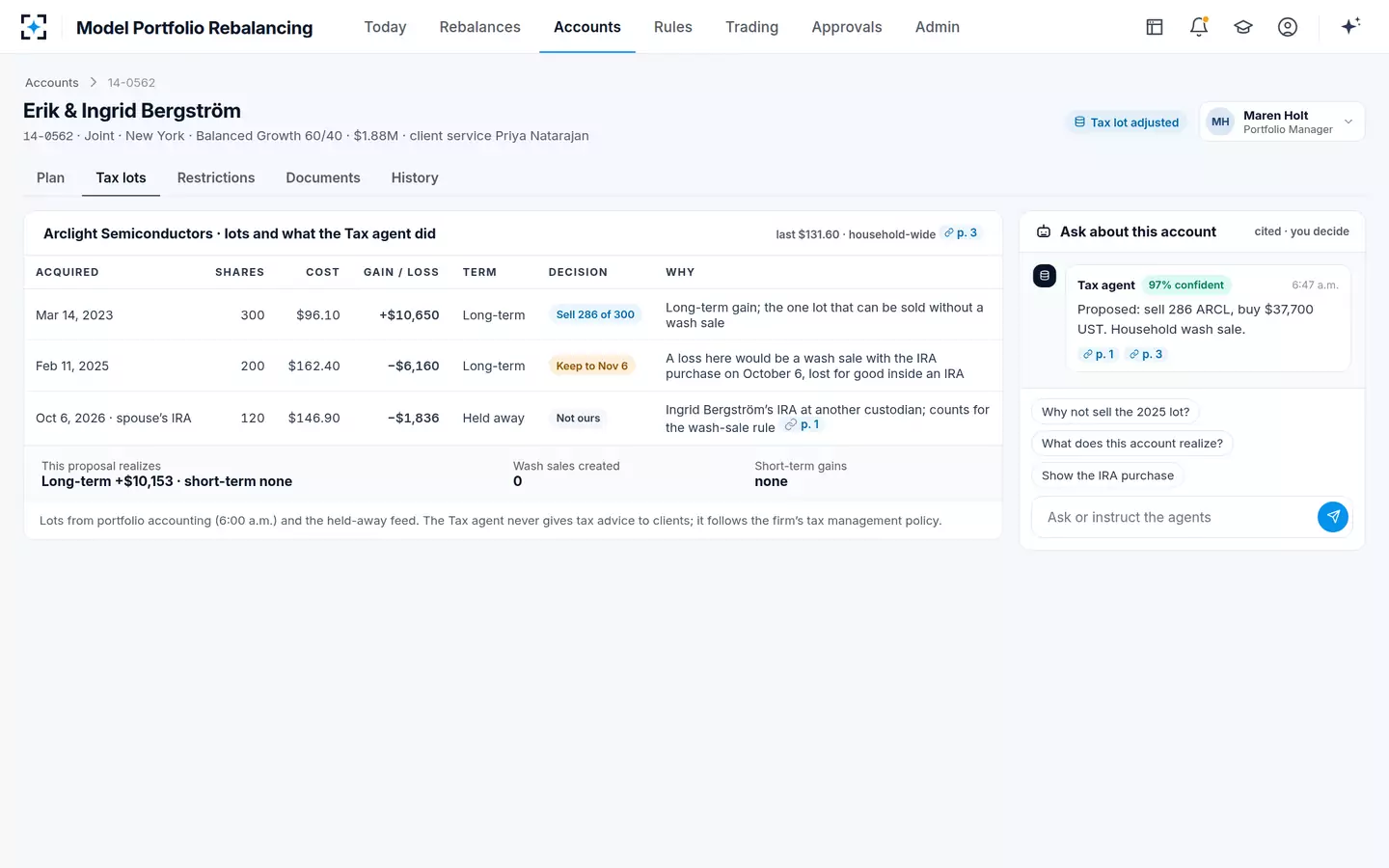
The 2025 lot was the loss: 200 shares bought at $162.40, worth $131.60 on the day, a $6,160 loss. Sold on 20 October it would have looked like a clean harvest inside the joint account. But on 6 October, fourteen days earlier, Ingrid's IRA at another custodian had bought 120 shares of the same stock. That purchase sits inside the 30 days before the sale, so a loss sale of the 2025 lot would be a wash sale for at least the 120 shares the IRA bought.
The window also runs forward. A loss sale on 20 October is exposed to any purchase of Arclight by the couple until 19 November: a dividend reinvested, a contribution invested by the IRA's own model, a spouse's trade. A check that only looks back at the last 30 days of fills answers half the question.
Does the wash sale rule apply to an IRA or Roth IRA?
Yes, and it is the worst place for the replacement purchase to land, because the loss is not deferred, it is lost. In the ordinary wash sale the disallowed loss is added to the basis of the replacement shares: "add the disallowed loss to the cost of the new stock or securities (except in (4) above)" (IRS Publication 550). Item (4) in the publication's list is the IRA and Roth IRA purchase. The exception is the whole point.
The IRS settled the IRA case in Revenue Ruling 2008-5. An individual sold 100 shares at a $400 loss and the next day caused his IRA to buy 100 shares of the same company. The ruling's holding: "the loss on the sale of the stock or securities is disallowed under section 1091 of the Code, and the individual’s basis in the IRA or Roth IRA is not increased by virtue of section 1091(d)" (Rev. Rul. 2008-5, IRB 2008-3). The IRA is a separate, tax-exempt trust, but the ruling borrows a 1933 Board of Tax Appeals case to say that the owner's "actual command over the property" decides it.
Same purchase, different account: what happens to the disallowed loss
Replacement bought in a taxable account: Disallowed for now.
Replacement bought in the client's IRA or Roth IRA: Disallowed.
Replacement bought in a taxable account: Added to the cost of the replacement shares, so it comes back when they are sold.
Replacement bought in the client's IRA or Roth IRA: Nowhere: the ruling says the basis in the IRA or Roth IRA is not increased.
Replacement bought in a taxable account: The replacement shares take on the holding period of the shares sold.
Replacement bought in the client's IRA or Roth IRA: Inside the IRA, holding period no longer matters for tax.
Replacement bought in a taxable account: A timing cost: the deduction moves to a later year.
Replacement bought in the client's IRA or Roth IRA: A permanent cost: the deduction never comes back.
For a household on a model, the arithmetic is unforgiving. If the Bergströms' joint account had sold the 2025 lot on 20 October, 120 of the 200 shares would have been matched to the IRA purchase. At $30.80 of loss per share, that is $3,696 of loss disallowed and, if the IRA treatment applies, never recovered, in exchange for harvesting a $6,160 loss the client was never going to get in full. Which lot a rebalancer sells decides whether that happens.
Wash sales between spouses: what the IRS says, and what it leaves open
A spouse's purchase triggers the rule. Publication 550 says so in one sentence, quoted above, and it is the reason household rebalancing has to read the spouse's accounts too. The publication names two parties besides yourself, your spouse and a corporation you control. It does not list children, parents or trusts.
What the IRS texts leave open is the combination: a spouse's IRA. Revenue Ruling 2008-5 speaks of the seller causing "his or her" own IRA or Roth IRA to buy. Publication 550 makes a spouse's purchase a wash sale but does not say what happens to basis when that spouse's purchase is inside an IRA. The cautious reading, and the one the sample firm's policy takes, is to treat a spouse's IRA like the client's own: avoid the loss sale, because if the IRA treatment applies the loss cannot be recovered. In the Bergström case the question is partly academic: the selling account is joint, so Ingrid is herself one of the sellers whose IRA bought.
Firms that extend the household further, to a child's account or a family trust, are setting policy, not following the publication. Rev. Rul. 2008-5's reasoning about "actual command over the property" is why some do it for trusts the client controls. That is a decision for the firm's tax policy, written down, not a default buried in code.
Are wash sales reported to the IRS? Why your 1099-B will not show this one
Some are, and the household ones usually are not. Publication 550 is precise about when Form 1099-B box 1g shows a disallowed wash sale loss: when the securities sold were covered securities and the replacement had "the same CUSIP numbers as the stock or securities you sold and were bought in the same account as the stock or securities you sold" (IRS Publication 550). A purchase in another account, at another custodian or by a spouse is outside what the broker reports.
The next sentence closes the loophole people hope for: "However, you cannot deduct a loss from a wash sale even if it is not reported on Form 1099-B." The taxpayer reports it on Form 8949 with code W. In practice that means the adviser who sold the loss lot created a reporting problem for the client and the client's preparer, who may not know the IRA bought.
What the wash sale rule reaches, and what the broker's form reports
| Replacement purchase | Wash sale under the rule? | Shown in Form 1099-B box 1g? |
|---|---|---|
| Same account, same CUSIP, covered security | Yes | Yes |
| Same account, a substantially identical security with a different CUSIP | Yes, if substantially identical on the facts | No |
| Another taxable account of the same person | Yes | No |
| The client's own IRA or Roth IRA | Yes, and the loss is not added to the IRA basis | No |
| The client's spouse, any account | Yes, per Publication 550 | No |
| A corporation the client controls | Yes, per Publication 550 | No |
Matching: which shares carry the disallowed loss
A wash sale is rarely all or nothing. When fewer shares are bought in the window than were sold at a loss, only that many shares of the loss are disallowed. The regulation's rule is mechanical: "The stock or securities acquired will be matched in accordance with the order of their acquisition (beginning with the earliest acquisition) with an equal number of the shares of stock or securities sold" (26 CFR 1.1091-1(c)). Publication 550's own example sells 100 shares at a $1,000 loss after buying 75 replacement shares in the window: $750 is disallowed, $250 is deductible.
Two more rules from the publication matter for model trades, which often sell several lots of one security on the same day. A wash sale loss on one block "cannot be used to reduce any gains on identical blocks sold the same day". And where losses on the same day cannot be ordered, the regulation treats the shares as sold in the order they were acquired. A rebalancer that nets gains and losses across lots before checking the window will report a number the return cannot use.
How a model change creates household wash sales
Model programs manufacture the conditions for this rule. The same security sits in many models; households hold several accounts on different models or sleeves; and one committee decision makes every one of those accounts trade the same name on the same days. A sale in the taxable account and a purchase in the IRA sleeve can come out of one rebalance.
The SEC has already described the pattern at a robo-adviser. Betterment let clients hold a third-party model portfolio beside its own; the two used some of the same ETFs, so "if TLH directed a sale of an ETF in the client’s Betterment portfolio, and the same security was subsequently purchased in the client’s third-party portfolio within a thirty-day period, there could be a negative tax consequence for the client" (SEC order, In re Betterment, April 2023). Betterment's fix was blunt: it stopped harvesting in asset classes where the overlap existed, and did not tell clients.
What a blanket wash-sale workaround cost one adviser's clients
5,600
accounts on two model strategies with tax-loss harvesting on, Sept 2017 to Jan 2019
3,200
of them, at least, lost harvesting benefits to the undisclosed overlap constraint
$1M
approximate potential tax benefits those accounts lost
The lesson is not that cross-account wash sales are rare. It is that avoiding them by turning things off costs clients money too, and that the only answer that loses nothing is lot-level: know which lots in which accounts were bought when, and choose the sale accordingly. How to test an automated harvester takes the same order apart for its other failures.
How Model Portfolio Rebalancing checks the household before the order
In Botminds' Model Portfolio Rebalancing the check runs before a single order is proposed. The Tax agent reads the lots in every account of the household from portfolio accounting, and the household's outside IRAs and spouse accounts from the custodians' held-away feed. For each sale at a loss it looks 30 days back at fills and 30 days forward at anything scheduled, then picks lots that sell cleanly.
A household wash-sale check in Model Portfolio Rebalancing, step by step
Agent
Rebalance PlannerFans the model change out to every account and proposes the sales the model needs, account by account.
Never: sends an order.
Agent
Tax agentGroups accounts into households, reads every lot, and matches each proposed loss sale against purchases 30 days back and forward, held-away IRAs included.
Never: gives tax advice to a client.
Agent
Tax agentSells other lots instead, holds the loss lot with the first clean date, and writes the reason beside each lot.
Never: realizes a short-term gain above the account’s budget without a portfolio manager.
Agent
CheckerRe-runs every proposed portfolio on a second model and blocks the group if it disagrees.
Never: resolves its own disagreement.
A person decides
Portfolio managerReads the group "Tax lot adjusted", questions any account, and approves it with a reason code or sends it back.
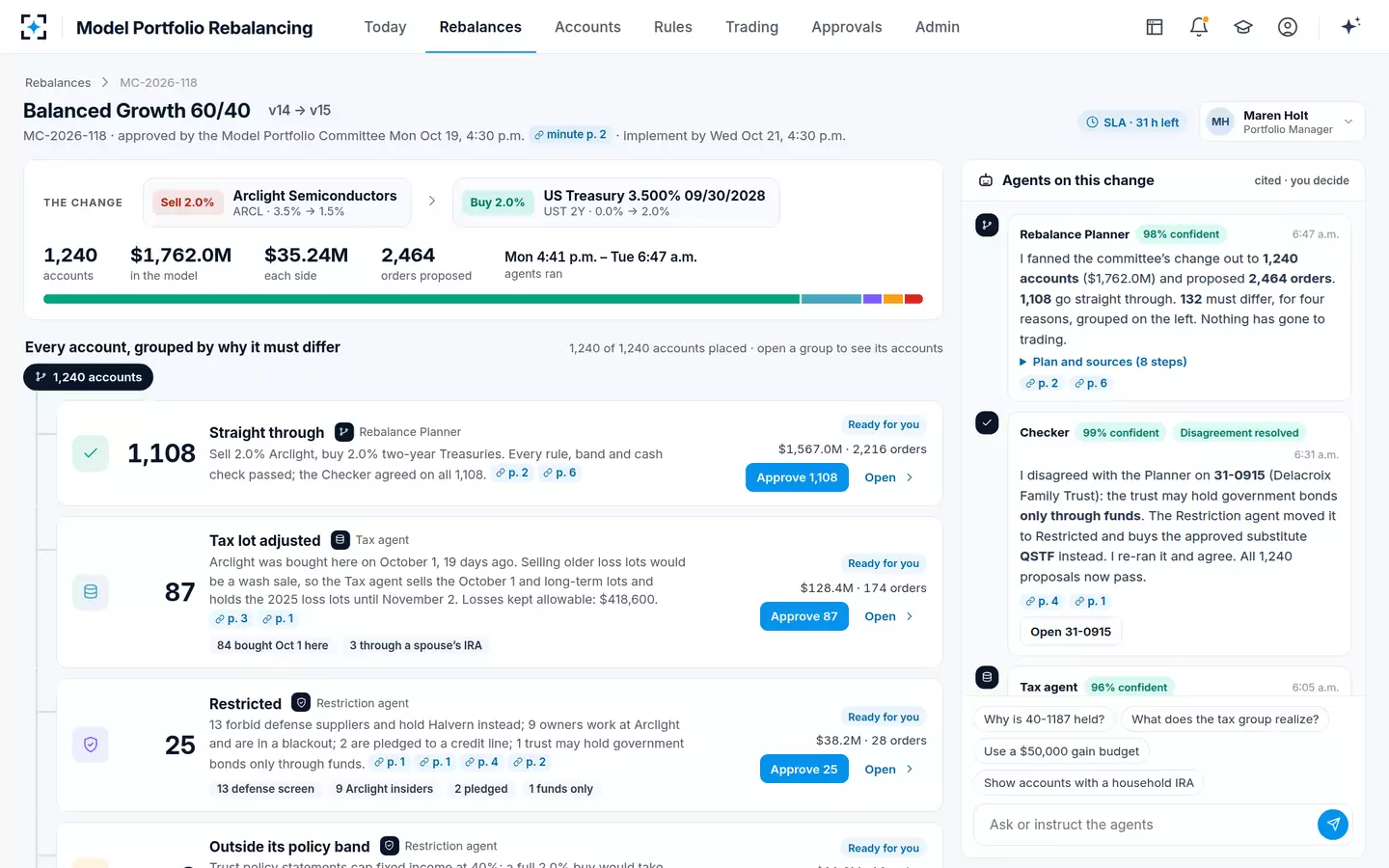
On the sample model change, 87 of 1,240 accounts landed in the group "Tax lot adjusted": 84 had bought Arclight in the same account on 1 October, and 3 households had bought it through a spouse's IRA elsewhere. Keeping their loss lots for later kept $418,600 of losses allowable across the 87, and the group created no wash sales. For the Bergströms, the Tax agent sold 286 of the 300 shares bought in March 2023, a long-term gain of $10,153, and held the 2025 lot until 6 November.
The tax group in Model Portfolio Rebalancing: 84 accounts bought here, 3 through a spouse's IRA
One household's lots: the row that is not the firm's decides the row that is
What to put in the firm's wash-sale policy
The rule tells the client what is lost; it does not tell the adviser how to avoid it. That is policy, and an examiner reading it will compare it with what the system did. The SEC's 2020 observations on adviser compliance programs list weaknesses in "Monitoring compliance with client investment and tax planning strategies" among the portfolio management findings, and a household wash-sale policy is exactly such a strategy.
Seven decisions a household wash-sale policy should write down
- Who is in the household
The client, the spouse and corporations the client controls, as Publication 550 lists them; then any further relations or trusts the firm chooses to include, and why.
- Which accounts are read
Every taxable and retirement account at the firm, and held-away accounts with the source of the feed and how late it may be before trades wait.
- Both directions of the window
Fills in the 30 days before the sale and anything scheduled in the 30 days after: model buys, reinvested dividends, contributions.
- What counts as substantially identical
The IRS gives no list. Name the pairs the firm treats as identical, such as share classes of one fund, and who decides a new pair.
- The order of remedies
Sell other lots, hold the loss lot to its first clean date, buy an approved substitute, or accept the wash sale with a recorded reason.
- IRA and spouse-IRA purchases
Treat as permanent loss and avoid unless a portfolio manager decides otherwise in writing.
- What the client is told
How wash sales are handled across accounts, including accounts the firm does not manage; Betterment's case turned on what clients were not told.
The last item is the one firms skip. Clients often hold accounts elsewhere, and a firm that does not see them should say so, so that the client or the preparer knows the household check stops at the firm's door. Where the firm does see them, the check should leave a trail: what each model change realizes for the client is much easier to explain when every lot carries its reason.
Questions people ask
Does the wash sale rule apply between an IRA and a taxable account?
Yes. Publication 550 lists acquiring substantially identical stock for your IRA or Roth IRA within 30 days of a loss sale as a wash sale. Under Rev. Rul. 2008-5 the loss is disallowed and the IRA's basis is not increased, so the loss does not come back later.
Does the wash sale rule apply to a Roth IRA?
Yes, in the same way as a traditional IRA. Both the publication and the 2008 ruling name the Roth IRA explicitly. Selling inside a Roth IRA at a loss has no tax effect, so the issue is a Roth purchase that matches a loss sale in a taxable account.
Does the wash sale rule apply to family members?
Publication 550 names your spouse and a corporation you control, and no one else. A child's or parent's purchase is not listed. Firms that include them, or family trusts, are setting a stricter policy than the publication states.
Are wash sales across accounts reported on Form 1099-B?
Generally not. Box 1g reports a disallowed loss only when the replacement had the same CUSIP and was bought in the same account. Publication 550 is explicit that the loss is still not deductible when the form does not show it; the taxpayer reports it on Form 8949 with code W.
How long after a wash sale can you sell the loss lot?
Once no purchase of substantially identical stock falls within 30 days before or after the new sale date. In the sample household the IRA bought on 6 October, so 6 November was the first day a sale of the 2025 lot sat outside the window, provided nothing is bought in the 30 days after it.
Can buying a different ETF avoid a wash sale?
Only if the two are not substantially identical, which the IRS judges on "all the facts and circumstances". Publication 550 says stock of one corporation is ordinarily not substantially identical to another's; for funds tracking the same index there is no published list, so the firm's policy has to decide and record which pairs it treats as identical.