Rebalancing is a taxable event when it sells an investment for more than its cost in a taxable account: the gain is a capital gain, long-term if the investment was held more than a year, short-term and taxed as ordinary income if not. Rebalancing inside an IRA, Roth IRA or 401(k) is generally not taxable, because those accounts are exempt from tax until money is withdrawn, and buying alone is never taxable. For a client on a model portfolio, the tax cost of a model change therefore depends on two choices the firm makes: which of the client's accounts does the selling, and which lots it sells. Botminds' Model Portfolio Rebalancing makes both choices per account and per lot, shows what each change will realize before it is approved, and lets a portfolio manager test a gain budget as a what-if.
Tax rates and rules are quoted from the IRS and the Internal Revenue Code, linked where they appear; the household below is illustrative arithmetic, and the solution's figures come from its fictional sample firm, Quillfield Private Wealth. Nothing here is tax advice to any client.
One model change, one household: what the client pays depends on which account sells
Taxable joint account, $1.0M
Copied into each accountSells $20,000 of the stock; basis $10,000
Gain if copied$10,000 long-term gain
Tax if copied$1,880
Sold where it costs leastSells $5,000; basis $2,500
Gain, sold where cheapest$2,500 gain
Tax, sold where cheapest$470
Traditional IRA, $0.7M
Copied into each accountSells $14,000
Gain if copiedNone: the IRA is exempt
Tax if copied$0
Sold where it costs leastSells all $24,500 it holds
Gain, sold where cheapestNone
Tax, sold where cheapest$0
Roth IRA, $0.3M
Copied into each accountSells $6,000
Gain if copiedNone
Tax if copied$0
Sold where it costs leastSells all $10,500 it holds
Gain, sold where cheapestNone
Tax, sold where cheapest$0
Household
Copied into each account$40,000 sold
Gain if copied$10,000 realized
Tax if copied$1,880
Sold where it costs least$40,000 sold
Gain, sold where cheapest$2,500 realized
Tax, sold where cheapest$470
Is rebalancing a taxable event?
In a taxable account, the sales are. "When you sell a capital asset, the difference between the adjusted basis in the asset and the amount you realized from the sale is a capital gain or a capital loss," the IRS's capital gains topic says (IRS Topic 409). A rebalance that sells a position held at a profit realizes that profit, whatever the reason for the sale. A rebalance done entirely by buying, with new money, realizes nothing.
The holding period decides the rate. "If you hold the asset for more than one year before you dispose of it, your capital gain or loss is long-term. If you hold it one year or less, your capital gain or loss is short-term," and "Net short-term capital gains are subject to taxation as ordinary income at graduated tax rates." A rebalance that sells a recent purchase at a gain can cost the client tax at the top of their income bracket.
Is rebalancing in an IRA or 401(k) taxable?
Generally not. Revenue Ruling 2008-5 restates the Code: "Under § 408(e)(1), generally, an individual retirement account is exempt from taxation" (Rev. Rul. 2008-5); sales and purchases inside it create no gain or loss on the owner's return. A 401(k) plan's trust is likewise exempt: the Code says an organization described in section 401(a) "shall be exempt from taxation under this subtitle" (26 U.S.C. §501(a)).
The tax comes later, on the way out: a traditional IRA's tax is generally deferred until money is distributed, and qualified Roth distributions are not taxed at all (IRS Publication 550; what that means for where each holding sits). The exception that catches model programs is not a sale inside the IRA but a purchase: an IRA buy within 30 days of a loss sale in a taxable account makes that sale a wash sale, and the IRA's basis does not rise. The household wash-sale test covers it.
What a sale costs: the rates that apply
What a rebalancing sale costs in a taxable account, by the IRS's 2025 figures
| Item | The rule | What it means for a model change |
|---|---|---|
| Short-term gain (held one year or less) | Taxed as ordinary income at graduated rates | The costliest gain a rebalance can realize |
| Long-term gain, 0% rate | Taxable income up to $48,350 single, $96,700 married filing jointly | Some clients can realize gains at no federal tax |
| Long-term gain, 15% rate | Up to $533,400 single, $600,050 married filing jointly | The rate most clients pay on long-term gains |
| Long-term gain, 20% rate | Above those thresholds | High earners |
| Net investment income tax | 3.8% on the lesser of net investment income or MAGI above $200,000 single, $250,000 joint | Added to the capital gain rate for many model-program clients |
| Net capital loss | Deductible against other income up to $3,000 a year ($1,500 married filing separately); the rest carried forward | Losses beyond the year’s gains are worth less this year |
Two features of the table matter most for rebalancing. The jump between short-term and long-term rates rewards waiting: a gain lot a few weeks from its one-year anniversary is often better sold on the next run. And the 0% bracket is a real opportunity for some clients, retirees with low taxable income among them, whose rebalancing gains may cost nothing federally; a program that treats all gains as costly will trade too little for them.
One model change, one household: where the client's tax goes
The frame at the top of this page shows the mechanism in its simplest form. A household with a taxable account, a traditional IRA and a Roth IRA, all on the same 60/40 model, must sell $40,000 of a stock the committee cut. Copied into each account, the change sells in proportion to account size, and the taxable account's half of the selling realizes a $10,000 gain: about $1,880 of tax at the assumed rates. Sold where it costs least, the change does most of its selling in the two retirement accounts, which hold $35,000 of the stock between them, and the taxable account sells only the last $5,000: a $2,500 gain, about $470 of tax.
The household ends with the same total weight in the stock either way. What differs is that the accounts no longer each match the model: the IRA and Roth hold none of the stock, and the taxable account holds more than the model does. That is the trade-off of tax-aware rebalancing, and the reason it needs an asset location policy and a written reason for every account that differs.
How to rebalance a portfolio without paying taxes
Trade where trades are not taxed, use money that is moving anyway, and sell the lots that cost least. The SEC's investor guide lists three ways to rebalance, two of which involve no selling: "You can purchase new investments for underweighted asset categories" and, for regular savers, "alter your contributions so that more investments go to under-weighted asset categories until your portfolio is back into balance" (SEC, Beginners' Guide).
Seven ways to rebalance with less tax, roughly in order of cost
- Use cash flows first
Deposits, dividends and withdrawals. FINRA describes how "the firm uses customer contributions to purchase underweighted asset classes and withdrawals from over-weighted asset classes".
- Do the selling in tax-deferred accounts
Sales inside an IRA, Roth IRA or 401(k) generally realize nothing for the client.
- Sell losses before gains
Realized losses offset realized gains; check the household for purchases within 30 days first.
- Sell long-term before short-term
Short-term gains are taxed as ordinary income; long-term gains at 0%, 15% or 20%.
- Choose high-basis lots
Specific identification, named before settlement, can sell the lots with the smallest gains.
- Trade only outside the bands
Fewer trades realize fewer gains; the SEC guide says rebalancing works best done relatively infrequently.
- Set a gain budget per client
A cap on net gains per year, as some clients' accountants ask for in writing.
FINRA's 2016 review of digital advice tools adds a caution on the first method: using dividends and reinvestments "is effective when portfolio drift is minimal within an account since dividends and reinvestments would typically not be large relative to the size of the position" (FINRA, Report on Digital Investment Advice). A model change of two percentage points is rarely minimal. For those, the choice is between the other six.
What is tax-aware rebalancing?
Tax-aware rebalancing is rebalancing that chooses its trades, accounts and lots to reach the target with the least tax, within limits the client and the firm have set. It is not tax avoidance: the model change still happens, and every gain realized is reported. What changes is that the realized gain becomes a decision rather than a by-product.
In practice that means three things the rebalancer must know that most do not: the lots and their holding periods in every account of the household; the client's tax constraints, such as a gain budget or a short-term gain ban; and the household's purchases in the 30 days either side of any loss sale. Which lot to sell works the second of those to the dollar on one sale.
The same model change, run account by account or tax-aware
Account by account: Every account, in proportion to its size.
Tax-aware, household-wide: Tax-deferred accounts first, where they can absorb the change.
Account by account: The custodian’s default: first in, first out.
Tax-aware, household-wide: Losses, then long-term high-basis lots, named before settlement.
Account by account: Realized if the default lot is short-term.
Tax-aware, household-wide: Avoided outside the account’s gain budget, or decided by a portfolio manager.
Account by account: Only if keyed into the system.
Tax-aware, household-wide: Read from the client’s documents, such as an accountant’s letter capping gains.
Account by account: A realized gain on the next statement.
Tax-aware, household-wide: The realized gain, and the reason each account and lot was chosen.
The gain budget: what a cap on realized gains costs in drift
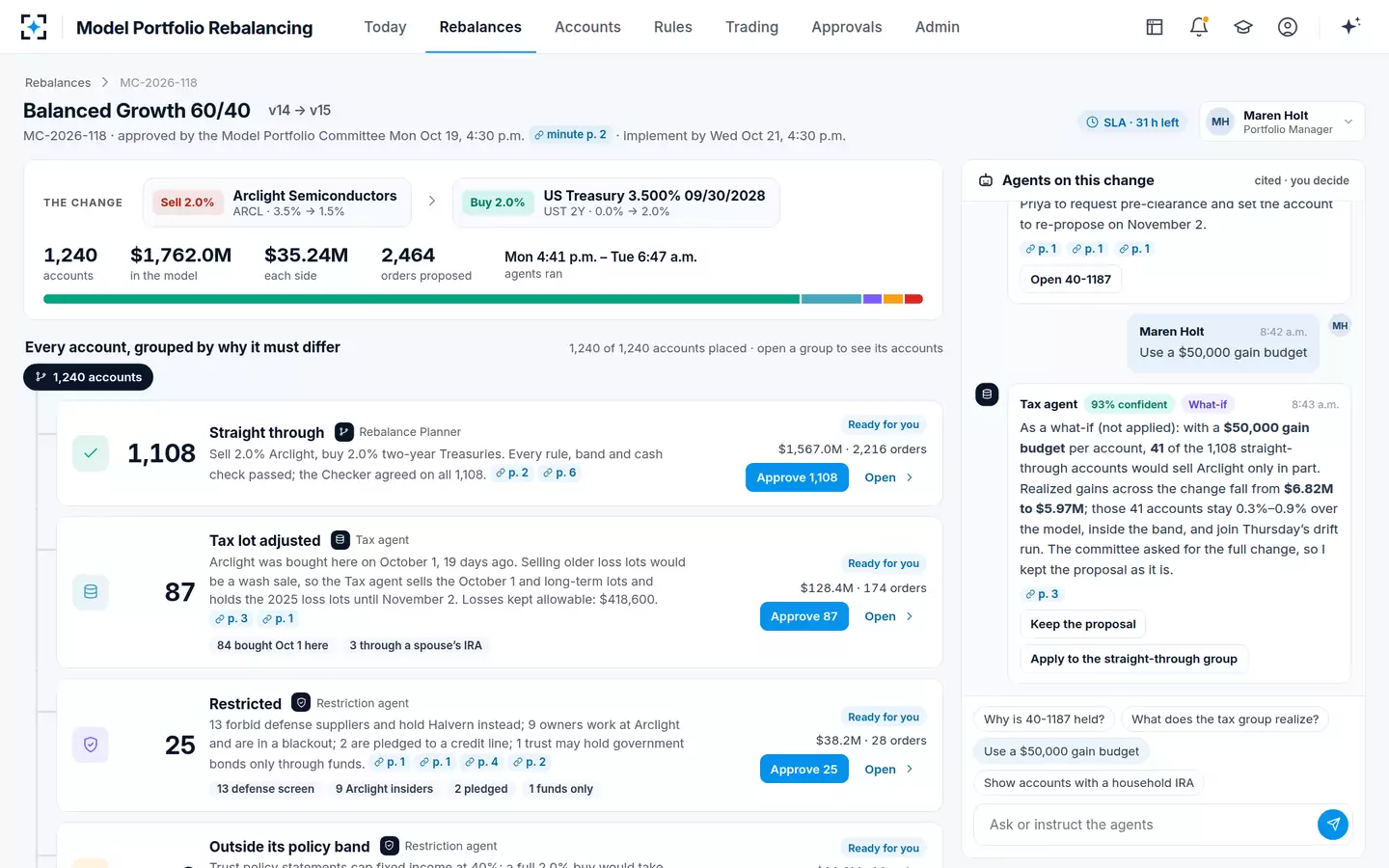
A gain budget caps the gains an account may realize in a year, and the price is drift: an account that hits its budget sells less than the model asks. In Botminds' Model Portfolio Rebalancing a portfolio manager can test a budget in plain words before applying it. On the sample firm's model change, the instruction "Use a $50,000 gain budget" came back as a what-if: 41 of the 1,108 straight-through accounts would sell Arclight only in part, realized gains across the change would fall from $6.82 million to $5.97 million, and those 41 accounts would stay 0.3% to 0.9% over the model, inside the band.
What a $50,000 gain budget would have done to one model change
$6.82M
realized gains across the change, as proposed
$5.97M
with a $50,000 gain budget per account
41
accounts that would sell only in part, left 0.3%–0.9% over the model
A gain budget tested as a what-if, before anyone applies it
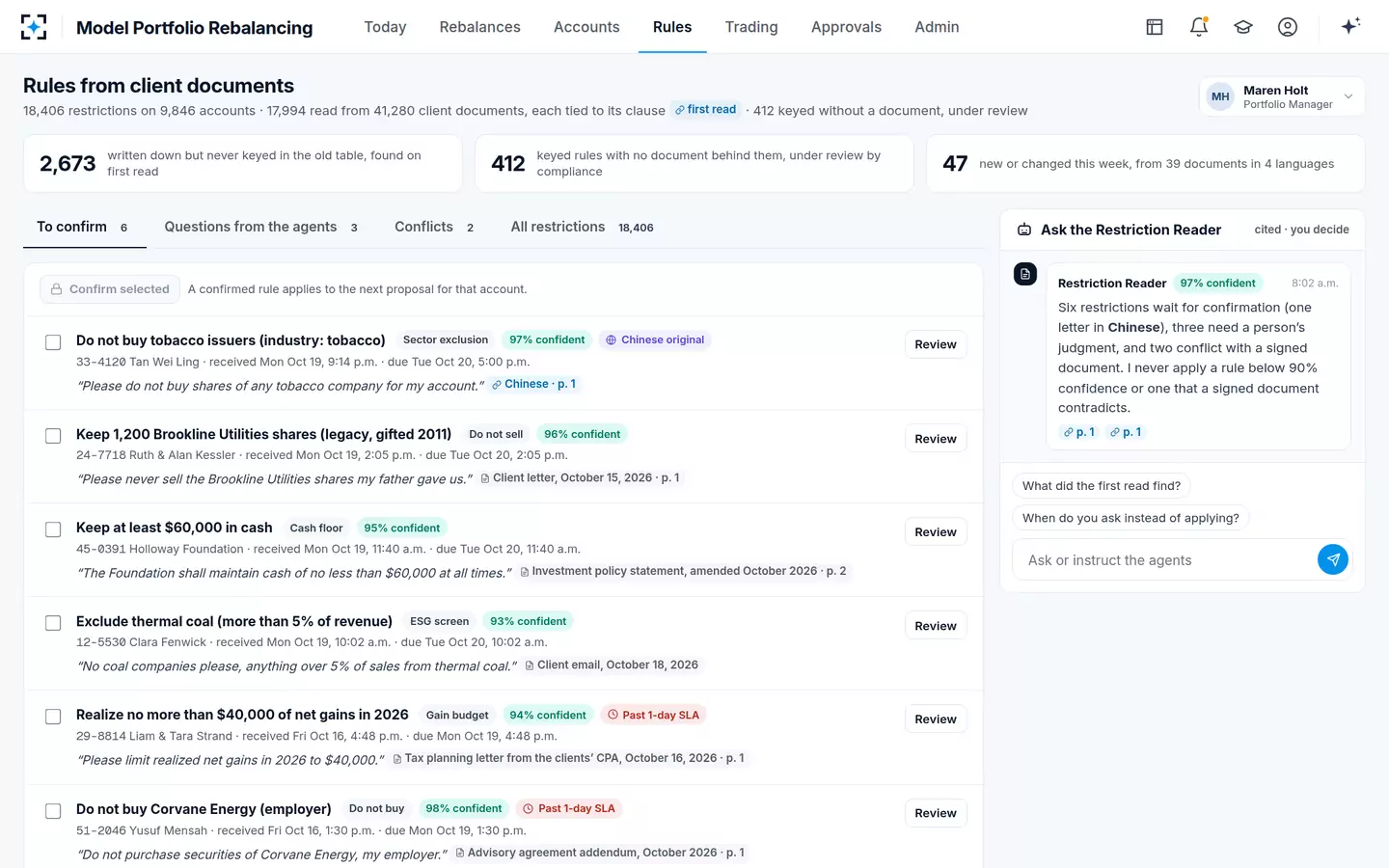
Clients set budgets too. Among the restrictions the sample firm's Restriction Reader found in client documents that week was a tax planning letter from a couple's accountant: "Please limit realized net gains in 2026 to $40,000." Read from the letter, quoted with its date and page and approved by compliance, it becomes a rule every future rebalance of that account obeys.
A client's gain limit, read from the accountant's letter
Short-term gains: the costliest line on the bill
Short-term gains are where a careless rebalance does the most damage, because they are taxed at ordinary rates. On the sample change, the Tax agent's group realized $712,400 of long-term gains and sold no lot held under a year at a gain: $1.27 million of short-term gains avoided. In the sample firm's rules, a short-term gain outside an account's budget can be realized only with a portfolio manager's approval.
The value of that rule is not on any fact sheet, because it shows up in the client's return, not in performance. It is the clearest case for measuring a rebalancing program by the gains its clients realize, by type, alongside its drift statistics.
What should the client be told?
That rebalancing can realize gains, how the firm decides which, and what the client can ask for. The SEC's investor guide tells investors to consider "whether the method of rebalancing you decide to use will trigger transaction fees or tax consequences", and FINRA's list of effective practices for automatic rebalancing includes "apprising the customer of the potential cost and tax implications of the rebalancing" and "developing methods that minimize the tax impact of rebalancing" (FINRA, 2016).
A tax-aware program can say more than that, account by account: what the last model change realized, why each account and lot was chosen, and which constraints the client set. That is a better conversation than a surprise on the 1099-B, and it is the one Model Portfolio Rebalancing's per-account rationales are built to support.
Questions people ask
Do you pay taxes when you rebalance your portfolio?
Only on gains realized by selling in a taxable account. Selling at a loss realizes a loss, buying realizes nothing, and trades inside an IRA, Roth IRA or 401(k) are generally not taxable events for the owner.
Is rebalancing a Roth IRA taxable?
No. Sales and purchases inside a Roth IRA do not create taxable gains, and qualified distributions are tax-free. A Roth purchase can still turn a loss sale in a taxable account into a wash sale if it falls within 30 days.
Is rebalancing a 401(k) a taxable event?
Generally not: a qualified plan's trust is exempt under 26 U.S.C. §501(a), so exchanges between funds inside the plan realize nothing for the participant. Tax is due when money is distributed, under the plan's and the IRS's distribution rules.
How can you rebalance without selling?
By directing new contributions and dividends to underweight asset classes, which the SEC's investor guide lists as a way to rebalance. It works when drift is small relative to the cash flowing in; for larger changes, selling in tax-deferred accounts first is the next cheapest route.
Does a model change force clients to realize gains?
It forces a decision. The change can be executed in full, at the gains it realizes, or partly, inside a gain budget, leaving the account off the model by a known amount. In the sample firm's what-if, a $50,000 budget cut realized gains from $6.82 million to $5.97 million and left 41 accounts within their bands.