The Rule 3a-4 safe harbor is the SEC rule under which a discretionary investment advisory program, such as a model portfolio, wrap, SMA or UMA program, is not deemed an investment company, so it need not register as a fund. It is a nonexclusive safe harbor with conditions: each account is managed on the client's financial situation and objectives and within any reasonable restrictions the client imposes; the sponsor asks about restrictions at opening, at least annually, and invites them in writing at least quarterly; each client gets quarterly statements and keeps the rights of a direct owner. The SEC has said compliance is close to impossible to show without records made at the time. Botminds' Model Portfolio Rebalancing reads restrictions from the client's own documents, keeps each one tied to its clause, and applies it to every proposed trade.
The rule text is quoted from the eCFR, the reasoning from the 1997 adopting release and the exam findings from the SEC's November 2021 risk alert. Product figures come from the solution's fictional sample firm, Quillfield Private Wealth, and are sample data.
Each Rule 3a-4 condition, and the evidence that proves it was met
- (a)(1) Managed on the client’s situation, objectives and reasonable restrictions
Evidence: the profile used for each account, and each restriction as written by the client, applied to the trades.
- (a)(2)(i) At opening: information gathered, restrictions offered
Evidence: the account-opening questionnaire and the client’s answer on restrictions, dated.
- (a)(2)(ii) At least annually: contact about changes and restrictions
Evidence: the annual contact itself, by any means including email, and its outcome.
- (a)(2)(iii) At least quarterly: written notice to get in touch, with a way to do it
Evidence: each quarter’s notice, often on the statement, with the contact route.
- (a)(2)(iv) Knowledgeable people reasonably available
Evidence: who the client can reach, and that access is not limited to technical support.
- (a)(3) The ability to impose reasonable restrictions
Evidence: the disclosure that restrictions are allowed, and no requirement to switch models to impose one.
- (a)(4) A statement at least quarterly
Evidence: statements with all activity, contributions, withdrawals, fees and opening and closing value.
- (a)(5) The rights of a direct owner
Evidence: withdrawal, proxy voting or its delegation, confirmations and the right to proceed against an issuer, all preserved.
What is the Rule 3a-4 safe harbor?
It is a rule under the Investment Company Act that answers one question: when is a program that manages many client accounts the same way not itself a fund? The rule's own note calls it "a nonexclusive safe harbor from the definition of investment company for programs that provide discretionary investment advisory services to clients", and adds that there is no Securities Act registration requirement for programs "organized and operated in the manner described" (17 CFR 270.3a-4).
The concern is structural. A program that invests thousands of clients identically, with no individual treatment, looks economically like a pooled fund that never registered. The SEC's 2021 examination sweep of advisers providing electronic advice found many that "Were unaware that the programs they sponsored or operated may be unregistered investment companies", where clients "received the exact same investment advice, were placed in the same model portfolio, and invested identically as other clients" (SEC Division of Examinations risk alert, November 9, 2021).
The safe harbor covers discretionary programs only. The same risk alert quotes the adopting release: a nondiscretionary program, where the investor accepts or rejects each recommendation, "generally will not meet the definition of investment company". And being nonexclusive, the rule creates no presumption against a program that operates outside it; such a program simply has to find its footing elsewhere.
Does Rule 3a-4 apply to model portfolios?
Yes, and the adopting release addressed models directly. Clients with similar objectives "may hold substantially the same securities in their accounts in accordance with a portfolio manager's model", and that does not by itself mean they lack individualized treatment; nor is it "necessary under the rule for a portfolio manager to make separate determinations regarding the appropriateness of each transaction for each client prior to effecting the transaction" (Status of Investment Advisory Programs, 62 FR 15098, March 31, 1997).
The release then closed the gap a model might open. Advisers owe clients suitable advice whether or not it comes through a program, and "The adviser's use of a model to manage client accounts would not alter this obligation in any way." The 2021 risk alert drew the same line from the other side: the steps that meet Rule 3a-4 "may not satisfy an adviser’s obligations under the Advisers Act, including its fiduciary obligations". The safe harbor settles the program's status; it does not settle whether each account was well managed.
What counts as a reasonable restriction?
A restriction is reasonable unless it is clearly inconsistent with the strategy or the client's objective, or fundamentally inconsistent with how the program works. The rule itself gives the core example: "the designation of particular securities or types of securities that should not be purchased for the account, or that should be sold if held in the account" (17 CFR 270.3a-4(a)(3)). It also sets a limit: nothing requires "that a client have the ability to require that particular securities or types of securities be purchased".
The adopting release supplies the test. "In general, a restriction would be unreasonable if it is clearly inconsistent with the portfolio manager's stated investment strategy or philosophy or the client's stated investment objective"; other factors are "the difficulty in complying with the restriction, the specificity of the restriction and the number of other restrictions imposed by the client" (62 FR 15098). And one sentence every operations head should know: "A restriction would not be unreasonable, however, simply because it placed administrative burdens on the manager, or could affect the performance of the account."
Reasonable or not: how the 1997 adopting release sorts restrictions
Ordinarily reasonable: Excluding individual stocks: "would appear to be a reasonable restriction under ordinary facts and circumstances".
May be unreasonable: Requiring particular securities to be bought: the rule does not require that ability at all.
Ordinarily reasonable: Excluding stocks from a particular country.
May be unreasonable: Excluding foreign issuers from a strategy that invests exclusively or primarily in foreign securities.
Ordinarily reasonable: A restriction that adds administrative work or could affect performance.
May be unreasonable: In a fund allocation program, a restriction that would require monitoring each fund’s own holdings.
Ordinarily reasonable: A few specific restrictions, changed when the client’s circumstances change.
May be unreasonable: Restrictions unreasonable in aggregate, or altered "with excessive frequency".
When a sponsor judges a restriction unreasonable, the release expects a conversation, not a silent refusal: the client "should be notified and given an opportunity to restate the restriction more reasonably". If the client will not, the client can be removed from the program, or not accepted, without losing the safe harbor. What the rule does not allow is a program that quietly ignores what the client wrote. The hardest restrictions to honour are exclusions that depend on facts about an issuer, such as a revenue threshold, where a data feed and the issuer's own filing can disagree: investment exclusion lists, the data and the filing.
How often must clients be contacted under Rule 3a-4?
At opening, at least annually and, in writing, at least quarterly. At least annually the sponsor or its designee "contacts the client to determine whether there have been any changes in the client's financial situation or investment objectives, and whether the client wishes to impose any reasonable restrictions" or modify existing ones; at least quarterly it "notifies the client in writing" to get in touch with any changes, and "provides the client with a means through which such contact may be made" (17 CFR 270.3a-4(a)(2)).
The release is practical about method. "Under appropriate circumstances, an electronic mail message requesting information from clients in the program would constitute annual client contact", the quarterly notice can ride on the quarterly statement, and a sponsor that cannot reach a client after "pursuing all reasonable means" does not lose the safe harbor. It also warns against reading the quarterly notice as an invitation to constant change: it "is not intended to imply that it necessarily would be reasonable for a client to change his or her investment restrictions on a quarterly basis."
What did SEC examiners find in Rule 3a-4 programs?
They found programs that claimed the safe harbor without meeting it. In the November 2021 risk alert, "Nearly all of the examined advisers received a deficiency letter", and the Rule 3a-4 findings were specific (SEC risk alert, November 9, 2021). "Some advisers expressly prohibited the imposition of any restrictions, while others appeared to impede clients from imposing reasonable restrictions." Examples included advisers that "Required the selection of a different model portfolio if any restrictions were requested".
What the SEC's 2021 sweep found in model and robo programs
Nearly all
examined advisers received a deficiency letter
1–2a year
times many advisers contacted clients, against a quarterly written-notice requirement
Many
had Rule 3a-4 policies that were inadequate, not implemented, or both
On contact, "Many advisers did not satisfy the Rule’s quarterly notification provision, as they contacted clients only once or twice per year." On access, some limited clients to technical support or tied access to knowledgeable staff to account-size thresholds. On rights, some restricted withdrawals to cash or did not let clients vote proxies. The alert's prescription is short: programs relying on the rule "should adopt compliance policies and procedures that are reasonably designed to validate that such programs are, in fact, consistent with the Rule’s provisions."
The restriction in a letter that never reached the system
The commonest failure is not refusing a restriction; it is accepting one and never applying it. A client writes that she will not hold tobacco, or that the shares her father gave her must never be sold. Client service files the letter. Somebody keys a subset into the rebalancing system's restriction table. The rebalancer, which knows only the table, buys the excluded stock in the next model change, and the program's footing under Rule 3a-4(a)(1) goes with it, because the account was not managed "in accordance with any reasonable restrictions imposed by the client".
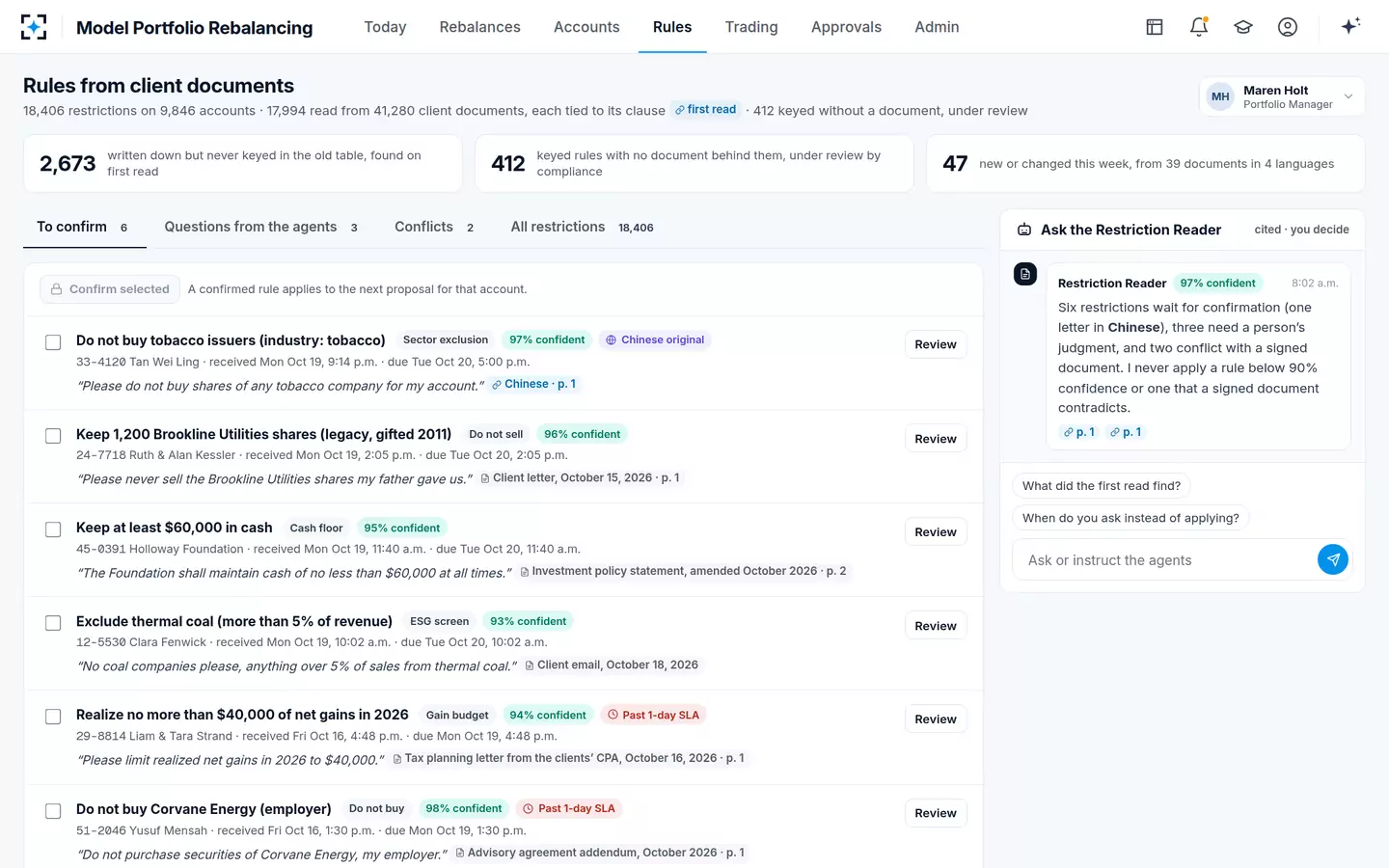
At the solution's fictional sample firm the first full read of client documents measured the gap. Across 41,280 advisory agreements, policy statements, trust documents, letters, emails and CRM notes, the Restriction Reader found 2,673 restrictions written down but never keyed into the old table, and 412 keyed rules with no document behind them, now under compliance review. Both kinds matter: the first is a client's restriction ignored, the second is a restriction the firm imposed that the client may never have asked for.
Restrictions read from client documents in Model Portfolio Rebalancing, each with its clause
Why the records matter more than the rule's wording suggests
Rule 3a-4 has no recordkeeping paragraph, but the adopting release makes records the condition behind every condition. "A person seeking to rely on rule 3a-4 must be able to establish compliance with each of the rule's provisions," and compliance with the client-contact, document-delivery and restriction provisions "would be difficult, if not impossible, to demonstrate without contemporaneous recordkeeping" (62 FR 15098).
"The Commission, therefore, strongly recommends that a sponsor of an advisory program seeking to rely on rule 3a-4 establish and implement written policies and procedures, and a system for applying such procedures, that are reasonably designed to ensure that the program operates in the manner contemplated by the rule."
Status of Investment Advisory Programs under the Investment Company Act of 1940, adopting release, 62 FR 15098 (March 31, 1997)
For restrictions, contemporaneous records mean three things: the client's own words with the date they arrived; the rule the firm derived from them, with who approved it; and, for each trade, evidence the rule was checked. A restriction table with no link back to a document fails the first. A rebalancer that applies rules without writing down which ones it applied fails the third.
How Model Portfolio Rebalancing keeps restrictions tied to clauses
Botminds' Model Portfolio Rebalancing treats each client document as the source and each rule as derived from it. The Restriction Reader reads advisory agreements, policy statements, trust documents, letters, emails and CRM notes in the client's language and proposes a rule with its clause, page and confidence. People decide what becomes a rule: client service proposes, compliance approves.
From a client's sentence to a restriction applied to every trade
Agent
Restriction ReaderReads the new document and drafts a rule with the quoted clause, the page and a confidence score.
Never: applies a rule below 90% confidence or one a signed document contradicts.
A person decides
Client serviceAnswers the reader’s questions where wording is ambiguous (from 50% to 90% confidence) and proposes the rule.
A person decides
Investment complianceApproves the rule with the clause in front of them, or rejects it with a reason.
Agent
Restriction agentApplies every approved rule, the firm restricted list and the insider list to every proposed trade; holds what may not trade with a dated reason.
Never: overrides or lifts a restriction.
Agent
CheckerRe-runs every proposed portfolio against every rule on a second model and blocks the group on any disagreement.
Ambiguity goes to a person rather than into a guess. One sample client, writing in Spanish, asked that her portfolio exclude companies that make weapons or components for military use. The reader's confidence was 71%: the wording needed a threshold, because Arclight Semiconductors earns 14% of its revenue from military programs. Client service proposed 10% of revenue or more, and the rule waited for compliance. That is the release's "restate the restriction more reasonably" conversation, held before a trade instead of after a complaint.
A restricted account held with a dated reason, and the rationale on file
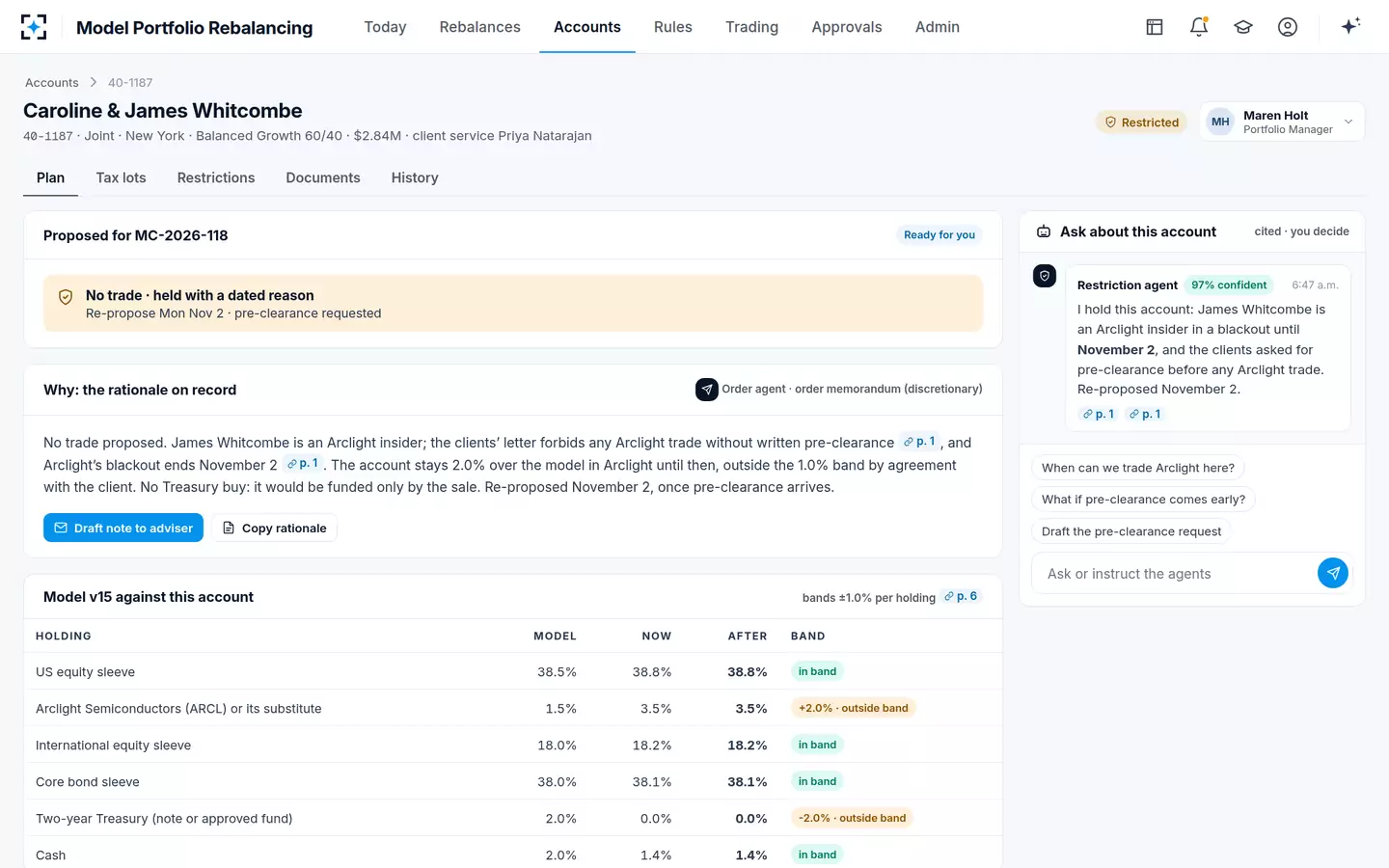
Every account's rationale is stored with its orders, and a rebalance exports as one evidence file: the committee minute, the rationales, the quoted clauses, the approvals and the order files. How one account travels through the overnight run shows where the restriction check sits; how rebalancing software differs on this point compares the approaches a firm can choose from.
Questions people ask
What is Rule 3a-4 under the Investment Company Act?
17 CFR 270.3a-4, adopted in 1997, is a nonexclusive safe harbor: a discretionary advisory program that meets its conditions is not deemed an investment company and need not register under the Securities Act. The conditions centre on individualized management, regular client contact, reasonable restrictions, quarterly statements and the client's ownership rights.
Can a client require a model manager to buy a particular security?
Not under the rule. Rule 3a-4(a)(3) protects the ability to designate securities that should not be bought or should be sold, and says nothing in the rule requires that a client be able to require particular purchases.
Does an email satisfy the annual client contact under Rule 3a-4?
It can. The 1997 adopting release says that under appropriate circumstances an email requesting information from clients would constitute annual client contact. The quarterly notice must be in writing and give the client a means to respond.
Can a firm refuse a client's restriction?
If it is unreasonable, yes, but with a process: the release expects the client to be notified and given a chance to restate it, and allows a client who refuses to be removed from the program without losing the safe harbor. Requiring a client to switch models to impose any restriction was a deficiency the SEC cited in 2021.
Does Rule 3a-4 apply to nondiscretionary programs?
No. The rule covers discretionary programs. The adopting release, as quoted in the SEC's 2021 risk alert, says a nondiscretionary program in which the investor accepts or rejects each recommendation generally will not meet the definition of investment company in the first place.
What records prove a program meets Rule 3a-4?
The rule names none, but the adopting release says compliance cannot really be shown without records made at the time. In practice that means dated client profiles, the annual contacts and quarterly notices, the restrictions as the client wrote them, and evidence each trade honoured them.