An operational due diligence analyst reviews fund managers' operations on behalf of an allocator, such as a pension fund, endowment, fund of funds or multi-manager platform, before money is committed and again every few years. The job description reads like judgment work: assess the administrator, the custody arrangements, the valuation policy, the controls, the people, and recommend a rating. The week is mostly something else. The analyst collects the data room by email, reads a long questionnaire and a stack of policies, some in other languages, draws the fund structure by hand, writes to service providers and waits for replies, and only then decides. With a review program of a couple of hundred managers a year spread over a small team, that collecting and chasing is what sets the pace. Botminds' Operational Due Diligence is designed to take that part: its agents read the data room overnight, draw the structure, check each claim against an independent source and draft the requests, so the analyst's week goes to the questions only she can answer.
The week on this page is a sample from the solution, on fictional data: Nadia Okafor, a senior ODD analyst in London at an allocator called Quillfield Capital, with seven reviews in progress. The people and firms are invented; the time estimates are ours, as explained under each figure.
One sample ODD team's year
248
reviews planned this year by a team of nine
436
approved managers, each re-reviewed every 24 or 36 months
28
reviews a year for one senior analyst, across Europe
6
reviews past their service level this morning
What does an operational due diligence analyst do?
An ODD analyst decides whether a fund manager's operations meet the allocator's standard, and proves it. In practice the job description has five parts: collect and read the manager's documents; map the fund's operating structure and service providers; verify the manager's claims with the providers and public registers; judge the policies (valuation, allocation, personal trading, cyber, continuity) against the house standard; and write findings and a recommended rating for someone senior to sign. Between reviews, the analyst watches approved managers for changes that should bring a review forward.
There is no government job category for it. The nearest occupation in the US Department of Labor's O*NET classification is Financial Risk Specialists, whose first listed task is to "Analyze areas of potential risk to the assets, earning capacity, or success of organizations" (O*NET 13-2054.00). ODD narrows that to one kind of risk: the chance of losing money to a fund's operations rather than its strategy.
The regulators' view of the work is plain. SEC examiners have recorded private fund advisers that "failed to perform adequate due diligence on important service providers, such as alternative data providers and placement agents" (SEC Division of Examinations risk alert, January 27, 2022), and the Division's priorities for fiscal 2027 again check whether advisers "conducted reasonable due diligence into products or services recommended to clients" (SEC, Examination Priorities, Fiscal Year 2027). An allocator that is itself an adviser carries that expectation into every review.
Where the week goes: reading and chasing, by hand and with agents
Most of an initial review's analyst time goes to work that precedes judgment. Our estimate for one initial manager review, built from practitioner ranges of six to ten analyst days, puts about eight days into it by hand: a day and a half collecting the data room and chasing missing documents, three days reading the questionnaire, offering documents, financial statements and policies, a day and a half drawing the structure and checking claims, half a day on confirmations and a day and a half writing findings and the report.
Where an initial review's analyst days go, by hand and with agents
By hand · about 8 analyst days
- Collect and chase · 19%
- Read · 37%
- Structure and checks · 19%
- Confirmations · 6%
- Findings and report · 19%
With agents · about 2 analyst days
- Collect and chase · 12%
- Read · 25%
- Structure and checks · 25%
- Confirmations · 13%
- Findings and report · 25%
The second bar is shorter in total and different in shape. Reading falls from three days to half a day, because the agents read every document in its own language and the analyst opens only the pages behind a contradiction. Drawing the structure and checking claims falls from a day and a half to half a day, and what remains is deciding what each contradiction means. Confirmations halve rather than vanish: the agents draft each request from a regulator's register, but the analyst still approves every one before it goes. The largest savings come out of collecting and reading.
Monday: the data room, and what is missing from it
The week starts with documents. A new review opens with a request list and a data room that rarely arrives complete: the questionnaire, the offering memorandum and its supplements, two years of audited financial statements, the valuation, allocation, personal trading, cyber and continuity policies, the service providers' controls reports. Some of it is scanned. Some of it, for a European fund, is in French or German. The analyst's first job is to know what is missing before reading what is there.
In the sample, the solution's Intake agent read Fernhill Macro Fund's data room overnight: 38 documents, 2,146 pages in English, French and German, each classified by type, language, page count and date, with one scan it could not read. Two documents were missing, Valmont's SOC 1 Type II report and the administration agreement, and the agent drafted the request for the analyst to approve. Nothing goes to the manager until she does.
Tuesday, 8:40 a.m.: one thing needs her first
The analyst's morning is a queue, and the useful question is which item needs a person. On the sample Tuesday, Nadia has 7 of the team's 41 reviews in progress; 6 reviews across the team are past their service level, 3 ratings wait for sign-off, and the Monitoring agent has raised 8 re-review triggers. Overnight the agents read Fernhill's documents, drew 10 entities, checked 146 claims and drafted 2 findings with a proposed rating of Conditional.
The morning queue: one next step per item, and what the agents did overnight
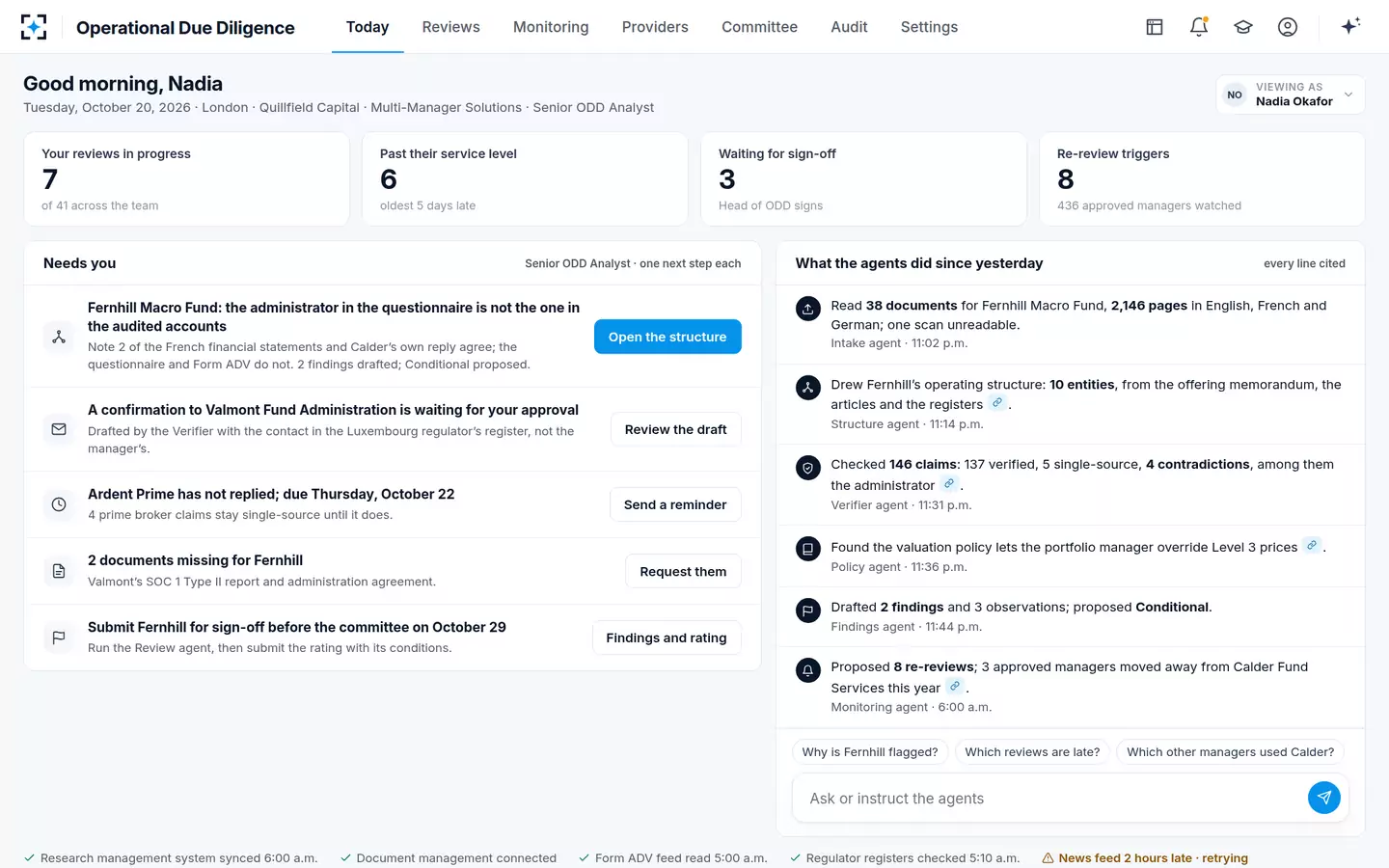
The first item is the one that changes a rating: the administrator in Fernhill's questionnaire is not the one in the audited accounts. Note 2 of the French financial statements and the former administrator's own reply agree; the questionnaire and Form ADV do not. By hand, an analyst would have found that sentence on day three of reading, if at all. Here it is the first thing she sees, with the page open beside it. The checklist behind that check pairs each question with the document that answers it independently.
Midweek: confirmations, replies, and the provider that has not answered
Confirmations are where a review waits. Each request goes to the provider at an address from a regulator's register, never one the manager supplied, and replies come back on the provider's timetable, sometimes in another language. In the sample, Calder, the depositary and the auditor had replied and been reconciled, the depositary in German; the request to Valmont, the new administrator, was waiting for Nadia's approval; and Ardent Prime, one of two prime brokers, was due to reply on Thursday, October 22. Until it does, its four claims stay single source.
This is the part of the week no tool removes, and it should not. Third-party due diligence has always run on the slowest reply. In the study of 444 hedge fund due diligence reports by Brown, Goetzmann, Liang and Schwarz, the authors note that "It takes from 4-8 weeks from a client’s request to the completion of the report by the DD company" (NBER working paper 15529). The sample allocator's service level for an initial review is 30 business days, with replies chased after five business days.
Thursday and Friday: findings, the rating and the sign-off queue
The end of the week is judgment, and it is the part an analyst cannot hand over. The agents' draft findings arrive with their evidence and the house standard they were judged against; the analyst accepts, edits or rejects each one with a reason, or raises her own from any entity in the structure. A second agent checks that every sentence of the draft report carries a citation that opens its passage. In the sample, it found 31 of 31 sentences cited and returned one note, which was applied.
Then the analyst submits the rating and stops. She cannot sign her own submission; the Head of Operational Due Diligence signs Pass, Conditional or Fail with a reason code, and the investment committee reads the rating without being able to change it. That split puts the analyst's name on the evidence and someone else's on the decision, which is what an auditor reading the file later will look for.
Operational Due Diligence, seen by the five people who carry one review
Today
Reads the data room and chases documents by email, then checks a sample of claims by hand.
With agents
Opens a structure already drawn and checked, asks the agents why, opens each source and approves every confirmation.
Still theirs: Every confirmation, every finding, the submitted rating
Today
Signs ratings from reports that read differently by analyst.
With agents
Signs with the findings, the conditions and every page cited, and a reason code on the trail.
Still theirs: The signature, and approval of every settings change
Today
Wants to know if ODD is a no before an hour on strategy.
With agents
Reads the signed rating and conditions on the agenda; cannot change the rating.
Still theirs: The investment decision
Today
Tracks late reviews and conditions precedent by email.
With agents
Sees service levels and workload, decides rebalancing proposals, approves each condition clearance.
Still theirs: The release of money
Today
Asks who decided, on what evidence, and whether one person did both.
With agents
Queries the trail in plain words and exports the complete review file.
Still theirs: The independent check on the process
How many managers does an ODD analyst cover?
Divide the approved list by the team, then multiply by the review cycle. The sample allocator has 436 approved managers and nine people, about 48 managers per head. On cycles of 24 months for its larger managers and 36 for the rest, plus new managers and event re-reviews, that becomes 248 reviews this year, or about 28 per analyst, which is exactly Nadia's load.
The arithmetic of an ODD caseload, on the sample allocator's numbers
| Step | Calculation | Result |
|---|---|---|
| Approved managers per analyst | 436 managers ÷ 9 people | about 48 |
| Reviews per analyst this year | 248 reviews ÷ 9 people | about 28 |
| Analyst days if each took our by-hand estimate | 28 reviews × 8 days | about 224 days |
| Analyst days at our estimate with agents | 28 reviews × 2 days | about 56 days |
The third line is the point. If every review took as long as an initial one, 28 reviews would consume most of a working year before any monitoring, on-site visits, committee preparation or training. Re-reviews are shorter, which is how teams cope; it is also why re-reviews are where checks get thinner. The backlog is not a staffing accident. It is the product of a list that grows, cycles that repeat and reading that does not get faster by hand.
The review program: who holds what, and which reviews are late
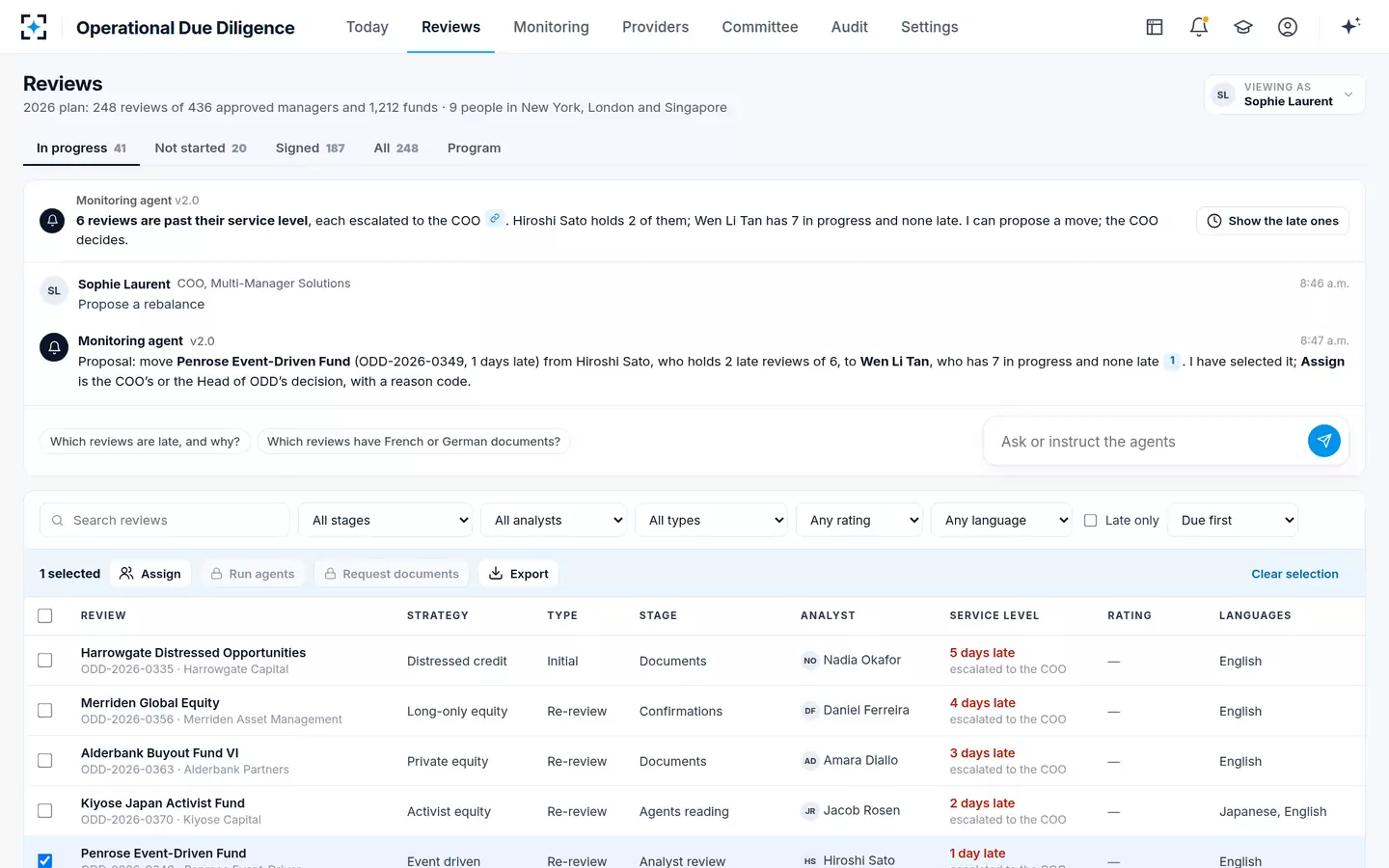
How often are managers re-reviewed, and what brings a review forward?
On a cycle set by tier, and early when something changes. The sample allocator re-reviews its Tier 1 managers every 24 months and Tier 2 every 36, with a service level of 20 business days for a re-review against 30 for an initial one. Event triggers bring a review forward: a change of service provider, a key person leaving, a qualified or emphasis-of-matter audit opinion, a regulatory action, a cyber incident, an exception in a controls report.
Events are where an analyst's monitoring week used to be thinnest, because finding them meant reading every manager's filings and letters. In the sample, the Monitoring agent watches the approved list through Form ADV amendments, audited financials, registers, controls reports, manager letters and news, and proposes each re-review with its source. Only the Head of ODD opens or dismisses one. What a Form ADV amendment can and cannot tell you explains why a filing alone is a late signal.
What skills does an ODD analyst need?
The skills are an auditor's skepticism, an operations specialist's map of how a fund actually runs, and the discipline to write down where every fact came from. Product knowledge matters less than people expect. A strong analyst can read a set of audited notes, a valuation policy and a prime brokerage agreement, and spot where they disagree with the questionnaire.
What an ODD analyst needs to be good at
- Reading fund documents
Offering memoranda, audited financial statements and their notes, valuation and allocation policies, controls reports; in more than one language helps.
- Knowing how a fund runs
Who calculates the net asset value, who holds the assets, how cash moves, who prices what.
- Verifying, not collecting
Turning each claim into a request to someone who does not work for the manager.
- Judging severity
Telling a finding that blocks funding from an observation for the next re-review.
- Writing for a committee
A rating, two or three reasons, and the conditions that would clear them.
- Keeping a file someone else can audit
Every sentence traceable to a page, every decision to a name.
Operational due diligence analyst salary: what public data shows
No government series reports pay for ODD analysts as such, and the published salary figures for the title come from recruiters and job boards rather than surveys anyone audits. The nearest US government benchmarks are the Bureau of Labor Statistics' figures for the two occupations closest to the work. In May 2025 the median annual wage was $117,330 for financial risk specialists and $102,740 for financial and investment analysts; in the industry that holds most allocators and managers, securities and other financial investments, the medians were higher, $133,070 and $124,370 (BLS Occupational Outlook Handbook, Financial Analysts, page modified August 27, 2026). Both occupations are broad and include roles far from fund due diligence, and the 66,000 financial risk specialists the BLS counted in 2025 include credit and market risk staff, so the figures are a reference point for a budget, not a market rate for the title.
The more useful number for a head of ODD is cost per review: analyst days times a loaded day rate, plus travel and any outside help. Comparing that cost with an outsourced firm's has its own guide. To see one review's structure, claims and confirmations on your own past files, start from Operational Due Diligence.
Questions people ask
What does ODD stand for in due diligence?
Operational due diligence: the review of a fund manager's operations, controls and service providers, as distinct from investment due diligence on the strategy. The term is used by allocators such as pension funds, endowments, funds of funds and multi-manager platforms, and by the outside firms some of them hire.
How long does an initial ODD review take?
Weeks of elapsed time and days of analyst time. The sample allocator's service level is 30 business days for an initial review and 20 for a re-review; a third-party due diligence firm in the Brown study took four to eight weeks from request to report. Most of the elapsed time is waiting for documents and replies.
Is an ODD analyst the same as an investment analyst?
No. The investment analyst judges whether the strategy will make money; the ODD analyst judges whether the fund's administration, custody, valuation and controls can be trusted. The sample allocator keeps the two apart: the committee weighs the strategy, and reads the signed ODD rating without being able to change it.
Does an ODD analyst still make on-site visits?
Interviews with the manager remain part of the method: the third-party firm in the Brown study gathered its information from the manager's documents, on-site interviews with the manager and forms the manager filled out, then verified it with the administrator and the auditor. A visit is more useful when the documents have already been read and the contradictions are known, so the meeting can be spent on them.
What does the analyst still decide when agents do the reading?
Everything that carries a consequence. In the sample, the analyst approves every confirmation before it is sent, accepts, edits or rejects each drafted finding with a reason, and submits the rating; the agents never contact a provider, sign a rating or open a review on their own.