Due diligence questionnaire software, on the allocator's side, reads the questionnaires fund managers send (the AIMA questionnaire for hedge funds, the ILPA questionnaire for private equity, or the allocator's own), compares each answer with the documents and outside sources that should confirm it, and helps the operational due diligence team turn what it finds into findings and a rating. It is a different product from the tools managers use to answer questionnaires. What decides whether it works from the first review is less the software than what the team brings: a written house standard the checks can be built from, rating rules, questionnaire templates, a set of past signed reviews to test against, the approved-manager list, access to data rooms and systems of record, and clear roles for who approves what. This page goes through each input, in the order it is needed, and shows how Botminds' Operational Due Diligence uses it. Most of a go-live, it turns out, is turning a standard written for people into checks a system can run. Whether the finished checks actually catch wrong answers is a separate test, set out in the operational due diligence questionnaire guide.
Examples come from the solution's fictional sample allocator, Quillfield Capital. The settings shown are its configuration; the timeline is our illustration, not a quoted implementation time.
What one sample allocator brought to its set-up
34
controls in its house ODD standard, version 7, grouped in 7 themes
40
past signed reviews used to test every agent version before it runs
436
approved managers on the list, with their review cycles
7
years it keeps review files, against the five Rule 204-2 sets for required records
What does due diligence questionnaire software do for an allocator?
It turns a questionnaire from something read into something tested. A manager's questionnaire can run to a hundred pages about its operations; the software reads each answer, maps it to the allocator's own standard, and looks for the document that confirms or contradicts it: the audited notes, the service providers' replies, a regulator's register, the manager's own filings. What comes out is not a summary of the questionnaire but a list of claims sorted into verified, single source and contradicted, each with its page.
In the sample review that list had 146 claims across 10 entities: 137 verified, 5 single source, 4 contradictions. The software did the reading; the standard told it what to look for. That is why the inputs below matter more than any feature list.
What you bring: eight inputs, in the order they are needed
The order matters because each input is tested with the next. The standard comes first because everything is checked against it; past reviews come before go-live because they are the test; access comes in parallel because it depends on other teams.
An illustrative set-up: what the team brings, and what is configured and tested from it
- Standardand rating rules
- Templatesand SLAs
- Accessrooms, systems
- Past reviews40 signed
- Parallel runlive reviews
- Checksfrom the standard
- Settingsv1 approved
- Connectionstested
- Agentstested on past
- Go-liveHead of ODD signs
Eight things to have ready for due diligence questionnaire software
- 1. Your house ODD standard
Every control you expect a manager to meet, with what evidence proves it and how severe a gap is.
- 2. Rating rules
The scale (for example Pass, Conditional, Fail) and the rules linking findings to ratings.
- 3. Questionnaire templates
AIMA, ILPA and your own, so answers can be mapped to the standard question by question.
- 4. Past signed reviews
A test set (the sample uses 40) and the baseline each re-review compares against.
- 5. The approved-manager list and review calendar
Tiers, cycles and next review dates, from the research management system.
- 6. Access
Data rooms, document management, the Form ADV filings feed, regulators’ registers, the CRM.
- 7. Roles and approvals
Who approves confirmations, submits, signs, clears conditions and releases money; who may not do two of those.
- 8. Retention, residency and legal hold
How long review files are kept, where documents may be stored, and what overrides deletion.
What house standards does DDQ software need?
A written standard specific enough to be tested. A standard written for people sets out themes, expectations and judgment calls. Software needs the same content broken into controls, each with the claim it tests, the evidence that would confirm it and the severity of a gap. The sample allocator's standard, version 7, has 34 controls in 7 themes, and every draft finding in the solution cites the section it was judged against.
Writing the standard down is also what regulators expect of advisers doing due diligence. SEC examiners have recorded private fund advisers that "outlined a due diligence process in fund disclosures, but did not maintain policies and procedures related to due diligence that were tailored to their advisory businesses" (SEC Division of Examinations risk alert, January 27, 2022). A standard tested by software is, by construction, one that is written down and followed.
One control, written for people and written as a check
Written for people: The fund should use a reputable independent administrator.
Written as a check: The administrator named in the questionnaire is confirmed by the audited notes and by the administrator itself.
Written for people: Analyst judgment.
Written as a check: Audited note naming the administrator; the administrator’s reply sent to the address in a regulator’s register.
Written for people: Discuss with the Head of ODD.
Written as a check: Undisclosed change: High, which blocks Pass. Single source: open item.
Written for people: Case by case.
Written as a check: Written confirmation of appointment and NAV services, a current controls report, a corrected questionnaire.
Rating rules, cycles and service levels, written as settings
Everything the team argues about in committee should be a setting, so it is applied the same way every time and changed only on purpose. The table shows the sample allocator's settings. In the solution, the administrator proposes a change, the change runs against past reviews, and the Head of ODD approves each new version.
The sample allocator's ODD settings: what a team decides before day one
| Setting | Sample value | Options and rules |
|---|---|---|
| Rating scale | Pass · Conditional · Fail | A Critical finding proposes Fail; a High finding blocks Pass; Conditional needs conditions precedent to funding |
| House standards and questionnaires | House ODD standard v7 (34 controls, 7 themes) | AIMA (hedge funds) · ILPA (private equity) · house questionnaire v7 |
| Re-review cycle | Tier 1 every 24 months · Tier 2 every 36 | Event triggers: provider change, key person departure, qualified or emphasis-of-matter opinion, regulatory action, cyber incident, controls report exception |
| Agents ask a person below | 85% confidence | Set per agent from 70% to 99%; a new value is tested on 40 past reviews first |
| Service levels | Initial review 30 business days · re-review 20 | Sign-off within 3 business days; the Head of ODD alerted 5 business days before, the COO when missed |
| Confirmation replies | Chase after 5 business days | In-app and email; daily digest at 7:30 a.m. local time |
| Data residency and retention | US East, EU-sourced documents in EU West · 7 years | Legal hold overrides deletion; exports watermarked with the recipient |
| Who signs | Head of Operational Due Diligence | A deputy only with a recorded delegation |
How are past reports migrated?
Not all of them, and not as data entry. Past signed reviews serve two purposes. A set of them, 40 in the sample, is the test: every agent version and every changed threshold runs against those reviews first, and the Head of ODD sees what would have changed before approving it. And for each approved manager, the last signed review is the baseline a re-review compares against, so a change since the last review (a new administrator, a departed principal) stands out.
The reviews go in as documents, read like any other in their own language, rather than retyped into fields. Choose the test set deliberately: reviews across strategies, jurisdictions and languages, including some with Conditional and Fail ratings and the findings behind them. A test set of easy Passes proves little. Planting known errors in those past files turns the test into a measure of what the software catches.
Can DDQ software read scanned documents and other languages?
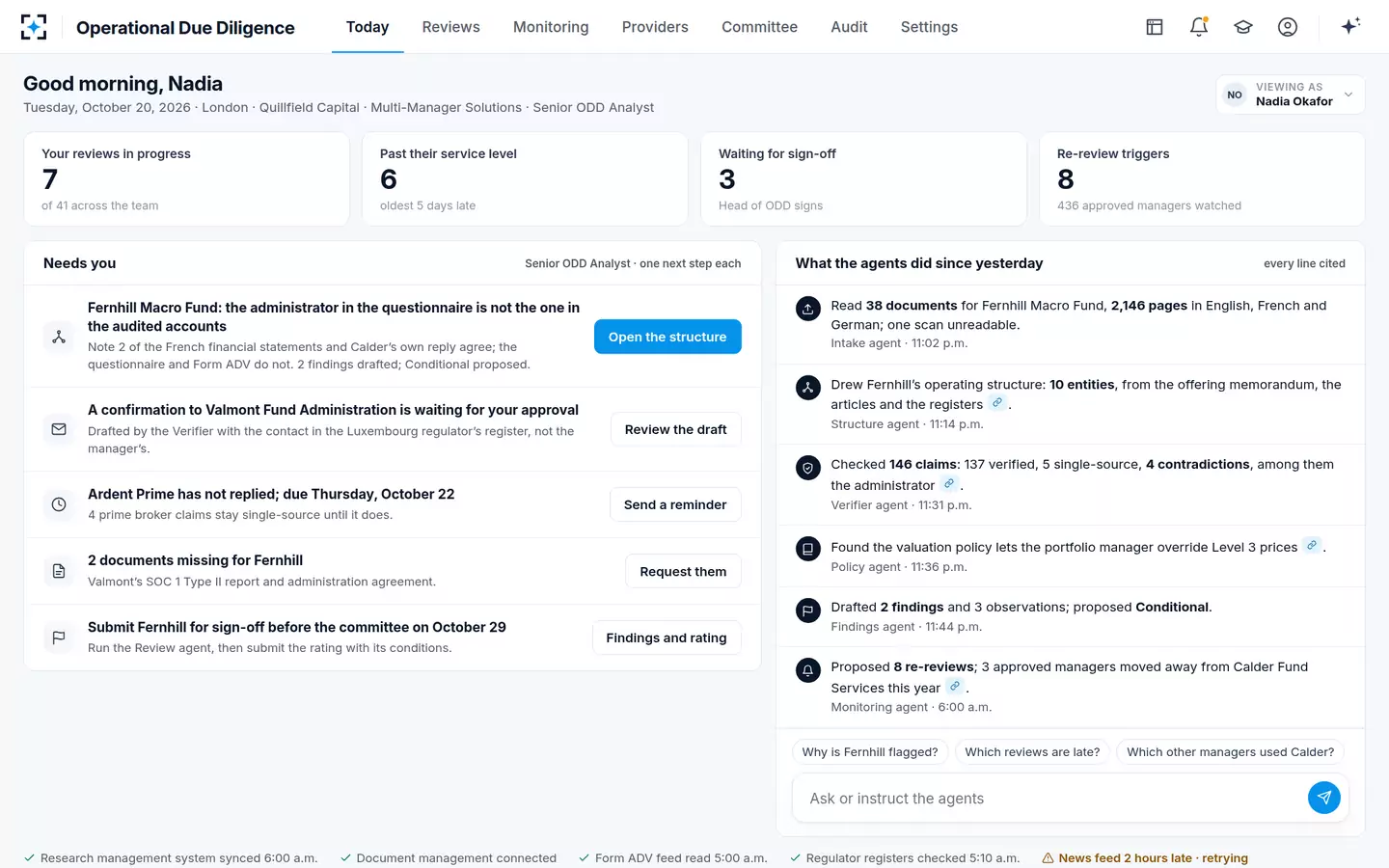
It should, and the test is what it does when it cannot. In the sample, the Intake agent read 38 documents and 2,146 pages in English, French and German, each in its own language, with OCR for scans, and reported one scan it could not read rather than guessing. Every source opens with the original beside the English translation, so an analyst can read a French audit note against an English questionnaire. Bring documents in the form you have them; ask the vendor to show you an unreadable page being flagged.
Access: data rooms, registers and your systems of record
Access is the input that depends on other teams, so start it first. The solution works with the sources a review already uses: managers' data rooms, audited financial statements, the Form ADV filings feed, regulators' and trade registers (in the sample, the SEC, FCA and Luxembourg), service providers' replies by email and portal, and the allocator's own systems: the research management system for the approved list, the CRM for contacts, document management for filing, portfolio accounting and the order management system, where a funding hold keeps a subscription until conditions are cleared.
Connections show their state on the first screen of the day
Do the same due diligence on the software that you do on a manager's administrator. Ask the vendor where documents are stored and for how long, who at the vendor can read them, and for its own controls report. The AICPA's SOC 2 examination covers "Controls at a Service Organization Relevant to Security, Availability, Processing Integrity, Confidentiality, or Privacy" (AICPA, SOC 2), which are the questions an ODD team would ask of any provider holding its files.
Roles, approvals and the audit trail
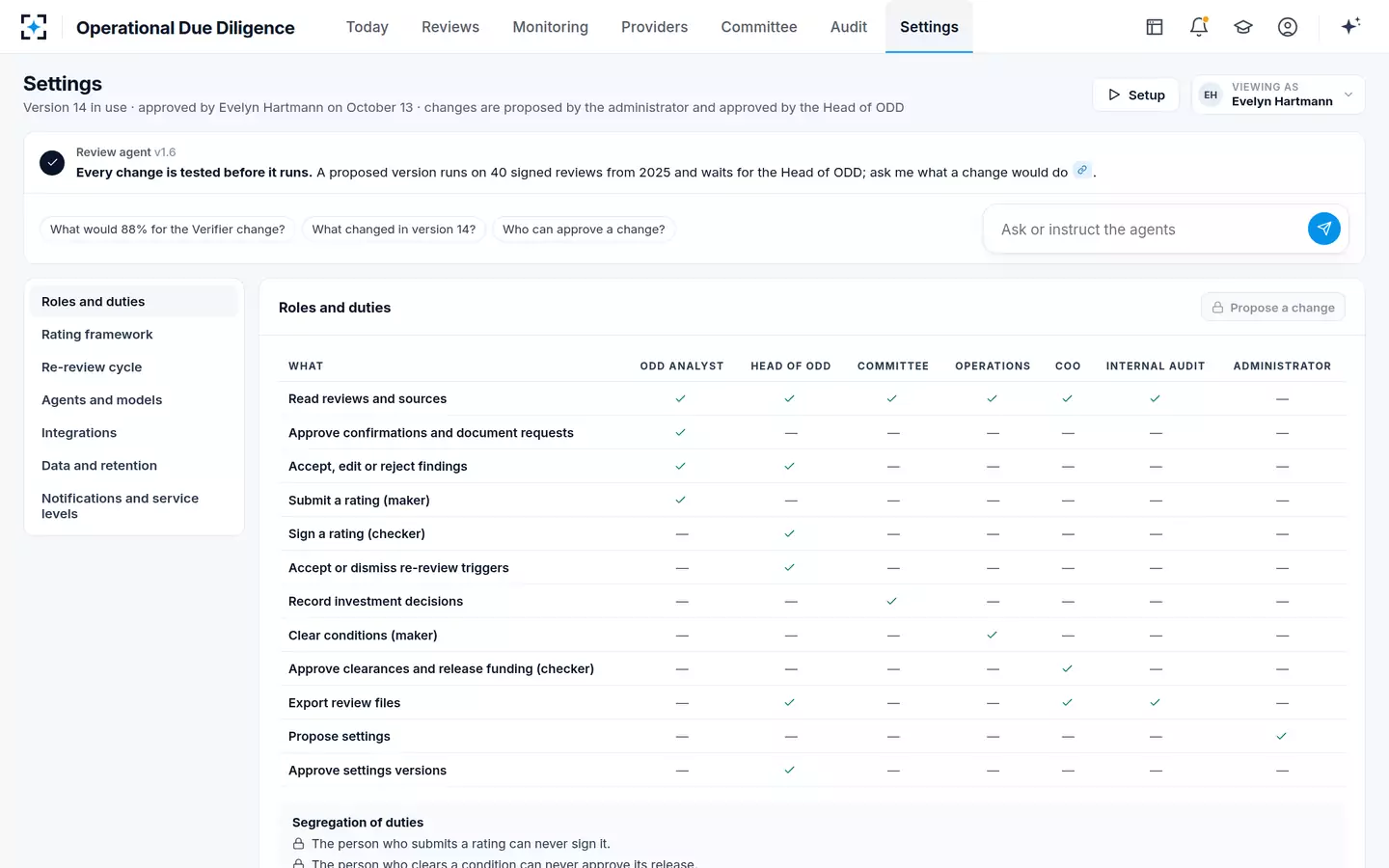
Bring the approval chain you want, and expect the software to enforce it rather than record it. In the sample, the analyst approves confirmations and submits ratings; the Head of ODD signs ratings, accepts or dismisses re-review triggers and approves every settings version; the committee records investment decisions; operations clears conditions and the chief operating officer approves the release; Internal Audit reads everything and changes nothing. The person who submits a rating can never sign it, and the person who clears a condition can never approve its release.
Roles and segregation of duties, approved as a settings version
Retention is part of the same decision. An adviser's required books and records must be kept for at least five years from the end of the fiscal year of the last entry, the first two in the adviser's own office (17 CFR 275.204-2(e)(1); the recordkeeping rule, record by record). The sample allocator keeps review files seven years, with legal hold overriding deletion, on an append-only trail that exports as one review file.
How long does DDQ software take to set up?
As long as it takes to make the standard testable and to prove the agents on your own past reviews; the software's own configuration is the short part. A team with a written, control-by-control standard, clean past reviews and early access to its systems is in a different position from one whose standard lives in senior analysts' heads. Botminds builds and deploys the solution from the allocator's requirements and documents (the ODD standard, rating framework, questionnaires and a sample of past signed reviews) and it goes live once its tests have passed, including a test of the agents against those past reviews.
The fastest route is to run it first on closed reviews you already know the answers to. Comparing the in-house cost per review with an outsourced firm's helps decide how far to take it, and the limits on what each agent may do are worth agreeing before the first live review. To start with your own past reviews and data rooms, go to Operational Due Diligence.
Questions people ask
Which due diligence questionnaires can the software read?
Whatever managers send: industry versions such as the AIMA questionnaire for hedge funds and the ILPA questionnaire for private equity, the allocator's own template, and the free-form answers and attachments that come back instead. Each is a manager's written claims about structure, service providers, custody, valuation, compliance, people and continuity; what the questionnaire covers, and how often its answers are wrong, has its own guide.
Is DDQ software for allocators the same as DDQ response software?
No. Response software helps a manager answer many investors' questionnaires consistently. Allocator-side software reads those answers and tests them against the documents and independent sources behind them; its output is verified and contradicted claims, findings and a rating, not a completed questionnaire.
What if our house ODD standard is not written down?
Write it down first, control by control, with the evidence each control needs and the severity of a gap. Past signed reviews help: the findings in them show the standard the team has actually been applying, which is often the best starting draft.
Who changes the settings after go-live?
In the sample, an administrator proposes a change, it runs against 40 past signed reviews, and the Head of ODD approves the new version, which is recorded with its date. Version 14 of the sample allocator's settings was approved on October 13.
Can DDQ software work with documents in French or German?
The sample review read documents in English, French and German, each in its own language, and shows every source with the original beside the English. Ask any vendor to demonstrate a contradiction found in a non-English document, not just a translated summary.