Form ADV Schedule D is the part of an investment adviser's SEC registration form that carries the detail behind several items of Part 1A; in the SEC's words, "Schedule D asks for additional information for certain items in Part 1A" (Form ADV General Instructions). For anyone doing due diligence on a fund manager, the section that matters is 7.B.(1), Private Fund Reporting. For each private fund it advises, the adviser must state, among much else, whether the fund is audited and by whom, which prime brokers and custodians it uses, whether an outside administrator keeps its books and sends investor statements, and how much of the portfolio someone unrelated to the adviser values. That makes Schedule D a pre-read for operational due diligence: a public statement, made to a regulator under penalty of law, about the fund's service providers. It is still the manager's own statement, not independent evidence. Botminds' Operational Due Diligence reads the filing alongside the due diligence questionnaire and the audited accounts, and treats any disagreement between them as something to resolve before the money goes in.
The examples on this page come from a sample review in the solution, on fictional data: an allocator reviewing Fernhill Macro Fund SICAV-RAIF, a Luxembourg fund with a Delaware feeder, run by a London adviser that files Form ADV. Every firm and person in it is invented.
How much of the private fund world Schedule D describes
62,637
private funds reported on Form ADV by SEC-registered advisers
5,912
SEC-registered advisers reporting private funds, of 16,442 registered
$27.4trillion
gross asset value of those private funds
What is Form ADV, and where does Schedule D fit?
Form ADV is the registration and disclosure form for investment advisers: Part 1A is a structured questionnaire filed with the SEC, Part 2 is the narrative brochure given to clients. Part 1A asks yes-or-no and numeric questions about the firm, and Schedule D is where the detail goes when an answer needs it. Item 7.B asks whether the firm advises any private fund. If the answer is yes, then "for each private fund that you advise, you must complete a Section 7.B.(1) of Schedule D", unless another adviser that files with the SEC already reports the fund (a sub-adviser, for example, files the shorter Section 7.B.(2) instead) (Form ADV Part 1A, Item 7.B).
Section 7.B.(1) runs to 28 questions per fund. Questions 1 to 22 describe the fund: its name and private fund identification number, where it is organised, its general partner or directors, whether it is a master or feeder fund, its type, its gross asset value, its investors and how it is offered. Questions 23 to 28 name the service providers. Exempt reporting advisers complete it too: the SEC's October 2026 custody proposal notes that "ERAs must complete Item 7 and any related items under Section 7.B.(1) of Schedule D" (91 FR 63870).
Form ADV Part 1 Schedule D, Section 7.B.(1): the questions that name the service providers
Questions 23 to 28 are the operational due diligence questions the SEC already asks. The table sets out what each asks, the answer the sample fund's adviser filed, and what an ODD analyst should do with it.
Schedule D questions 23 to 28, with a sample fund's answers and the check each one calls for
| Question | What it asks | In the sample review (fictional) | What the ODD analyst checks |
|---|---|---|---|
| 23 Auditors | Is the fund audited annually, under US GAAP? The auditing firm, its office, whether it is an independent public accountant, PCAOB-registered and inspected; whether audited statements go to investors; whether every report since the last annual amendment had an unqualified opinion | Auditor: Harlow & Pryce Audit S.à r.l., Luxembourg | Confirm the engagement with the auditor; read the notes, which disclose provider changes |
| 24 Prime broker | Each prime broker, its SEC registration number if any, its office, and whether it acts as custodian | Prime brokers: Northgate Securities plc and Ardent Prime LLC | Direct confirmation of the accounts and what each holds |
| 25 Custodian | Each custodian (prime brokers included): legal and business name, office, whether it is a related person | Depositary: Moselbank Luxembourg S.A. | Custodian or depositary confirmation; related-person answer read closely |
| 26 Administrator | Is there an administrator other than the adviser? Its name, location, whether it is a related person, and whether it sends investor account statements to all, some or no investors | Form ADV names Calder Fund Services; since March 1 the administrator is Valmont | Compare with the audited notes and the administrator’s own reply |
| 27 Valuation | The percentage of the fund’s assets, by value, valued during the last fiscal year by a person not related to the adviser | A valuation agent prices the hard-to-value book; the policy lets the portfolio manager override it | Compare with the valuation policy and the audited fair-value note |
| 28 Marketers | Anyone other than the adviser marketing the fund: placement agents, finders, solicitors; related or not; registration; websites | — | Check against the offering documents and any placement agreements |
What does Form ADV say about a fund's auditor?
More than most questionnaires do. Question 23 asks whether the fund's financial statements are subject to an annual audit and prepared under US GAAP, then, for each auditing firm, its name and the office responsible, whether it is an independent public accountant, whether it is registered with the Public Company Accounting Oversight Board and subject to its regular inspection, whether the audited statements for the last fiscal year were distributed to investors, and whether "all of the reports prepared by the auditing firm for the private fund since your last annual updating amendment contain unqualified opinions" (question 23(h)).
The last answer can be "Report Not Yet Received", and the form then imposes a deadline the rest of Schedule D does not have: "If you check “Report Not Yet Received,” you must promptly file an amendment to your Form ADV to update your response when the report is available." An ODD analyst who sees that box ticked months after a fiscal year end has a question to ask.
The auditor answer is also the one academic work weighs most heavily. In the study of 444 hedge fund due diligence reports by Brown, Goetzmann, Liang and Schwarz, the failure to use a major auditing firm was one of three features significantly related to legal and regulatory problems. Their example was the largest fraud of all: "the $17Billion fund (according to the Madoff SEC Form ADV filing) was audited not by a Big 4 firm but rather by David Friehling, a strip mall accountant who has since pleaded guilty to charges stemming from his role in the affair" (NBER working paper 15529). The auditor's name was on the public record. The question was whether anyone read it.
Prime brokers, custodians and the administrator: questions 24 to 26
Questions 24 and 25 name who holds the fund's assets. A prime broker that also acts as custodian is listed in both, and question 25 asks for each custodian whether it is a related person of the adviser. A related-person custodian is not disqualifying, but it moves the custody check from a formality to a priority: the confirmation of holdings should come from the custodian directly, and the analyst should ask how the adviser's own custody arrangements are examined.
Question 26 is the administrator, and its sub-question (e) is one of the most useful lines in the form: whether the administrator prepares and sends investor account statements to all investors, some, or none. A fund whose investors receive statements only from the manager has removed one of the simplest independent checks there is. Where the answer is "some" or "no", question 26(f) asks who sends the rest. The operational due diligence checklist turns each of these answers into a confirmation request.
Question 27: how much of the fund someone else values
Question 27 asks what percentage of the fund's assets, by value, was valued during the last fiscal year "by a person, such as an administrator, that is not your related person". The form counts an asset only where that person carried out the valuation procedure, including obtaining quotes, and where its valuation was the one used for subscriptions, redemptions, distributions and fees.
That definition is stricter than many questionnaire answers. An administrator that receives the manager's marks and loads them is not valuing the assets in the form's sense. A filed percentage well below what the questionnaire implies is a discrepancy to raise. A high filed percentage that sits beside a valuation policy letting the portfolio manager override prices, as the sample fund's policy does, is a question about which document describes what actually happens. Reviewing a hedge fund valuation policy takes that question further.
When must Form ADV be amended, and why can Schedule D lag?
Every adviser must file an annual updating amendment within 90 days after its fiscal year ends, and it must then "update your responses to all items in Part 1A, 1B, 2A and 2B (as applicable), including corresponding sections of Schedules A, B, C, and D" (Form ADV General Instructions, instruction 4). Between annual amendments, only some items must be updated promptly. Item 7, which carries Section 7.B.(1), is not one of them: the instructions say that in an other-than-annual amendment "you are not required to update your responses to Items 2, 5, 6, 7" and certain others "even if your responses to those items have become inaccurate".
So the private fund section of Schedule D can be many months out of date without anyone breaking a rule. A new administrator appointed in the spring may not appear until the next annual amendment. That cuts both ways for an ODD analyst. A mismatch between Schedule D and the questionnaire is not proof of concealment. But it is always a question, and an annual amendment filed after a change, still naming the old provider, is harder to explain.
One administrator change, and two of the manager’s documents that did not keep up
- Calderto Feb 28
- Valmontfrom Mar 1
- CorrectCalder
- Gap26 days
- Form ADV, Mar 27names Calder
- DDQ, Aug 14names Calder
How do you compare a DDQ with Form ADV?
Line them up provider by provider, with a third column from a source neither document controls. For each entity, write down what the questionnaire says, what Schedule D says, what the audited notes or the provider's own reply say, and the date of each. Where all three agree, the claim is verified. Where the manager's two documents agree with each other and not with the independent source, the manager's account is the one in doubt.
Three documents on one administrator: the questionnaire, Form ADV and the audited accounts
The manager’s documents: Questionnaire §4.1 and Form ADV question 26 both name Calder Fund Services.
The independent sources: Audited note 2 names Valmont Fund Administration from March 1, 2026.
The manager’s documents: The questionnaire says Calder has acted since launch in 2019.
The independent sources: Calder’s own reply: its appointment ended February 28, 2026.
The manager’s documents: The questionnaire says no provider changed in three years.
The independent sources: The Luxembourg regulator’s register lists Valmont as an authorised administrative agent.
The manager’s documents: A SOC 1 report in the data room.
The independent sources: It is Calder’s: it covers the former administrator only.
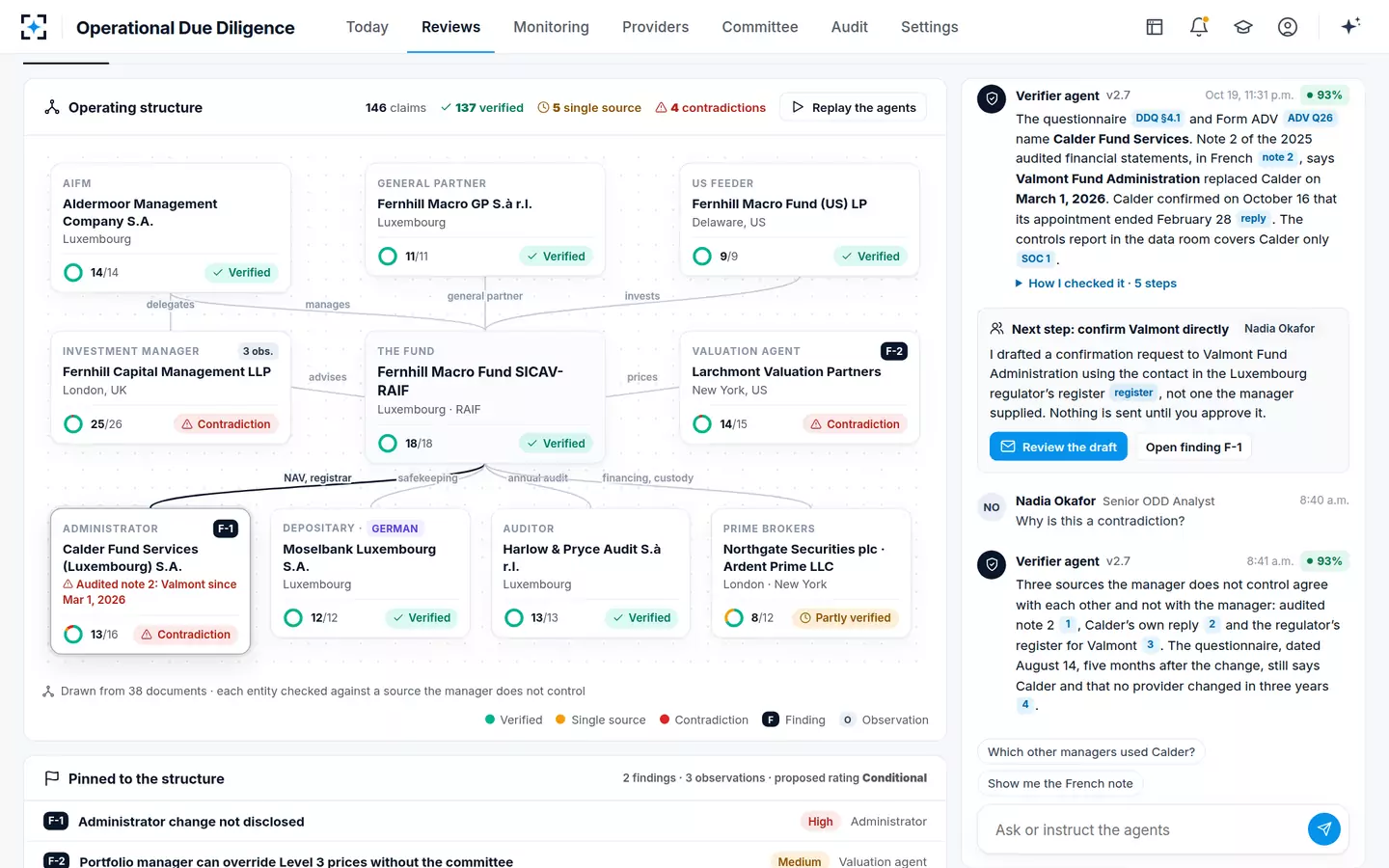
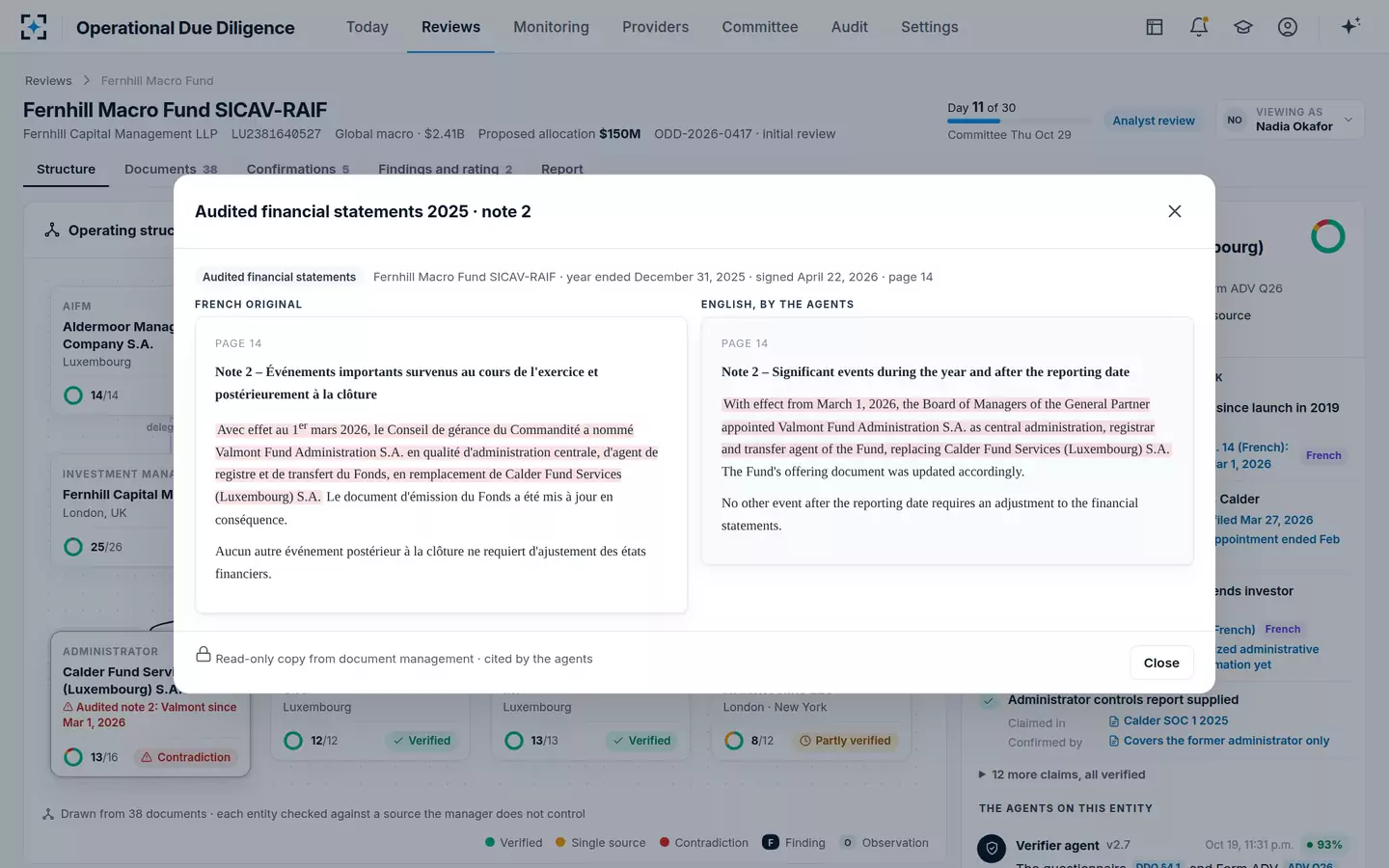
In the sample review the Verifier agent did exactly this, and when the analyst asked why the administrator was a contradiction, it answered that three sources the manager does not control agree with each other and not with the manager: the audited note, Calder's reply and the regulator's register for Valmont. The note it relied on is in French; the solution shows the original beside the English, so the analyst can read the sentence that settles the question herself.
Asked why, the agent answers with the three sources and a next step
The audited note that settles it, French beside English
Form ADV search and IAPD: where to read the filing
A firm's current Form ADV, including Schedule D, can be read through the SEC's Investment Adviser Public Disclosure search (IAPD), by firm name or SEC or CRD number. For screening across many managers (and for checking what a commercial manager database says against the filing), the SEC also publishes Form ADV data for registered and exempt reporting advisers as downloadable files, the latest dated October 2026; its page carries a warning worth repeating in any ODD file: "Neither the SEC nor the state securities authorities have approved the information filed on Form ADV" (SEC, Information About Registered Investment Advisers and Exempt Reporting Advisers).
That warning is the right frame. The filing is signed, and the instructions remind advisers that "Intentional misstatements or omissions constitute federal criminal violations under 18 U.S.C. § 1001 and 15 U.S.C. § 80b-17" (Form ADV General Instructions). That makes a Schedule D answer a serious statement. It does not make it a verified one.
Reading a manager's Schedule D before the data room opens
- Find every private fund the adviser reports
Including feeders and parallel funds; the private fund identification number stays the same across amendments.
- Note the date of the last annual amendment
Anything that changed since may not be there yet.
- Copy questions 23 to 28 into the review
Auditor, prime brokers, custodians, administrator, the percentage valued independently, marketers.
- Flag related-person custodians and administrators
They move confirmation of holdings and investor statements to the top of the list.
- Look for a ticked “Report Not Yet Received”
The form requires a prompt amendment once the audit report arrives.
- Compare with the questionnaire, entity by entity
Every difference is a question; the audited notes and the providers’ replies decide it.
- Watch for amendments after approval
A new administrator or auditor in a later filing is a re-review trigger.
What a filing cannot prove: mandatory disclosure and its limits
Schedule D exists because regulators believe disclosure helps investors judge operational risk, and the research says investors often do not use it. Studying the short 2006 period when large hedge funds had to register and file Form ADV, Brown, Goetzmann, Liang and Schwarz wrote that "Mandatory disclosure is a regulatory tool intended to allow market participants to assess operational risk", but found that operational risk did not change how money flowed after performance: "Investors either lack this information or regard it as immaterial" (Journal of Finance, 2008).
The rules around private fund audits have also shifted. The SEC's 2023 private fund adviser rules included an audit rule that, in the Fifth Circuit's summary, "requires registered private fund advisers to cause the private funds they advise to undergo audits"; the court vacated the whole rule set on June 5, 2024 (National Association of Private Fund Managers v. SEC, No. 23-60471). The form keeps changing too: the SEC's custody proposal of October 6, 2026, open for comment until December 7, 2026, would add Schedule D questions on self-custodied crypto assets (a new question 25(h)) and tokenized private funds (a new question 29). It is a proposal, not a rule.
None of this changes the ODD conclusion. Read Schedule D first, because it tells you what the manager has committed to in public. Then check it, because the manager wrote it. To see the filing, the questionnaire and the audited notes compared entity by entity on your own managers, start from Operational Due Diligence; the fraud cases where the auditor was on the record and nobody checked show why the order matters.
Questions people ask
Where do I find a fund manager's Form ADV Schedule D?
Through the SEC's Investment Adviser Public Disclosure search (IAPD), which shows the firm's current Form ADV Part 1A with its Schedule D sections, and through the SEC's downloadable Form ADV data files for bulk screening. Section 7.B.(1) lists each private fund the firm reports, with questions 23 to 28 naming its service providers.
Who has to complete Schedule D Section 7.B.(1)?
Every adviser that answers yes to Item 7.B (advising a private fund) completes one Section 7.B.(1) per fund, including SEC exempt reporting advisers. Where another SEC-registered or exempt reporting adviser already reports the fund, as with a sub-adviser, the firm completes the shorter Section 7.B.(2) instead.
Is Form ADV Schedule D verified by the SEC?
No. The SEC's own data page says neither it nor the state securities authorities have approved the information filed on Form ADV. Intentional misstatements are federal crimes, which makes the filing a serious statement, but an ODD review should still confirm each provider independently.
Why might Form ADV and a fund's questionnaire disagree?
Often timing: Item 7, which carries Section 7.B.(1), only has to be updated in the annual amendment due within 90 days of the adviser's fiscal year end. A disagreement can also mean one document is wrong. Either way the audited notes and the provider's own reply decide it.
What is the private fund identification number on Schedule D?
A number the adviser generates on the IARD website when it first reports a fund in Section 7.B.(1). It must be reused in every later amendment, and an adviser reporting a fund that already has a number from another adviser must use the existing one, which makes it a stable key for tracking a fund across filings.