An operational due diligence report is an allocator's written opinion on whether a fund manager's operations can be trusted with client money. A good example has six parts: a summary with the rating (commonly Pass, Conditional or Fail), the fund's operating structure, findings with the conditions that must be met before funding, lower-severity observations, a sign-off by someone other than the author, and an index of sources. What separates a useful report from a long one is the source column. Most of what an ODD team reads comes from the manager: the due diligence questionnaire, the offering memorandum, the policies. A report that repeats those documents describes the manager's view of itself. A report worth signing ties each material claim to something the manager does not control, such as the administrator's own reply, the audited accounts, a regulator's register or the depositary. Botminds' Operational Due Diligence is built around that discipline: its agents read the data room, check each claim against an independent source, and draft a report in which every sentence opens the page it came from.
The example on this page is a sample report produced by the solution on fictional data: an allocator, Quillfield Capital, reviewing Fernhill Macro Fund SICAV-RAIF, a $2.41 billion Luxembourg global macro fund with a Delaware feeder, ahead of a proposed $150 million allocation. Every firm, fund and person in it is invented. The research figures come from regulators and peer-reviewed studies, linked where they appear.
What independent due diligence finds when it checks
444
hedge fund due diligence reports studied, on 403 advisers, 2003–2008
100–200pages
the length of a typical report in that sample
42%
of funds had a misrepresentation or a claim the checker could not reconcile
What is operational due diligence, and what does the report decide?
Operational due diligence is the review of how a fund manager runs the money rather than how it picks investments: who administers the fund, who holds the assets, who values the positions that do not trade, who audits the books, how cash moves, and whether the policies say what the manager says they say. Investment due diligence asks whether the strategy is worth paying for. Operational due diligence asks whether the allocator would get its money back, at the value reported, if the strategy worked.
The report is the decision record for that question. It goes to an investment committee, which usually decides the allocation but should not be able to overrule the operational view without a trace. It goes into the file an examiner or an auditor will read later. And it becomes the baseline for every re-review, so a change two years on (a new administrator, a departed principal) can be measured against what was true when the money went in.
The academic record shows why the checking matters more than the reading. In the 444 third-party reports Brown, Goetzmann, Liang and Schwarz studied, the authors write that "the DD reports reveal how portfolio values are determined, where day-to-day accounting is done, how the DD firm verifies the accuracy of the data provided, and how the governance and control processes are conducted" (NBER working paper 15529). Those four things, valuation, accounting, verification and governance, are the spine of a good report, and each of them needs a source other than the manager.
The anatomy of an operational due diligence report, section by section
Every section of an ODD report should answer one question and carry its own evidence. The checklist below is the structure the solution's Findings agent drafts, with the independent source each section should rest on. A house template may order or name the sections differently; the evidence column is the part to keep.
Six sections of an ODD report, and the source each one should stand on
- 1. Summary and rating
Pass, Conditional or Fail in the first sentence, then the two or three reasons. Rests on the findings below it, never on the manager’s marketing.
- 2. The operating structure
Each entity (fund, feeder, general partner, AIFM, adviser, administrator, depositary, auditor, prime brokers, valuation agent) with what it was checked against: registers, audited notes, the provider’s own reply.
- 3. Findings and conditions
Each finding with a severity, the page that proves it and, where funding depends on it, a condition precedent with the evidence that would clear it.
- 4. Observations
Weaknesses that do not change the rating, such as a continuity test older than the questionnaire says. Each still cites a page.
- 5. Sign-off
Who submitted the rating and who signed it, with the time and a reason code. The author and the signer are different people.
- 6. Sources index
Every document cited, with its date, language and the page relied on, so a reader in two years can reopen the evidence.
The summary and the rating: what does an ODD rating mean?
An ODD rating states whether the manager's operations meet the allocator's minimum standard, and on what terms. In a three-step scale, Pass means the operations meet the standard as found; Conditional means they will once named conditions are met, and the money waits until then; Fail means they do not, whatever the strategy promises. The scale itself is a house choice. What matters is that the rules linking findings to ratings are written down before the review starts, so two analysts reach the same rating from the same facts.
The sample allocator's rule is short: a Critical finding proposes Fail, a High finding blocks Pass, and Conditional needs conditions precedent to funding. Fernhill had one High finding and one Medium, so the rating could be Conditional at best. The summary the agents drafted reads: "We rate the Fund Conditional. Its operating structure is sound and independently confirmed: the depositary, the auditor and the regulators’ registers agree with what the manager told us." The next sentence names the two matters to fix before funding, and each clause carries a citation number.
The signed report opens with the rating and the reasons
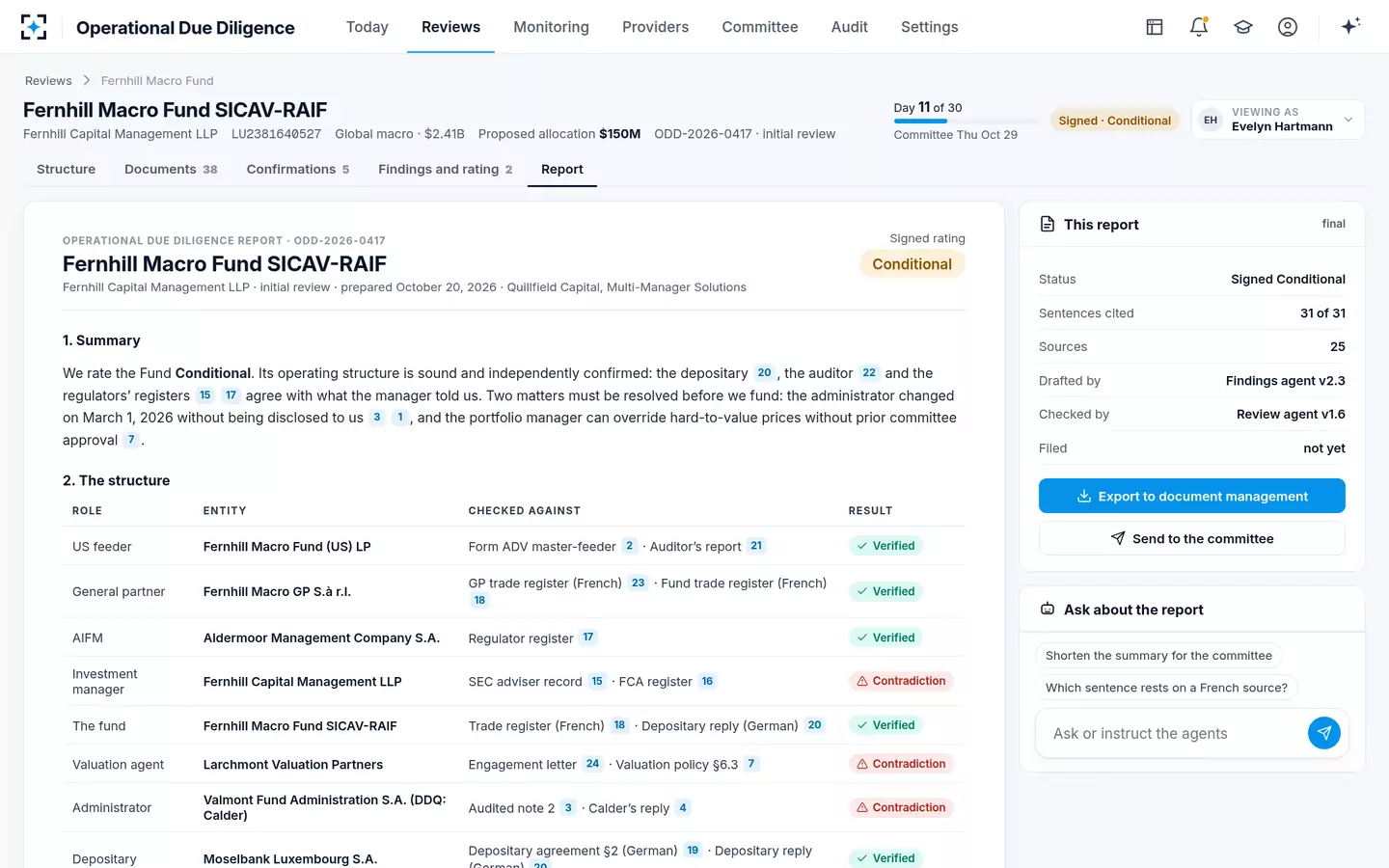
The structure section: every entity, and what it was checked against
The structure section is where a report earns its independence. It lists every entity that touches the money and states, for each, which source confirmed it. The table below is the sample report's structure section. Read the middle column: a register, an audited note, a provider's own reply. The manager's documents appear only as the claim being tested.
The structure section of a sample ODD report: who does what, and who confirmed it
| Role | Entity (fictional) | Checked against | Result |
|---|---|---|---|
| US feeder | Fernhill Macro Fund (US) LP | Form ADV master-feeder entry; auditor’s report | Verified |
| General partner | Fernhill Macro GP S.à r.l. | Luxembourg trade register entries, in French | Verified |
| AIFM | Aldermoor Management Company S.A. | Regulator’s register | Verified |
| Investment manager | Fernhill Capital Management LLP | SEC adviser record; FCA register | 25 of 26 claims verified, one contradiction |
| Valuation agent | Larchmont Valuation Partners | Engagement letter; valuation policy §6.3 | Contradiction: who has the last word on a price |
| Administrator | Valmont Fund Administration S.A. (the questionnaire still says Calder) | Audited note 2; Calder’s own reply | Contradiction: the change was not disclosed |
| Depositary | Moselbank Luxembourg S.A. | Depositary agreement §2 and the depositary’s reply, both in German | Verified |
| Auditor | Harlow & Pryce Audit S.à r.l. | The auditor’s own reply, reconciled | 13 of 13 claims verified |
| Prime brokers | Northgate Securities plc; Ardent Prime LLC | Prime broker confirmations; Ardent Prime’s reply awaited | 8 of 12 claims verified |
Two details make this section defensible. First, the result is counted, not described: "13 of 16 claims verified" says more than ‘the administrator appears appropriate’. Second, a single-source claim is labelled as such. Five claims in the sample rest on one source because one prime broker had not replied; the report says so instead of rounding them up to verified. A reader can see exactly which part of the opinion is still waiting.
The administrator row is the one that changed the rating. The questionnaire, dated August 14, said Calder Fund Services had administered the fund since launch and that no provider had changed in three years. Note 2 of the audited accounts, in French, said Valmont Fund Administration replaced Calder from March 1. Calder's own reply confirmed its appointment ended on February 28. What the manager filed with the SEC about its administrator is a separate check, worked through on its own page.
Findings: how to write one a committee can act on
A finding states a fact, proves it with a page, rates its severity against a written standard, and says what would clear it. Anything less is an opinion. The sample report's two findings show the pattern.
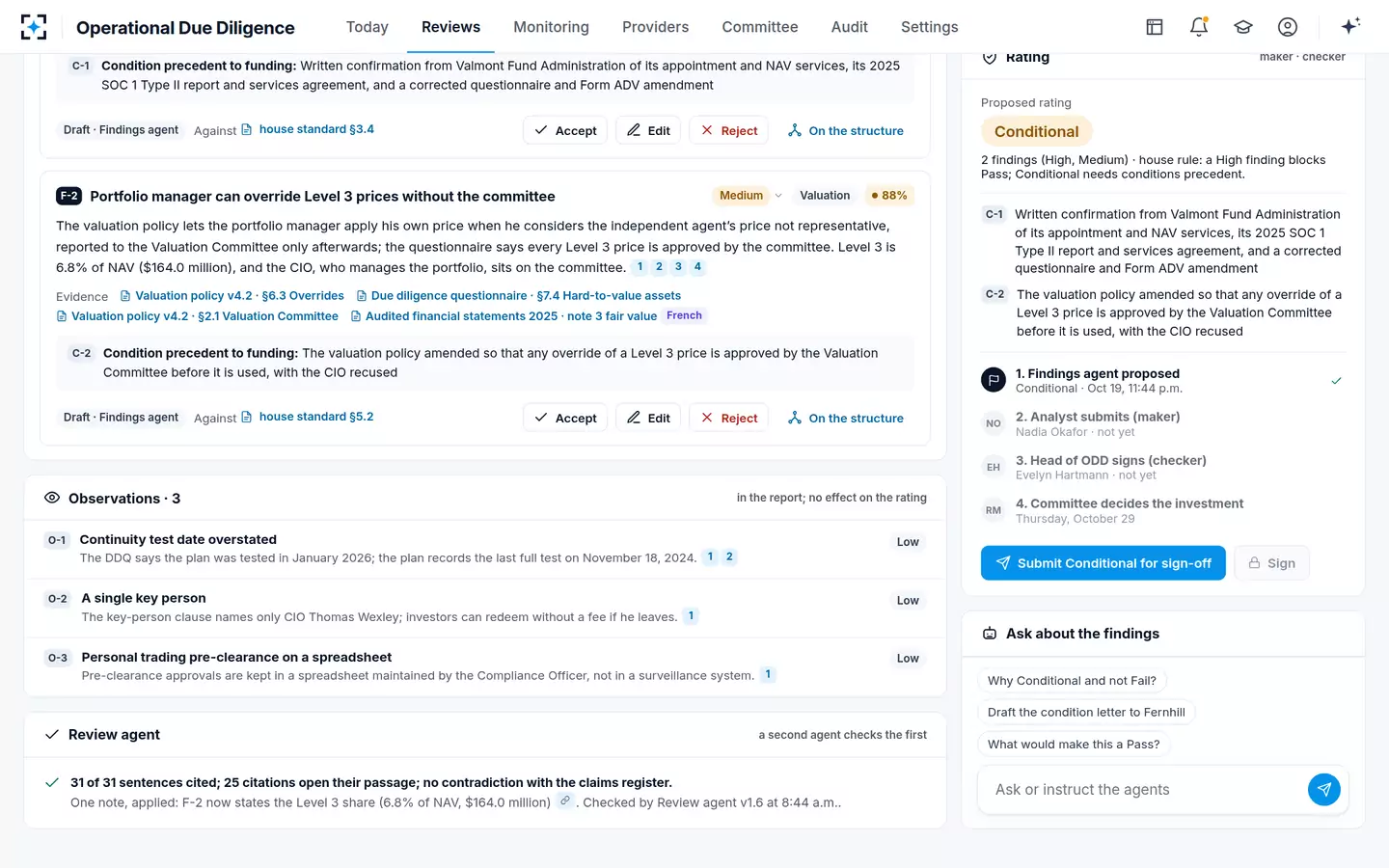
F-1, rated High, reads in substance: the administrator changed on March 1, 2026 and the manager did not disclose it; the questionnaire and Form ADV still name the former administrator. Its condition, C-1, asks for written confirmation from Valmont of its appointment and net asset value services, its 2025 SOC 1 Type II report and the services agreement, and a corrected questionnaire and Form ADV amendment. F-2, rated Medium, reads: the valuation policy lets the portfolio manager override a Level 3 price and tell the Valuation Committee afterwards, while the questionnaire says the committee approves every Level 3 price; Level 3 is 6.8% of net asset value, $164.0 million. Its condition, C-2, asks for an amended policy requiring committee approval before any override, with the chief investment officer recused. Why a price override weighs so heavily in a valuation policy review has its own guide.
Each finding carries its evidence, its standard and its condition
Both findings are the kind regulators keep finding too. SEC examiners reported private fund advisers that "did not follow practices described in their limited partnership agreements (“LPAs”), operating agreements, private placement memoranda, due-diligence questionnaires, side letters or other disclosures" (SEC Division of Examinations risk alert, January 27, 2022). The questionnaire is a disclosure. When it and the evidence disagree, the disagreement is the finding.
Observations, sign-off and the sources index
Observations are the findings that do not move the rating, and they still need a page. The sample report has three, each rated Low: a continuity plan the questionnaire says was tested in January 2026 when the plan records its last full test on November 18, 2024; a key-person clause that names only the chief investment officer; and personal trading pre-clearances kept in a spreadsheet rather than a surveillance system. None blocks funding. All three are what the next re-review should check first.
Sign-off is a control, not a formality. In the sample, the analyst submits Conditional with conditions C-1 and C-2, and the Head of Operational Due Diligence signs it with a reason code; the person who submitted the rating cannot sign it. The committee then reads the signed rating and cannot change it. That split matters later, when someone asks who decided, on what evidence, and whether it was the same person who made the case.
The analyst submits; someone else signs
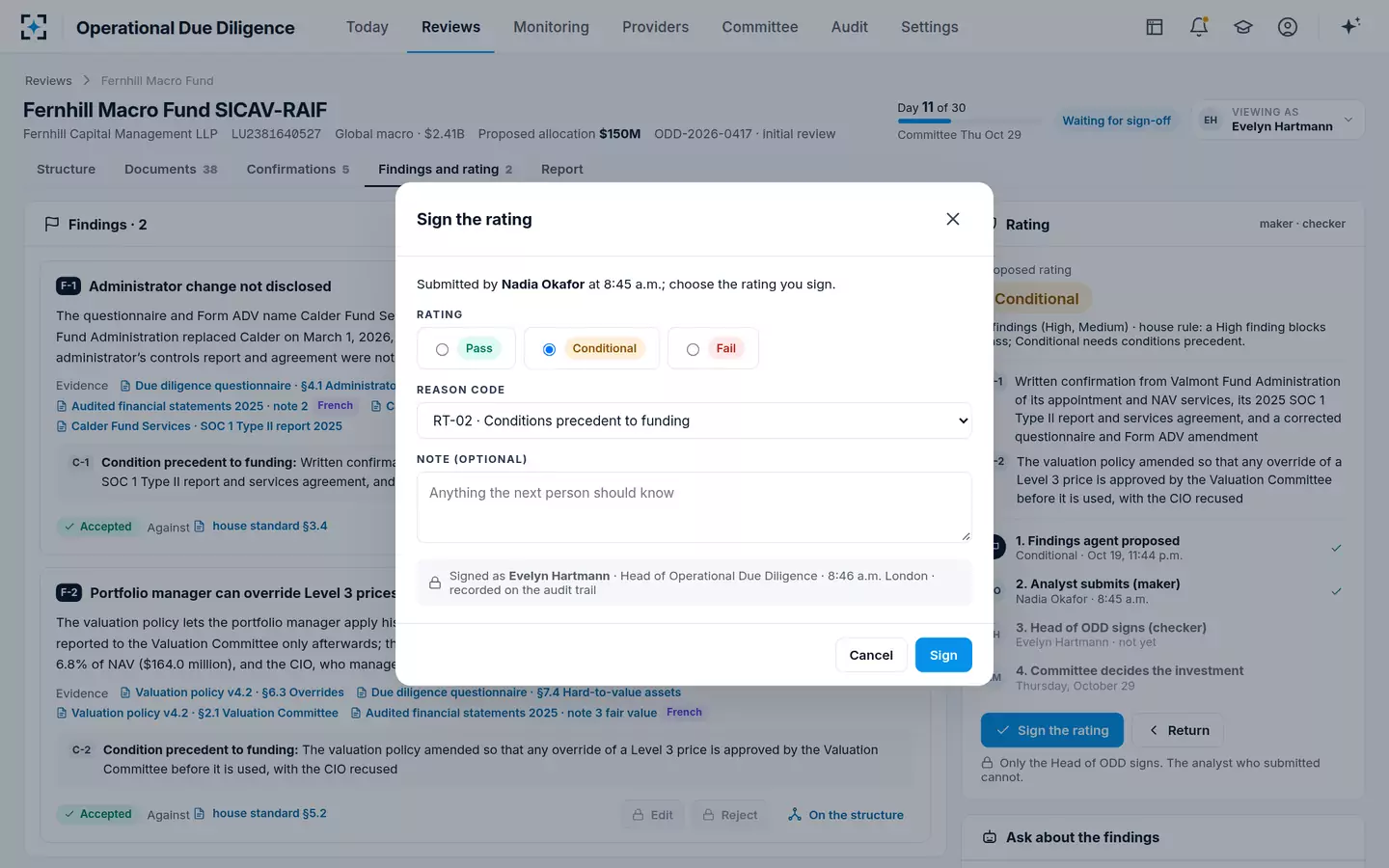
The sources index closes the report. The sample cites 25 sources for 31 sentences, and a second agent checked that each of the 31 sentences carries a citation, that each citation opens the passage it points to, and that no sentence contradicts a verified claim. That check returned one note, which was applied: F-2 now states the Level 3 share. A reviewer reading the report in two years can reopen note 2 at page 14, in French beside the English, rather than trusting a summary of it.
Why the independent source matters: the Madoff lesson
The case for the source column was written by the SEC's own inspector general. Reviewing how three examinations and two investigations missed Bernard Madoff's fraud, the Office of Inspector General recorded its expert's view that "the most critical step in examining or investigating a potential Ponzi scheme is to verify the subject's trading through an independent third party" (SEC OIG, Report OIG-509, executive summary, August 31, 2009).
"Yet, at no time did the SEC ever verify Madoff's trading through an independent third-party, and in fact, never actually conducted a Ponzi scheme examination or investigation of Madoff."
SEC Office of Inspector General, Report OIG-509 (2009)
An allocator's report faces the same test on a smaller scale. A questionnaire answer that says the administrator calculates the net asset value is a claim. The administrator's reply saying it does, sent to an address taken from a regulator's register rather than from the manager, is evidence. The difference costs a few days and an approved email, and it is the difference between a report that describes a fund and one that has checked it. The hedge fund fraud cases behind this rule show the same failure from the allocator's side.
The same report line, written from the manager's word and from evidence
Rests on the manager: Calder “has acted as the Fund’s administrator since launch in 2019” (questionnaire, August 14, 2026).
Rests on an independent source: Audited note 2: Valmont appointed from March 1, 2026; Calder’s reply: appointment ended February 28.
Rests on the manager: An audit opinion PDF in the data room.
Rests on an independent source: The auditor confirms the engagement and the opinion directly; its registration is checked on the regulator’s register.
Rests on the manager: Holdings report from the manager’s system.
Rests on an independent source: The depositary’s or custodian’s own statement or confirmation.
Rests on the manager: Questionnaire §7.4: the Valuation Committee approves every Level 3 price.
Rests on an independent source: Valuation policy §6.3 read in full, and the audited fair value note.
Rests on the manager: Biographies in the pitch book.
Rests on an independent source: Regulators’ registers and the fund documents’ key-person clause.
What is operational due diligence in private equity, compared with hedge funds?
The method is the same; the structure and the risks differ. A hedge fund ODD report centres on the daily machinery of an open-ended fund: who calculates the net asset value used for subscriptions and redemptions, which prime brokers hold the assets and lend against them, how cash moves, and how the hard-to-value book is priced. The industry questionnaire written for hedge funds is the AIMA due diligence questionnaire.
A private equity ODD report centres on a closed-ended fund's governance over ten years or more: how the general partner values unrealised holdings each quarter, how fees and expenses are allocated between the fund, co-investors and portfolio companies, whether the advisory committee is asked to consent to conflicts, and what happens if key people leave. The industry questionnaire written for private equity managers is the ILPA due diligence questionnaire. SEC examiners have recorded private fund advisers that "did not adhere to the LPA “key person” process after the departure of several adviser principals" (SEC risk alert, 2022), which is why the key-person clause belongs in both kinds of report.
Some checks travel unchanged. Form ADV asks every private fund adviser, for each fund, whether every audit report since its last annual amendment carried a clean, unqualified opinion (Form ADV Part 1A, Schedule D, Section 7.B.(1), question 23(h); the question as filed, and how to read it). Whatever the strategy, the report should record the answer and whether the audit file agrees with it.
How long is an ODD report, and what should the PDF keep?
Length follows the reader, not the effort. "A typical DD report spans between 100 to 200 pages with both quantitative and qualitative sections prepared for the clients," Brown, Goetzmann, Liang and Schwarz note of the third-party reports they studied (NBER working paper 15529). That is a file, not a report. A committee reads a few pages: the rating, the reasons, the conditions. The rest belongs in the evidence behind it.
The useful split is a short report with a deep index. The sample report reads in five sections plus the sources index and exports to document management as one file. When a report is exported as a PDF, keep three things that usually get lost: the citation beside each sentence, the date and language of each source, and the names of the person who submitted and the person who signed. A PDF without them is a summary of a review, not the review.
Two practical rules help. Write the summary last, from the signed findings, so it cannot promise more than the evidence. And keep one line per open item in the summary itself (the reply still awaited, the document still missing), because the committee may be reading before the last confirmation arrives. To see the structure, the findings and the signed report together on your own past reviews, start from Operational Due Diligence; the operational due diligence checklist lists the independent source for each question the report must answer.
Questions people ask
Is an operational due diligence report the same as investment due diligence?
No. Investment due diligence judges the strategy and the team's ability to make money; operational due diligence judges whether the fund's administration, custody, valuation, controls and service providers can be trusted with it. In the sample program the committee decides the investment but reads the ODD rating as fixed, so an operational Fail stops an allocation however strong the strategy case.
Who signs an operational due diligence report?
Usually the head of operational due diligence or a delegate, and never the analyst who wrote it. In the sample, the analyst submits the rating and the Head of ODD signs it with a reason code; the committee reads it and cannot change it, and the funding waits for the conditions.
Can a manager rated Conditional be funded?
Yes, once the conditions are met. A Conditional rating should list each condition precedent with the evidence that clears it, such as a provider's written confirmation or an amended policy, and the subscription should stay on hold until someone other than the person clearing the condition approves the release.
How often should an ODD report be refreshed?
On a cycle and on events. Re-reviews commonly run every two or three years; the sample allocator uses 24 months for its larger managers and 36 for the rest, plus event triggers such as a provider change, a key person leaving, a qualified audit opinion or a regulatory action.
Is there a standard operational due diligence report template?
No regulator prescribes one. The questionnaires are more standard than the reports: AIMA publishes one written for hedge funds and ILPA one for private equity. A report template should fix the sections, the rating rules and the evidence each section needs, and leave the prose to the facts.
What does an unqualified audit opinion tell an ODD analyst?
That the auditor found the financial statements fairly presented, not that the operations are sound. It is worth recording, and Form ADV asks advisers to state it for each private fund, but the analyst should still confirm the engagement with the auditor and read the notes, where changes such as a new administrator are disclosed.