Operational due diligence firms are specialist consultants that review fund managers' operations for allocators: they gather the manager's documents, interview its staff, verify claims with administrators, custodians and auditors, and deliver a report and often a rating. The alternative is an in-house ODD team, and a third option is an in-house team whose reading, cross-checking and drafting is done by agents. Choosing between them is a question of cost per review, coverage and control. There is little public price data: neither regulators nor independent studies publish current fees for ODD services, and the one academic figure is old (a typical third-party report cost a client $12,500 in a 2009 study). So the comparison has to be built on your own numbers: analyst days, day rates, travel, fees and the oversight time an outsourced review still needs. One constraint does not change with the option: outsourcing the work does not outsource the responsibility. Botminds' Operational Due Diligence is built for the third option, and this page sets out where it fits and where a firm still earns its fee.
Worked figures use the solution's fictional sample allocator, Quillfield Capital, and Botminds' own estimates of analyst time; where you need a price, the page gives the formula and leaves the rate to you.
Three numbers from the record on outsourced due diligence
$12,500
typical cost of one third-party hedge fund due diligence report to a client, in a 2009 study
4–8weeks
from request to finished report at the same firm
$56M
invested in Bayou by about 40 clients of a consultant that skipped two of its five promised checks
What do operational due diligence firms do?
They sell a review, or a programme of reviews, that an allocator would otherwise do itself. The firm in the Brown, Goetzmann, Liang and Schwarz study is a well-documented example. Such firms, the authors write, "are typically retained by clients who are considering an investment in a hedge fund, and who wish to gather more information beyond what is provided by the fund prospectus and by regulatory filings", and "Typical clients are mainly funds of hedge funds, but also include investment banks, family offices, and other institutions" (NBER working paper 15529). Its method combined the manager's documents, on-site interviews and forms with verification at the administrator and the auditor and background checks on the firm and its staff.
Today the market includes specialist ODD providers, investment consultants that include ODD in a wider mandate, and outsourced chief investment officers that run it inside a delegated programme (what an OCIO charges has its own guide). For a buyer, the differences that matter are not the brand but the method: which claims the firm verifies independently and how, whether its report can be audited back to evidence, and who at the allocator still signs.
How much does an operational due diligence review cost?
Firms do not publish fee schedules, and no regulator or independent study tracks them, so the honest answer is a formula rather than a figure. The one academic data point is dated: in the 2009 study, "a typical DD report" cost a client $12,500, and the firm took four to eight weeks from request to report. Treat that as history, not a quote.
For an in-house review, the cost is the analyst days it takes multiplied by a fully loaded day rate (salary, benefits, systems, management time), plus travel for any on-site visit and the time of the person who signs. Botminds estimates an initial review at about eight analyst days by hand, from practitioner ranges of six to ten, and about two with the solution. For an outsourced review, the cost is the fee plus the in-house time to scope the work, read the report, resolve its open points and sign a rating; outsourcing never takes that time to zero.
Three ways to staff operational due diligence, priced on the same terms
| Cost element | Outsourced firm | In-house team | In-house team with agents |
|---|---|---|---|
| Fee per review | The firm’s fee (ask for it per initial review and per re-review) | None | None per review; a subscription for the software |
| Analyst days per initial review | Oversight only: scoping, reading the report, follow-up, sign-off | About 8, by our estimate (6–10 in practice) | About 2, by our estimate, the rest done by agents |
| Cost per analyst day | — | Your loaded day rate | Your loaded day rate |
| Travel for on-site visits | In the fee or billed separately: ask | Yours | Yours |
| Languages and jurisdictions | The firm’s coverage | Your team’s languages | Documents read in their own language; registers as connected |
| Evidence you own afterwards | The report, and what the firm agrees to share | Your full file | Your full file, every claim cited, on an audit trail |
| Responsibility for the rating | Yours | Yours | Yours |
A worked comparison on one review programme
Analyst days are the common unit, because a day rate turns them into money and every allocator knows its own. The sample allocator plans 248 reviews this year across 436 approved managers, with a team of nine. If every review took as long as an initial review, the by-hand estimate would be about 1,984 analyst days a year, far more than nine people have after monitoring, committee work and leave. With the solution, at about two days a review, it would be about 496.
Analyst days for the sample programme, by option
| Option | Calculation | Analyst days a year | What you still pay for |
|---|---|---|---|
| In-house, by hand | 248 reviews × about 8 days | about 1,984 (upper bound) | Day rate × days, travel |
| In-house with agents | 248 reviews × about 2 days | about 496 (upper bound) | Day rate × days, travel, the software |
| Outsourced firm | 248 reviews × your oversight days | your oversight time | Fee × 248, plus oversight days × day rate |
The comparison usually resolves into a hybrid. A firm's fee is easiest to justify where the allocator lacks the language, the jurisdiction or the specialist knowledge for a particular manager, or needs capacity for a burst of new allocations. An in-house team is easiest to justify where the reviews are many and repeated, because what it learns about one administrator or auditor carries to every manager that uses it. Agents change the in-house line most, because they take the hours that grow with volume: reading, cross-checking and drafting.
Who is responsible if an outsourced review misses something?
The allocator. Regulators say so in different words for different firms. The UK's rule for regulated firms is that if a firm "outsources critical or important operational functions or any relevant services and activities, it remains fully responsible for discharging all of its obligations under the regulatory system" (FCA Handbook, SYSC 8.1.6R). FINRA reminds US broker-dealers that "outsourcing an activity or function to … [a Vendor] does not relieve members of their ultimate responsibility for compliance with all applicable federal securities laws and regulations" (FINRA Regulatory Notice 21-29, August 13, 2021).
For an allocator that is a fiduciary to its own clients or beneficiaries, the same logic applies to manager selection: a report bought from a firm is evidence the allocator relied on, not a transfer of its judgment. The UK Financial Conduct Authority's asset management market study made the point from the other direction, finding that investment consultants could not, on average, identify managers that delivered better returns, but that the manager selection process reduced operational risk for investors (FCA, Asset Management Market Study final report, June 2017). Screening is exactly what an allocator cannot hand away.
What the Hennessee case teaches buyers of ODD services
The clearest public record of an outsourced due diligence failure is an SEC order against a hedge fund consultant. Hennessee Group marketed a "Five Level Due Diligence Process" and, the SEC found, "represented to clients and prospective clients that it would not recommend investment in hedge funds that did not satisfactorily complete all five levels of its due diligence evaluation" (SEC, Advisers Act Release No. 2871, April 22, 2009). For the Bayou funds, it skipped two of them: the analysis of the fund's trading records, after Bayou refused to provide its prime brokerage reports, and the verification of Bayou's relationship with its auditor.
"In reality, Hennessee Group’s “Verify Auditor” procedure consisted only of confirming that a fund’s financial statements contained an unqualified audit opinion letter."
SEC order, In the Matter of Hennessee Group LLC and Charles J. Gradante (2009)
About forty of its clients invested over $56 million in Bayou on its recommendation, and the consultant collected over $500,000 in advisory fees for those referrals. Bayou was a fraud; its audit opinions had been fabricated by one of its own principals. The SEC censured the consultant and its principal, ordered disgorgement of $549,076 plus interest and a $100,000 civil penalty, and required it to send the order to its clients. The Bayou fraud itself, and the public records that would have exposed it, is one of the cases in the casebook.
The lesson for a buyer is specific. Ask a firm what each step of its method consists of, not what it is called. "Verify auditor" can mean writing to the auditor and receiving its confirmation, or it can mean reading the opinion page. Ask what the firm does when a manager refuses a document, and whether it tells you. And ask to see, for a past review, the evidence behind one verified claim.
Questions to ask an operational due diligence firm before you hire it
- What does each step of your method consist of?
For “verify the administrator” or “verify the auditor”: who is contacted, how the contact is found, and what reply counts.
- Where do your confirmation contacts come from?
A regulator’s register, not the manager’s documents.
- What do you do when a manager refuses a document or a provider will not reply?
Is it in the report, and are we told before the rating?
- Who pays you for this manager?
A report commissioned by the manager is a different product from one you commission.
- Can we see the evidence behind one verified claim from a past review?
Redacted is fine; absent is not.
- What do we receive: a report, or the file?
Your auditor and regulator may want the evidence, not the summary.
- How do you watch a manager after approval?
Form ADV amendments, audited notes, provider changes, key people.
- What does a re-review cost, and how long does it take?
Most of a programme’s volume is re-reviews.
Should operational due diligence be outsourced?
Partly, for most allocators, and the split should follow the work rather than the org chart. Keep in-house what compounds: the house standard, the rating rules, the approved-manager list and its monitoring, and the signature. Buy what is specialist or occasional: a jurisdiction the team does not know, an asset class it reviews rarely, on-site visits it cannot staff. Whatever is outsourced, keep the right to see the evidence, because the rating, and the responsibility, stay with you.
What you buy from a firm, and what you keep either way
Can be bought: Collecting and reading the data room
Stays with the allocator: Deciding what is material to your standard
Can be bought: Writing to providers and reconciling replies
Stays with the allocator: Accepting that a reply settles a question
Can be bought: Drafting findings and a proposed rating
Stays with the allocator: Signing the rating and setting conditions
Can be bought: Alerts on filings, provider changes, people
Stays with the allocator: Opening a re-review and acting on it
Can be bought: A report
Stays with the allocator: A file an auditor or examiner can follow
How long does an operational due diligence review take?
Elapsed time is set by documents and replies, analyst time by reading and writing. The third-party firm in the Brown study took four to eight weeks from request to report. The sample allocator's service level is 30 business days for an initial review and 20 for a re-review, with sign-off within three business days of submission and replies chased after five. Its design target with the solution is ten days to sign a first review, against that 30-day service level: a target, not yet a measured result.
Late reviews, and a proposed fix the COO decides
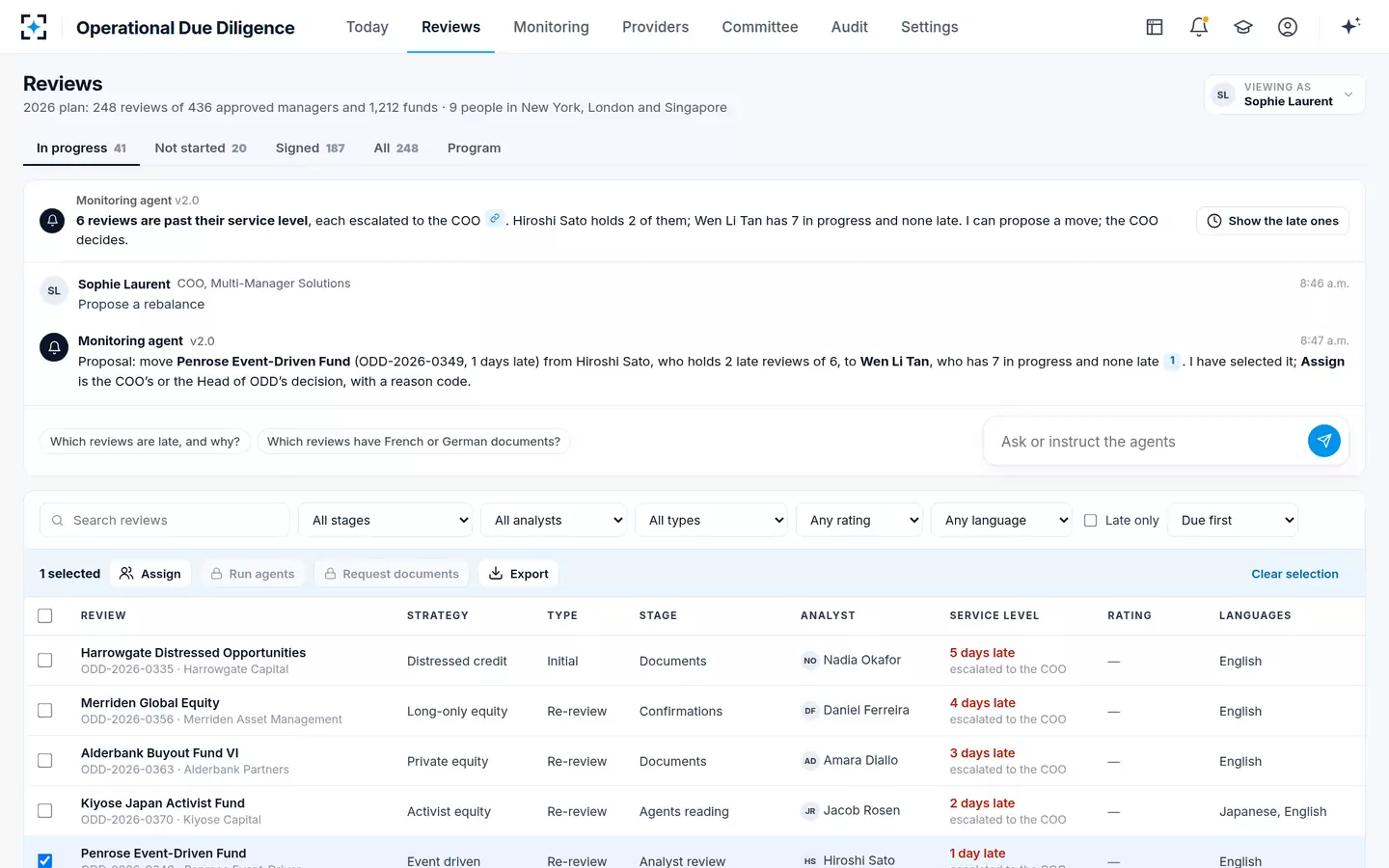
Where Operational Due Diligence fits, and where a firm still helps
The solution fits allocators that run, or want to run, ODD in-house across many managers and repeat cycles: pension funds, endowments, funds of funds, multi-manager platforms and outsourced chief investment officers. It takes the reading, structure-drawing, cross-checking and drafting; it leaves every confirmation, finding, rating and release of money to named people, with the committee reading the rating and unable to change it. It can also sit beside a firm: a firm's report can be read like any other document in the data room, and its claims checked against the same independent sources.
The committee reads the rating; the money waits for the conditions
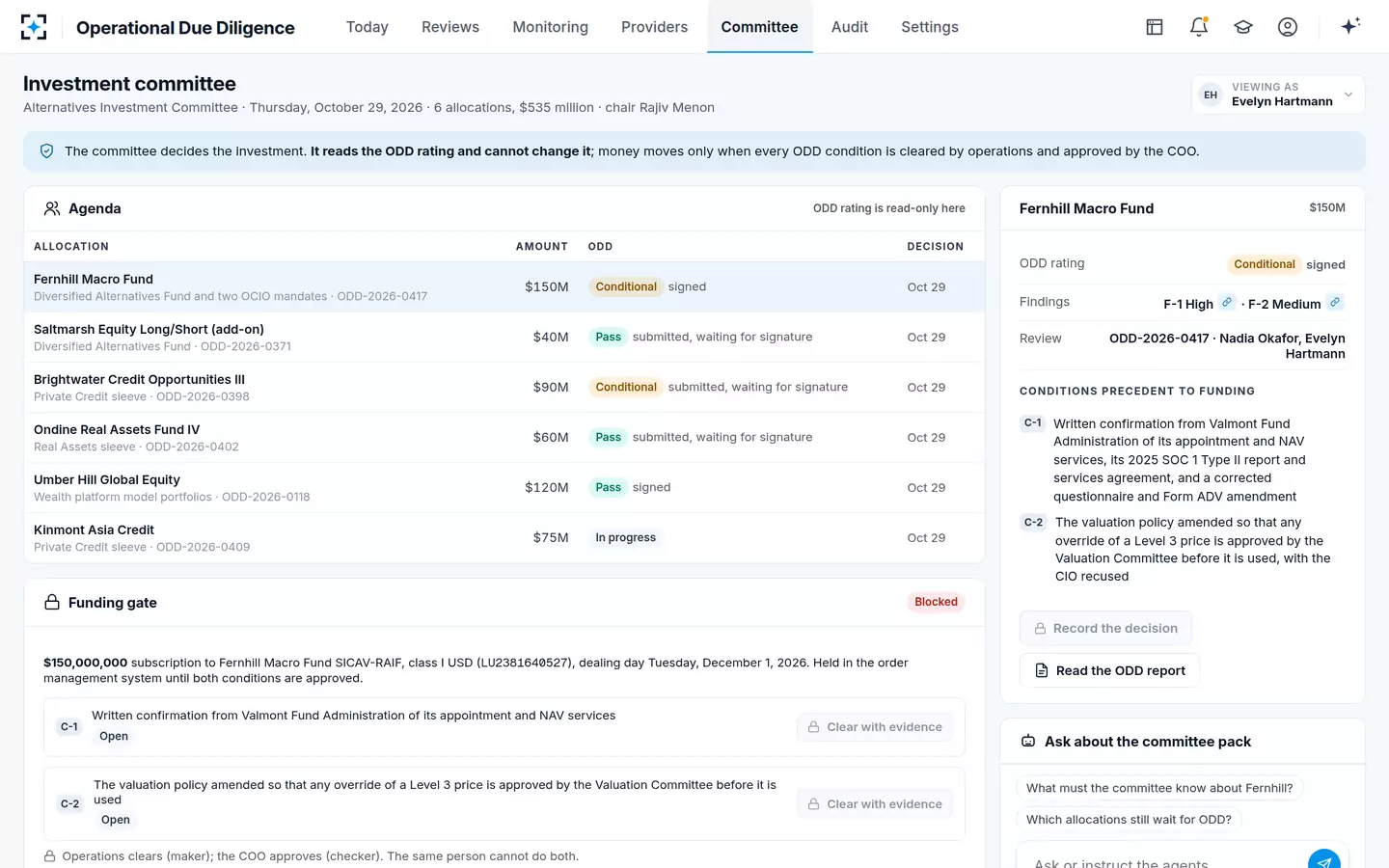
Where a firm still helps is in the parts that are presence and specialism: an on-site visit in a city the team does not cover, a strategy it rarely sees, a surge of new managers before a fund launch. What an in-house team needs to bring before day one and where an analyst's week goes help size the in-house side. To price the third option on your own past reviews, start from Operational Due Diligence.
Questions people ask
What do operational due diligence services include?
Typically document collection, a review of the manager's questionnaire and policies, interviews with operations and compliance staff, verification with the administrator, custodian and auditor, background checks, a written report and often a rating. Ask which of those are verified independently and which are summarised from the manager's documents.
Can an allocator rely on an ODD report the manager commissioned?
As one input, not as the review. A report paid for by the manager was scoped by the manager; the allocator should check who commissioned it, what was verified and when, and re-confirm the providers itself. The responsibility for the rating stays with the allocator either way.
Does outsourcing ODD reduce regulatory responsibility?
No. The FCA's outsourcing rule says a firm that outsources remains fully responsible for its obligations, and FINRA tells broker-dealers that outsourcing does not relieve them of ultimate responsibility. An allocator should keep the evidence and the signature in-house.
How are operational due diligence firms paid?
By fee per review, by annual programme or as part of a wider consulting or outsourced CIO mandate. Fee levels are not published; the 2009 academic figure of $12,500 per typical report is the only independent data point, and it is long out of date.
Is it cheaper to do ODD in-house?
It depends on volume. With few reviews a year, a firm's fee can be cheaper than a team; with hundreds of reviews and repeat cycles, the in-house cost per review falls because what the team learns carries over, and agents cut the analyst days that grow with volume. Compare on your own day rate and the firm's quoted fees.