Average OCIO fees, what an outsourced chief investment officer charges to run an institution's portfolio and its managers, are not published by any US regulator or independent study, and providers' quotes are hard to compare because the fee is only part of what the client pays. The best public evidence is British. When the UK Competition and Markets Authority investigated fiduciary management, the UK name for the OCIO model, it found that "fiduciary management fees constitute around half of combined fiduciary management and asset management costs," against about a tenth for advice alone, and that "Median fiduciary management fees are around five times higher than median investment consulting fees" (CMA, final report, December 2018). The question to answer is therefore not the average fee but the all-in cost in basis points, compared with what it would cost to oversee managers yourself. Botminds' Investment Manager Oversight sits on the in-house side of that comparison: agents that collect, read and test what each manager reports, so a small team can oversee many managers.
Who takes the money: the share of the total fee bill under each model, as the CMA found it
Investment consultant advises; scheme hires managers
- Investment consultancy fee · 10%
- Asset management fees · 90%
Fiduciary manager (OCIO) runs the portfolio
- Fiduciary management fee · 50%
- Asset management fees · 50%
What are average OCIO fees?
There is no reliable public average for US plans. Fees are negotiated, tiered by assets, and often quoted separately from the fees of the managers the OCIO selects; no US regulator collects them as a series, and the surveys that circulate are produced by firms in the market. What can be said with evidence is how big the OCIO's own fee is relative to everything else the client pays, and the CMA's investigation is the most thorough public measurement of that.
The CMA's numbers describe UK pension schemes in 2017, and they are worth reading closely. Investment consultancy and fiduciary management together cost UK schemes "around £591 million" a year, against asset management fees its partial dataset put above £669 million and called "likely to be a significant underestimate." The fiduciary management market alone "was worth £254 million in 2017 in terms of revenues," its providers managed "over £110 billion in assets and have 741 clients," and "13% of UK pension schemes currently buy fiduciary management services" (CMA final report).
The UK fiduciary management market the CMA measured
£254m
fiduciary management revenues in 2017, up from £50 million in 2007
£110bn
at least, in assets managed by confirmed fiduciary managers for 741 clients: "over £110 billion"
13%
of UK pension schemes buying fiduciary management
~5×
median fiduciary management fees against median consulting fees
Reading the UK evidence for a US plan, endowment or fund
The CMA's shares travel better than its pound figures, because they describe how a fee bill is divided rather than what any one provider charges. Any institution can compute the same measure on its own bill: the outsourced provider's fee divided by that fee plus all the asset management fees paid on the same assets. On the CMA's evidence, advice alone took about a tenth of the combined bill and fiduciary management about half. A US proposal that puts the provider's share well above or below those marks is not wrong for that reason, but it is a question to ask.
Three cautions apply. The CMA's data are UK pension schemes in 2017, measured as medians across providers that gave it data. Fees vary by size and are negotiated: providers told the CMA "that their fee levels varied between schemes" and "appeared prepared to negotiate on fees in order to secure appointments" (CMA, paragraph 10.15). And US plans can get the inputs directly. The Department of Labor's guide for ERISA plan fiduciaries says that, for an arrangement to be reasonable, service providers "must provide certain information to you about the services they will provide to your plan and all of the compensation they will receive" (EBSA, September 2021), which is the raw material for the share calculation.
How are OCIO fees quoted?
OCIO fees are quoted in basis points of assets, usually on a sliding scale, and the quote rarely includes everything. The CMA describes the convention: "It is common practice to express fees in basis points, that is as a percentage of assets under management, multiplied by 100" (CMA, paragraph 10.11). The fee for the OCIO's own work sits on top of the fees of the funds or managers it selects, and those sit on top of custody, fund operating expenses and trading costs.
In the US, an OCIO that is an SEC-registered investment adviser must describe its pricing in its Form ADV brochure. Part 2A Item 5 requires it to "Describe how you are compensated for your advisory services. Provide your fee schedule. Disclose whether the fees are negotiable," and to "Describe any other types of fees or expenses clients may pay in connection with your advisory services, such as custodian fees or mutual fund expenses" (Form ADV Part 2). One exception matters for large institutions: an SEC-registered adviser need not include the fee information in a brochure delivered only to qualified purchasers. The brochure is a starting point for a comparison, not the comparison.
The all-in cost of outsourced oversight, term by term
OCIO fee
bps on assets, usually tiered
The provider’s own fee for strategy, manager selection, implementation and reporting.
Form ADV Part 2A, Item 5.A
Underlying manager fees
Σ (manager bps × assets with that manager)
Funds, separate accounts or the provider’s own pooled vehicles.
Item 5.C: other fees clients may pay
Fund and custody costs
Operating expenses + custody + administration
Often paid inside fund NAVs and easy to miss.
Fund documents; custodian invoices
Transaction costs
Commissions, spreads, transition costs
Highest at hiring and at manager changes.
Trade records; transition reports
Do OCIO fees include manager fees?
Usually not, and when they appear to, ask how. An OCIO that uses outside managers passes their fees through; one that uses its own pooled vehicles may charge at the vehicle level, which can make the headline fee look smaller. The UK Financial Conduct Authority flagged the conflict in its 2017 asset management study: the range of fiduciary managers' services "includes fund of fund and manager of manager in-house products," and "many of our concerns about fiduciary management apply equally to other in-house products. This includes the conflicts of interest concerns about performance reporting" (FCA, Asset Management Market Study final report, June 2017).
The CMA's 10% and 50% shares only make sense because the OCIO fee and the manager fees are both counted. A fair comparison of two proposals lines up all four terms of the formula for the same assets, and then asks how much of the manager-fee term goes to the OCIO's own products.
OCIO vs investment consultant: what the extra fee buys
A consultant advises and the client decides and implements; an OCIO decides and implements within limits the client sets. The extra fee buys delegated decisions and the work of carrying them out: hiring and firing managers, rebalancing, cash management, and reporting. It does not buy the client out of oversight. Under ERISA, a plan that appoints an investment manager still has to monitor it, which is the subject of 3(21) vs 3(38) fiduciary services.
The CMA also found how often the decision is not really a decision. Around half of UK schemes buying fiduciary management "appointed their existing investment consultant," and among schemes that bought it from their existing consultant only 14% ran a formal tender (CMA final report, paragraphs 7.34–7.46). The CMA's remedy, which took effect in 2019, required trustees to run a "Competitive Tender Process," inviting bids from "three or more unrelated Fiduciary Management Providers," before putting 20% or more of a scheme's assets under fiduciary management, and to set objectives for their consultants (CMA Order, 2019). US plans have no such rule; the discipline is a good one to borrow.
What does in-house manager oversight cost?
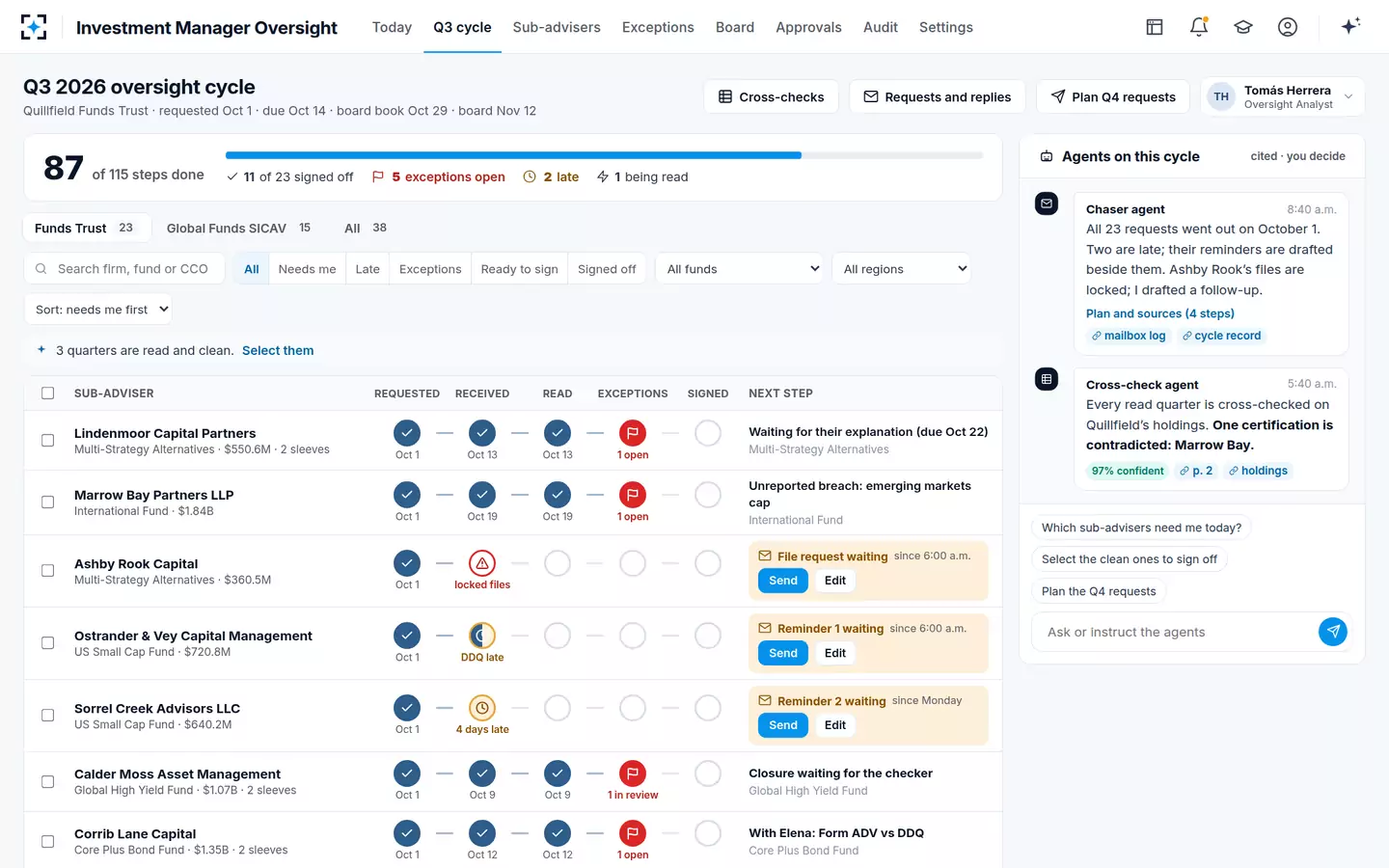
In-house oversight costs people's time, and the time is mostly spent before any judgment is made. The solution's own estimate, on its sample fund trust with 23 sub-advisers, is about 12 analyst hours per manager per quarter by hand: 3 requesting and chasing, 4 reading certifications and reports, 1.5 comparing them with the agreement, last year's questionnaire and Form ADV, 2 logging exceptions and chasing explanations, and 1.5 on the board report section. That is about 276 hours a quarter for 23 managers. The design target with agents is 2 hours per manager, about 46 hours.
To turn that into basis points, multiply the hours by a loaded hourly cost, add the cost of the systems used, and divide by the assets overseen. The answer is usually small next to an OCIO fee measured on the whole portfolio, but the two are not the same purchase: the OCIO also makes the investment decisions. The honest comparison is between an OCIO's fee and the cost of the decisions plus the oversight, in-house or bought in pieces. A plan or fund that keeps the decisions still has to oversee the managers, and that is the part whose cost agents change.
What 23 managers' quarter looks like on one screen in Investment Manager Oversight
The KPIs that show what oversight is worth
Oversight is worth what it finds and how fast it closes it, so measure both, in-house or outsourced. The eight measures below can be computed from the records any oversight program keeps; the sample figures show what they look like on the solution's sample data.
Eight KPIs for manager oversight, with formulas, whoever does the work
Fee load
All-in cost in basis points ÷ assets overseen
The number to compare across OCIO bids and against in-house oversight.
Cost per sub-adviser quarter
Oversight hours × loaded hourly cost ÷ sub-advisers
The in-house unit cost; in the sample, about 12 hours by hand and a 2-hour target.
Re-test coverage
Guideline tests run ÷ (coded guidelines × business days)
100% means every guideline, every day; a sample is a fraction of that.
Unreported breaches found
Breaches the fund found ÷ breaches managers reported
What the manager’s own word missed. The sample quarter: two unreported against one reported.
On-time certificates
Certificates received by the due date ÷ requested
Late paper is where bad quarters hide; a late certificate is an open question, not a clean one.
Days to close an exception
Closure date − date found, per exception
Shows whether problems are resolved or carried; the sample SLA is 20 business days.
Contradictions per questionnaire
Answers contradicted by Form ADV, last year or holdings ÷ answers compared
In the sample, one key-person contradiction in 284 answers for one manager.
Board report statements cited
Statements linked to a source ÷ statements
Whether the board can trace what it is told; 41 of 41 in the sample.
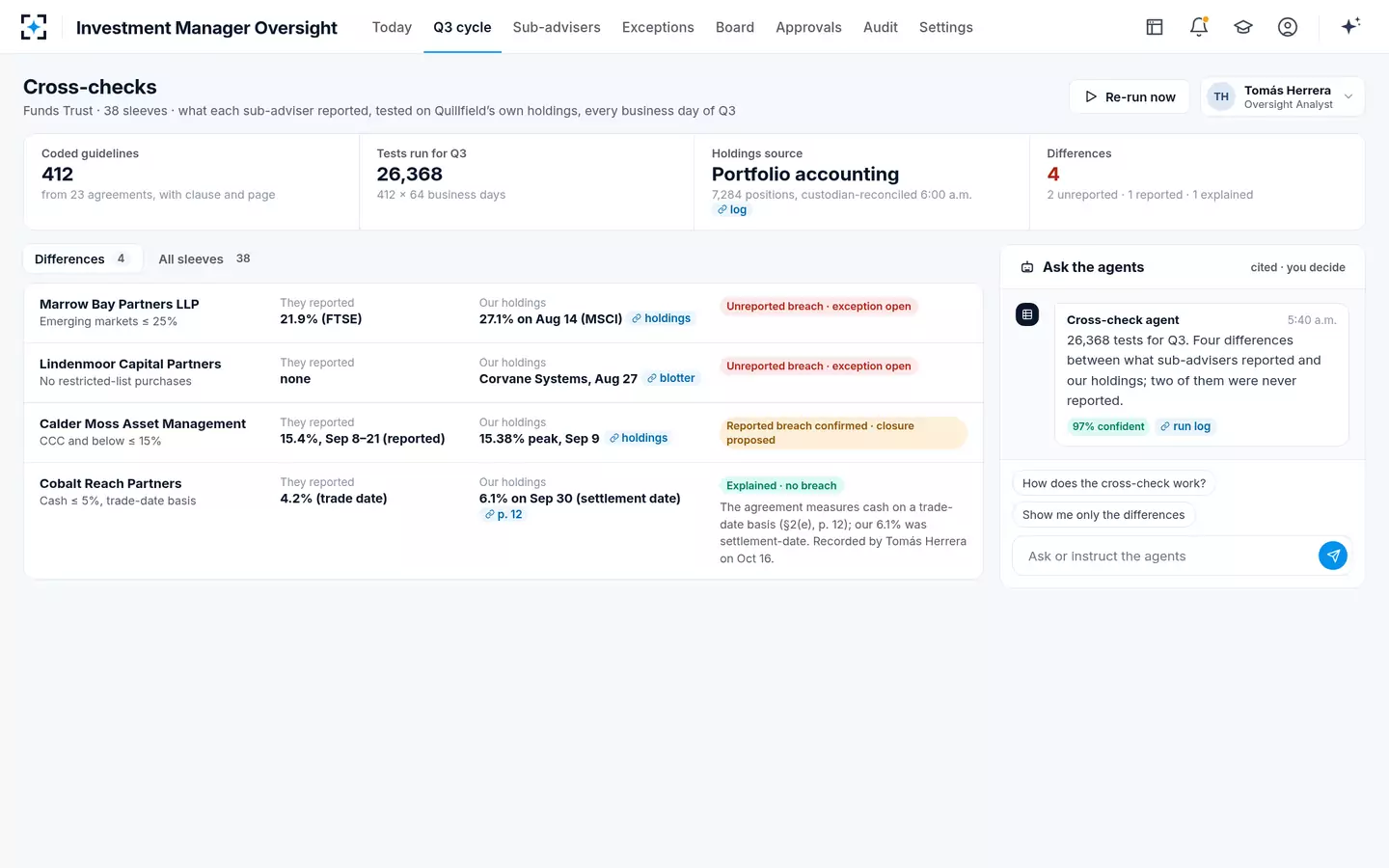
Two of these do most of the work in a fee negotiation. Re-test coverage tells you whether the "monitoring" in a proposal is a quarterly look at a manager's own report or a daily test on the holdings. Unreported breaches found tells you whether that test has ever caught anything. In the sample, re-testing 412 guidelines on every one of 64 business days produced 26,368 tests and two breaches the managers' own certifications had missed.
How to compare OCIO proposals, or an OCIO against doing it yourself
- Price the same portfolio, all four terms
OCIO fee, underlying manager fees, fund and custody costs, transaction costs, in basis points on the same assets.
- Ask how much goes to the provider’s own products
The FCA named in-house products as a conflict; get the share in writing.
- Read the brochure
Form ADV Part 2A Item 5: fee schedule, whether fees are negotiable, other fees clients may pay.
- Ask what monitoring means
Which guidelines are tested, how often, on whose holdings data, and what was found last year.
- Ask who monitors the OCIO
Delegating decisions does not delegate the duty to oversee the delegate.
- Run a real tender
The UK requires three or more unrelated bidders before outsourcing 20% or more of a scheme’s assets; it is good practice anywhere.
- Cost the in-house alternative honestly
Hours per manager per quarter, times your managers, times a loaded rate, plus the decisions you would have to make.
How do you choose an OCIO provider?
Choose on what the provider will do with your portfolio and how you will see it, not on a headline rate. For a US ERISA plan, the Department of Labor's guidance frames it: "Hiring a service provider in and of itself is a fiduciary function," service providers must disclose their services and compensation, and "While the law does not specify a permissible level of fees, it does require that fees charged to a plan be 'reasonable'" (EBSA, Meeting Your Fiduciary Responsibilities, September 2021). Reasonable is measured against the services, which is why the all-in cost and the monitoring detail belong in the same comparison.
Where Investment Manager Oversight fits is narrow and worth stating. It is not an OCIO and makes no investment decisions. It is for the team that oversees external managers itself, at a fund group, a plan or an endowment, or that oversees the managers an OCIO has hired: it chases each manager's reports, reads them in their own language, re-tests them on the institution's own holdings and drafts the report to the board or committee, while people decide and sign. What that oversight needs from the rest of the stack is set out separately.
Every manager's reported numbers, tested on the institution's own holdings in Investment Manager Oversight
Questions people ask
What are typical OCIO fees?
No regulator or independent study publishes a typical US figure. The UK CMA found fiduciary management fees making up around half of combined fiduciary and asset management costs, with median fiduciary management fees around five times median consulting fees; ask each US bidder for an all-in basis-point figure on your own portfolio.
Is an OCIO a fiduciary?
For an ERISA plan, an OCIO with discretion over plan assets is usually appointed as an investment manager under section 3(38), which requires it to acknowledge in writing that it is a fiduciary. The plan's own fiduciaries keep the duty to select it prudently and monitor it.
What is the OCIO fee structure?
Usually a tiered percentage of assets for the OCIO's own work, plus the fees of the managers or funds it uses, plus fund, custody and trading costs. An SEC-registered OCIO must describe its compensation and fee schedule in Form ADV Part 2A Item 5, unless the brochure goes only to qualified purchasers.
Did the UK require a tender for fiduciary management?
Yes. The CMA's 2019 Order prohibited trustees from putting 20% or more of a scheme's assets under fiduciary management without a competitive tender, defined as inviting bids from three or more unrelated providers and evaluating them. It also required trustees to set objectives for their investment consultants.
Can oversight software replace an OCIO?
No. Software, including Investment Manager Oversight, does not make investment decisions. It reduces the cost of the oversight an institution must do either way, which changes the in-house side of the comparison rather than replacing the OCIO's role.