A sub-advisor, or sub-adviser in the spelling the SEC uses, is an investment manager hired by a fund's own adviser to make the day-to-day investment decisions for all or part of the fund's portfolio, under a written sub-advisory agreement that the fund's board, and normally its shareholders, must approve. The fund's name, prospectus and board stay the same; the person choosing the securities works for another firm. That is the whole difficulty: the fund still answers to shareholders and the SEC for what the sub-advisor does, but sees its trading only through reports the sub-advisor writes. Botminds' Investment Manager Oversight is built for the team that closes that gap each quarter: agents collect each sub-advisor's certification, guideline reports and questionnaire, re-test them on the fund's own holdings, and draft the chief compliance officer's report, while people decide and sign.
Examples on this page come from the solution's sample data: a fictional fund trust with 23 sub-advisers running 38 sleeves. Every rule, figure and finding outside the sample comes from the statute, the SEC's own rules and releases or its examination staff, linked where it appears.
The fund world sub-advisers work in, in the SEC's own numbers
14,297
registered funds at December 2025, managing about $47 trillion
~800
fund complexes with nearly 15,000 portfolios, the population SEC fund examiners cover
100+
manager-of-managers orders the SEC had issued by 2003, letting advisers swap sub-advisers without a vote
What is a sub-adviser, in the Investment Company Act's own terms?
In law, a sub-adviser is simply another investment adviser to the fund. Section 15(a) of the Investment Company Act makes it unlawful to act as investment adviser of a registered fund "except pursuant to a written contract, which contract, whether with such registered company or with an investment adviser of such registered company, has been approved by the vote of a majority of the outstanding voting securities" (15 U.S.C. 80a-15). The words "or with an investment adviser" are the sub-adviser: a firm that contracts with the fund's adviser rather than with the fund is still covered.
The SEC has said the same thing in plainer words. Its 2003 proposal on sub-advisory contracts defines a subadviser as "a party that contracts with a fund's principal adviser to provide investment advisory services to the fund," and quotes its own 2001 release: "The Act does not distinguish an adviser from a sub-adviser" (68 FR 61720). What the Act asks of an adviser's contract, from writing to board approval to a shareholder vote, it asks of the sub-adviser's too.
The spelling question that brings many readers here has a short answer. "Advisor" and "adviser" mean the same thing; the statute, the SEC's rules and its examination staff write "adviser", and the SEC writes both "subadviser" and "sub-adviser". Searchers type "sub advisor". An agreement or a policy should pick one and keep it.
Sub-adviser vs advisor: who decides, and who answers for it?
The sub-adviser decides what to buy and sell in its sleeve; the adviser decides whether the sub-adviser keeps the sleeve; the board decides whether the arrangement stands. Responsibility runs the other way. The manager-of-managers notices the SEC publishes repeat the same formula: primary responsibility for managing the fund stays with the adviser, which hires, evaluates and oversees the sub-advisers, allocates assets among them and decides when one should go, always subject to the board (SEC notice, 91 FR 8285, February 20, 2026). The notice's own words, and the conditions that come with them, are set out in the manager-of-managers guide.
Four parties, two contracts, one chain of approval: who approves what in a sub-advised fund
1Shareholders
RelationshipOwn the fund; elect the board
ApprovesEvery advisory contract, sub-advisory contracts included, by majority vote under section 15(a), unless an exemptive order says otherwise
Answers forNothing: they are who the chain answers to
2Fund board
RelationshipGoverns the fund; a majority of independent directors votes on each adviser and sub-adviser contract under section 15(c)
ApprovesEach sub-advisory contract; each sub-adviser’s compliance policies under Rule 38a-1(a)(2); the CCO and the CCO’s pay
Answers forThat the fund’s compliance program oversees every adviser, sub-advisers included
3Adviser (the principal adviser)
RelationshipContracts directly with the fund
ApprovesSelects and proposes each sub-adviser; negotiates and usually pays the sub-advisory fee
Answers forThe whole mandate: in the SEC’s manager-of-managers notices, primary responsibility stays here
4Sub-adviser
RelationshipContracts with the adviser (sometimes three-way, with the fund)
ApprovesThe trades in its sleeve, within the guidelines the agreement sets
Answers forRunning its sleeve to the agreement, and reporting on it: certifications, guideline reports, questionnaires
Rule 38a-1 closes the loop on compliance. A fund's written policies must provide for overseeing the compliance of each of its investment advisers; its board must approve the fund's policies and each adviser's; the fund must review them at least once a year; and its chief compliance officer must report to the board in writing, at least annually, on how the fund's and each adviser's policies operated (17 CFR 270.38a-1). A sub-adviser is "each investment adviser" in every one of those sentences. The four duties Rule 38a-1 sets toward sub-advisers are taken apart one by one elsewhere in this series.
What is a sub-advisory agreement, and what must it contain?
A sub-advisory agreement is the contract under which the adviser, and sometimes the fund as a third party, appoints the sub-adviser to manage a stated portion of the portfolio. The statute fixes four terms; practice adds the ones that oversight actually runs on.
What a sub-advisory agreement must say, and what oversight needs it to say
| Term | Where it comes from | Why the oversight team cares |
|---|---|---|
| Compensation, described precisely | Section 15(a)(1) | The fee is usually paid by the adviser, but the board must still understand it when it weighs the adviser’s own contract. |
| Two-year initial term, then yearly continuance by the board or shareholders | Section 15(a)(2) | The yearly renewal is when the board asks what oversight found; the SEC’s 2024 risk alert lists "not timely reviewing advisory and sub-advisory agreements" among board failures. |
| Termination without penalty on not more than 60 days’ written notice | Section 15(a)(3) | The board, or shareholders, can end the contract without paying to do so; the SEC’s 2003 manager-of-managers proposal would also have required the adviser to be able to terminate. |
| Automatic termination on assignment | Section 15(a)(4) | A change of control at the sub-adviser ends the contract; someone has to notice the deal. |
| Investment guidelines schedule | Practice: the fund’s prospectus limits and the adviser’s own, written into the agreement | This is the text a "no breaches" certificate is measured against, including its definitions. |
| Reporting duties | Practice, and the 2003 adopting release of Rule 38a-1 | Periodic certifications, guideline reports, notice of material compliance events, access for the fund’s CCO. |
The guidelines schedule deserves more attention than it gets. In the solution's sample, one sub-adviser certified that "no breaches occurred" in a quarter when the fund's own holdings showed its international value sleeve at 27.1% emerging markets against a 25% cap. Both sides were reading the same schedule. The agreement defined an emerging market country by the MSCI Emerging Markets Index; the sub-adviser's compliance system had counted by another provider's classification, which left out South Korea, 5.2% of the sleeve that day. The certificate was honest by its own definitions and wrong by the contract's. A fund that wants such breaches stopped before the order rather than found at quarter end needs the other half of the job, set out in pre-trade vs post-trade compliance.
What are sub-advisory fees, and who pays them?
A sub-advisory fee is the sub-adviser's pay for managing its sleeve, usually a percentage of the assets it manages, and in most funds the adviser pays it out of its own advisory fee. The SEC put it this way in 2003: "In most cases, subadvisers are compensated by the fund's principal adviser, which negotiates the amount of the subadvisers' compensation" (68 FR 61720). The fund's shareholders see the adviser's fee in the prospectus; the split between adviser and sub-adviser is what the board has to look at.
That split is not a private matter between two firms. Because the adviser keeps the difference between what the fund pays it and what it pays the sub-adviser, the board weighs the sub-advisory fee when it renews the adviser's own contract. The SEC's same release notes that manager-of-managers orders allowed funds to disclose only the aggregate fees paid to unaffiliated sub-advisers, and that the adviser then had to give the board information about its profitability on each fund. How a board weighs fees and profitability at renewal is the subject of 15(c) Board Reporting, and this series leaves it there.
Who is responsible for a sub-adviser's mistakes?
The sub-adviser is responsible for its own conduct, and the adviser, the fund and its board stay responsible for having overseen it. Neither escapes. When the SEC adopted Rule 38a-1, commenters asked to let funds "simply rely on their service providers' policies and procedures." The Commission refused:
"We have not adopted this suggestion because it would permit funds and their boards to absolve themselves of responsibility for compliance activities of the service providers through which funds conduct most of their activities."
SEC, Compliance Programs of Investment Companies and Investment Advisers, 68 FR 74714, note 29 (December 2003)
The SEC's case against four Transamerica entities shows how a sub-adviser's failure travels up the chain. AEGON USA Investment Management "acted as the sub-adviser to the Products, under the supervision of TAM, which was the adviser to the Products," and marketed model-driven strategies but "did not confirm that the models worked as intended" (SEC order, IA-4997). The entities, the adviser among them, agreed to pay disgorgement, interest and a penalty and to distribute "the entire $97.6 million to affected investors" (SEC press release 2018-167, August 27, 2018).
For three years it looked as if the duty would get a rule of its own. In 2022 the SEC proposed a rule on outsourcing that would have required advisers to diligence and monitor service providers, sub-advisers included, reasoning that "the fact that a sub-adviser is registered with the Commission does not negate the need for sufficient due diligence and monitoring" (87 FR 68816). On June 17, 2025 the Commission withdrew it: "The Commission does not intend to issue final rules with respect to these proposals" (90 FR 25531). Oversight of sub-advisers therefore still rests where it has since 2004: on Rule 38a-1 for the fund, Rule 206(4)-7 for the adviser's own program, and the adviser's fiduciary duty.
Does the fund board approve sub-advisers?
Yes, twice over. Under section 15(c), a sub-advisory contract, like any advisory contract, must be approved by a majority of the directors who are not parties to it or interested persons, "cast in person at a meeting called for the purpose" (15 U.S.C. 80a-15(c)). Under Rule 38a-1(a)(2), the board, including a majority of independent directors, must also approve each investment adviser's compliance policies, on a finding that they are reasonably designed to prevent violations of the federal securities laws.
The second approval is the one examiners find missing. In nearly 300 fund examinations over two years, SEC staff found funds whose boards had never approved their sub-advisers' compliance policies (OCIE risk alert, November 7, 2019). Five years later they found funds that had never checked their advisers' and sub-advisers' policies against what the contracts required and the providers had represented (risk alert, November 4, 2024). Each finding, quoted beside the duty it breaches, is in the Rule 38a-1 guide.
Approval does not mean reading every page. The 2003 adopting release lets directors work from "summaries of compliance programs prepared by the chief compliance officer," as long as the summaries explain "how the compliance programs address particularly significant compliance risks" (68 FR 74714). What the board gets, in practice, is the oversight team's work, which is why its quality decides whether the approval means anything.
Can a sub-adviser be replaced without a shareholder vote?
Only under an SEC exemptive order. By default section 15(a) sends every new or materially amended sub-advisory contract to a shareholder vote, which means a proxy statement and a meeting, the "costs and delays" sponsors cited to the SEC when they asked for relief. Since 1995 the SEC has granted manager-of-managers orders that let the adviser, with board approval, hire and replace unaffiliated sub-advisers without one; shareholders get an information statement instead. A rule meant to replace the orders was proposed in 2003 and never adopted, so funds still apply one by one. How the manager-of-managers exemptive order works, and what it asks in return, is the next guide in this series.
What oversight of a sub-adviser looks like each quarter
Oversight is a quarterly cycle built on the adopting release's own toolkit: the CCO's "direct access" to each provider's compliance staff, regular reports and special ones when something goes wrong, contracts that oblige providers to certify their compliance from time to time, and the CCO's own statistical testing of how each provider does its job (68 FR 74714). How the certifications are chased and read has its own guide. Translated into a quarter: requests out on day one, certifications and guideline reports back within two weeks, reading, testing, exceptions, and a section in the board book.
One sample quarter in Investment Manager Oversight: one row per sub-adviser, Requested to Signed
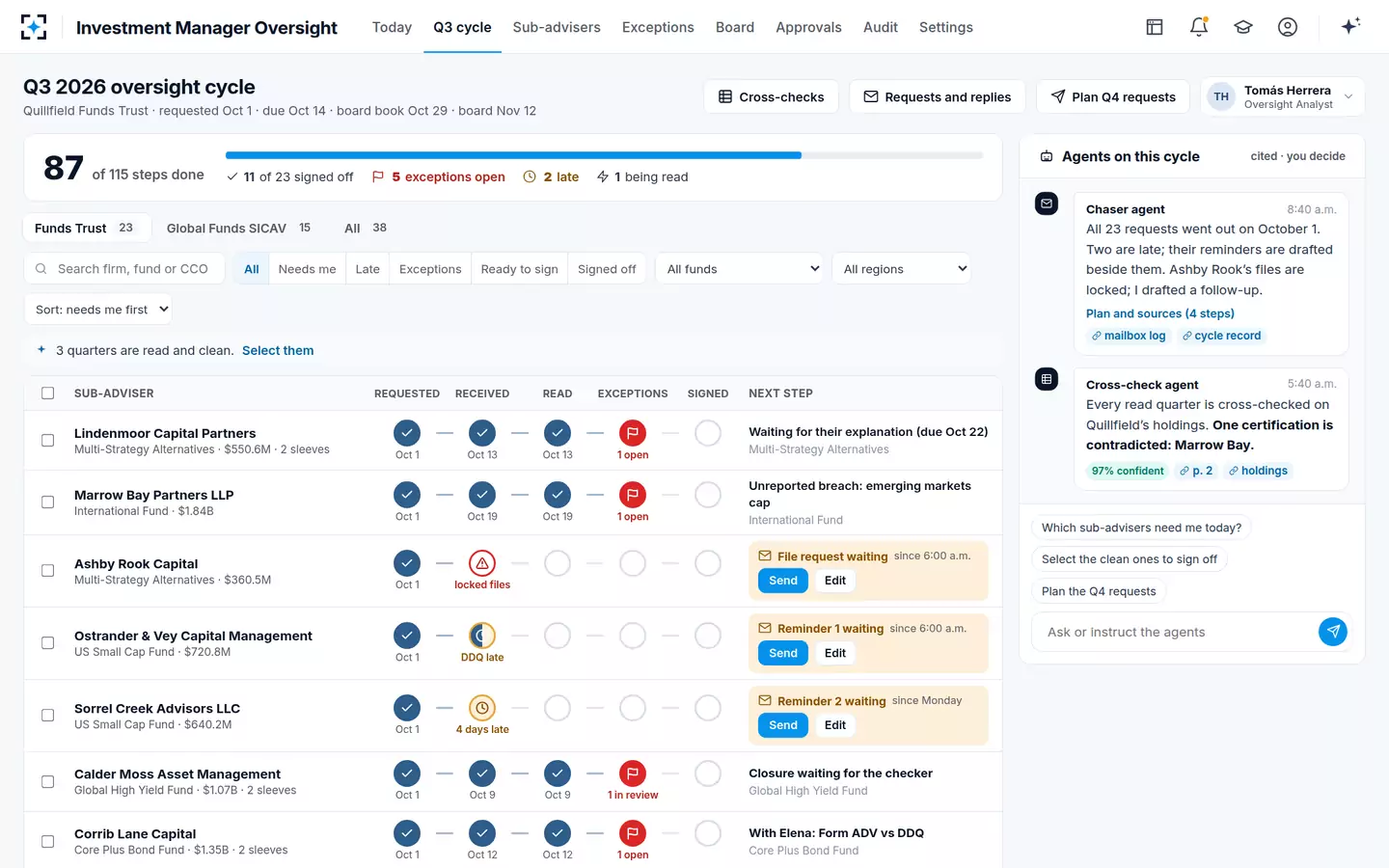
The step that separates oversight from paperwork is the test. A certificate that says "no breaches" is the sub-adviser's reading of its own work; the fund's holdings, reconciled to the custodian and measured with the agreement's definitions, are the fund's. In the sample quarter the solution re-ran 412 guidelines coded from 23 agreements on every one of 64 business days, 26,368 tests, and found two breaches the sub-advisers had not reported. Each went to an analyst, then to a second person who closed it, then into the CCO's report.
What the sub-adviser certified, beside what the fund's holdings say, in Investment Manager Oversight
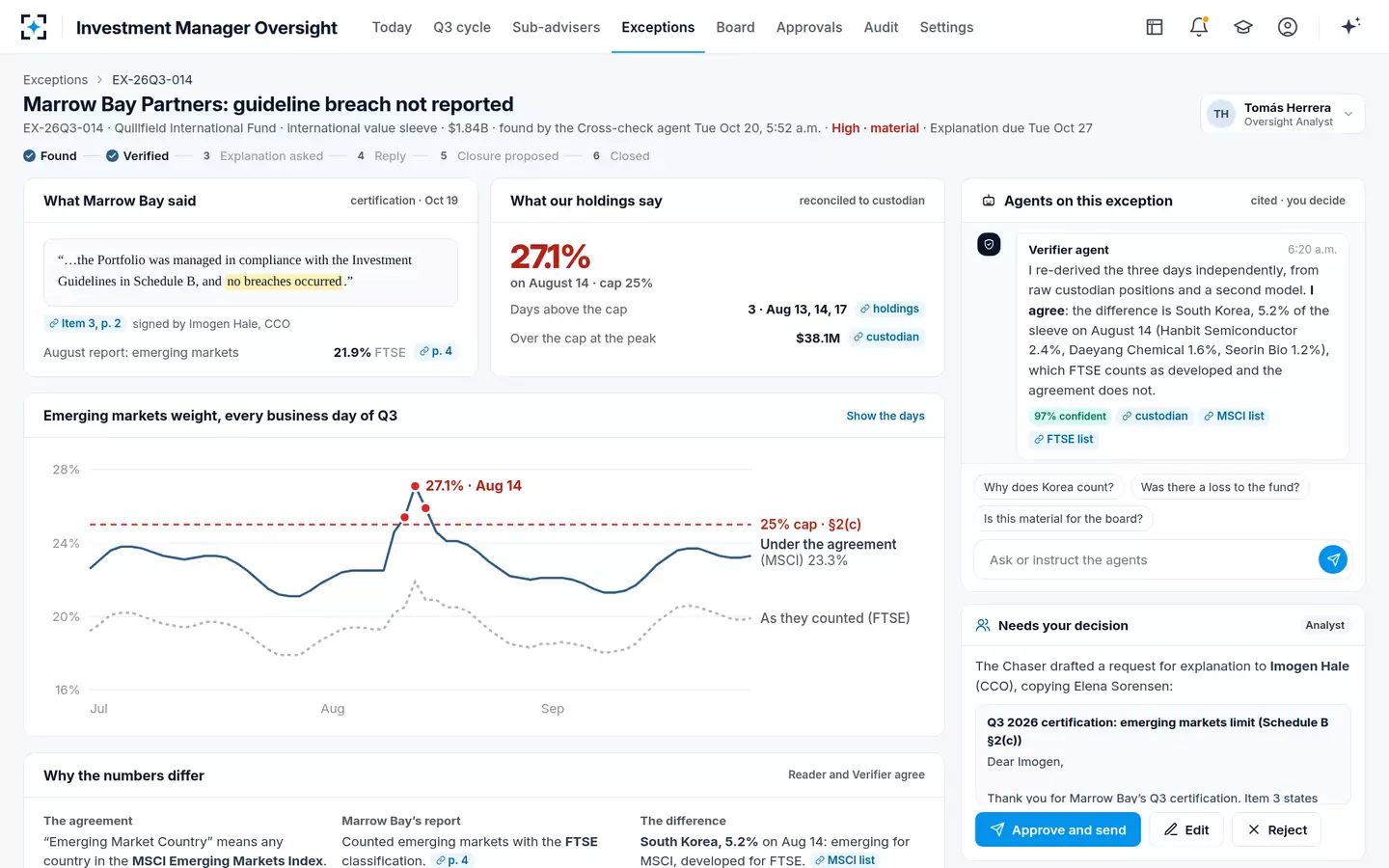
What a fund should hold on file for every sub-adviser, every year
- The signed sub-advisory agreement and every amendment
With the guidelines schedule and its definitions, because that is what every test is measured against.
- The board’s approval of the contract and of the compliance policies
Section 15(c) for the contract; Rule 38a-1(a)(2) for the policies, with the finding that they are reasonably designed.
- Each quarter’s certification and guideline reports
As received, in the original language, with the date they arrived.
- The fund’s own test of those reports
Holdings, the guideline coded from the agreement, the result, and who reviewed it.
- Every exception, explanation and closure
With the sub-adviser’s reply and the person who closed it.
- The annual review and the CCO’s report
Rule 38a-1(d) keeps these at least five years after the fiscal year, the first two easily accessible.
That is the work Investment Manager Oversight takes on: six agents chase, read in the sub-adviser's own language, re-test on the fund's holdings and draft the CCO's section, while an analyst decides, the head of oversight checks and the CCO signs.
Questions people ask
What is a sub-advised fund?
A sub-advised fund is a fund whose adviser has hired one or more outside managers to run some or all of its portfolio. Some use one sub-adviser for the whole fund; others split it into sleeves, each with its own manager and guidelines. The SEC's 2003 proposal counted more than 100 fund complexes offering manager-of-managers funds, holding more than $400 billion at the time.
Is a sub-adviser the same as a portfolio manager?
It does the same job but from another firm, under its own contract. Sponsors seeking manager-of-managers relief have argued that a sub-adviser is "closely analogous" to hiring another portfolio manager, which is why the SEC lets them change sub-advisers without a vote under conditions. The fund still discloses who its sub-advisers are in the prospectus.
Does a sub-adviser have to follow the fund's prospectus?
It has to follow its agreement, and the agreement is where the fund writes in the prospectus limits that apply to the sleeve. A breach of the prospectus by the sleeve is the fund's problem first: the 2019 SEC risk alert found funds without procedures to stop them breaching their own investment limitations and guidelines.
Who oversees a sub-adviser's compliance program?
The fund's chief compliance officer, under Rule 38a-1, alongside the adviser's own oversight. The 2003 adopting release expects the CCO to know "each service provider's operations," keep "an active working relationship" with its compliance staff and press non-compliance "aggressively"; a CCO who does not "would risk her position."
How long must sub-adviser oversight records be kept?
Rule 38a-1(d) keeps the policies for five years after they were last in effect, and the board materials and CCO reports for at least five years after the end of the fiscal year, the first two in an easily accessible place. Many funds keep longer; the solution's sample keeps six years.