Research valuation, in asset management, is the process of deciding what the investment research a firm consumed was worth to its investment decisions, and paying each broker and research provider accordingly. In most firms the broker vote supplies the judgement and a formula turns it into dollars: scores by service, weighted by service and by voter, become each provider's share of a research budget, then caps from provider agreements and a minimum payment shape the result. It is hard because the formula is usually a spreadsheet only one person understands, rebuilt each half, while regulators now ask for evidence of how the amounts were set. Botminds' Broker Vote turns the votes into a budget with one agent and recomputes every line with a second, so a reviewer can see the method behind each provider's payment and any difference over $1 stops the approval.
The worked figures below come from a fictional sample firm, Quillfield Capital, whose second-half 2026 vote produced a budget of $14.2 million across 31 providers; every firm and person named is invented. (The phrase "research valuation" is also used for valuation research and for grant budgets; this guide means paying for investment research.)
Where the sample firm's $14.2 million research budget comes from, and how a score is weighted
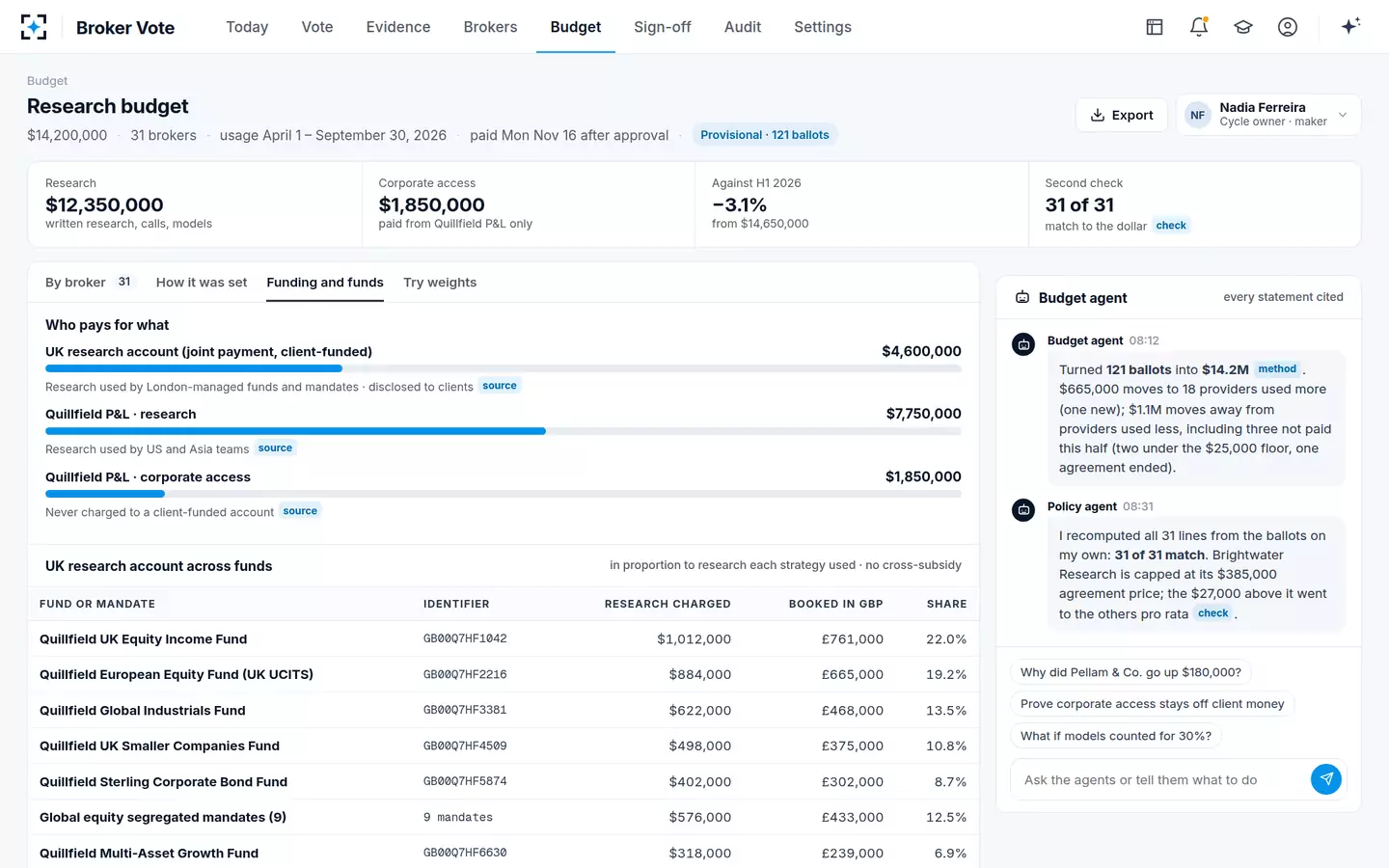
Funding of the budget
- UK research account, client-funded, research only: $4.6M · 32.4%
- Firm's own P&L, research: $7.75M · 54.6%
- Firm's own P&L, corporate access: $1.85M · 13%
Weight of each service in a voter's score
- Written research · 30%
- Analyst calls · 30%
- Models · 20%
- Corporate access · 20%
What is research valuation?
Research valuation is the step that links a firm's judgement of research quality to a payment, and it has two halves that are often confused. The first is the assessment: did the research help, how much, from whom. The second is the price: what was paid for it, and was that reasonable. The broker vote answers the first; the budget calculation and the provider agreements answer the second. A valuation that only counts interactions has skipped the first half, and one that only collects scores has skipped the second.
Every regime asks for both halves in its own words. A UK manager using joint payments must assess at least annually the value, quality and use of the research it bought and its contribution to investment decisions, and must also "ensure that the amount of research charges to clients is reasonable compared with those for comparable services" (FCA COBS 2.3B.25R(7)). The EU's amended MiFID II requires an annual assessment of research quality, usability and value whichever way a firm pays (Directive (EU) 2024/2811). In the US, Section 28(e) protects a manager only where it judged in good faith that the commissions were reasonable for the value of what it received (15 U.S.C. 78bb(e)).
How do asset managers value research? Three valuation models
Asset managers value research with one of three models, or a mix: a rate card that prices each kind of interaction, pricing tiers that place each provider in a band, or a vote that allocates a fixed budget by share of weighted scores. The FCA's review of how firms implemented unbundling found "a clear gap between best practice and weaker models", and described the stronger ones in detail (FCA multi-firm review, 2019, now marked historical).
Three research valuation models, and what each can and cannot show
| Model | How it sets payment | Strength | Weakness |
|---|---|---|---|
| Rate card | A price per call, meeting, model or report, multiplied by what was consumed | Simple, auditable, easy to explain to providers | Pays for volume; a long call that changed a decision earns the same as a courtesy call |
| Pricing tiers | Each provider placed in a band by service level and quality, with a range of payment per band | Reflects quality without pricing every interaction | Moving a provider between tiers needs evidence, or it becomes a negotiation |
| Vote-based allocation | Weighted scores by service become each provider's share of a budget set in advance | Puts the investment team's judgement at the centre; scales to dozens of providers | Only as good as the scores; needs caps, a floor and evidence of use to stay defensible |
Among the features of the stronger models, the FCA listed "Internal rate cards with ranges of potential payments based on clear quality criteria" and "Ongoing assessment of quality and cost of research, both before and after the firm uses it to make investment decisions". The common thread is that quality criteria are written down and that the assessment repeats. A vote-based model meets both if the policy is versioned and the vote runs on a fixed clock.
How are broker votes turned into a research budget?
Broker votes become a research budget in four moves: each score is multiplied by its service weight and the voter's weight to give points; each provider's points are added up; each provider's share of all points is applied to the budget; and the result is adjusted for caps, a floor and the funding source. The arithmetic is simple; what makes it defensible is that every input is fixed before the votes are counted.
The research budget formula, term by term
Points
score × service weight × voter weight
A 9 for analyst calls from an analyst: 9 × 30% × 1.0. From a portfolio manager, × 1.5.
Voter weights and service weights: the research policy
Share
provider's points ÷ all providers' points
Summed over every ballot and every service the provider was scored on.
Computed; never edited by hand
Dollars
share × research budget
The budget is set in advance from the expected need for research, not from trading volumes.
Budget: Director of Research, approved by the COO
Caps and floor
− amount above agreement price; − allocations under the floor
What is removed goes back to the other providers pro rata.
Provider agreements; the floor in the policy
The sample shows what each move does in money. With a $14.2 million budget, one point on one analyst's analyst-call score was worth about $2,930 before redistribution, so one voter's choice between a 6 and a 9 for one broker moved about $8,530 once the pro-rata effects across all 31 providers were netted. A provider whose written research scores rose from an average of 7.4 to 8.1, whose two new models were used by 31 voters and whose logged calls rose from 441 to 495 went from $1,280,000 to $1,460,000. Those are the numbers a reviewer should be able to trace back to ballots.
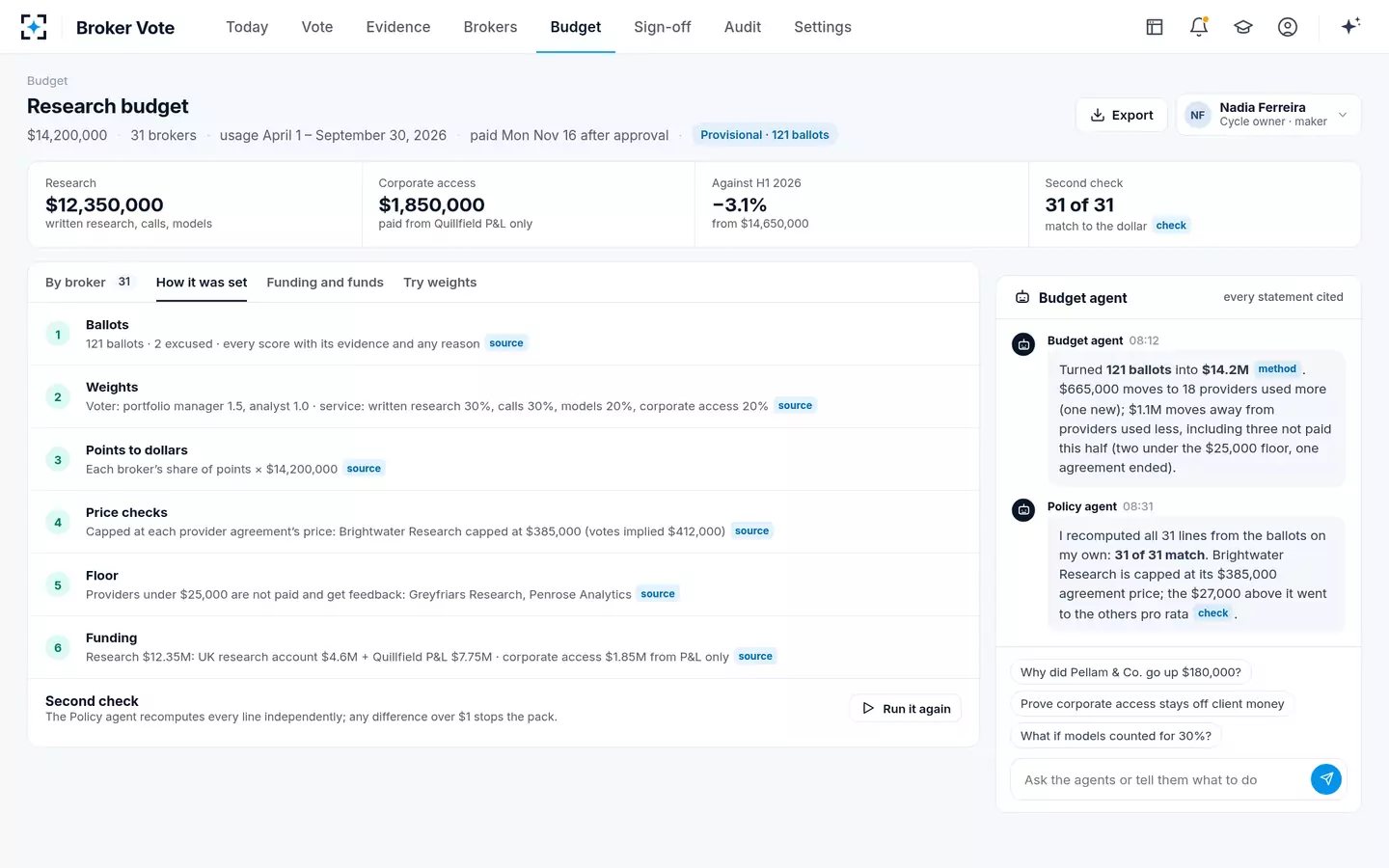
How the sample budget was set, step by step
| Step | What happens | Sample result |
|---|---|---|
| 1. Ballots | 121 ballots counted, 2 voters excused; every score carries its evidence and any reason | Policy questions resolved before counting |
| 2. Weights | Portfolio managers 1.5, analysts 1.0; written research 30%, calls 30%, models 20%, corporate access 20% | Fixed in Research Valuation Policy v3.1 |
| 3. Points to dollars | Each provider's share of points × $14,200,000 | 31 providers above the floor |
| 4. Price checks | Allocation capped at each provider agreement's price | Brightwater Research capped at $385,000; votes implied $412,000; $27,000 to others pro rata |
| 5. Floor | Providers under $25,000 are not paid and get feedback | Two providers below the floor |
| 6. Funding | Research $12.35M: $4.6M UK client-funded account, $7.75M own P&L; corporate access $1.85M own P&L only | Second calculation: 31 of 31 lines match to the dollar |
What weights should research services get?
Research services should be weighted by what drives your investment decisions, decided once by the Director of Research and changed only with a second approval. There is no regulatory weighting, and copying another firm's is a mistake: a team that builds its own models values a broker's model less than a team that buys them, and a small-cap team may value meetings with management more than written research.
Three tests help. First, does the weight match how your people spent their time? If analysts logged far more calls than reports opened, a 50% weight on written research is paying for what they did not use. Second, does the weight survive a scenario? Before proposing new weights, rerun last cycle with them and look at which providers move and by how much; the sample firm can try weights as a scenario before the Director proposes them. Third, is corporate access weighted on the ballot but kept out of research money? In the UK it must be, because the FCA does not regard corporate access services as research that a research account or joint payment may fund (COBS 2.3B.23G).
How do you set a research budget floor and caps?
Set a cap from each provider's agreement price, so a popular provider cannot be paid more than it charges, and set a floor below which an allocation is not worth paying, so the long tail does not turn into dozens of small invoices. Both should be written in the policy before the vote, with a rule for where the money removed goes; the usual answer is back to the other providers pro rata.
The cap protects the client as much as the budget. Paying a provider $412,000 when its agreed price is $385,000 is a payment for nothing, and in the UK it would be hard to square with the requirement that research charges be reasonable against comparable services. The floor needs a feedback step: a provider below it, such as two in the sample at under $25,000, should hear that its research was used too little to pay, which is a signal to improve or to stop sending.
What the price checks and the floor moved in the sample budget
How do you show research payments were reasonable?
You show research payments were reasonable by keeping three things together: the evidence that the research was used and valued, the method that turned that evidence into an amount, and a comparison of the price with what comparable research costs. The first is the vote with its evidence; the second is the formula and its inputs; the third is the agreements and any benchmarks. Remove any one and "reasonable" becomes an assertion.
The FCA introduced the UK's comparison step in outcome terms: firms must ensure research charges are reasonable, and guidance says benchmarking prices against comparators is one way to show it (FCA PS24/9, paragraph 1.23). The regulator also warned in its review that it would question payments at the extremes that had no clear justification, which is why a cap and a voter's written reason for an outlier score matter more than a perfect benchmark. How sell-side research is priced and benchmarked covers the comparison half in detail.
Allocation across clients is part of reasonableness too. A UK manager must allocate the cost of research bought with joint payments fairly between clients, and the FCA's guidance asks for an outcome in which "relative costs incurred are commensurate with relative benefits received" (COBS 2.3B.27G). The sample firm charges its client-funded UK account across funds in proportion to the research each strategy used: its UK equity income fund bore 22.0% of the account, its smaller companies fund 10.8%.
Who pays for research, fund by fund
What must the annual research assessment cover?
The annual research assessment must cover quality, usability and value, and whether the research contributed to better investment decisions, with action when it did not. In the UK the joint payment rules add use and price: the assessment looks at value, quality, use and contribution, and at whether charges are reasonable against comparable services (COBS 2.3B.25R(7)). The EU requires the assessment under Article 24(9a) whichever way a firm pays, from 6 June 2026 (Directive (EU) 2024/2811).
The Commission's delegated directive of 20 February 2026 says what a firm should do when the assessment is poor. Its recital lists the remedies a firm should consider: "requesting the third party research provider to enhance the quality of the research, stopping the use or distribution of the research of insufficient quality or choosing an alternative provider of the research" (Commission Delegated Directive C(2026) 994, recital 5). A broker vote already produces two of those as outputs: the feedback letter that asks for better coverage, and the floor that stops paying for research nobody uses. The third, a new provider, enters through a request that the next vote then tests.
In practice the assessment can be assembled from two half-year votes: the evidence of use, the scores and reasons, the policy questions raised and resolved, the allocation and its comparison with the previous period, and the actions taken. The sample firm's annual assessment for its UK joint payment arrangement is drafted from exactly those materials for Compliance to review.
Why the budget needs a second, independent calculation
A research budget needs a second calculation because a single spreadsheet error moves real money between providers, and a reviewer reading a total cannot see it. The second calculation should start from the ballots, not from the first calculation's intermediate figures, so that an error in a weight or a formula shows up as a difference rather than being copied.
In Broker Vote, the Budget agent turns the ballots into dollars, and the Policy agent then recomputes all 31 lines on its own, by a separate method; any line that differs by more than $1 stops the approval pack. In the sample, 31 of 31 lines matched. The same check confirms that no corporate access dollar landed in the client-funded account. The broker vote process shows where this step sits in the season, and payment optionality for investment research sets out the UK, EU and US conditions the budget must satisfy.
How the research budget was set, with the second check beneath it
Questions people ask
Is the research budget set before or after the vote?
Before. In the UK, a joint payment budget must be based on the expected need for third-party research and set at least annually, not derived from trading volumes; the vote then allocates that budget between providers. Setting the total after seeing the votes invites the total to follow the favourites.
What happens if research spending exceeds the budget?
Under the UK joint payment rules, the firm's written policy must say in advance what it will do if research charges exceed the budget or the budget is raised, and what it will tell clients (FCA COBS 2.3B.26R). The disclosure can go in the next periodic costs and charges report.
Does research valuation apply if we pay for research ourselves?
In the EU, yes: the annual assessment of quality, usability and value applies whatever the payment method. In the UK the detailed joint payment guardrails apply only to joint payments, but a firm paying from its own resources still has to show its research spending is in clients' interests, and the FCA's 2019 review looked at valuation models in both cases.
How should a new research provider be valued in its first period?
On the same ballot as everyone else, once it is on the approved research list; until then, usage becomes a new-provider request rather than a score. In the sample half, one of the 18 providers whose allocation rose was new to the list.
Can the voter weights differ by team?
Yes, if the policy says so. The sample firm weights by role, portfolio managers at 1.5 and analysts at 1.0, and allows team weights by research-intensive assets; any change is proposed by the Director of Research and approved by Compliance, and new weights can be tried as a scenario on the ballots before they are proposed.
How much of a research budget moves between halves?
It depends on how much use shifts. In the sample, $665,000 moved to 18 providers voters used more, $1.1 million moved away from providers used less, including three not paid that half, and the total fell 3.1%.