Broker vote software runs a buy-side firm's broker vote: it sets up the cycle, collects each analyst's and portfolio manager's scores for the brokers and research providers they used, keeps the trading desk's execution scorecard separate, turns the votes into a research budget and produces the approval pack, the broker feedback letters and the client disclosures. Bought on its own, it automates a spreadsheet; what makes it worth buying is evidence, and evidence comes from five data feeds the firm already has scattered across systems. Without them, a ballot is still a memory test and the budget is still an assertion. Botminds' Broker Vote is broker vote software built around those feeds: seven agents match the usage logs, pre-fill every ballot, question scores that rest on thin evidence and re-check every dollar, while voters score and the COO approves.
This guide is for the COO or head of research operations approving a project. The examples come from a fictional sample firm, Quillfield Capital; every name in them is invented.
The five data feeds to bring before the first broker vote
- 1. Interaction logs: CRM, calendar and email
Calls and meetings logged against brokers, and invitations accepted from broker domains. Without them, analyst calls and corporate access have no evidence.
- 2. Readership and models: research portals, inbox, model downloads
Reports opened by user and date in each provider portal, and models downloaded. Without them, written research and models are scored from memory.
- 3. Provider agreements and broker service statements
Agreed prices and methods for each provider, and each broker's claimed calls, meetings and models. Without them, there is no cap and no reconciliation.
- 4. Desk and credit data: cost analysis, settlement, trader surveys, ratings, the approved list
Cost against expected by counterparty, fails, trader scores, credit data and the order management system's list. Without them, the approved broker list is decided in a separate spreadsheet.
- 5. People and funds: HR directory, funds and mandates, research account balances
Voters, teams, leave and roles; which funds and mandates bear research costs; balances in research accounts. Without them, voter weights and fair allocation across clients cannot be computed.
What does broker vote software do?
Broker vote software does six jobs: set up the cycle, gather evidence of use, run the ballots, keep the desk and credit review separate, turn votes into dollars, and assemble what has to be approved and sent. A product that does the middle job, ballots, without the jobs on either side is a survey tool. The table shows what each job should deliver and the question to ask of any product.
Six jobs of broker vote software, and the question that tests each
| Job | What it should deliver | Ask the vendor |
|---|---|---|
| Set up the cycle | Voters with weights, the ballot list, service weights, deadlines and reminders, copied from the last cycle and changed by approval | Who can change a weight, and is the change versioned? |
| Gather evidence | Usage from your systems matched to broker and voter; broker statements reconciled | What happens to an interaction it cannot match? |
| Run the ballots | Each ballot pre-filled with evidence; policy questions raised as scores are entered | Does anything ever enter or suggest a score? |
| Desk and credit | A separate execution scorecard and credit watch that set the approved list | Can a research score or comment move an execution decision? |
| Votes into dollars | Allocation with weights, caps and a floor; the funding source per dollar; a second, independent calculation | Can a reviewer rerun every line from the ballots? |
| Approve and send | A signed pack, broker letters, payment instructions, client disclosures, regulatory drafts, an examiner export | Can anything leave before a named person releases it? |
What data do you need to start a broker vote?
You need the five feeds above, a written research valuation policy, and the last cycle's ballots and allocation. The feeds supply evidence; the policy supplies rules the software can check; the last cycle supplies a test: run it again through the new software and compare the result with what was actually paid.
Not every feed has to be perfect on day one, but each gap has a visible cost. Without portal readership, the written research column on every ballot is blank. Without provider agreements, nothing caps a provider's payment. Without the HR directory, a voter on leave for three months votes as if present. The sample firm's cycle drew on 21,486 interactions from four logs, 34 broker statements, 31 provider agreements and a fund list of 23 funds and 9 segregated mandates bearing UK research costs.
What one sample cycle drew on and produced
21,486
interactions from four usage logs, 97.6% matched on the first pass
Sample data
41
policy questions raised on 5,206 scores, all resolved before approval
Sample data
31 of 31
budget lines matched to the dollar by an independent recompute
Sample data
32
client disclosures drafted, one per fund and mandate
Sample data
Can broker vote software read CRM, calendars and portal logs?
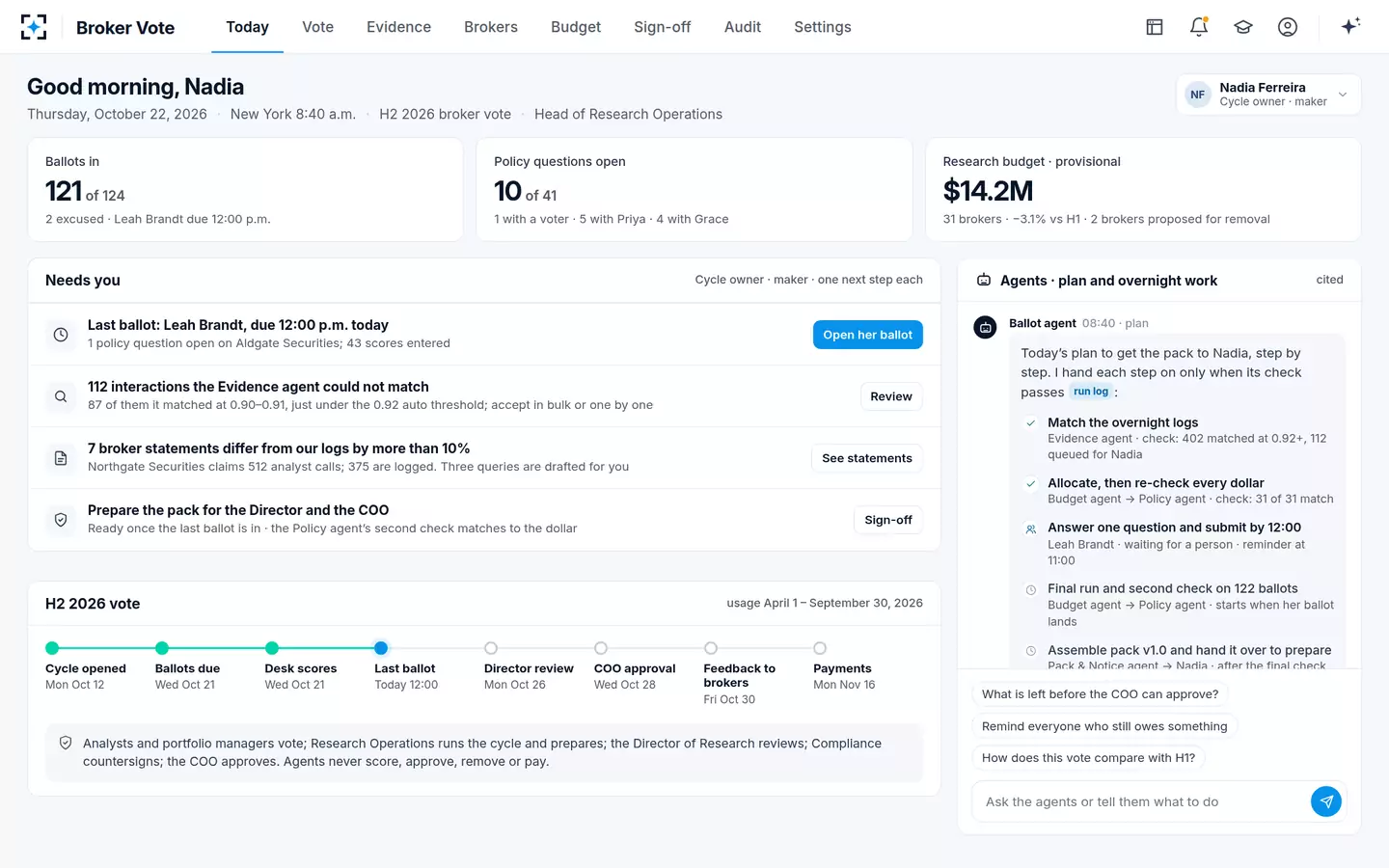
It should, read-only, from the systems where your people already work, and it should tell you when a feed fails. The sample firm's Evidence agent reads the CRM interaction log, calendar and email invitations from broker domains, readership from 31 provider portals and the research inbox, and the model download log, overnight; when one portal returned an error at 06:10 it retried at 06:40 and recovered with no gap, and the cycle owner saw it on her morning screen.
Three details separate a usable connection from a fragile one. Aliases: brokers appear under many names, so matching needs confidence scores and a person for the uncertain ones. Identity: portal logins, email addresses and HR records must resolve to one voter. And freshness: a feed that silently stops mid-cycle leaves some ballots with evidence and others without. Research consumption tracking software covers matching accuracy and its trade-offs in detail.
The cycle owner's morning: feeds read overnight, what needs a person
How does broker vote software handle UK, EU and US accounts?
It should run one vote and route the money and the disclosures by regime. The scores are the same wherever the voter sits; what differs is which account may pay for what, and what clients and regulators must be told. A product that runs separate votes per regime doubles the work and invites inconsistent scores for the same provider.
One vote, three regimes: what changes in the output
| Output | UK (joint payment) | EU (from 6 June 2026) | US (Section 28(e)) |
|---|---|---|---|
| Budget | Set at least annually from expected need; breach rule in the policy | Required where a research payment account is used | Not required; good-faith determination of reasonableness |
| Corporate access | Not payable from research accounts or joint payments | Not research; pay from own resources | Meeting content can be research; travel cannot |
| Allocation across clients | Fair, relative cost matching relative benefit | Not specified for joint payments | Disclose whether benefits serve all accounts |
| Client disclosure | Policy and expected costs before service; total costs annually | Payment choice and policy; total research costs on request | Form ADV Part 2A, Item 12 |
| Assessment | Value, quality, use, contribution, and reasonable charges, at least annually | Quality, usability, value and contribution, annually | Supports the good-faith determination |
Two EU and UK details are easy to miss in a software evaluation. The EU directive requires firms to keep track of the total cost of the third-party research they receive, where they know it, and to give clients that figure once a year on request (Directive (EU) 2024/2811), so the software must hold research costs by provider even where joint payment blurs them. And UK fund managers adopting joint payment for authorised funds must notify unitholders first, and assess value fund by fund (FCA PS25/4), so the evidence must attribute to funds, not only to teams. Payment optionality for investment research sets out each regime in full.
What will auditors and examiners ask for?
They will ask why each provider was paid what it was, and they will want to follow one dollar from the payment back to the votes, the evidence and the approvals. In the US, the SEC's staff listed among common adviser deficiencies a failure to disclose soft dollar arrangements fully and a failure to allocate the cost of mixed-use products reasonably (OCIE risk alert, July 2018); Form ADV requires an adviser to describe the products and services bought with client commissions in enough detail for clients to evaluate the conflicts (Form ADV Part 2A, Item 12.A.1.e). In the UK, the FCA said in its review of research valuation that it would question payments with no clear justification (FCA, 2019).
The examiner's questions, and where the answer should already be
| The question | Where the answer lives |
|---|---|
| Why did this provider receive $1.46 million? | The budget line, opening to the votes by service and voter weight, and the evidence behind each score |
| Who decided, and who checked? | Prepared, reviewed, countersigned and approved, each with a name, a time and a reason code |
| Did client money pay for anything that is not research? | The funding split per line; corporate access shown as paid from the firm's own resources |
| Were execution decisions kept apart from research? | The separate desk scorecard, and the research comments flagged for mentioning execution |
| How were costs shared across clients? | The allocation of client-funded research across funds and mandates, in proportion to use |
| What did you tell clients? | The disclosures and the Form ADV text, drafted from the approved vote and released by a named person |
The SEC also expects advisers to evaluate the execution they receive periodically and systematically (SEC, 2019), and the desk scorecard's history is the evidence. The test of any broker vote software is whether those answers exist on the day the question is asked, not whether they could be rebuilt from emails.
Buy broker vote software for the day an examiner asks why one provider was paid what it was. Every other benefit follows from being able to answer that.
How long does broker vote software take to set up?
Set-up time is mostly the time it takes to connect the five feeds and write down the policy, not to install software. The fastest honest path is to run the new software beside the existing process on the last completed cycle: load last cycle's ballots, connect the feeds for the same period, let the agents match and allocate, and compare the result with what was actually approved and paid. Differences are either errors in the old process or settings to fix in the new one, and both are worth knowing before a live cycle.
After the first cycle, each new cycle in Broker Vote is set up from the last one and back-tested before the Director of Research approves it, and any change to the agents ships only after an evaluation on the last two cycles. Our estimate of the effect on the season, for a large manager, is that Research Operations' working days fall from about 30 to about 6, mostly because matching, chasing and arithmetic move to the agents; that is an estimate, not a measured result, and the first cycle is where a firm should measure its own. The broker vote process shows where those days go.
What should you look for in broker vote software?
Look for evidence beside every score, rules you own, two calculations of every dollar, separation of research from execution, and a hard line between what software prepares and what people decide. Then look at what it costs you to leave: policy, ballots and evidence should export in a form your next system or your examiner can read.
Five tests catch most weak products in a demonstration on your own data. Open any count on a ballot and see the items behind it. Enter a 9 on one logged interaction and see what happens. Change a service weight and see who must approve it. Rerun the allocation and see whether a second calculation agrees. Try to send a broker letter without a checker. A product that fails any of these is asking the firm to trust it rather than check it.
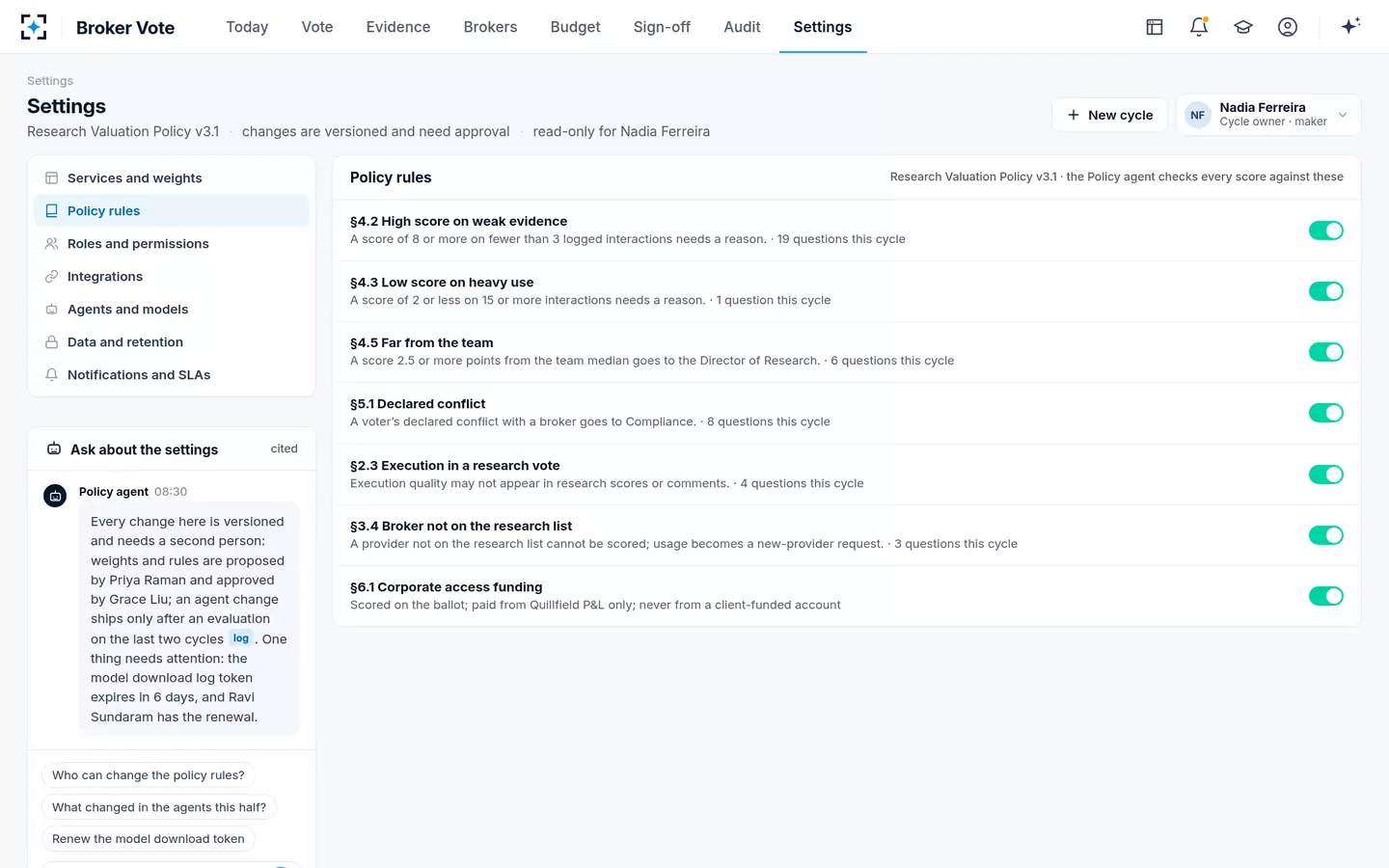
The policy as settings: versioned, and changed only with a second person
Where Broker Vote fits, and where it does not
Broker Vote fits managers whose broker vote moves meaningful money across dozens of providers and several teams, under UK or EU joint payment rules, a US soft-dollar programme, or both, and whose evidence sits in a CRM, calendars, portals and model logs that nobody has joined up. It decides how much each provider earns and from which funding source, and drafts the approval pack, the letters, the client disclosures, the UK annual assessment and the Form ADV Item 12 input for Compliance to review.
It does not move money: payments go out through the firm's commission and payment system, which holds research account balances and payment instructions. It does not run transaction cost analysis; it reads its results for the desk scorecard. It does not store or search the firm's own research notes. And for a small manager paying a handful of providers from its own resources, with every interaction visible in one inbox, a disciplined spreadsheet and the policy rules in this series may be enough. Broker Vote shows the seven agents and their limits.
Questions people ask
Is there free broker vote software?
A spreadsheet and a survey tool cost nothing and can collect scores. What they cannot do is match thousands of interactions to brokers and voters, reconcile broker statements, check scores against a policy as they are entered, or recompute a budget independently; those are the parts that make a vote defensible.
Does broker vote software replace a commission management system?
No; they work together. The vote decides how much each provider earns and from which funding source; the commission and payment system holds research account balances and payment instructions, and pays.
Can we bring last cycle's ballots?
Yes, and you should: last cycle's ballots and allocation are the test data for the first run. Rerunning them through the new software and comparing the result with what was paid shows both errors in the old process and settings to fix.
Who owns the settings in broker vote software?
The firm. In the sample firm, the Director of Research proposes weights and rules, Compliance approves them, and the cycle owner can read but not change them. Every version is kept, so an examiner can see which rules applied to which vote.
What happens if a data feed fails during the cycle?
The software should retry, say so, and show which ballots are affected. In the sample, a portal error at 06:10 was retried at 06:40 with no gap, and a model download token due to expire in six days was flagged with the person responsible for renewing it.
Does broker vote software work for fixed income and multi-asset firms?
Yes, if the services and feeds are set up for them. Fixed income research comes more through calls and chat than portals, so the CRM and calendar feeds matter more; the execution scorecard needs bond and FX cost data, and the approved list is set by asset class.