Research consumption tracking software records which investment research each analyst and portfolio manager actually used during a period: calls and meetings logged in the CRM, invitations accepted from brokers' domains, reports opened in providers' portals and the research inbox, and models downloaded. It matches each item to a provider and a person, so the broker vote, the research budget and the annual assessment of research value rest on what happened rather than on what voters remember. The hard part is the matching: the same broker appears under a dozen names across four systems, and a provider's own count of its calls rarely agrees with the firm's. Botminds' Broker Vote uses agents to read the logs, match them, reconcile broker statements and pre-fill every ballot with the evidence, and leaves every score, every conflict decision and every dollar to a named person.
This guide is for the head of research operations choosing how to track consumption. The figures come from a fictional sample firm, Quillfield Capital, over one half-year; every person and provider named is invented. Tracking consumption for the broker vote is a different job from storing and searching the firm's own research notes, which is what a research management system does.
What consumption tracking takes off each desk, and what stays theirs
Today
Scores 14 brokers from memory twice a year, with no record of which calls and models mattered.
With agents
Opens a ballot already filled with the calls, reports, models and meetings logged against each broker.
Still theirs: every score, and the reason behind an unusual one
Today
Matches names across four logs by hand and argues with brokers about how many calls they made.
With agents
Reviews only the items below the matching threshold and sends the broker queries the agents drafted.
Still theirs: which unmatched items to accept, and every query sent
Today
Reviews scores that cannot be tested against use.
With agents
Sees each policy question with the voter's answer and the evidence behind it.
Still theirs: accepting or returning an answer; the policy itself
Today
Finds declared conflicts and execution remarks in research scores only if someone happens to spot them.
With agents
Receives declared conflicts and failed reasons as they arise, with the voter's words attached.
Still theirs: the conflict decision and the countersignature
Today
Approves a deck built by many hands.
With agents
Approves one pack in which every budget line opens to its evidence.
Still theirs: approving the broker list and the budget
What is research consumption tracking?
Research consumption tracking is the evidence half of research valuation: a running account of which research the firm's people used, from whom, and when. It answers the question every broker vote eventually faces, "what did this provider actually do for us?", with counts that open to the underlying items rather than with impressions.
Regulators have moved the question from good practice to requirement. The UK's joint payment rules require an assessment, at least once a year, of the value, quality and use of research bought that way (FCA COBS 2.3B.25R(7)). In the EU, the Commission's 2026 delegated directive explains that firms "should be required to assess the quality of research that they consume or provide to ensure that the research provided by a third party to them is of quality and can be used to contribute to a better investment decision" (C(2026) 994, recital 4). Use is not quality, but an assessment of quality that cannot show use is hard to defend.
What data does research consumption tracking collect?
Research consumption tracking collects four kinds of record: interactions logged in the CRM, meetings and calls from calendars and email, readership from research portals and the research inbox, and downloads of models and data files. Analyst notes that cite a call or a report add a fifth, the reason a piece of research mattered.
Four usage logs behind one half-year broker vote
What each source shows, and the trap in each
| Source | What it shows | The trap |
|---|---|---|
| CRM interaction log | Calls and meetings an analyst logs against a broker and a company | Logging is voluntary in many firms; heavy users of a broker may log least |
| Calendar and email | Invitations accepted from broker domains, with attendees and times | An accepted invite is not an attended meeting; broker domains change after mergers |
| Research portals and inbox | Reports opened, by user and date, from each provider's portal | An open is not a read; a forwarded report is invisible; portals name users differently |
| Model download log | Models and data files downloaded from provider sites | A model downloaded once may be used all year; a download count understates it |
| Analyst notes | Which call or report a note or rating change cites | Rarely structured; the reason is in the text, not a field |
Can AI match readership to voters?
Yes, and matching is where agents earn their keep: the same broker appears as a legal name, a trading name, a domain, an abbreviation in a CRM field and a city-suffixed portal account, and the same analyst appears under a work email, a portal login and a nickname. An agent can resolve those aliases at scale, propose a match with a confidence score, and leave the uncertain ones to a person.
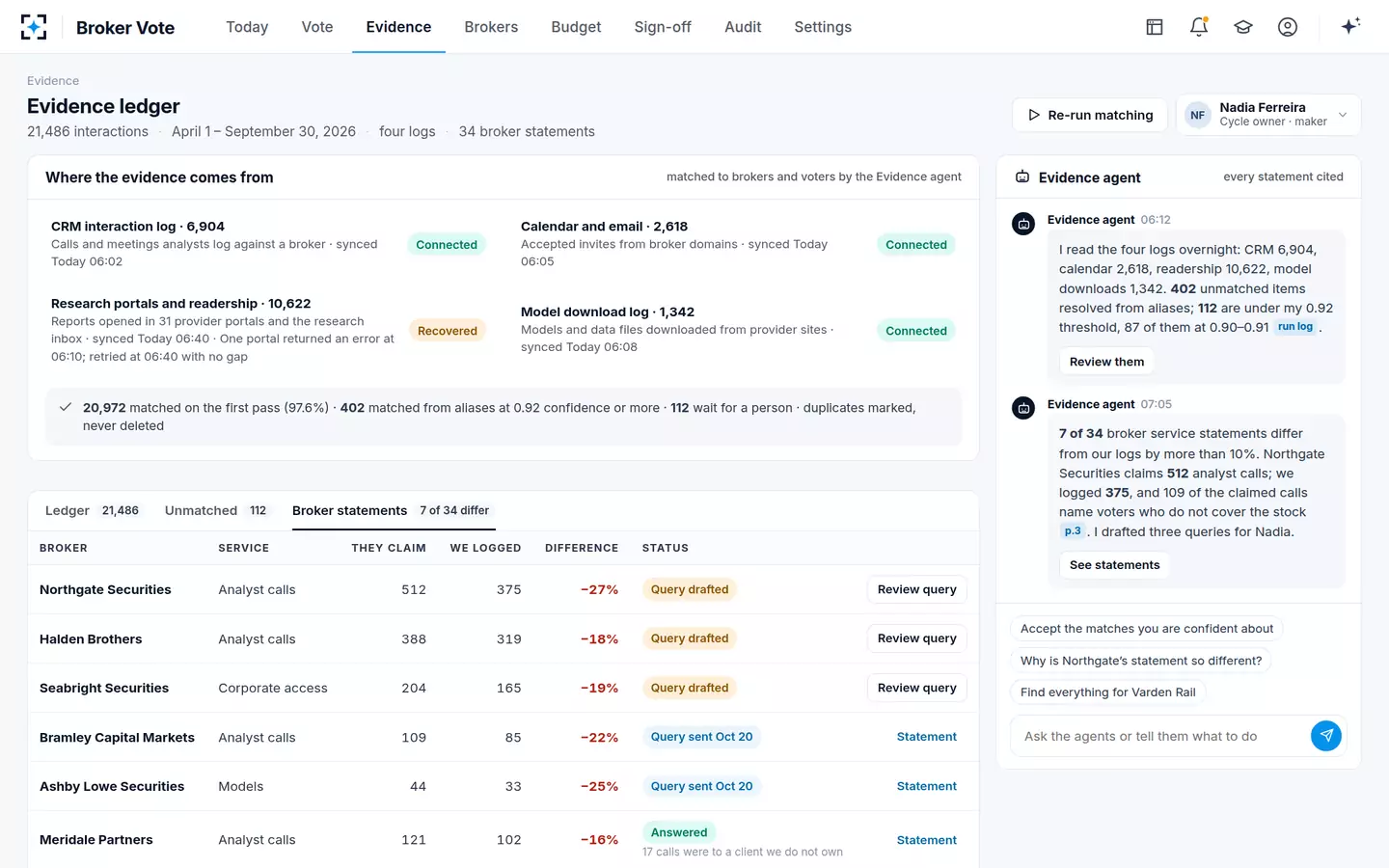
The design choices matter more than the model. In Broker Vote the Evidence agent never matches on its own below a confidence of 0.92, never deletes an item, and marks duplicates rather than removing them, so every count can be traced back to the raw entries. In the sample half it matched 20,972 interactions on the first pass, resolved 402 more from aliases such as "PELLAM CO LDN", and left 112 for the head of research operations, 87 of them at 0.90 to 0.91, just under the line.
How accurate is automatic matching of research interactions?
As accurate as the threshold you set and the checks you run on it, which is why the threshold must be a measured setting, not a default. No independent study publishes accuracy for matching research interactions to brokers and voters; the useful evidence is a firm's own hand-checked sample, repeated when systems change.
Matching one half's research use, on the sample firm's data
97.6%
of 21,486 interactions matched to broker and voter on the first pass
Sample data
402
more matched from aliases at 0.92 confidence or above
Sample data
112
left below the threshold for a person to decide
Sample data
0.4% → 0.1%
false matches after raising the threshold from 0.90 to 0.92, on 1,200 hand-checked matches
Sample data
The trade-off is visible in those numbers. A higher threshold sends more items to a person but makes fewer false matches, and a false match is worse than an unmatched one: it puts a call on the wrong broker's ballot and moves money. The sample firm chose 0.92 because the hand check showed false matches falling from 0.4% to 0.1% for the cost of a short review queue. Any firm buying tracking software should ask to see that trade-off on its own data before go-live.
How do you reconcile broker service statements?
Reconcile broker service statements by setting each broker's claimed calls, meetings and models against the firm's own logs for the same period, querying any gap above a threshold, and resolving the queries before the vote closes. UK firms using joint payments already owe a version of this discipline: they must reconcile and report on the accounts used to pay for research with appropriate frequency and timeliness (COBS 2.3B.28R), and a statement reconciliation is the usage side of the same control.
In the sample half, the Evidence agent reconciled 34 statements and found seven more than 10% away from the logs. The largest: one broker claimed 512 analyst calls against 375 logged, and 109 of its claimed calls named people who do not cover the stock discussed. The agent drafted the query; the head of research operations sent it. Another broker, asked about a smaller gap, answered that 17 of its calls had been with a client the firm does not own, which closed the question.
Four usage logs, matched, and the broker statements that disagree
Does consumption tracking replace the broker vote?
No. Tracking tells you what was used; only the people who used it can say what it was worth. A firm that pays by count has built a rate card on volume, and the FCA's review recorded providers' complaint that some managers priced research from a volume-based rate card and summed it into payments with little assessment of what the content was worth (FCA, 2019). The FCA's own picture of a strong valuation model kept the investment team, not the finance function, at the centre of it.
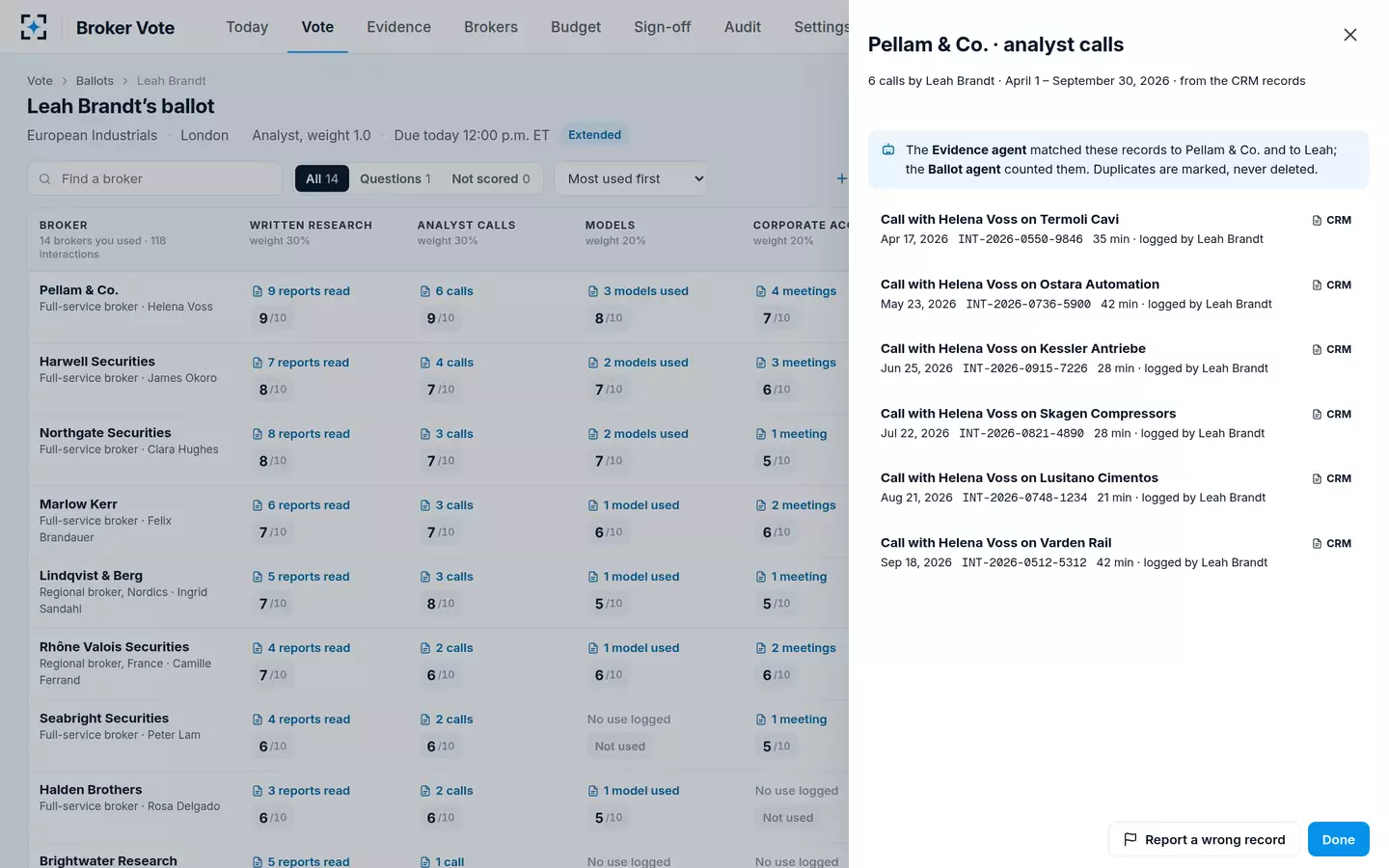
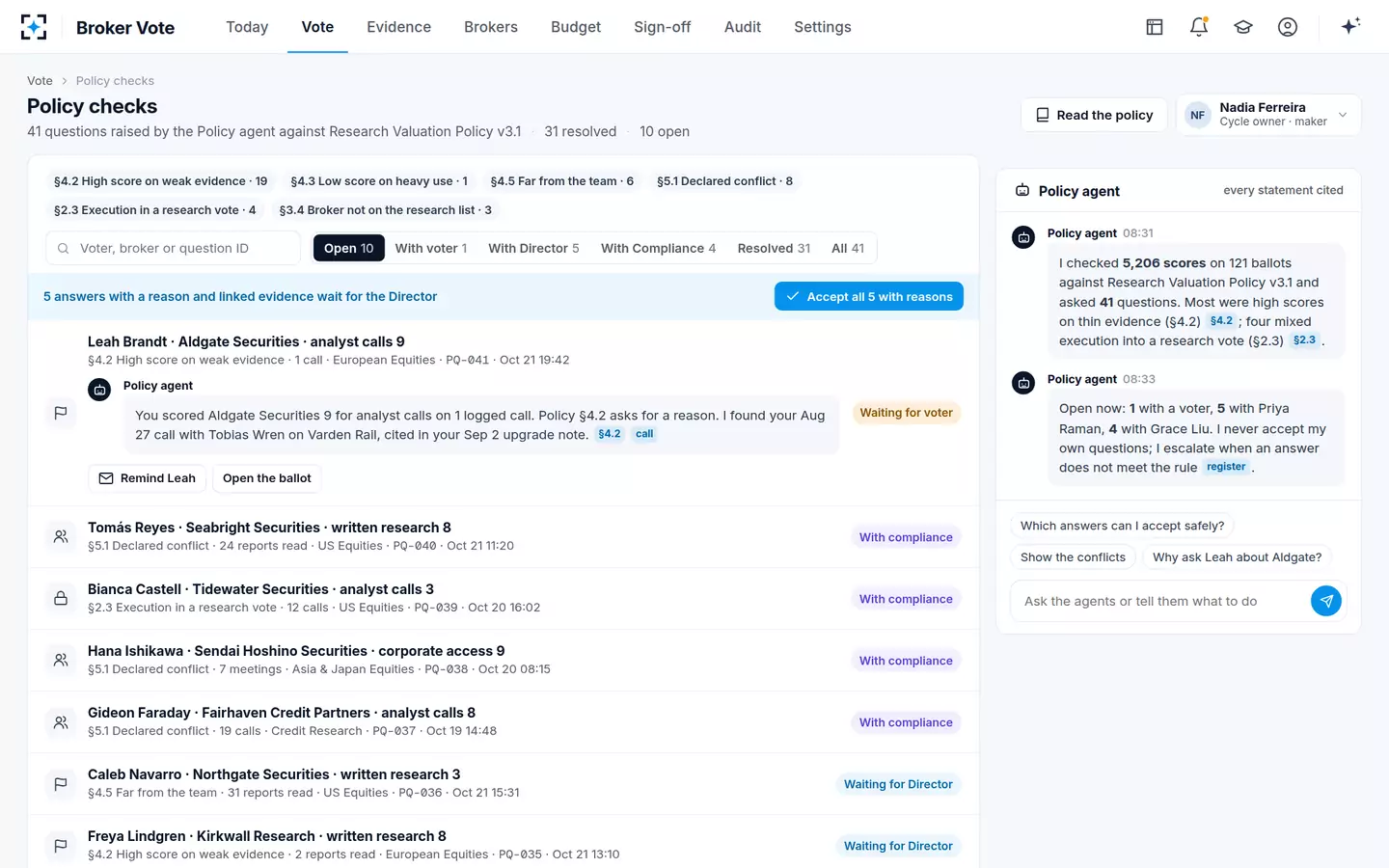
The right place for tracking data is beside each score on the ballot, as evidence the voter sees and a reviewer can open. When the two disagree, the policy asks for a reason rather than overriding either. In the sample, an analyst scored one broker 9 for analyst calls on a single logged call, explained that the call drove her upgrade of a stock a week later, and kept her 9; another scored a broker's written research 3 after reading 31 of its reports, and the score went to the Director of Research because it sat far from the team. Both scores stood. The broker scorecard template sets out those calibration rules.
A count on the ballot opens to every call behind it
What should an AI agent never do with ballots?
An AI agent should never enter, suggest or change a score, never show one voter another's ballot, never accept the answer to a question it raised, never move money and never send anything to a broker on its own. Those are not technical limits; they are the line between evidence and judgement, and supervisors expect firms to draw it. FINRA's 2026 oversight report lists the risk of agents acting without human validation and beyond the scope a user intended, and suggests firms may need supervision tailored to each agent's type and scope (FINRA, December 2025). ESMA wants the board-level management of a firm to know where and how its AI is applied, and to oversee it (ESMA public statement, May 2024).
In Broker Vote the limits are written per agent. The Ballot agent pre-fills counts and the records behind them and sends reminders; it never enters or suggests a score and never shows one voter another's ballot. The Policy agent asks the voter one plain question when a score breaks a rule, proposes the evidence it found and escalates; it never changes a score and never accepts its own question. Agent changes ship only after an evaluation on the last two cycles and approval by the Director of Research and Compliance, which gives the management body something concrete to understand and sign.
Policy questions raised by an agent, decided by people
What to ask before you buy research consumption tracking software
Ask what the software reads, how it matches, what it does with what it cannot match, and what it is forbidden to do. A demonstration on a vendor's clean sample data proves little; ask to see one month of your own logs matched, with the unmatched queue and the false matches counted.
Eight questions for research consumption tracking software
- Which of our systems does it read?
CRM, calendars and email, each research portal and inbox, model logs; and how it handles a portal that fails overnight.
- How does it resolve aliases?
Legal names, trading names, domains, abbreviations and logins, with a confidence score per match.
- What is the matching threshold, and who can change it?
A versioned setting, raised or lowered only after a hand-checked sample and a second approval.
- What happens below the threshold?
A queue for a person, never a silent guess; duplicates marked, never deleted.
- Does it reconcile broker statements?
Claimed against logged by service, with a query drafted above a set gap.
- Does any count become a score?
It should not. Counts sit beside scores as evidence; voters score.
- Can a reviewer open every count?
Each number on a ballot should open the entries behind it, with source system and reference.
- What is the agents' rulebook?
Written limits per agent, evaluation before each change, and an audit trail of what each did.
Broker Vote fits firms that already log research use in several systems and want it matched, reconciled and on the ballot without a spreadsheet in between. It is not a research management system for storing and searching the firm's own notes, it does not replace the CRM where analysts log calls, and it cannot track what is never logged anywhere: a firm with no portal readership data will see that column empty until a feed exists. The five data feeds to bring before you start lists what a first cycle needs, and Broker Vote shows the agents together.
Questions people ask
Is a report opened the same as a report read?
No, and tracking software should not pretend otherwise. Portal data shows opens by user and date; it cannot show attention. That is why readership is evidence beside a written research score, not the score, and why a voter who read a report forwarded by a colleague may need to say so.
Do analysts have to log every call?
The more they log, the better the evidence, but calendars fill much of the gap: accepted invitations from broker domains catch calls and meetings never entered in the CRM. In the sample half, 2,618 interactions came from calendar and email against 6,904 from the CRM.
Can consumption tracking cover independent research providers?
Yes, if their portals or deliveries can be read. In the sample firm the Evidence agent reads 31 provider portals plus the research inbox, so independent providers' readership sits in the same evidence as brokers'.
How long should consumption evidence be kept?
As long as the firm keeps the records the vote supports, under its own retention policy and the rules that apply to it. The sample firm keeps ballots, evidence, questions, the allocation and approvals together for seven years in one export an examiner can receive.
Should brokers see the consumption data?
In aggregate, when a statement is disputed: telling a broker that the firm logged 375 calls against its 512 is the point of reconciliation. Individual voters' use and scores should stay inside the firm.
Does tracking work for fixed income and macro research?
The method does; the sources differ. Fixed income and macro research arrive more often through calls, chat and email than through portals, so the CRM and calendar logs carry more weight and the readership column less.