Rebundling research means an asset manager paying for third-party investment research through its execution commissions again, after MiFID II required, from January 2018, that research be paid for separately from the firm's own resources or from a client-funded research payment account. The UK reopened that route on 1 August 2024 and widened it to fund managers in May 2025; the EU followed on 6 June 2026. Both had concluded that strict unbundling had shrunk the research market without enough benefit. It is not a return to the old bundle: the research cost must be identifiable within the commission, and the UK and EU options come with budgets, allocation rules and an annual assessment of value. Botminds' Broker Vote produces that assessment from the broker vote itself, so a manager that rebundles can show what its clients' commissions bought.
This guide is for COOs and CIOs deciding a payment model. Examples come from a fictional sample firm, Quillfield Capital; every name in them is invented. The evidence on what unbundling did to research coverage is set out in MiFID II research unbundling after 2024.
What a commission could pay for, 2014 to 2028, in three markets
- Tighter dealing commission rulesJun 2014
- Unbundled: own resources or research accountJan 2018
- Joint payment with guardrailsAug 2024
- Before MiFID IIto 2018
- UnbundledJan 2018
- Joint payment for issuers up to €1bnFeb 2021
- Joint or separateJun 2026
- Section 28(e) client commissionsto Oct 2017
- SEC staff relief for separate research paymentsOct 2017
- Relief expired; Section 28(e) unchangedJul 2023
What is research rebundling?
Research rebundling is the reintroduction of a single payment, through commissions on client trades, that covers both execution and research. In the UK and EU rules it is called joint payment: the manager pays one charge per trade, the research part is separately identified and set aside, and that part is spent only on research, from the executing broker or from other providers. In the US, where Section 28(e) has let client commissions pay for research since 1975, the term matters mainly to managers with UK or EU business.
What came back is narrower than what went away. Before 2018 a manager could receive research from a broker with no price attached, as part of the service its commissions paid for. Now the research charge must be calculated by an agreed method, the UK requires a budget set from the expected need for research rather than from trading volumes, and both regimes require an assessment of the research's worth at least once a year.
Why did managers unbundle research in 2018?
Managers unbundled in 2018 because MiFID II required them to, for portfolio management and independent advice. The FCA summarised the objectives of those reforms as being "to manage conflicts of interest, improve accountability over costs passed to customers, and improve price transparency for both research and execution services" (FCA PS24/9, paragraph 2.2). Firms had two choices: pay from their own resources, or agree a separate research charge with clients and run a research payment account.
In the UK the ground had been prepared earlier. In 2014 the FCA tightened its dealing commission rules after supervisory work in which it "found the majority of investment managers had inadequate controls and oversight when acquiring research goods and services from brokers or other third parties in return for client dealing commissions" (FCA PS14/7, paragraph 1.9). Corporate access was ruled out of commissions at the same time.
The first results looked like savings for clients. Most UK managers chose to absorb research costs themselves. The FCA estimated that investors in UK-managed equity portfolios saved about £70 million in the first half of 2018 against the same period of 2017, and that the reforms could save nearly £1 billion over five years; it also found a reduction of around 20% to 30% in budgets for externally produced equity research (FCA multi-firm review, 2019, now marked historical).
What unbundling did in its first year, in the FCA's review
£70m
saved by investors in UK-managed equity portfolios in H1 2018 against H1 2017
FCA sample estimate
20–30%
fall in the budgets firms set for externally produced equity research
FCA survey of 40 buy-side firms
~£1bn
estimated savings from the reforms over five years
FCA estimate
Why is research rebundling allowed again?
Because between 2024 and 2026 the UK and the EU each restored a route to pay for research through commissions, after concluding that unbundling had hurt the supply of research. The UK government's Investment Research Review, published in July 2023, recommended an option for combined payments; the FCA consulted in April 2024 and its rules came into force on 1 August 2024 (PS24/9), with fund managers following from 9 May 2025 (PS25/4). The EU had already allowed joint payment in 2021 for research on issuers up to €1 billion of market capitalisation; the Listing Act removed the threshold, noting that "The decline of investment research has, however, not slowed" (Directive (EU) 2024/2811, recital), and member states apply the new rules from 6 June 2026.
The US moved the other way at the same moment. The SEC staff's temporary relief that let US broker-dealers accept separate research payments from MiFID II clients without registering as advisers expired on July 3, 2023 (Commissioner Uyeda, July 5, 2023). That made it harder for UK and EU managers to buy US research with hard dollars and is one reason the UK designed its option to work with commission-based payment models elsewhere. Payment optionality for investment research sets out each regime's conditions side by side.
Is rebundling the same as full bundling?
No. Full bundling, as the FCA describes US practice, is an arrangement "under which research can only be procured from the broker-dealer with which trade execution was undertaken" (PS24/9, paragraph 2.7). The UK option deliberately is not that: payments must go through a structure that can pay independent research providers, and the research charge must be identifiable within the total.
Full bundling against UK joint payment
Full bundling (pre-2018 style, or US full-service): None visible: research comes with the execution service
UK joint payment (COBS 2.3B, from 2024): A separately identified research charge, by an agreed method
Full bundling (pre-2018 style, or US full-service): The executing broker only
UK joint payment (COBS 2.3B, from 2024): Any provider through a payment allocation structure, including independent research firms
Full bundling (pre-2018 style, or US full-service): Follows trading volume
UK joint payment (COBS 2.3B, from 2024): A budget set at least annually from the expected need for research, not from trading
Full bundling (pre-2018 style, or US full-service): Whichever accounts trade with that broker
UK joint payment (COBS 2.3B, from 2024): Allocated fairly across clients, relative costs matching relative benefit
Full bundling (pre-2018 style, or US full-service): None required beyond the general duty
UK joint payment (COBS 2.3B, from 2024): An assessment at least annually of value, quality, use and contribution, with a price test
The FCA presented that design as a feature. Responding to a concern that independent providers would lose out, it said its option "already goes beyond those of other jurisdictions in its requirement that payments be made via a structure that includes such IRPs" (PS24/9, response to Q1). Some respondents, by contrast, wanted full alignment with markets that allow full bundling, and the FCA kept the separately identifiable charge anyway.
Who pays for research now, the client or the manager?
It is now each firm's choice, and many will mix routes: own resources for some teams, joint payments for others, a research payment account where clients have agreed one. The rules make the choice visible. A UK firm must tell clients whether and how it combines joint payments with other routes, and an EU firm must tell clients whether it pays jointly or separately and make its policy available.
No regulator has yet published how many firms have taken up the new options. The FCA said it would judge success by take-up, by changes in research production and consumption, and by checking that this has not come "via undue costs or harms to consumers", and that it would run a survey after a reasonable period (PS24/9, paragraphs 1.26 and 1.27). Until those figures exist, the honest answer to "who pays now" is: whoever each firm's policy says, provided it can prove the research was worth it.
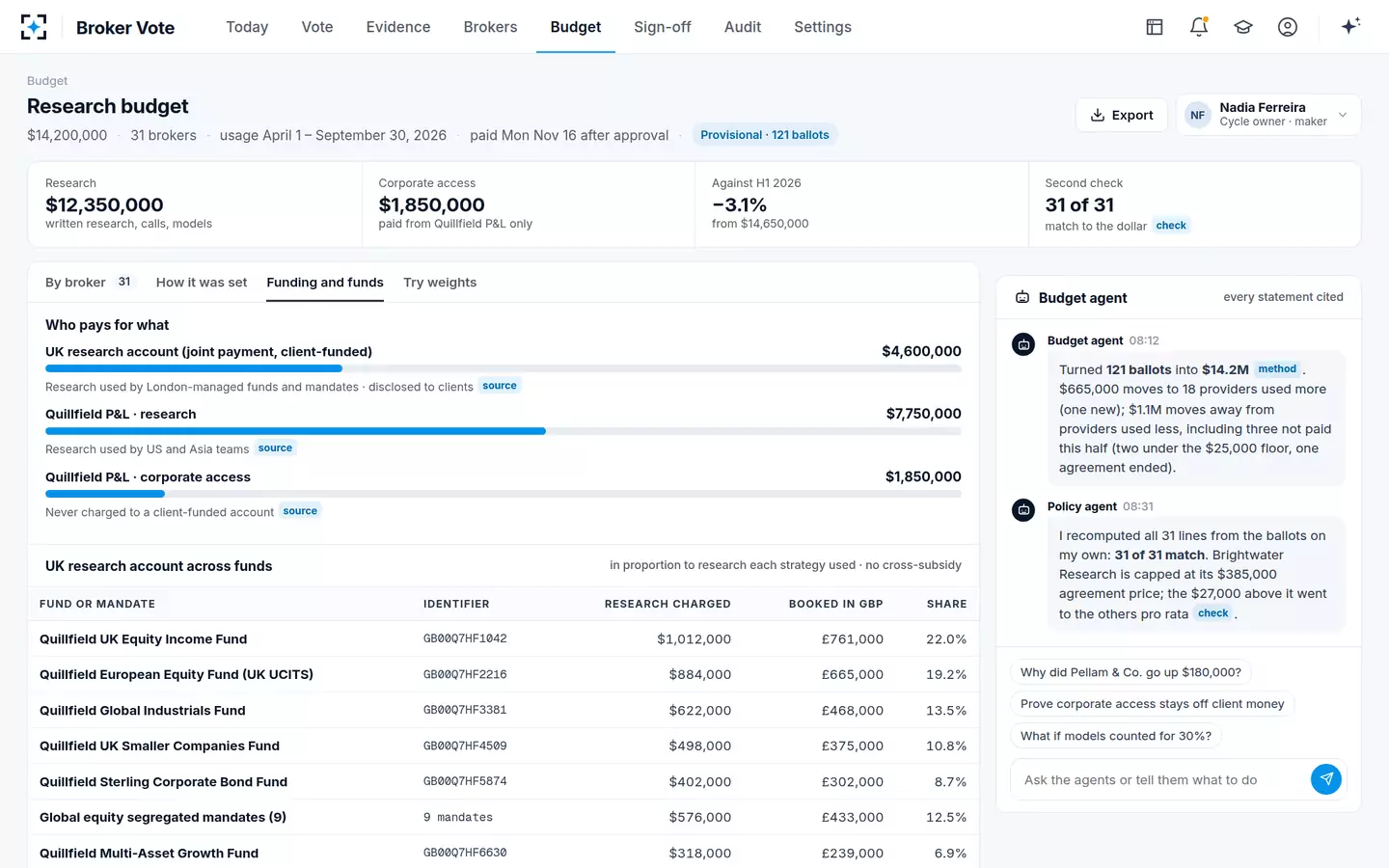
The sample firm shows a typical split for a manager with London and New York teams. Of its $14.2 million second-half budget, $4.6 million of research for London-managed funds and mandates is client-funded through joint payment; $7.75 million of research used by its US and Asia teams and all $1.85 million of corporate access are paid from its own P&L.
What does academic research say about bundled commissions?
The academic evidence explains why the guardrails exist: bundled commissions behave like a fixed fee for access, they concentrate business with few brokers, and research paid through commissions has come with costlier trading. Goldstein, Irvine, Kandel and Wiener, studying institutional trades from 1999 to 2003, argued that commissions work as a fixed fee, agreed in advance, for continuing access to a broker's premium services, and found that institutions "negotiate commissions infrequently, and thus commissions vary little with trade characteristics" (Review of Financial Studies, 2009).
Conrad, Johnson and Wahal, using proprietary order data, estimated that orders sent to soft-dollar brokers carried an extra implicit cost of about 29 basis points for buys and 24 for sells, rising to 41 and 30 for large orders, while noting wide variation and allowing that the research bought could make up part of the difference (Journal of Finance, 2001; examples of soft dollars sorts what such commissions actually buy). A fixed fee, paid regardless of volume or value received, is precisely what a budget set from expected need, and an annual value assessment, are meant to replace.
Research on unbundling itself is mixed, and the regulators say so. The FCA accepted in 2024 that respondents had shown reduced research availability and declining analyst coverage in the UK, but said "there was less evidence on the causal link between this and the change in payment options available under MiFID II" (PS24/9, paragraph 1.15). Rebundling is therefore a policy bet on access and competition, with the guardrails as its insurance.
Rebundling brought back the commission as a way to pay. It did not bring back the commission as a way to avoid deciding what research is worth.
Does rebundling raise conflicts of interest?
Yes, which is why it comes with guardrails. The two conflicts are old ones: research paid through commissions can pull orders toward brokers for research rather than execution, and research costs can drift up with trading volume rather than value. The UK answers the first by forbidding research from counting as an execution factor and leaving best execution rules unchanged, and the second with a budget not linked to volumes and an annual value assessment.
Not everyone thought that was enough. The FCA's Financial Services Consumer Panel opposed reintroducing joint payment, believing "that concerns over consumer protection outweigh the harms identified regarding competition and international competitiveness" (PS24/9, paragraph 3.5). One respondent warned that independent providers could be squeezed because "larger broker-dealers may leverage low-cost research as marketing and to attract trading volumes" (paragraph 3.6). The FCA went ahead, pointing to the guardrails.
For a manager, the practical consequence is that the conflicts are now managed by evidence rather than by structure. Under strict unbundling a research payment could not travel with a trade; now it can, so the firm has to show that order routing ignored research and that research spending followed value. The FCA's 2019 finding that unbundled managers selected brokers on execution alone is the benchmark a rebundled firm will be measured against (FCA, 2019).
What a rebundled broker vote must show
A rebundled broker vote must show four things that an unbundled one could leave implicit: that the research budget was set before and independently of trading; that each provider's share follows scored value with evidence of use; that client-funded money paid only for research and was allocated fairly across clients; and that execution scores never touched research money. Each of those is an output of a well-run vote, if the vote keeps its evidence.
In Broker Vote, the Budget agent turns votes into dollars and the Policy agent recomputes every line independently; corporate access is barred from the client-funded account; the client-funded amount is charged to funds and mandates in proportion to the research each used; and the desk's execution scorecard sets the approved broker list without writing into research budgets. How broker votes become a research budget shows that arithmetic, and the approved broker list shows the execution side kept apart.
A rebundled budget: client-funded research only, allocated by use
Questions people ask
Is rebundling allowed in the EU now?
Yes, from 6 June 2026, when member states apply the Listing Act's changes to MiFID II. Firms may pay jointly or separately for research on companies of any size, provided they agree a remuneration method with the provider, tell clients which route they use and assess the research every year.
Does rebundling mean higher commissions?
Not necessarily. The commission rate may rise to include a research charge, but in the UK the research budget must be based on the expected need for research and not linked to trading volumes, so research spending should not grow just because trading does. Clients must be told the expected and actual research costs.
Can a firm use joint payments for some clients and pay from its P&L for others?
Yes. The UK rules expect firms to disclose how joint payments are combined with other routes, and the sample firm uses joint payment for London-managed funds while its US and Asia teams' research is paid from its own P&L.
What was the Investment Research Review?
A review commissioned by HM Treasury and published in July 2023 that evaluated research provision in the UK and its effect on the competitiveness of UK capital markets. The FCA's PS24/9 arose from its second recommendation: an option to pay for research with combined payments for research and execution.
Is a commission sharing arrangement a form of rebundling?
It is the plumbing that makes rebundling work across providers. The FCA said its required research provider payment allocation structure is "similar to CSAs", letting a manager trade with one broker and pay another provider for research from the research part of the commission.
Will rebundling bring analyst coverage back?
Nobody can say yet. The FCA described the market integrity benefits as likely "neutral or marginally positive" and the causal link between payment rules and coverage as weakly evidenced, and ESMA must report on research coverage and costs in the EU by December 2028.