A sell-side research pricing model is the way a broker or research provider charges an asset manager for research: a baseline fee for access to written research with other services priced separately, tiered service levels, pay-as-you-go, or a price per call, meeting or model. Since MiFID II made European managers pay for research explicitly, these models have multiplied, and the FCA found "a wide range of sell-side research pricing levels" that it put down to "an ongoing process of price discovery". The difficulty for a buyer is that no regulator or independent study publishes market prices for a call or a report, so the reasonableness test that UK and EU rules impose has to be met from the firm's own data. Botminds' Broker Vote turns that data into a price per thing used: it sets each provider's allocation from the broker vote, caps it at the price in the provider's agreement, and shows what the allocation implies per logged interaction.
This guide is for the research budget owner deciding what to pay. The worked figures come from a fictional sample firm, Quillfield Capital; every provider named is invented. "Research pricing" also means pricing research for products or grants; here it means paying for investment research from brokers and independent providers.
Four sell-side research pricing models, and what a buyer must check in each
| Pricing model | How the provider charges | What the buyer must check | Where it goes wrong |
|---|---|---|---|
| Baseline access fee plus priced extras | A fixed fee for the written research, with calls, models or events priced on top | Whether the extras were used, and whether the fee matches readership | A fee paid for access nobody uses |
| Tiered service levels | Bronze, silver, gold: each tier a bundle of access and analyst time | Which tier the firm's actual use fits, provider by provider | Buying the top tier for one team's needs |
| Pay as you go | A price per item consumed, invoiced after the period | The provider's count against the firm's own logs | Invoices built on the provider's count, not yours |
| Price per interaction or product | A rate for each call, meeting, model or report, often agreed in advance | Volume against value: a short courtesy call and a decision-changing call cost the same | Paying for volume with little test of quality |
How is sell-side research priced? The four pricing models
Sell-side research is priced by access, by tier, by consumption or by interaction. The FCA's review described exactly that spread: "It is common for providers to charge a baseline fee for access to written research, and price additional services separately. Firms’ models varied with some using tiered service pricing levels, others offering ‘pay as you go’, while others price per type of interaction or product consumed" (FCA multi-firm review, 2019, now marked historical).
The model matters less than whether the buyer can see what it is paying per unit of value. A base access fee is cheap to administer and expensive if readership is thin. A per-call rate is transparent and rewards volume. Tiers sit in between and need evidence each year that the firm's use still fits the tier. A firm that knows its own consumption by provider and service can negotiate under any model; a firm that does not is a price taker under all of them.
Brokers must also price their own services apart. MiFID II "requires brokers to price and supply execution services separately from research or other services, and ensure pricing of other services are not conditioned or influenced by execution payments", in the FCA's summary of its rules in COBS 2.3C (FCA, 2019). The FCA also heard that some providers "were sometimes reluctant to offer a price to buy-side firms and prefer to be price takers", which leaves the buyer to propose the number.
How much does sell-side research cost?
There is no market price to quote: no regulator or independent study publishes what a research call, a model or a year of written research costs, and providers do not publish price lists. The figures a firm can rely on are its own: the total it spends, what each provider receives, and how much of each provider's research its people used. From those, every provider has an effective price per thing used, and that is the number to manage.
The order of magnitude is set by the budget, not by the market. In the sample firm, a $14.2 million half-year budget runs from providers paid nothing because their share fell under a $25,000 floor, through a specialist capped at its $385,000 agreement price, to the largest full-service broker at $1.46 million. The half's $14.2 million splits into $12.35 million of research and $1.85 million of corporate access across 31 providers. What tells the firm whether those amounts are reasonable is what each bought, and what the same service cost from comparable providers.
The FCA's evidence on the overall level points the other way from the usual worry. Its review found budgets for externally produced equity research fell around 20% to 30% after unbundling, and that independent providers believed prices were "potentially too low because large multi-service banks are internally cross-subsidising their research, making it hard for them to compete" (FCA, 2019). Low prices from a broker that also earns execution commissions are not automatically a bargain.
How to value sell-side research from what you used
Value sell-side research from use by dividing what a provider is paid by what the firm's people used of it, service by service, and comparing the result with the agreement and with other providers. The division gives an effective price; the comparison tells you whether it is reasonable; the voters' scores tell you whether the expensive units were the valuable ones.
From the vote to a price per thing used
Allocation
provider's share of weighted points × budget
From the broker vote: scores by service, weighted by service and by voter.
The vote; checked by a second calculation
Use
logged calls + reports read + models + meetings
From the firm's own CRM, calendars, portals and model logs, matched to provider and voter.
Research Operations
Effective price
allocation ÷ use, by service
For example, the analyst-call share of an allocation ÷ calls logged with that provider.
Computed
Above the agreement
− allocation above the agreed price
Capped; the excess goes to other providers pro rata.
Provider agreement
Two sample numbers show the scale of decisions involved. One point of one analyst's score for analyst calls was worth about $2,930 before redistribution, so one voter's choice between a 6 and a 9 for one broker moved about $8,530. And one specialist's votes implied $412,000 against an agreed price of $385,000: the cap paid the agreed price and sent $27,000 back to the other providers. How broker votes become a research budget works through the whole calculation.
How do you benchmark a research price?
Benchmark a research price against comparators you can observe: the same provider's price in earlier periods, the effective price of comparable providers for the same service in your own data, and the agreed prices in your provider arrangements. The UK guidance says a firm "may benchmark prices paid for research services purchased using joint payments against relevant comparators" (FCA COBS 2.3B.33G); it does not say which comparators, and it does not require market data.
Comparators inside the firm are usually the best available. A firm that pays two full-service brokers similar amounts, one for about 500 logged calls and one for 300, has a benchmark question to ask before it has any external data. Splitting comparators by provider type helps too: the UK rules ask firms to disclose the types of providers they buy from, with independent research providers against others offered as one breakdown (COBS 2.3B.32G), and the same split makes a natural benchmark group.
The EU took a lighter line on comparison. When the Commission adopted its delegated directive in February 2026, it recorded that ESMA had already considered and rejected a requirement for firms to compare each provider's research quality with other providers', judging it too burdensome (C(2026) 994, explanatory memorandum). EU firms must still assess quality, usability and value each year (Directive (EU) 2024/2811); they are simply not told to do it provider against provider.
The price test in the UK and the EU
UK joint payments (COBS 2.3B): Research charges to clients must be reasonable compared with comparable services, checked at least annually
EU (MiFID II as amended, from 6 June 2026): Annual assessment of quality, usability and value; no separate price test in the directive
UK joint payments (COBS 2.3B): Benchmarking against relevant comparators is one way, set out in guidance
EU (MiFID II as amended, from 6 June 2026): Objective quality criteria and remedial action where research falls short
UK joint payments (COBS 2.3B): Allowed as a benchmark, not required
EU (MiFID II as amended, from 6 June 2026): Considered by ESMA and rejected as a mandatory comparison
UK joint payments (COBS 2.3B): Types of providers paid; no amounts per provider
EU (MiFID II as amended, from 6 June 2026): Total research costs on request, annually, where known
What does the FCA price benchmarking rule require?
The FCA's rule requires an outcome, not a method: a UK manager using joint payments must ensure, at least annually, that what it charges clients for research is reasonable against comparable services (COBS 2.3B.25R(7)(b)). Benchmarking prices against comparators is the guidance's example of how to show it. The FCA had consulted on a mandatory benchmarking requirement and changed it after feedback, explaining: "We believe this is a proportionate approach, focusing on the outcome we are seeking to achieve, but also indicating an approach that can enable firms to meet the requirements, while providing latitude for other approaches" (FCA PS24/9, paragraph 1.23).
For a broker vote, that means the price evidence should travel with each budget line: the agreed price or method, the allocation, the use behind it, the effective price and the comparators the firm chose. A cap at the agreed price and a written reason for any provider paid well above its peers will usually say more than an external survey.
Should models and written research be priced differently?
Yes. Models, written research, analyst calls and meetings differ in cost to produce, in how they are consumed and in how directly they feed a decision, so one blended rate misprices all of them. The FCA's description of providers pricing "per type of interaction or product consumed" reflects that, and a buyer should mirror it with service weights on the ballot and separate price evidence per service.
Consumption patterns make the point. In the sample half, the firm's people opened 10,622 reports in 31 provider portals and downloaded 1,342 models. A blended price per item would make a model look cheap and a report look dear, when a model is often used for months and a report read once. The sample firm weights written research at 30% of a score and models at 20%, with voters scoring each service separately, so a provider whose model is indispensable but whose notes go unread is paid for the model.
How do caps from provider agreements work?
A cap limits a provider's payment to the price agreed for the period, whatever its votes imply, and sends the excess back to the other providers in proportion to their shares. It turns the agreement into a ceiling and stops a popular provider being paid for research it did not charge for. In the UK it also anchors the arrangements that set the method for calculating and separately identifying research costs that joint payments require (COBS 2.3B.25R(2)).
A cap should come with two checks. First, if a provider hits its cap every period, the agreement is probably too low for what the firm uses, which is a renegotiation, not a saving. Second, a cap does not cover a provider paid below its agreement: if votes imply far less than the agreed price, the firm should ask whether it still needs the agreement. In the US, where commissions can pay more than the lowest available rate for research under Section 28(e), the same discipline supports the good-faith determination; Form ADV asks an adviser to disclose if clients may pay more than other brokers charge in return for soft dollar benefits (Form ADV Part 2A, Item 12.A.1.c), and the SEC's 2006 guidance sets out which products count as research at all (SEC Release 34-54165).
Broker statements, and the price you actually pay
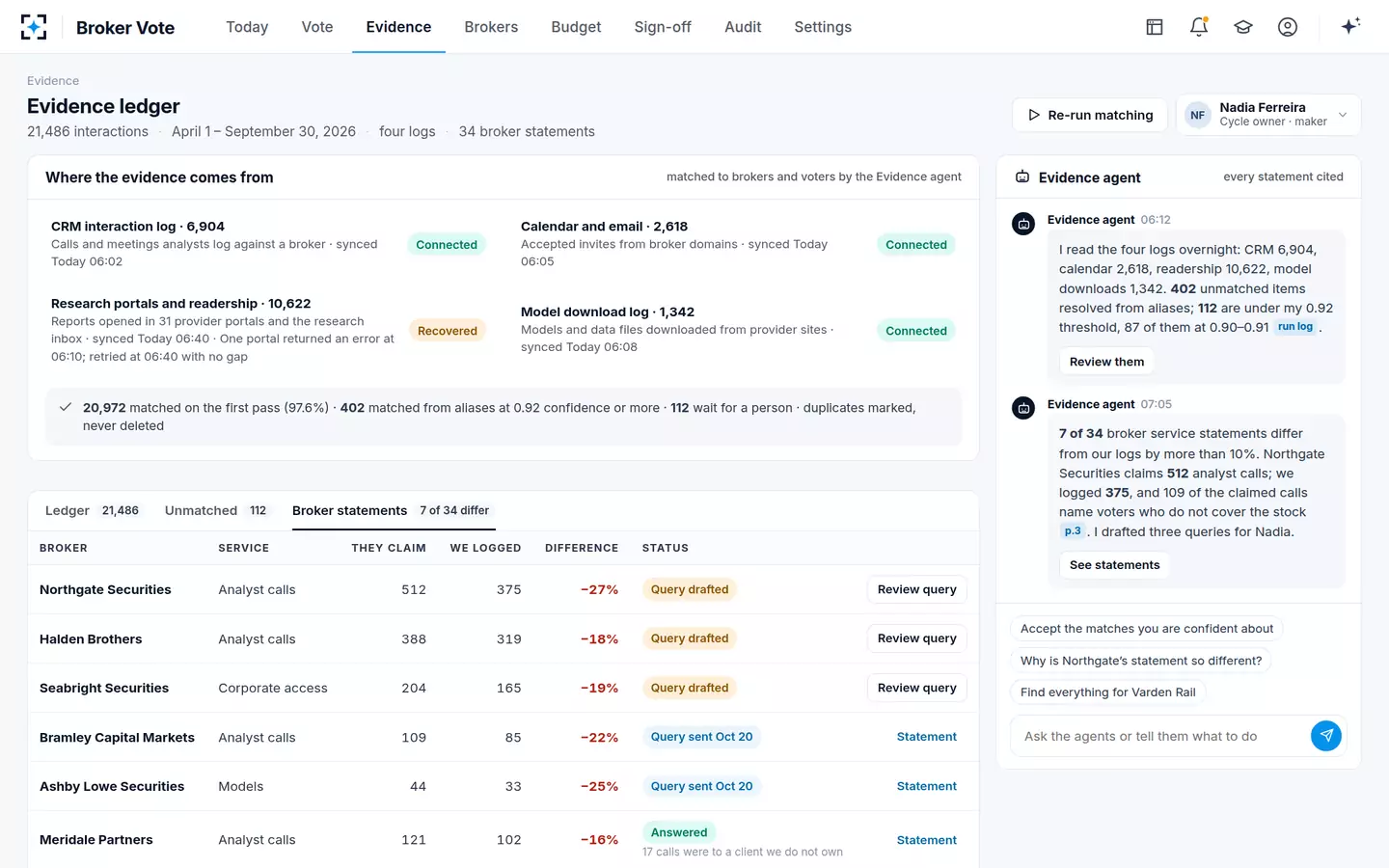
Under any per-interaction or pay-as-you-go model, the price a firm pays is only as good as the count it pays on. Providers send service statements claiming how many calls, meetings and models they delivered; the firm's own logs often show fewer. Paying on the provider's count raises the effective price by the size of the gap.
Share of each broker's claimed services that the firm's own logs do not show
Some gaps have innocent explanations: a call logged under the wrong broker, a meeting attended by someone who left, a broker counting calls with another client. Others do not. In the sample, 109 of one broker's claimed calls named people who do not cover the stock discussed. Reconciling before the vote closes turns every gap into a query with the records attached, and it is the only way an effective price means anything. Research consumption tracking software covers the matching behind the reconciliation.
Broker service statements set against what was logged
Questions people ask
Why won't some brokers quote a price for research?
Some prefer the buyer to name a figure, which the FCA found in its 2019 review when providers were "sometimes reluctant to offer a price". A buyer with its own usage data and effective prices per service can make that first offer with evidence behind it.
Do independent research providers charge less than brokers?
No public data says so either way. In the FCA's review, independent providers argued the opposite problem: that banks' research was priced too low because it was cross-subsidised by other business. The UK joint payment rules require a payment structure that can reach independent providers, so their prices can be compared in the same budget.
Is it acceptable to pay for research per call?
Yes, as a pricing model, provided quality is assessed too. The FCA's concern was firms paying by fixed rates on volume with little evaluation of content; a per-call price paired with voters' scores and a cap keeps the volume in check.
How often should research prices be renegotiated?
At least once a year in the UK if joint payments are used, because the budget and the price test are both annual minimums. Firms that vote twice a year can renegotiate where a provider hits its cap or falls under the floor two periods running.
Can research be given away free to win trading?
Not under MiFID II: brokers must price research separately from execution and may not let execution payments shape the price of other services. A manager receiving unpriced research from a broker it trades with should treat it as a potential inducement, not a discount.
Does the budget set the price, or the price the budget?
Both, in sequence. The budget is set first from the expected need for research; the vote allocates it; agreements cap what any one provider can receive. Where caps bind across many providers, the budget was set above the price of what the firm actually used.