A broker scorecard template is the form a buy-side firm uses to rate each broker and research provider, service by service, at the end of a period: written research, analyst calls, models and corporate access on the research side, and cost, settlement and service on a separate execution side. The template most firms start with is a spreadsheet with a 1-to-10 score per service, and its weakness is not the scale but the empty column beside it: nothing shows what the voter actually used. Without that column, voters score from memory, two analysts can rate the same broker three points apart for no reason anyone can see, and the research budget follows recollection. Botminds' Broker Vote fills that column before the voter opens the scorecard, with the calls, reports, models and meetings logged against each broker, and leaves the score to the voter.
The template below is written for the research director who owns the policy and the head of research operations who runs it. The worked examples come from a fictional sample firm, Quillfield Capital, whose second-half 2026 vote runs through the solution; all names in them are invented.
A broker scorecard template for research, with the evidence column most templates leave out
| Service and weight | Evidence shown beside the score | Score | A reason is required when |
|---|---|---|---|
| Written research · 30% | Reports opened in the provider's portal or the research inbox during the period, by this voter | 1–10 | The score is 8 or more on fewer than 3 logged interactions, or 2 or less on 15 or more |
| Analyst calls · 30% | Calls logged in the CRM or accepted calendar invites from the broker's domain, with date and analyst | 1–10 | Same rule; and any comment that mentions execution is returned |
| Models · 20% | Model and data files downloaded from the provider, by this voter | 1–10 | Same rule |
| Corporate access · 20% | Meetings with company management arranged by the broker | 1–10 | Same rule; the score is kept, but the payment comes only from the firm's own resources |
| Comment (research only) | Free text, read by a person and checked for conflicts and execution remarks | — | A declared conflict with the broker sends the ballot line to Compliance |
What should a broker scorecard include?
A broker scorecard should include the services you pay for, a weight for each, a score per service per provider, the evidence of use beside each score, and a rule for when a score needs a reason. Header fields matter as much as the grid: the period covered, the voter and team, the voter's weight, and a declaration of conflicts signed before the first score.
The services should match the way providers charge and the way your people consume, not a vendor's default list. The sample firm splits research into written research, analyst calls, models and corporate access, and weights them 30, 30, 20 and 20. A fixed-income team might weight desk analysts' commentary and models more heavily; a small-cap team might weight corporate access higher. What matters is that the weights are written down before the window opens and changed only with a second person's approval, because a weight moved after the votes are in is a payment moved after the fact.
The evidence column is what turns a form into a defensible record of judgement. It does not have to be precise to the minute; it has to exist. "9 reports read, 6 calls, 3 models used, 4 meetings" beside a broker tells a reviewer what the voter's 9 rests on. A blank tells the reviewer nothing, and it tells a broker who disputes its allocation even less.
How do you score research and execution separately?
Score them on two different scorecards, filled by different people from different data, and let them meet only at the approval table. Research is scored by the analysts and portfolio managers who used it; execution is scored by the trading desk from transaction cost analysis, settlement data and trader surveys. Mixing them in one weighted total lets a good research house hide poor execution, or a cheap executor buy a research payment.
Two scorecards, two decisions
Research scorecard (the broker vote): Analysts and portfolio managers, only for providers they used
Execution scorecard (the desk): Traders, from a survey, and the cost analysis itself
Research scorecard (the broker vote): Value of written research, calls, models and corporate access
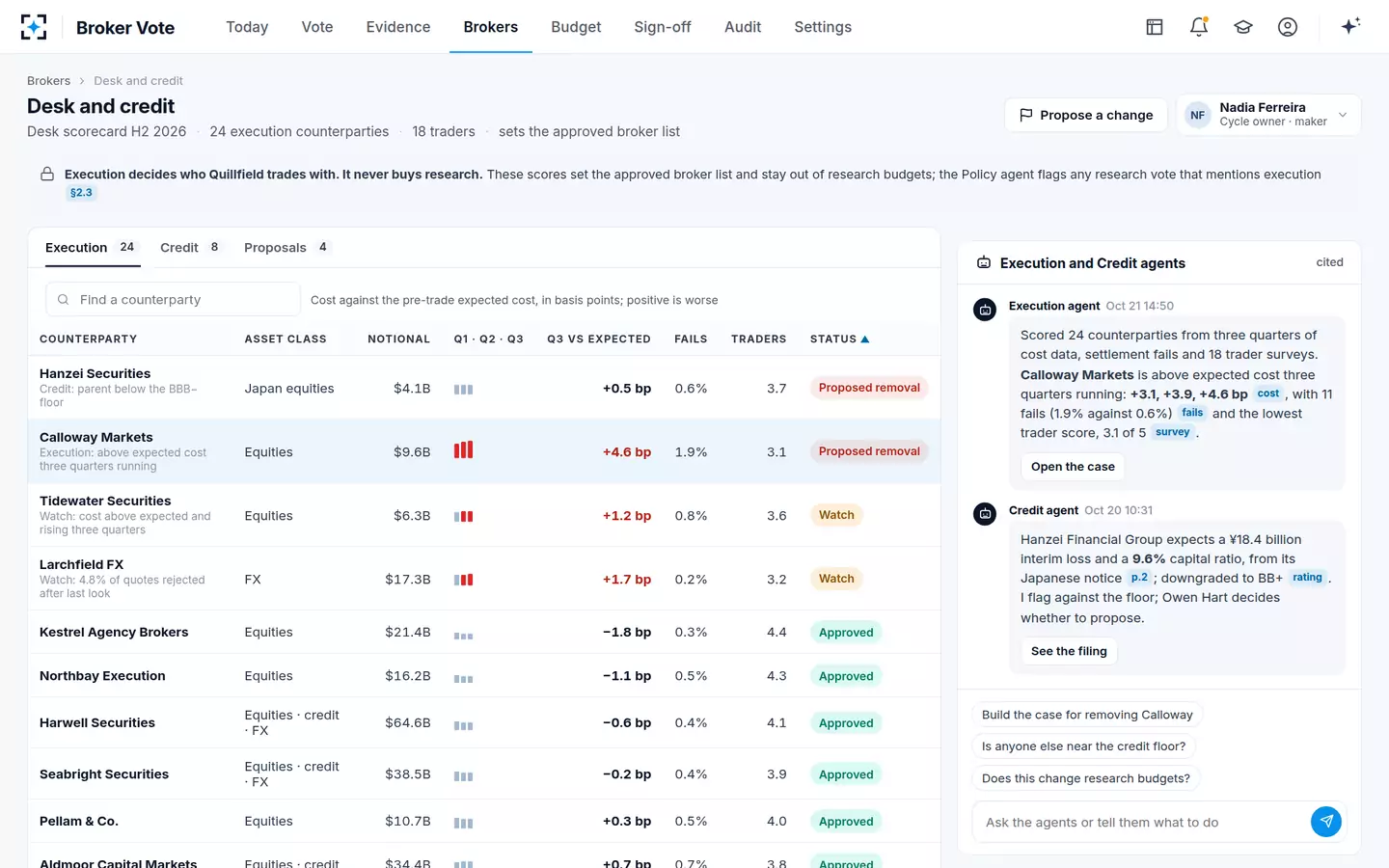
Execution scorecard (the desk): Cost against the expected cost, settlement fails, errors, responsiveness
Research scorecard (the broker vote): Logged calls, reports read, models downloaded, meetings
Execution scorecard (the desk): Basis points against expected cost per quarter, fail rate against the desk average, trader rating
Research scorecard (the broker vote): Each provider's share of the research budget
Execution scorecard (the desk): Who stays on the approved broker list, who goes on watch
Research scorecard (the broker vote): Execution complaints in research scores or comments
Execution scorecard (the desk): Research money: a broker on execution watch keeps its research payment
The execution side has its own regulatory anchor. The SEC's 2019 interpretation describes best execution as more than the lowest commission and points advisers to qualitative factors such as a broker's execution capability, its financial strength and how responsive it is (SEC, 2019). Its staff's 2018 risk alert listed, among common deficiencies, reviews that left those qualitative factors out and reviews that never asked the firm's own traders and portfolio managers what they saw (OCIE risk alert, 2018). A trader survey on the desk scorecard is the cheapest answer to the second point.
Keep the desk scorecard honest about what it can attribute. Anand, Irvine, Puckett and Venkataraman show that trading-desk performance persists across periods and that "some brokers can deliver better executions consistently over time" (Review of Financial Studies, 2012), but the same study finds that the desk's own skill matters too. A cost figure against expected cost, three quarters running, says more about a broker than one bad week. In the sample, Calloway Markets ran +3.1, +3.9 and +4.6 basis points above expected cost over three quarters, with a 1.9% fail rate against a desk average of 0.6%; its research payment was not touched by any of that.
The desk's scorecard sits on its own screen, and sets the approved list
Why do voters score the same broker differently?
Voters score the same broker differently for three good reasons and two bad ones. The good reasons: they used different services, they cover different sectors where the broker's strength varies, and they valued the same call differently because it changed one of their decisions. The bad reasons: memory, which favours the last month and the loudest analyst, and undeclared relationships. A scorecard should keep the first three and expose the last two.
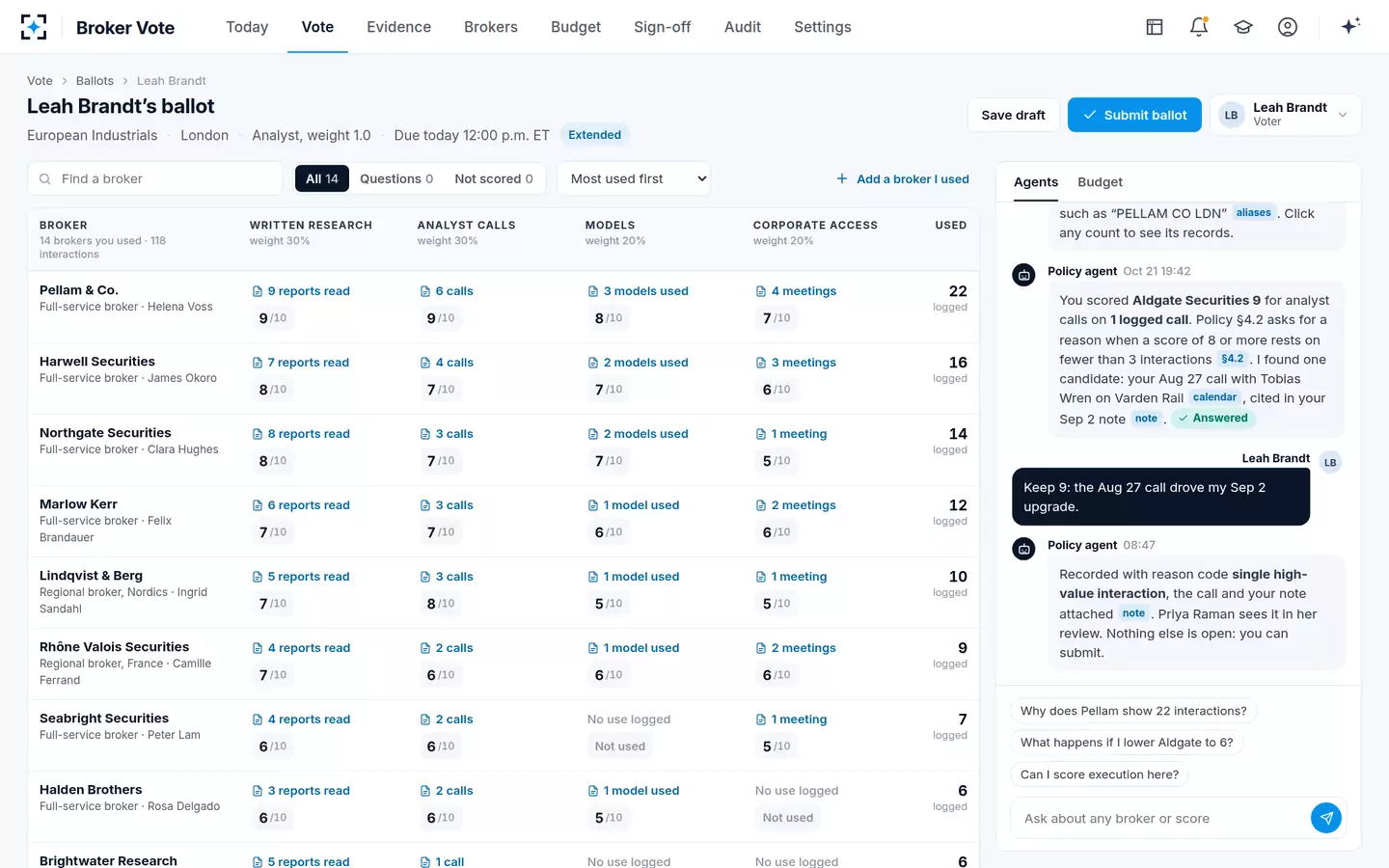
The evidence column does most of that work. A voter who read 31 of a broker's reports and scored its written research 3 is telling you something; so is a voter who scored a broker 9 on one logged call. Both may be right. In the sample cycle, one analyst gave a broker's written research a 3 after reading 31 of its reports, and the policy routed the score to the Director of Research because it sat 2.5 points or more from the team's median. Another gave a 9 for analyst calls on a single logged call, and the Policy agent asked why.
Disagreement is information until it is unexplained. Averaging 124 ballots hides a broker that one team relies on and another ignores; a spread by team shows it. The sample firm keeps the raw scores, the voter weights and the team medians side by side, so a reviewer can see whether a broker's total rests on breadth or on a few enthusiasts.
How do you calibrate broker scores without flattening them?
Calibrate with rules that ask for reasons, not with formulas that rescale votes. Forcing every voter's scores to the same mean and spread punishes the analyst who genuinely found one broker outstanding. Rules that trigger a question at the edges keep the judgement and make it visible.
The sample firm uses four. A score of 8 or more on fewer than 3 logged interactions needs a reason. A score of 2 or less on 15 or more interactions needs a reason. A score 2.5 or more points from the team median goes to the Director of Research. A declared conflict goes to Compliance. With two further checks, for execution remarks and providers not on the research list, they raised 41 questions on 5,206 scores in the sample cycle, and every one was resolved before the pack went for approval.
Where 41 policy questions came from, on 5,206 scores
The regulator's stated expectation supports calibration by exception. Reviewing how asset managers valued research, the FCA said that "As long as firms can show their approach is rational and consistent, we would not expect them to assign specific payments to every single interaction, or justify small variations between similar providers" (FCA multi-firm review, 2019). Rules at the edges are how a firm shows rational and consistent without auditing every cell.
Should usage data override a score?
No. Usage data is evidence for a score, not a substitute for one. A count of calls cannot tell whether a call was the one that changed a recommendation, and a firm that pays by count has built a rate card, which the FCA's review criticised when it rested on volume "with only limited evaluation of the quality of the content" (FCA, 2019). The same review put the principle plainly: "Assessing research quality and value requires judgement."
What usage data should do is make the voter state the judgement when the two disagree. In the sample, the analyst who scored a broker 9 on one logged call answered the Policy agent in her own words: the August 27 call drove her September 2 upgrade of a stock. The agent recorded the reason with the call and the note attached, and the Director saw it in review. Had her reason named no interaction or decision, the score would still have stood, and the question would have gone to Compliance with her words.
A high score kept, with a reason anyone can read
How many brokers should each voter score?
Each voter should score only the providers they used during the period, which is usually far fewer than the firm's full list. Research on institutional trading supports what desks see: Goldstein, Irvine, Kandel and Wiener found that institutions "concentrate their order flow with a relatively small set of brokers" (Review of Financial Studies, 2009). In the sample firm, the ballot list has 60 brokers and research providers; one European industrials analyst used and scored 14.
Three conventions keep the grid honest. A provider the voter did not use is left unscored, not scored zero, because a zero moves money away from a broker the voter never tried. A provider that is not on the approved research list cannot be scored at all; a voter who used one raises a new-provider request instead, which in the sample happened three times. And a voter with no logged use of a provider who still wants to score it must say why, because unlogged use is either a logging gap to fix or a memory to question.
How do you defend a score to the broker?
You defend the result, not the individual score. Brokers receive a letter with their ranking by service, the change in their allocation and the reasons, built from the scores and the evidence in aggregate; they never see a named voter's score. That protects voters' candour, and it means the evidence must be good enough to stand on its own when a broker disputes it.
The usual dispute is about volume. A broker's own service statement claims a number of calls or meetings; the firm's logs show fewer. Reconciling the two before the vote closes turns an argument into a query. In the sample, one broker claimed 512 analyst calls against 375 logged, and 109 of its claimed calls named voters who do not cover the stock; the query was drafted for the cycle owner before the allocation was final. How consumption tracking reconciles broker statements covers the matching behind that.
A score without its evidence is an opinion. A score with its evidence and a reason is a decision someone can review.
What to look for in broker scorecard software, and where Broker Vote fits
Look for software that fills the evidence column from your own systems, asks for reasons by rule, keeps research and execution apart, and lets a second person rerun every number. A shared spreadsheet can hold the template; it cannot match 20,000 interactions to voters or stop a corporate access payment landing in a client-funded account.
Eight questions to put to any broker scorecard or broker vote tool
- Does each score sit beside the evidence of use?
Counts by service, each opening to the calls, reports, models and meetings behind it.
- Where does that evidence come from?
Your CRM, calendars, research portals and model logs, matched to broker and voter, not a broker's own statement.
- Are the calibration rules yours and versioned?
Thresholds such as 8 or more on fewer than 3 interactions, changed only with a second approval.
- Does anything ever enter or suggest a score?
It should not. Scores belong to voters; software that suggests them is scoring for them.
- Is execution kept off the research scorecard?
A separate desk scorecard, and a check on research comments that mention execution.
- Can a reviewer rerun the allocation?
Every budget line recomputed independently, with any difference stopping approval.
- Do brokers ever see an individual vote?
Feedback letters should carry rankings and reasons, never a named voter's score.
- What does the examiner get?
Ballots, evidence, questions, the allocation and approvals in one export, kept for your retention period.
Broker Vote fits firms where the vote moves real money across dozens of providers and several teams, under UK or EU joint payment rules or a US soft-dollar programme, and where the evidence is scattered across systems. It is less useful to a firm that pays a handful of providers from its own resources and can see every interaction in one inbox; a well-kept spreadsheet may serve there. It does not execute payments, run transaction cost analysis or decide anything: it prepares, checks and drafts, and people score and sign. The five data feeds to bring before you start sets out what a first cycle needs, and Broker Vote shows the agents at work.
Questions people ask
Is there a free broker scorecard template in Excel?
The table at the top of this guide is a complete starting template: copy its columns into a sheet, add a row per provider and a tab per voter. The part a spreadsheet cannot supply is the evidence column, which needs your CRM, calendar, portal and model logs matched to each broker and voter before the window opens.
What scale should a broker scorecard use?
Any scale works if every voter uses the same one and the policy says what the ends mean. The sample firm uses 1 to 10 per service, with a reason required for 8 or more on fewer than 3 logged interactions and for 2 or less on 15 or more. Narrow scales such as 1 to 3 lose the difference between good and outstanding that drives payments.
Should corporate access be on the research scorecard?
Score it, but keep it apart in payment. In the UK the FCA does not treat corporate access services as research, so they cannot be paid from a research account or the research part of a joint payment; the sample firm scores corporate access on the ballot and pays all of it, $1.85 million in the sample, from its own P&L.
How often should the execution scorecard be updated?
More often than the research vote. UK portfolio managers must monitor the execution quality of the firms they place orders with on a regular basis and review the arrangements at least annually (FCA COBS 11.2A.34R); the sample desk scorecard uses three quarters of cost data so that a trend, not a single bad week, drives a watch or a removal.
What is a broker evaluation form?
It is another name for the voter's scorecard: one form per voter, listing the providers used and a score per service. The name matters less than two features, the evidence beside each score and a signed declaration of conflicts at the top.
Who should be able to see individual scores?
The voter, the Director of Research and Compliance reviewing questions, and an examiner on request. Not other voters during the window, and never the broker. Keeping ballots private during voting stops anchoring on a senior colleague's score.