An approved broker list is the list of broker-dealers and counterparties a buy-side firm's traders may send client orders to, set by asset class and loaded into the order management system so that an order to anyone else is blocked. A firm approves a broker after checking its execution capability, its financial standing and its operations, and keeps it on the list only while those checks hold. The hard part is that the same brokers often sell research, and the twice-yearly broker vote that splits the research budget runs in the same weeks as the desk's review, so research loyalty can quietly keep a weak counterparty on the list. Botminds' Broker Vote scores the desk side and the credit side on their own screens, keeps research votes out of them, and sends any removal to the COO with its evidence.
The examples come from a fictional sample firm, Quillfield Capital, in its second-half 2026 review; every broker and person named in them is invented.
Two decisions, two evidence trails, one approval table
Approved broker list: Can we route client orders to this firm and expect the best result, safely, for this class of instrument?
Research budget: How much is this provider's research worth to our investment decisions this period?
Approved broker list: Traders, transaction cost analysis, operations, counterparty credit risk
Research budget: Analysts and portfolio managers who used the research
Approved broker list: Cost against expected, fails, errors, ratings, capital, spreads, filings
Research budget: Calls, reports read, models downloaded, meetings, scores with reasons
Approved broker list: Head of Trading (execution) or Counterparty Credit Risk (credit)
Research budget: The vote itself; a new provider through a request to Research Operations
Approved broker list: The approved broker list, by asset class, loaded into the order management system
Research budget: The research budget, provider by provider, and the funding source
Approved broker list: Research votes; sales of the firm's own fund shares
Research budget: Execution complaints, execution volumes
Both meet at one table: the COO approves the list and the budget together, as two decisions.
What is an approved broker list?
An approved broker list is a firm's register of permitted execution counterparties, usually by asset class and sometimes by region, with each firm's status: approved, on watch, restricted or removed. In the UK and the EU it is not optional in substance. A portfolio manager placing orders with other firms must have a policy that names, for each class of instruments, the firms it places orders with, and those firms must have execution arrangements that let the manager meet its own best execution duty (FCA COBS 11.2A.34R; Delegated Regulation (EU) 2017/565, Article 65).
In the United States no rule uses the phrase, but the same list falls out of the adviser's duty. The SEC's 2019 interpretation expects an adviser selecting brokers to weigh the full range and quality of each broker's services, not the lowest commission alone (SEC, 2019), and Form ADV requires every adviser to set out the factors it weighs when choosing brokers and when judging whether their compensation is reasonable (Form ADV Part 2A, Item 12.A). An approved list, with the reason each firm is on it, is how an adviser shows those factors were applied.
The list is also a control. Once loaded into the order management system, it blocks a trader from routing to a counterparty that has not been checked, and it lets the desk move flow away from a firm in a day when its credit weakens, without waiting for the next review.
What criteria decide broker selection?
Broker selection criteria fall into four groups: execution quality, financial responsibility, operations and service, and conduct. Research belongs in a different conversation in the UK and EU; in the US it may legitimately count among a broker's services, which is exactly why it needs its own evidence and disclosure.
Broker selection criteria, and the rule or evidence behind each
| Criterion | What to check | Where it comes from |
|---|---|---|
| Execution quality | Cost against expected cost by quarter, fill rates, price improvement, behaviour in difficult orders | SEC 2019 interpretation; FCA COBS 11.2A.34R and Article 65 of Delegated Regulation 2017/565 |
| Financial responsibility | Credit rating of the firm and its parent, capital ratios, credit spreads, net capital for US broker-dealers | SEC 2019 interpretation; SEC Rule 15c3-1 for broker-dealers' own capital |
| Operations and settlement | Settlement fail rate against the desk average, trade errors, affirmation on trade date, confirmations | The firm's own best execution monitoring; the desk's scorecard |
| Responsiveness and service | Trader survey: coverage, market colour on the trade, handling of problems | SEC 2019 interpretation; the SEC staff's 2018 best execution risk alert |
| Conduct and conflicts | Affiliations, disciplinary history, whether the firm sells the manager's own funds | SEC Rule 12b-1(h) and FINRA Rule 2341(k) for funds' portfolio brokerage |
| Research | Not an execution factor in the UK; in the US, value of research may count, disclosed as a soft dollar benefit | FCA COBS 2.3B.29R; Section 28(e) and Form ADV Item 12 |
The research line is where firms in different jurisdictions most often get tangled. In the UK, research may not be counted among the factors that decide execution (COBS 2.3B.29R), so research cannot justify sending an order to a broker. In the US, the SEC's interpretation lists the value of research among the services an adviser may weigh, and Section 28(e) lets a manager pay more than the lowest commission for it in good faith; the price of that freedom is disclosure, since Form ADV requires an adviser to say that it "may have an incentive to select or recommend a broker-dealer based on your interest in receiving the research" (Item 12.A.1.b). Either way, the question "is this firm safe and competent to execute our orders?" should be answered on execution and credit evidence alone.
Who approves a new broker? The counterparty approval process
A new broker should be proposed by the desk that wants to use it, checked by operations, counterparty credit and compliance, and approved by a named senior person or committee, with the file kept for the examiner. The counterparty approval process is the same whether the firm is adding a regional specialist for one market or a global bank for every asset class; what changes is the depth of the credit work.
A defensible approval file holds six things: the business reason and the asset classes requested; the firm's registration and regulatory status; its financial position, including the parent's rating and capital where the parent stands behind it; settlement and operational set-up, including standing instructions; a conflicts check, including any affiliation and any role selling the firm's own funds; and the signed decision with the limits that apply. For derivatives counterparties, legal documentation is a further step on its own timetable.
Two practices save trouble later. Set a review date at approval, so a broker added for one trade does not stay on the list for years unused. And approve by asset class, not by firm, because a broker that executes European equities well may have no business handling emerging-market bonds.
How is counterparty credit checked?
Counterparty credit is checked against a floor the firm sets in advance, using ratings, capital ratios, credit spreads and the counterparty's own filings, for the trading entity and for the parent that stands behind it. In the United States a broker-dealer must also meet the SEC's net capital rule, under which every broker or dealer "must at all times have and maintain net capital" above set minimums (17 CFR 240.15c3-1); that is a regulatory minimum for the broker, not a credit floor for the buyer.
The sample firm's floor is a rating of BBB− or better and a capital ratio of at least 10.5%. When the parent of one Japanese broker announced, in a Japanese-language notice on September 26, an expected interim loss of ¥18.4 billion and a capital ratio of about 9.6% against 14.8% six months earlier, and was then downgraded to BB+, the Credit agent read the notice, set an English version beside it with each figure cited to its page, and flagged the breach. The counterparty credit officer proposed removal. Orders for that market had already moved to two other approved brokers, with nothing left unsettled.
Counterparty credit from the original filing, against the firm's floor
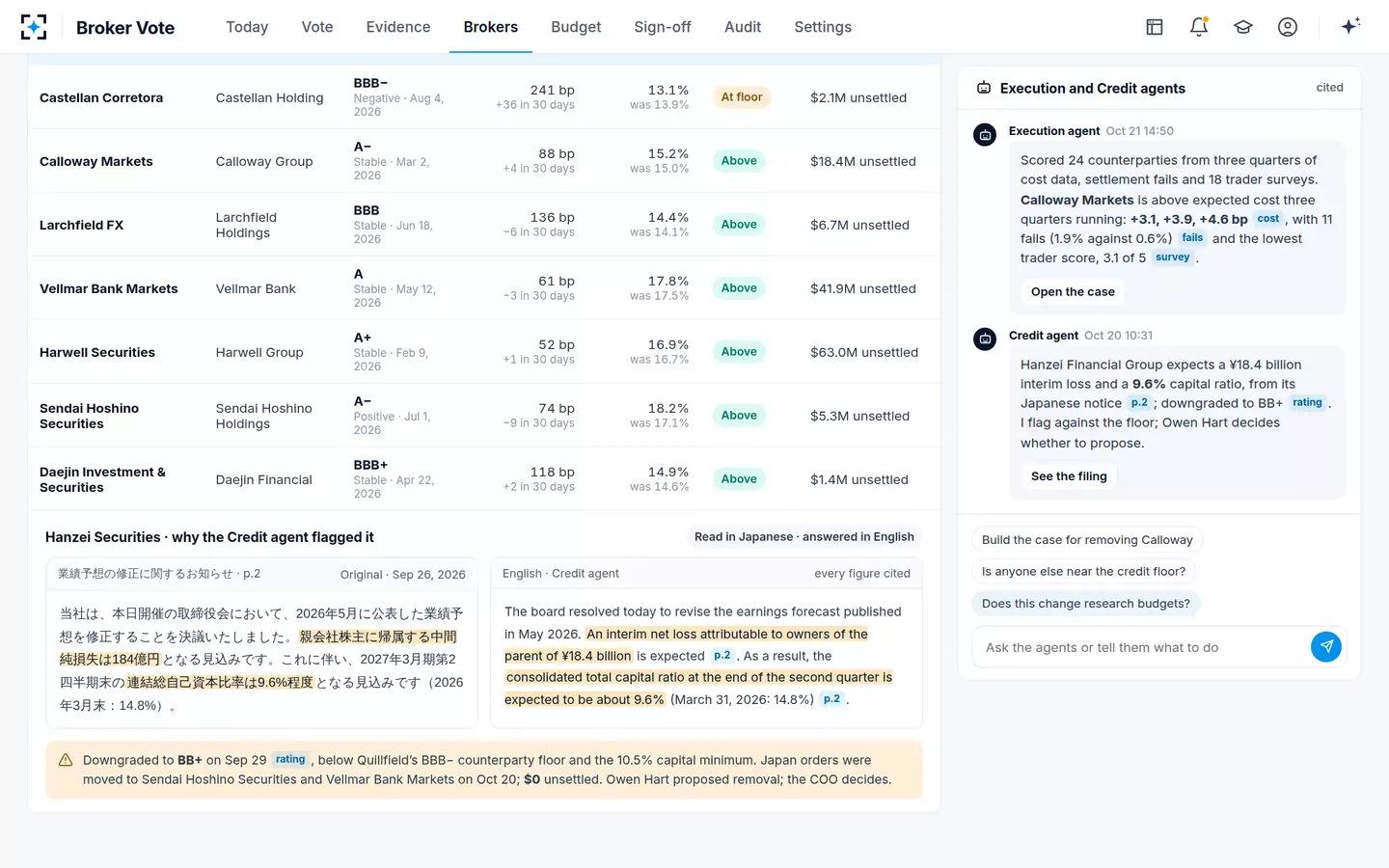
The same screen shows why a floor needs a watch band above it. One broker sat exactly at BBB− with a negative outlook, its spread up 36 basis points in 30 days and its capital ratio down from 13.9% to 13.1%: not a breach, but a counterparty the desk should not grow exposure to while the trend runs.
Can fund share sales influence broker selection?
No. For US registered funds the rule is explicit: a fund may not pay a broker for selling its shares by directing portfolio trades to it, and a fund that trades through brokers who also sell its shares must have board-approved procedures to stop the people selecting brokers "from taking into account the brokers' and dealers' promotion or sale of shares issued by the company or any other registered investment company" (SEC Rule 12b-1(h)). The broker's side carries the mirror rule: a FINRA member may not push or hold back the sale of a fund's shares because of the brokerage commissions it receives or expects from that fund (FINRA Rule 2341(k)).
For an approved broker list, that means distribution relationships belong in the conflicts check at approval, and the desk scorecard must not include any measure of how much of the manager's funds a broker sells. It is one more reason to score execution only on execution evidence.
Can a research provider be dropped without changing execution?
Yes, and the reverse is just as important: a broker can be removed from the trading list without touching what it earns for research in the period it was used. Once payment for research is separated from execution, the two lists can move independently, and the FCA saw that happen after 2018: "We also saw an increase in the number of counterparties that asset managers used for execution-only services. Fewer brokers are being used for both research and execution" (FCA multi-firm review, 2019).
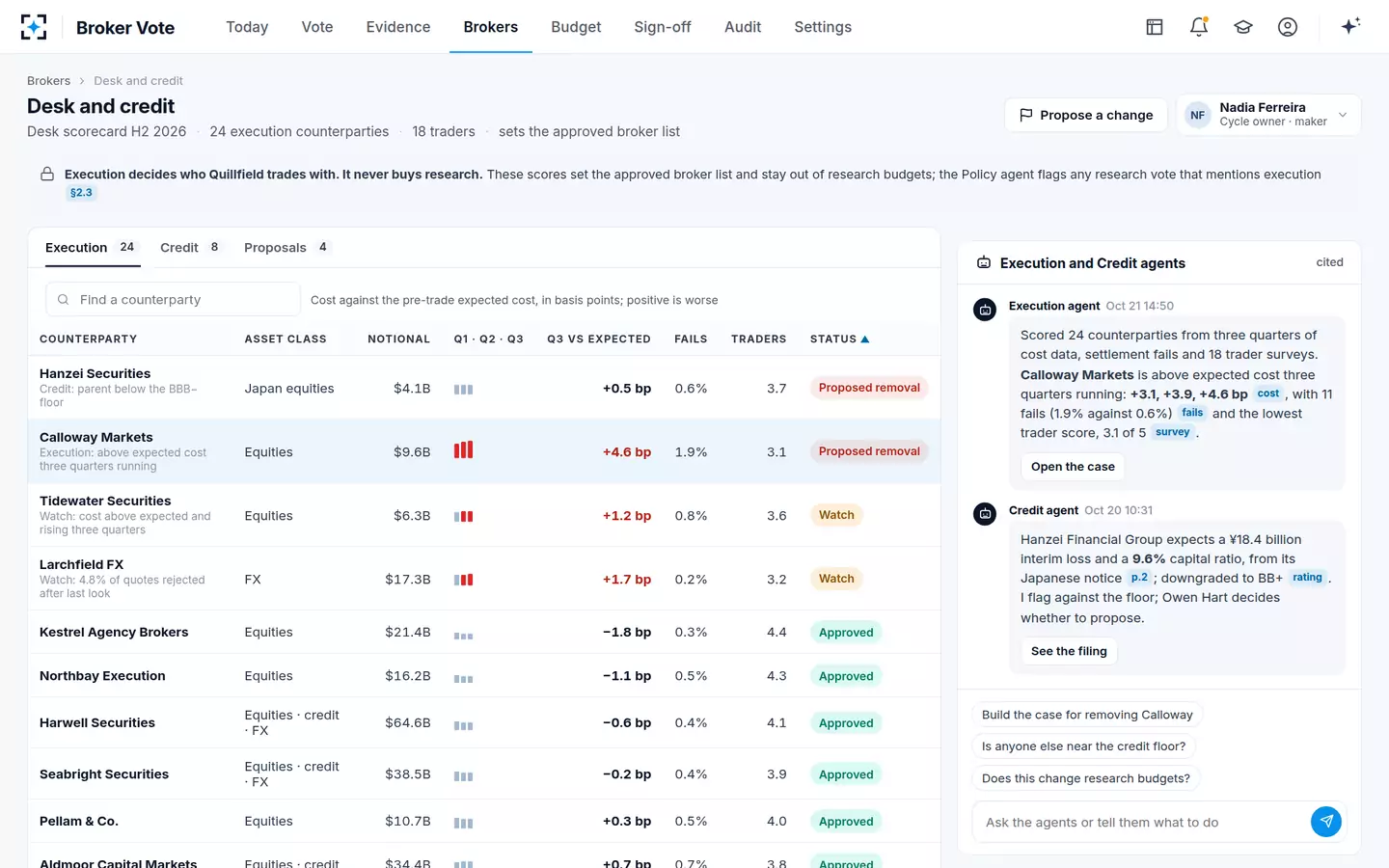
In the sample review, two brokers went on execution watch, one for costs above expected that rose three quarters running and one for rejecting 4.8% of quotes after last look, and their research allocations were calculated exactly as if they had not. A third, Calloway Markets, was proposed for removal on execution evidence: +3.1, +3.9 and +4.6 basis points above expected cost over three quarters, 11 settlement fails for a 1.9% fail rate against a desk average of 0.6%, and the lowest trader score, 3.1 of 5. The research vote played no part in either decision. Research on institutional trading supports keeping the measures apart: Anand, Irvine, Puckett and Venkataraman show that execution results reflect the trading desk's own skill as well as the broker's (Review of Financial Studies, 2012), so a research score is no shortcut to an execution judgement.
One sample review of the approved broker list
24
execution counterparties scored on three quarters of cost data, fails and 18 trader surveys
Sample data
2
proposed removals: one on execution evidence, one on credit
Sample data
2
brokers on watch, research payments untouched
Sample data
$0
left unsettled with the removed Japanese broker when its orders moved
Sample data
How often is the approved broker list reviewed?
At least once a year in full, more often for the firms that matter most, and immediately when credit or conduct changes. UK portfolio managers must keep watching the execution quality of the firms they place orders with, and must review the whole set-up every year and again after any material change that threatens the best result for clients (COBS 11.2A.34R). The SEC expects advisers to evaluate the execution they receive periodically and systematically (SEC, 2019).
In practice that means three clocks. The full review runs with the broker vote, twice a year at the sample firm, using three quarters of cost data so a trend rather than a bad week drives a decision. The watch list is reviewed at a set date, in the first quarter of 2027 for the sample's two brokers on watch. And credit is watched continuously, because a downgrade does not wait for a committee: the sample firm moved its Japanese orders on October 20, before the removal was formally approved on October 28.
The UK rules also limit how short the list can be. A firm may rely on a single executing firm "only where the firm is able to show that this provides the best possible result for their clients on a consistent basis" (FCA COBS 11.2A.36G), which in practice means keeping at least one alternative approved for every asset class.
How Broker Vote keeps the two lists apart
Broker Vote keeps the approved broker list and the research budget apart by giving them different agents, different evidence and different proposers, and by bringing them together only in the COO's approval pack. The Execution agent builds the desk scorecard; the Credit agent watches the floor; neither writes into research budgets, and neither removes a broker. The Policy agent flags any research score or comment that mentions execution.
How a broker leaves the approved list in Broker Vote
Agent
Execution agentScores every counterparty on cost against expected, settlement fails, trade errors and trader surveys; assembles the evidence for a watch or a removal.
Never: write into research budgets or remove a broker
Agent
Credit agentWatches ratings, spreads, capital and filings, in the issuer's own language, and flags any counterparty against the credit floor.
Never: propose a removal itself
A person decides
Head of Trading or Counterparty Credit Risk proposesProposes the watch or removal with a reason code: execution quality or credit.
A person decides
Compliance countersignsChecks conflicts and the client communications that follow.
A person decides
COO decidesApproves or rejects the removal in the same pack as the research budget, as a separate line.
A person decides
Head of Trading publishes the listConfirms the new version of the approved list for the order management system.
The separation runs the other way too. A broker on execution watch keeps the research money its votes earned, and a provider that falls below the research budget's floor stays on the trading list if it executes well. The broker vote process shows where the desk review sits in the season, and the broker scorecard template gives the desk's columns beside the research ones.
Execution decides who the firm trades with; it never buys research
Questions people ask
Is an approved broker list a regulatory requirement?
In the UK and EU, a portfolio manager's order placement policy must name, for each class of instruments, the firms it places orders with, which is an approved list in all but name. In the US no rule names it, but an adviser must be able to describe its broker selection factors in Form ADV and show it applied them.
Can clients ask to see which brokers a manager uses?
Yes, in the UK: on reasonable request, a firm must give clients or potential clients information about the entities where their orders are transmitted or placed for execution (FCA COBS 11.2A.34R(6)). US advisers disclose their selection factors and soft dollar practices in Form ADV Part 2A, Item 12.
What is a broker watch list?
It is a status between approved and removed: the broker stays on the list, but the desk limits new flow or exposure and the firm sets a date to decide. The sample firm put two brokers on watch with a review in the first quarter of 2027 and no routing change in the meantime.
What happens to open trades when a broker is removed?
Open trades still have to settle, so the removal plan should state the unsettled exposure and how new orders move. In the sample review, orders for the Japanese market had moved to two other approved brokers a week before the COO approved the removal, and the unsettled amount with the removed broker was zero.
Should the same committee approve brokers and research budgets?
It can, as long as the two are separate decisions with separate evidence. The sample firm puts both in one approval pack for the COO, with each removal and the budget as distinct lines, so neither can be traded against the other.
Does a broker's parent company matter for credit?
Often more than the broker itself, because a trading entity's standing usually rests on its group. The sample firm sets its floor on the counterparty and its parent: the removal described above was triggered by the parent's downgrade and capital ratio, read from the parent's own Japanese-language notice.