Examples of soft dollars, meaning research and brokerage services paid for with clients' trading commissions, include broker and independent research reports, calls with analysts, meetings with company management, market and economic data, portfolio analysis software, and order-routing and algorithmic trading tools. Examples of what client commissions may not buy under Section 28(e) include computer terminals and other hardware, newspapers, travel and meals, rent, salaries and membership dues. Between them sit mixed-use products, such as a data license, an order management system or a proxy service, which are split by measured use. Botminds' Commission Management applies these lines to every invoice line, citing the rule, and routes the ineligible share to the firm's own account before any payment is prepared.
The sorting below follows the SEC's 2006 interpretive release, page by page. The sample cases come from a fictional manager, Quillfield Capital, as it runs through the solution.
Twenty-four common soft-dollar items, sorted under Section 28(e)
Eligible
Broker and independent research reports
Reports on issuers "clearly are eligible" · p. 28
Eligible
Calls with research analysts
Furnishing advice directly on investing · p. 28
Eligible
Meetings with company executives
Oral reports concerning issuers · p. 28
Eligible
Market data: quotes, last sale, volume
"Reports concerning ... securities" · pp. 35–36
Eligible
Company financial and economic data
Substantive content on the statute's subjects · p. 36
Eligible
Portfolio analysis software
Expresses reasoning about portfolios · p. 29
Eligible
Specialist newsletters and trade journals
Marketed to a narrow audience · p. 31
Eligible
Pre- and post-trade analytics for trading decisions
"Market research" · p. 34
Eligible
Algorithmic and order-routing software
Brokerage, within the order-to-settlement window · p. 41
Eligible
Dedicated lines and order messaging to the broker
Connectivity used to transmit orders · p. 41
Not eligible
Computer terminals and hardware
"Any computer terminals" excluded · p. 33, n. 101
Not eligible
Newspapers and mass-market magazines
Mass-marketed publications are overhead · p. 31
Not eligible
Travel, hotels and meals for conferences or company visits
Operational overhead · p. 32
Not eligible
Rent, utilities, office furniture
Overhead · p. 32
Not eligible
Salaries, including research staff
Overhead · p. 32
Not eligible
Membership dues and licensing fees
Overhead · pp. 32–33
Not eligible
Accounting, legal and back-office software
Administrative functions · pp. 32–33
Not eligible
Consultants on the firm's own operations
Not portfolio strategy · p. 29
Not eligible
Error-correction trades
Corrects the manager's error · p. 43
Not eligible
Long-term custody
Outside Section 28(e); the client's own cost · p. 44
Mixed use
Seminars and conferences
Eligible "if they truly relate to research"; travel is not · pp. 28–29
Mixed use
Proxy services
Issuer research yes; casting and counting votes no · p. 37
Mixed use
Order management system
Routing yes; compliance and portfolio functions no · pp. 41–42, n. 125
Mixed use
Performance analytics
Research for decisions; not when used for marketing · p. 45
What are examples of soft dollars?
The clearest examples of soft dollars are the products the statute names: advice and reports on the value of securities, issuers, industries, economic trends, portfolio strategy and the performance of accounts, and the services involved in executing a trade. The SEC's 2006 test for research is whether the item reflects "the expression of reasoning or knowledge" on those subjects; its test for brokerage is whether the service falls between the moment an order is sent and the moment the trade settles (Release 34-54165, pages 28 and 40 to 41).
Two practical consequences follow. First, form does not matter: a report, a phone call and a meeting are all research if they carry reasoning or knowledge about an issuer. Second, delivery does not count: the terminal, the cable and the server that carry research are never research themselves. The SEC said it does "not believe that any computer terminals are eligible 'research'" (note 101), while the market data on the screen is a "report concerning securities" that can be (pages 35 to 36).
Research that qualifies, and why
Research qualifies when it carries substantive content and the manager uses it for investment decisions. Traditional sell-side and independent reports "clearly are eligible", discussions with analysts "fall squarely within the statute", and meetings with corporate executives qualify when the manager can expect to come away with reasoning or knowledge about the issuer (Release 34-54165, page 28; outside the US the answer differs, as corporate access under MiFID II explains). Market data, company financial data and economic data such as "unemployment and inflation rates or gross domestic product figures" also qualify (page 36).
Publications divide by audience. Mass-marketed newspapers and magazines are "more appropriately considered as overhead expenses", while newsletters and trade journals aimed at a narrow readership can be research: "Trade magazines and technical journals concerning specific industries (e.g., nano-technology) or product lines (e.g., medical devices) are eligible as research under Section 28(e) if they are marketed to, and intended to serve the interests of a narrow audience" (page 31). Price, the SEC added, is one sign: specialised publications tend to "have high cost".
Brokerage that qualifies: order to settlement
Brokerage qualifies when it serves the execution of the trade itself. The SEC lists trading software used to route orders, "software that provides algorithmic trading strategies", software that transmits orders to direct market access systems, and connectivity between the manager and the broker's desk, including dedicated lines and message services used to send orders (Release 34-54165, page 41). After the trade, post-trade matching, allocation messages, routing settlement instructions and short-term custody tied to settlement also qualify (pages 39 to 40).
Anything that is not part of executing the client's trade does not. Long-term custody, stock lending, margin and capital introduction are outside it, and so are "error correction trades or related services in connection with errors made by money managers", which are "separate transactions to correct the manager's error, not to benefit the advised account" (page 43). A manager's own trade errors are its cost.
Never eligible: the overhead list
The SEC's overhead list is long and specific, and it is the fastest way to settle an invoice. "Office equipment, office furniture and business supplies, salaries (including research staff), rent, accounting fees and software, website design, e-mail software, internet service, legal expenses, personnel management, marketing, utilities, membership dues ..., professional licensing fees, and software to assist with administrative functions such as managing back-office functions, operating systems, word processing, and equipment maintenance and repair services" are all outside the safe harbor (Release 34-54165, pages 32 to 33).
The list was not written in the abstract. In its 1998 sweep the SEC staff found advisers paying for "chartered financial analyst ('CFA') exam review courses, membership dues and professional licensing fees, office rent, utilities, phone, carpeting, marketing, entertainment, meals, copiers, office supplies, fax machines, couriers, backup generators, electronic proxy voting services, salaries, and legal and travel expenses" with client commissions (page 22). Some 28% of the managers and 35% of the broker-dealers examined had at least one arrangement outside Section 28(e).
What the SEC's 1998 sweep found in the money
$1B+
estimated third-party research bought with soft dollars each year
1.7:1
average ratio of soft-dollar commissions to research value at the brokers examined
6¢
average commission per share on third-party soft-dollar trades
$274M
of soft-dollar payments for third-party research reviewed
The ratio is the mechanic to understand. At 1.7:1, a manager directed $1.70 of client commissions to a broker for each $1 of third-party research the broker paid for; the difference paid for execution and the broker's margin. A commission sharing agreement makes that ratio visible per share, which is one reason commission sharing agreements replaced many bundled arrangements.
Is a market data terminal eligible for soft dollars?
The data and analytics can be; the terminal cannot; and the license is usually mixed use. A market data and analytics service delivers eligible research, market data and analytics, but its users also run administration, compliance, marketing and operations on it, so its cost is split by a study of how the firm actually uses it. Hardware is excluded outright.
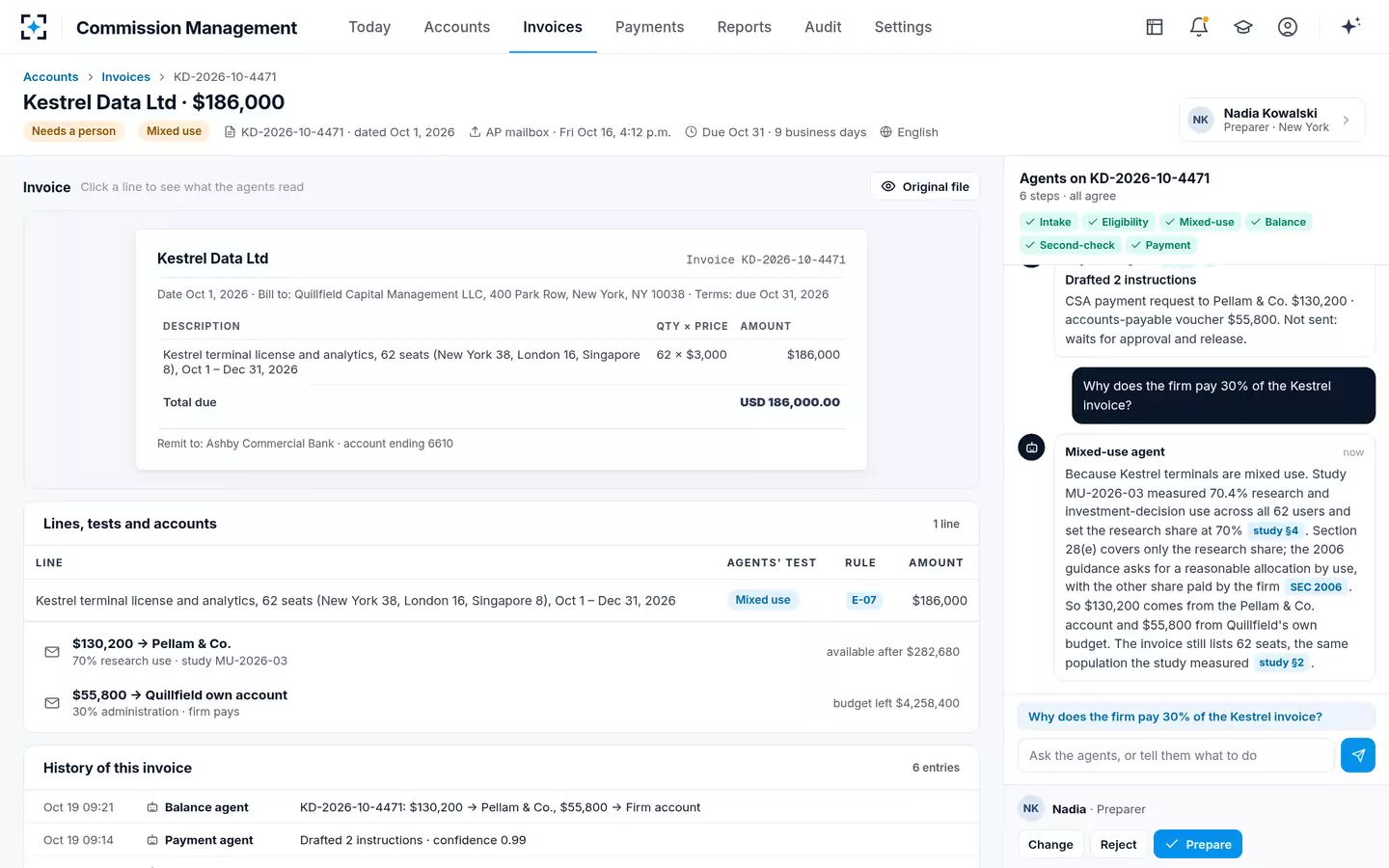
In the sample firm, a data and analytics license for 62 seats at $3,000 each for a quarter costs $186,000. A signed study measured 70.4% research and investment-decision use across all 62 users, weighted by logged active time, and set the research share at 70%: $130,200 from a commission sharing account and $55,800 from the firm. How to split a license and prove the split covers the study itself.
Commission Management: a data license split by its signed study
Are conferences, travel and meals eligible for soft dollars?
The research content of a conference can be; the travel, hotel, meals and entertainment around it are not. Seminars "may also be eligible under the safe harbor if they truly relate to research, that is, they provide substantive content relating to the subject matter in the statute", but "travel and related expenses (e.g., meals and entertainment) associated with arranging trips to meet corporate executives or to attend seminars or conferences are not eligible" (Release 34-54165, pages 28 to 29 and note 92). A single conference invoice therefore splits line by line.
Commission Management: the morning's exceptions, each with one next step
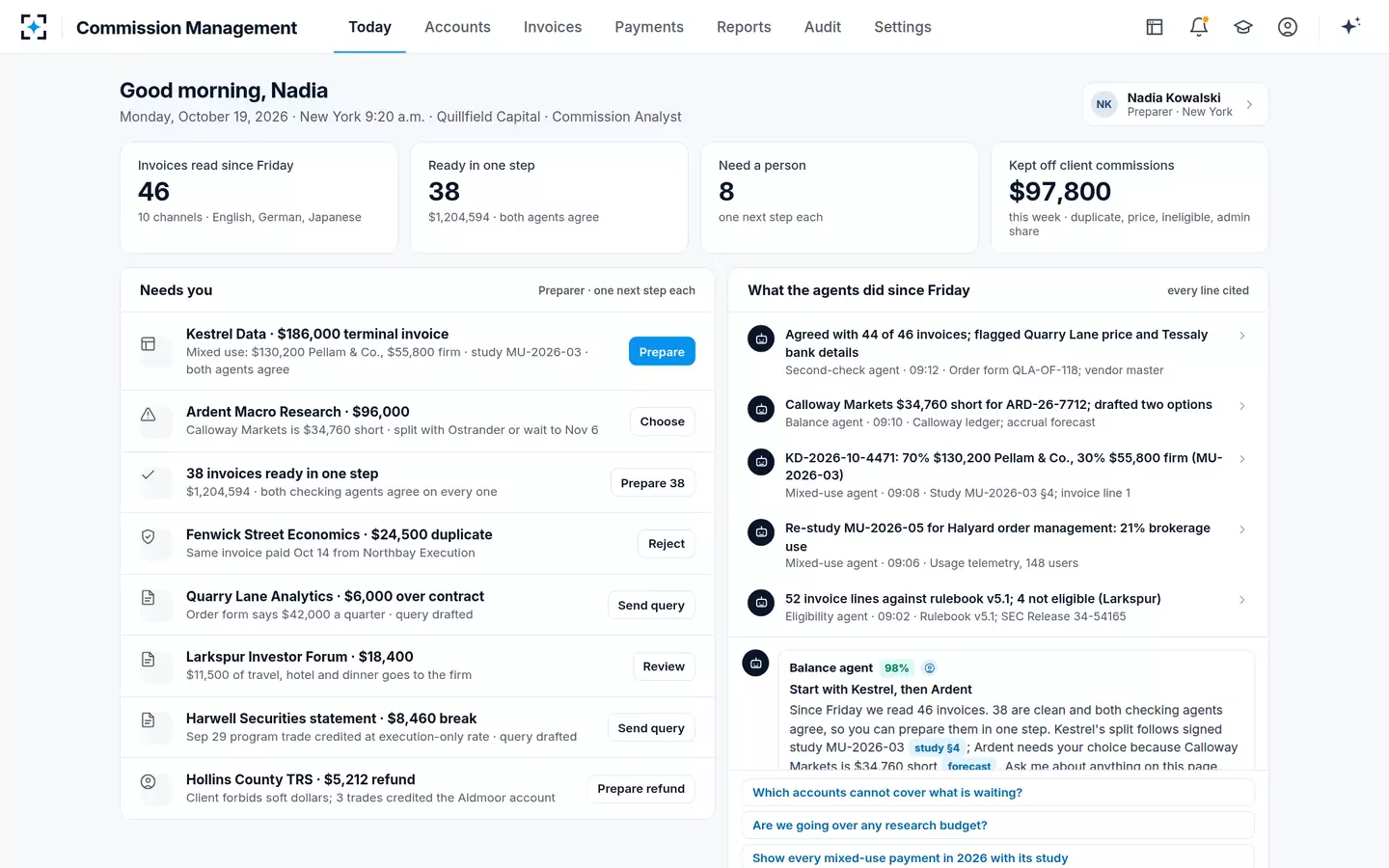
That is what happened to one conference invoice in the sample week: an $18,400 bill for an investor forum, from which $11,500 of travel, hotel and dinner was routed to the firm and the research sessions stayed eligible. Meals and entertainment paid with client commissions are among the oldest findings in the SEC's files; the 1998 staff listed both.
Where the UK and EU draw the line differently
A UK manager paying from a research payment account or by joint payment works from a narrower list. The FCA names goods and services it "does not regard as research", and several of them are eligible in the US.
Same item, two answers: US Section 28(e) and the FCA's research rules
United States, Section 28(e): Eligible market research if used for trading decisions.
United Kingdom, COBS 2.3B.23G: Not research.
United States, Section 28(e): Market data is a "report concerning securities".
United Kingdom, COBS 2.3B.23G: Not research unless "analysed or manipulated" to give meaningful conclusions.
United States, Section 28(e): Eligible if the content truly relates to research.
United Kingdom, COBS 2.3B.23G: Not research.
United States, Section 28(e): Eligible as oral reports on issuers.
United Kingdom, COBS 2.3B.23G: "Corporate access services" are not research.
United States, Section 28(e): Eligible if marketed to a narrow, specialist audience.
United Kingdom, COBS 2.3B.23G: "Subscriptions for publications" are not research.
United States, Section 28(e): Routing and algorithmic functions are eligible brokerage.
United Kingdom, COBS 2.3B.23G: Not research, so not payable from research money.
For a manager with clients on both sides of the Atlantic, the practical rule is that the eligibility call depends on which account pays. A post-trade analytics invoice may be paid from a US commission sharing account and must not be paid from the UK research payment account; in the sample firm, research for UK and Luxembourg funds is paid only from the UK and EU accounts.
What happens if an ineligible item was paid with client commissions?
It depends on the client, and for some clients the answer is a legal violation, not a disclosure problem. For a registered fund, using commissions outside Section 28(e) may violate Section 17(e)(1) of the Investment Company Act, and "disclosure of the arrangement would not cure" it (Release 34-54165, note 31). For an ERISA plan, it can be a prohibited transaction: the Department of Labor's example is a manager whose plan commissions paid for $500,000 a year of bookkeeping for its own corporate purposes, which it said violated ERISA sections 406(a)(1)(D), 406(b)(1) and 406(b)(3) (ERISA Technical Release 86-1, 1986).
An ineligible payment, by client type
| Client | What the payment can amount to | What usually has to happen |
|---|---|---|
| Registered fund | A possible Investment Company Act §17(e)(1) violation; disclosure does not cure it | Reimburse the fund; tell the board; fix the control |
| ERISA plan | A prohibited transaction under ERISA §406 when the manager benefits | Restore the plan; review under ERISA; fix the control |
| Separate account or private fund | A breach of fiduciary duty unless fully and specifically disclosed | Reimburse or disclose; correct Form ADV Item 12 and Item 8.G |
| A client that forbids soft dollars | A breach of the client's agreement | Re-book at execution-only rates and refund the credit |
The last row is a case the sample firm met in the same month: a public retirement system client forbids soft dollars, yet three of its trades, 260,600 shares, credited 2.0 cents a share, $5,212, to one broker's research pool. The agents proposed re-booking at execution-only rates and a refund; the analyst prepares it and compliance approves.
How much more do soft-dollar trades cost?
In the best-known study, a good deal more. Conrad, Johnson and Wahal used proprietary order data to separate institutional orders sent to soft-dollar brokers from others, and estimated "the incremental implicit cost of soft-dollar execution at 29 (24) basis points for buyer- (seller-) initiated orders", rising to "41 (30) basis points for buys (sells)" for large orders (Journal of Finance, 2001). The authors also found "substantial variability" in the estimates and noted that research from soft-dollar brokers "may at least partially offset these costs".
The execution cost of routing for research, in basis points
Research can earn its keep. A 2023 study of US mutual funds in the Review of Financial Studies found that "client funds generate higher returns on stocks for which they have access to research by industry expert analysts", and that funds "allocate more commissions to brokers providing such coverage" (Gokkaya, Liu, Pool, Xie and Zhang, Review of Financial Studies, 2023). Together the two findings make the economic case for the controls: research bought with client commissions can be worth its price, but only if the manager is buying the research it uses, at a reasonable price, from brokers it would choose anyway. An ineligible item paid with commissions has no offsetting value to the client at all.
Questions people ask
What can soft dollars be used for?
In the US, eligible research (advice, analyses and reports on securities, issuers, industries, economics and portfolio strategy, including market data and analytics) and eligible brokerage (services from order to settlement). The item must also be used in investment decisions and be reasonably priced for its value.
Are CFA exam courses or professional memberships soft-dollar eligible?
No. The SEC's 2006 release lists membership dues and professional licensing fees as overhead, and its 1998 sweep found advisers paying for CFA exam review courses with client commissions as an example of non-research items.
Can soft dollars pay for an order management system?
Partly. Order routing, algorithmic strategies and connectivity to brokers can be eligible brokerage, while portfolio management, compliance testing and recordkeeping functions cannot, so the license is usually split by a mixed-use study. Terminals and hardware are excluded.
Are proxy voting services soft-dollar eligible?
Only the issuer research, and only when used for investment decisions. The SEC says the mechanics of voting, "casting, counting, recording, and reporting votes", are administrative overhead, and research used only to decide how to vote does not count.
Is software eligible for soft dollars?
It depends on what it does. Portfolio analysis software and trade analytics can be research, and order-routing and algorithmic software can be brokerage, but accounting, back-office, e-mail and word-processing software are overhead. Many packages do several of these and are mixed use.
Can soft dollars pay for research used only by other clients?
Yes, within the statute's "overall responsibilities" language, but it must be disclosed: Form ADV Item 12.A.1.d asks whether soft-dollar benefits serve all clients or only those that paid. See soft dollar disclosure, clause by clause.