The best research management software is the one a buy-side team's analysts actually use, and that depends less on its feature list than on four things: whether it captures research from the places analysts already work, whether it files that research with little of their time, whether it gives them answers from the firm's own history that save them work, and whether it protects their reasoning when they change coverage or leave. A research management system (RMS) is the investment research management software where a team keeps its notes, meetings, models, emails and expert calls so the firm's reasoning on each name can be found again; one that analysts bypass for personal notebooks holds the firm's paperwork and loses its thinking. Botminds' Research Management System was built around that problem: seven agents file, screen, track, answer and verify, analysts confirm only what the agents are unsure of, and every answer is cited to the firm's own records.
No regulator or independent study ranks research management software, and this guide does not rank vendors. It sets out the questions that separate systems analysts adopt from those they abandon, with the solution's fictional sample firm, Quillfield Capital, as the worked example. A tool that answers questions across research, rather than keeping it, is tested differently, as best AI for investment research explains.
Research management software that tags notes, and research management software that keeps the reasoning
Tag-based research notes software: The analyst saves or forwards each note and tags it to a ticker
Research filed to thesis versions: Captured overnight from mail, notebooks, the model store, calendar, documents and expert networks
Tag-based research notes software: By ticker, date and author; the decision it fed is not recorded
Research filed to thesis versions: By name and thesis version, by an agent that asks the analyst when it is unsure
Tag-based research notes software: A search returns a pile of documents to read
Research filed to thesis versions: A cited answer from the stretch of history around the decision
Tag-based research notes software: Stored with the notes; compliance samples some later
Research filed to thesis versions: Screened before they reach the library; a version citing a held call is blocked
Tag-based research notes software: Whatever was tagged stays; notebooks and reasoning often go
Research filed to thesis versions: Items linked to versions before the last day; access ends, records stay
Tag-based research notes software: A separate archive, often
Research filed to thesis versions: Every item kept by retention class, with holds and two-person disposal
What is a research management system?
In investment management, a research management system is the software where a research team stores and organises its own research: analysts' notes and memos, meeting notes with issuers and experts, emails, model versions, filings and transcripts, ratings and theses. It sits between the inputs analysts consume, such as broker research and data feeds, and the outputs the firm acts on, such as ratings, committee decisions and orders. The name is shared with academic and clinical research administration software, which manages grants and studies; buyers searching for research management software should make sure they are looking at the investment kind.
The job an RMS does for the firm is memory. The CFA Institute's Standard V(C) asks members to keep the records that show how far their research went and why they acted as they did, and treats those records as the firm's property (CFA Institute, Standard V(C)). Research shows why that memory matters: star analysts who changed employers performed worse at once, and stayed worse for at least five years, which the authors attribute partly to firm-specific skills and capabilities (Groysberg, Lee and Nanda, Management Science, 2008). Part of an analyst's value belongs to the firm's accumulated information; an RMS is where the firm keeps it.
What is the best research management software?
The one that passes three tests on your own research, run before you sign. Can it file a month of a covered name's real material, from your mail, notebooks and model store, to the right decisions, without the analyst's help for most of it? Can it answer a "why did we?" question about a decision whose analyst has left, citing the original evidence? Can it show compliance every expert call, held or released, with the decision and both names? A product that passes all three will be used, because it saves analysts work and gives compliance its evidence. One that fails the first will be bypassed, however good its search.
Price, integrations and interface matter too, and a buyer should compare them. But they rarely decide whether an RMS succeeds. Adoption does, and adoption is decided by how much the system asks of analysts against how much it gives them back.
Why do analysts not use the RMS?
Because most research management software asks analysts to do filing work for other people's benefit, at the end of the day, and gives them little back. An analyst who writes in a notebook application, models in Excel and talks on calls must re-enter or forward everything to the RMS and tag it. The beneficiaries are the portfolio manager who may ask a question next year, the successor who may inherit the name, and compliance. The analyst gets a search box over notes they already remember.
Three design choices predict abandonment. Manual capture, which loses whatever the analyst forgets. Tagging by ticker alone, which makes the archive searchable but not explicable, so even the people it was meant to serve stop asking it questions. And compliance that arrives after the fact, sampling notes and calls weeks later, which teaches analysts that the RMS is where they get into trouble. The SEC's examiners found advisers that did not track or review expert calls at all (SEC risk alert, April 26, 2022); an RMS that makes screening invisible and fast removes the incentive to keep calls out of it.
How do you get analysts to adopt new software?
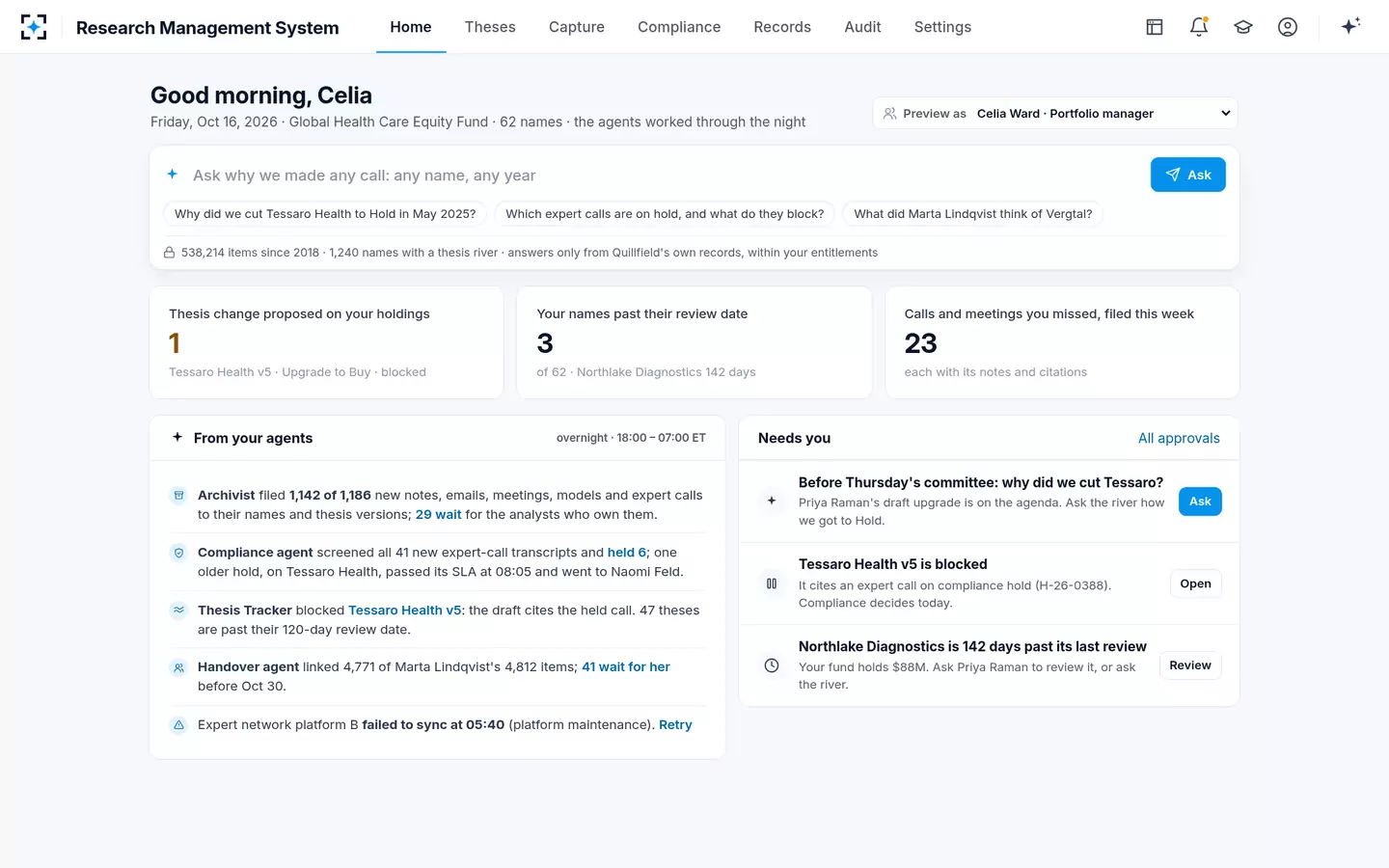
Ask little, answer fast, and protect their work. Ask little: capture from the systems analysts already use and file on their behalf, asking only when unsure. At the sample firm the Archivist filed 1,142 of 1,186 overnight items on its own and asked the analysts about 29; an analyst can confirm a batch with one instruction, such as "Confirm everything at 0.85 or above", and nothing is filed silently below the firm's 0.90 line. The method is set out in the guide to an investment research database whose agents ask.
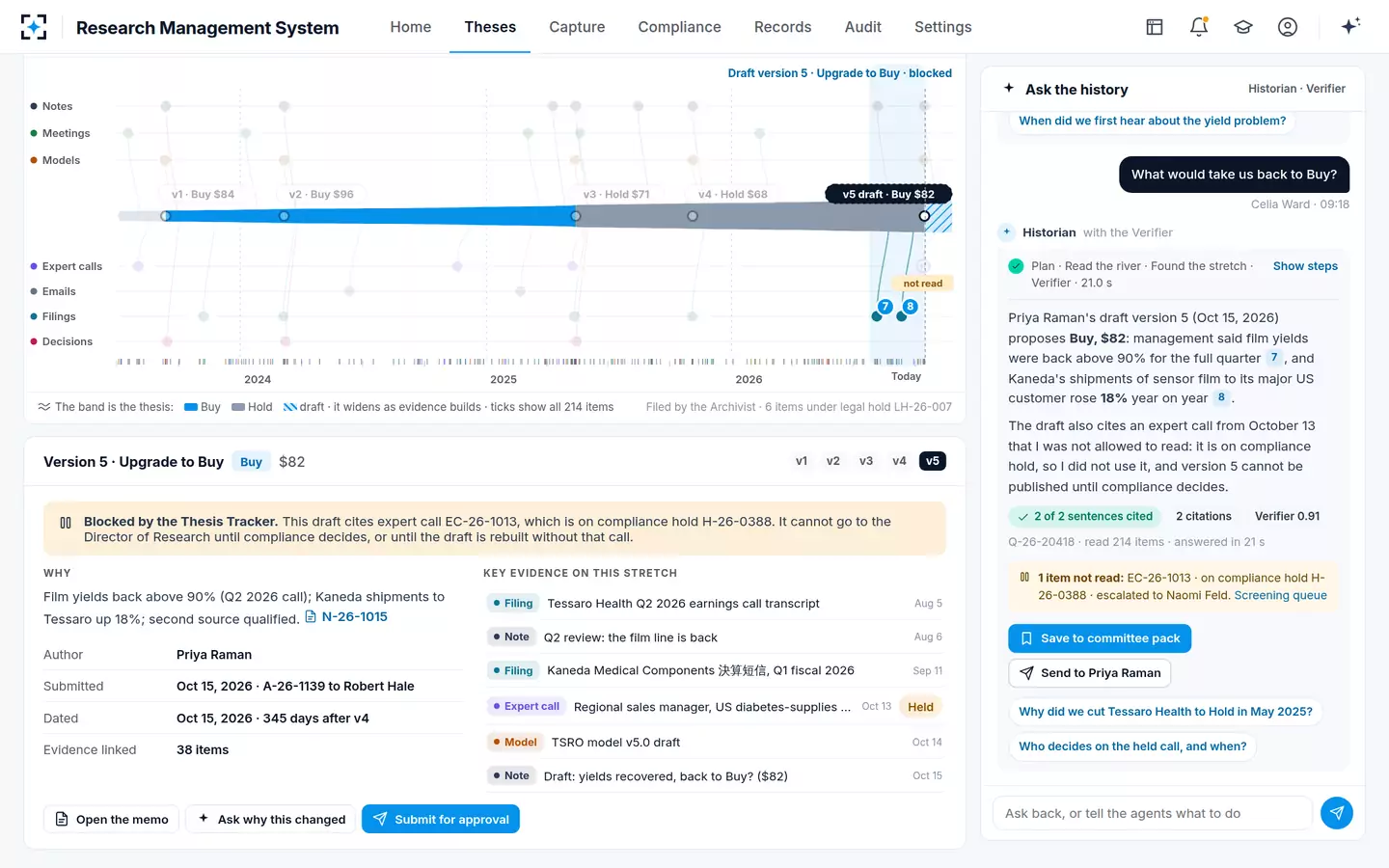
Answer fast: give analysts and portfolio managers something they cannot get elsewhere. The sample firm's portfolio manager asked why the firm cut a stock to Hold in May 2025 and got four sentences with six citations in 38 seconds, from 214 items, every sentence checked by a Verifier that removes what it cannot support. Analysts adopt a system that answers their own questions, including "what did my predecessor think?". Protect their work: the Archivist never edits an author's text, every refiling needs a reason, and a held expert call is visible to compliance only, so an analyst's mistake on a call is handled privately and quickly.
What the sample firm's analysts are asked to do, and what they get back
2.4%
of overnight items sent to analysts to confirm; the rest filed at confidence 0.90 or above
38s
to a cited answer on why the firm cut a stock to Hold, from 214 items
23
calls and meetings a portfolio manager missed this week, filed with notes and citations
99.1%
of a leaver's 4,812 items linked to a thesis version before her last day
How do you migrate old research notes?
Backfill the history before launch, starting with the names analysts cover now, so the first question anyone asks has an answer. A migration that starts empty fails: the system is no use until it holds the past, and analysts will not wait. The sample firm's history runs from 2018 and holds 538,214 items across about 1,240 names, each with a research history built from mail, notebooks, models, calendar entries, documents and expert-call transcripts.
Four sources need care. Notebooks hold the reasoning and the least structure; import them by section, with the author and date, and let the filing agent propose versions for the analyst to confirm. Model stores hold saved versions that become the strongest evidence once linked to decisions. Email archives are large and mostly irrelevant; filter by research mailboxes, covered issuers, portfolio managers and brokers, as the sample firm does. And leavers' material is the most valuable and the most at risk: the sample firm's Handover agent imported a leaving analyst's notebook sections, linked 4,771 of her 4,812 items and listed the other 41 for her to confirm before her last day.
A leaving analyst's 27 names, split between two proposed successors
27 names, 4,812 items
- Proposed for the first successor: 19 names · 70.4%
- Proposed for the second successor: 8 names · 29.6%
Research Management System's home screen: what the agents did overnight, and what needs a person
What should an RMS do?
An RMS should keep the firm's research findable, explicable, compliant and the firm's. In buying terms, that becomes ten questions a director of research and a chief compliance officer can ask together, of any product, on a sample of their own material.
Ten questions to ask of any research management software
- Where does capture come from?
Mail, notebooks, the model store, calendar and CRM, document management, expert-network platforms: which are automatic, and which need the analyst?
- What is an item filed to?
Ticker only, or the thesis version it supported? Who decides, and what happens when the system is unsure?
- Does it keep every model version?
And can it show which cells changed between the versions behind two decisions?
- Can it answer "why did we?" with citations?
Every sentence linked to a page, minute, cell or filing; uncited sentences removed, not hedged.
- What does it do with expert calls?
Screen before the shared library, hold the risky ones, block dependent research, record two-person decisions.
- Are entitlements and information barriers enforced at every read?
Including answers: a question must not reveal what the asker may not see.
- What happens when an analyst leaves?
Items linked before the last day, successors approved, access ended, records kept.
- Is it the books and records, or beside them?
Retention classes, legal holds, disposal with two approvals, and an exam export with hashes.
- Does it read material in its original language?
Foreign filings and notes, with the original beside any translation.
- What does it report about itself?
A failed source, a stale thesis, an agent's confidence: gaps shown, not assumed away.
Where Research Management System fits in a research stack, and where it stops
Research Management System is a research memory and control layer for buy-side teams. It is not a portfolio management or order management system, a market data or broker research platform, a CRM, a trade surveillance tool or a system for publishing research to clients. It reads from several of those, such as ratings, restricted and watch lists and positions from the order management and portfolio accounting systems, and leaves each to do its own job.
Research Management System: what it does, and what stays elsewhere
| Need | Research Management System | Stays with |
|---|---|---|
| Keep notes, meetings, emails, models and expert calls by name and thesis version | Yes: captured overnight, filed by the Archivist, confirmed by analysts when unsure | — |
| Answer "why did we?" with citations | Yes: the Historian answers, the Verifier checks every citation | — |
| Screen expert calls for possible MNPI | Yes: every transcript before the library; compliance decides with two people | Expert-network platforms for booking and expert terms |
| Block research that cites a held call | Yes: the Thesis Tracker blocks the version until compliance decides | — |
| Handovers when analysts leave | Yes: packs per name, successors for the Director of Research to approve | HR system for the leaver notice |
| Retention, legal holds, exam packs | Yes, for the research it keeps | The firm-wide archive and legal hold tool for everything else |
| Ratings, orders, positions, restricted lists | Reads them; puts an issuer on the watch list only by a compliance decision | Order management and portfolio accounting systems |
| Trade surveillance and personal trading | No; supplies call dates and issuers for look-backs | The firm's surveillance and code of ethics systems |
| Market data and broker research | No; filings and transcripts it is given are kept with the research | Data and research vendors |
Trust is the other half of fit. Regulators have been consistent that firms remain responsible for decisions however they are reached: ESMA said in May 2024 that firms' decisions remain the responsibility of management bodies whether taken by people or AI-based tools (ESMA public statement, May 30, 2024), and most UK firms running AI agents in 2026 used them for decision support, with agents recommending and humans deciding (Bank of England and FCA, 2026). The solution is built that way: the agents propose and explain, every answer cites its sources, and hold decisions, thesis versions, handovers, disposals and legal holds each need two different people.
A follow-up answer that says what it could not read
How to measure adoption
Measure what analysts do, not what the system holds. A full archive can hide an abandoned RMS: the email connector keeps filling it whether anyone uses it or not. Five measures tell a director of research the truth. The share of items filed without the analyst, and the share asked, which together show the work the system saves. The time analysts take to clear their queue, which shows whether the questions are good ones. The number of "why did we?" questions asked each week, and by whom, which shows whether the system gives value back. The linking rate for leavers before their last day, which shows whether the firm keeps its reasoning. And the number of research items found outside the system in an annual review, which is the honest test of all the others.
Those measures also connect the RMS to the rest of the research process. How agents and analysts divide the work from first read to published view is the subject of the sibling guide on the equity research process; how the memo at its centre should cite its evidence, of the investment memo template.
Questions people ask
What does RMS stand for in investment management?
Research management system: the software where a buy-side research team keeps its notes, meetings, models, emails and expert calls, organised by name so the firm's reasoning can be found again. Outside finance the same initials are used for records management and for research administration systems in universities and hospitals.
Is OneNote or Evernote enough for investment research?
For one analyst, often yes; for a firm, rarely. Personal notebooks keep the analyst's reasoning but not the firm's: they do not file to decisions, link model versions, screen expert calls, apply retention or survive a departure. Many firms keep the notebook as the analyst's workspace and capture its sections into the RMS.
How long does it take to implement research management software?
It depends mostly on how much history must be backfilled and how many systems must be connected. A sensible plan starts with names under active coverage and their last two or three years, measures the filing agent on known decisions, and extends the backfill once analysts trust the results.
Can an RMS replace the compliance archive?
For research it can, if every item is kept as a books-and-records item with retention classes, legal holds and two-person disposal, as at the sample firm. For the rest of the firm's communications, an enterprise archive is still needed.
Who should own the RMS: research or compliance?
Research should own it, with compliance as a co-owner of the controls. A system owned by compliance tends to become a place analysts avoid; one owned by research without compliance tends to miss expert-call screening, holds and retention. The Director of Research and the chief compliance officer should choose it together.