Material nonpublic information (MNPI) is information about an issuer or its securities that a reasonable investor would consider important in making an investment decision and that has not been disseminated to the market in general. Typical examples are unreleased earnings, sales or order figures, a pending merger, clinical trial results before they are announced, a regulator's decision before it is published, and what a lender or creditors' committee learns about a borrower in a restructuring. For a buy-side research team the risk is not the textbook insider but the side door: an expert on a paid call, a consultant on a committee, a political-intelligence firm, an investor-relations executive on a private call. Botminds' Research Management System exists partly for that door: it reads every expert-call transcript for possible MNPI before it reaches the shared research library and holds the risky ones for compliance.
The legal tests come from the US Supreme Court, the SEC's rules and the UK's market abuse regulation; the examples from SEC press releases, each linked. The transcript passages at the end are from the solution's fictional sample firm.
Six SEC matters, six ways material nonpublic information reached an investment firm
| Route in | What the information was | SEC matter | Outcome |
|---|---|---|---|
| A paid expert | Results of a clinical trial for an Alzheimer's drug, from a doctor chosen to present them who consulted through an expert network | CR Intrinsic, March 15, 2013 | Settled for more than $600 million |
| A political-intelligence firm | A coming decision by the Centers for Medicare and Medicaid Services, from an analyst who "heard from a reliable cms source" | Deerfield Management, Aug. 21, 2017 | Section 204A policy failure; more than $4.6 million |
| Lender groups | Information about companies whose loans sat in collateralized loan obligations the firm traded | Sound Point Capital, Aug. 26, 2024 | Section 204A policy failure; $1.8 million penalty |
| Ad hoc creditors' committees | Information shared with committee members, or analysed by their advisers, about distressed issuers | Marathon Asset Management, Sept. 30, 2024 | Section 204A policy failure; $1.5 million penalty |
| A consultant on a committee | Information from a confidential mediation over Puerto Rico's defaulted bonds, alleged by the SEC | Silver Point Capital, filed Dec. 20, 2024 | Dismissed with prejudice, April 2025 |
| Investor-relations calls | An issuer's internal smartphone sales data, given privately to analysts at about 20 firms before results | AT&T, Regulation FD, Dec. 5, 2022 | $6.25 million penalty on the issuer |
What is material nonpublic information?
US law has no single statutory definition; the two halves come from court decisions and the SEC's practice. Material means there is a substantial likelihood that a reasonable investor would consider the fact important, a standard the Supreme Court set in TSC Industries v. Northway in 1976 and adopted for securities fraud cases in Basic v. Levinson in 1988. Nonpublic means the information has not been disseminated in a way that reaches investors generally. The UK and EU call the same thing inside information: precise information, not yet public, about an issuer or an instrument, that would be likely to move the price significantly if it were made public (UK MAR, Article 7). How fast each market then makes an issuer publish it is compared in ad hoc disclosure rules by market.
The CFA Institute's Standard II(A) turns the definitions into a list. Material information "may include, but is not limited to", information on earnings; mergers, acquisitions, tender offers or joint ventures; changes in assets; new products, trials or discoveries; licences, patents and regulatory approvals or rejections; developments with customers or suppliers, such as winning or losing a contract; changes in management; and a change of auditor (CFA Institute, Standard II(A)). Every item on that list is something an expert, a supplier or a distributor might know before the market does.
What makes information material?
Information is material when there is a substantial likelihood that a reasonable investor would consider it important, and when it would change the overall picture, not merely add a detail to it. The Supreme Court put the second part in words every compliance manual repeats.
There must be a substantial likelihood that the disclosure of the omitted fact would have been viewed by the reasonable investor as having significantly altered the "total mix" of information made available.
TSC Industries, Inc. v. Northway, Inc., 426 U.S. 438 (1976)
For events that may or may not happen, such as merger talks or a trial still running, materiality "will depend at any given time upon a balancing of both the indicated probability that the event will occur and the anticipated magnitude of the event in light of the totality of the company activity" (Basic Inc. v. Levinson, 485 U.S. 224 (1988)). That is why a hint from a scientist that early results look poor can be material even though nothing is certain: a low probability of a very large event can still matter. The CFA Institute adds the practical factors: the specificity of the information, how far it differs from public information, its nature and its reliability.
When does information become public?
Information becomes public when it has been disseminated to the market in general, not when some investors have heard it. The CFA Institute's standard is direct on the point analysts most often get wrong: "a disclosure made to a room full of analysts does not necessarily make the disclosed information 'public'", and information "made available to analysts remains nonpublic until it is made available to investors in general" (CFA Institute, Standard II(A)). A press release, a filing, or a call open to anyone by dial-in or webcast disseminates it. A private conversation with the chief financial officer, a dinner with three portfolio managers or an expert's account of a confidential meeting does not.
For US issuers, Regulation FD backs this up from the issuer's side: a company that gives material nonpublic information to an investment adviser must publish it, at the same time if the disclosure was intentional. The AT&T case in the table is that rule's largest penalty, and what an analyst may hear under Regulation FD is covered in a sibling guide. Regulation FD does not stop the analyst from being exposed: the issuer breaks the rule, and the analyst holds information the firm must now control.
Examples of MNPI from SEC cases
The six matters in the table share one pattern. In none did the firm set out to obtain inside information; it arrived through a research channel the firm had chosen, and the case turned on whether the firm's controls fitted that channel. Four lessons follow, one for each route.
Consultants who are also insiders. In CR Intrinsic the consultant was not a former employee with stale knowledge but a doctor the drug companies had selected to present the trial's final results, who "moonlighted as a medical consultant" for an expert network (SEC 2013-41). The expert's current role, not the network's terms, was the risk. Research vendors who sell access. Deerfield's political-intelligence analyst wrote that he had "heard from a reliable cms source" that a regulation was coming, and the SEC found the firm on notice; its policies relied on an initial review of the vendors and on employees policing themselves (SEC 2017-146).
A business line that creates MNPI. Sound Point traded collateralized loan obligations while its credit business sat in lender groups; it began pre-trade reviews after a 2019 incident but had no written policy for them until July 2022 (SEC 2024-106). Marathon "regularly participated on ad hoc creditors' committees where participants may receive material nonpublic information" without policies for that risk (SEC 2024-158). The same facts can fail in court. The SEC's case against Silver Point over a consultant on a creditors' committee was dismissed with prejudice in April 2025, and the SEC said the dismissal did not necessarily reflect its position elsewhere. A guide should not treat an allegation as a finding.
Is expert network information MNPI?
Usually not, and sometimes very much so; the test is who the expert is and what they say, not the fact of the call. The CFA Institute's standard draws the line with a clinical-trial example: information about trials "from qualified personnel involved in the trials is likely to be material, whereas educated conjecture by subject experts not connected to the trials is unlikely to be material" (CFA Institute, Standard II(A)). The same logic applies to every industry.
Expert calls: what is likely material nonpublic information, and what is likely not
Likely material and nonpublic: Interim results from someone running the trial or the test
Likely part of the mosaic: A physician's view of how a class of drugs performs in practice
Likely material and nonpublic: A current distributor's unreleased quarterly orders for one issuer
Likely part of the mosaic: A former buyer's sense of how the category is trending
Likely material and nonpublic: Unannounced terms of a renewal between the expert's employer and the issuer
Likely part of the mosaic: How pricing usually works in the industry, and who has power in it
Likely material and nonpublic: A decision an agency has made but not yet published
Likely part of the mosaic: An expert's reading of a published proposal and its comment record
Likely material and nonpublic: What a creditors' committee or lender group has been told
Likely part of the mosaic: Analysis of a company's public debt documents
Where the mosaic ends
The mosaic theory lets an analyst combine public information with non-material nonpublic details into a conclusion that would have been material had the company stated it, without breaking the rules. It is the professional basis for channel checks, expert calls and site visits, and the CFA Institute's Standard II(A) endorses it, as the sibling guide on writing an investment thesis you can test explains. The mosaic ends where any single piece is itself material and nonpublic: no amount of public context launders a distributor's unreleased order figure.
The theory also carries a duty to keep the pieces. The analyst who can show which public filings, which conversations and which reasoning produced a conclusion can defend it; the one who cannot is left asserting that the conclusion came from the mosaic. That is why the place a research team stores its notes matters to compliance: an analyst's evidence trail is the firm's defence.
A five-question test for any piece of information
The test runs in the order an analyst meets the problem. Precision first, because most of what experts say is opinion about an industry and needs no further thought. Dissemination second, because a fact in a filing is public however surprising it is. Materiality third, judged by the total mix and, for uncertain events, by probability against magnitude. Then the source: under SEC Rule 10b5-2 a duty of trust or confidence exists, among other cases, "Whenever a person agrees to maintain information in confidence" (17 CFR 240.10b5-2), which describes most consultants and committee members. Last, the decision, which belongs to compliance.
A five-question test for any piece of information an analyst receives
1. Is it precise, about a particular issuer or security?
YesGo to 2.
NoIndustry views, general conditions and an expert's educated conjecture: usually part of the mosaic. Document it and use it.
2. Has it been disseminated to the market in general?
YesPublic: a filing, a release, a broadly accessible call or webcast. Use it.
NoStill nonpublic, even if a room full of analysts heard it. Go to 3.
3. Would a reasonable investor think it important?
YesMaterial: it would alter the total mix. For an event that may not happen, weigh probability against magnitude. Go to 4.
NoNon-material nonpublic detail: a mosaic piece. Record where it came from.
4. Did it come from someone who owes, or is breaching, a duty of confidence?
YesAn insider, a consultant under confidentiality terms, a committee member, a family member: stop. Tell compliance; do not trade or tip.
NoStill stop and ask compliance. Duty questions are for lawyers, and the firm's policy usually treats all material nonpublic information alike.
5. Has compliance decided?
YesAct on the decision: release, release with redaction, restrict, watch-list the issuer.
NoHold the information and everything that cites it until compliance decides.
The fourth question is the one analysts are tempted to answer for themselves, and the one a firm's policy should take away from them. Whether a tip breaches a duty depends on facts the analyst rarely knows, such as what the expert agreed with an employer. Most firms' Section 204A policies therefore treat any piece that passes the first three questions the same way: stop, report, hold.
What happens if you trade on MNPI?
Trading on material nonpublic information in breach of a duty, or tipping someone who trades, can bring a civil penalty of up to three times the profit gained or loss avoided (15 U.S.C. 78u-1), disgorgement and, for wilful violations, criminal fines of up to $5,000,000 and imprisonment of up to 20 years for an individual, and fines of up to $25,000,000 for a firm (15 U.S.C. 78ff). An adviser whose people trade also faces the Section 204A charge for its policies, as Deerfield did, even where the firm itself is not accused of insider trading.
The cheaper failures are the common ones. The SEC's examination staff reported in April 2022 that Section 204A and code of ethics deficiencies were among those it found most often, including employees trading names on their own adviser's restricted list (SEC risk alert, 2022). A firm that cannot show how it handled a piece of MNPI turns a near miss into a finding, which is the subject of the expert network compliance method.
Three passages from one expert call, scored
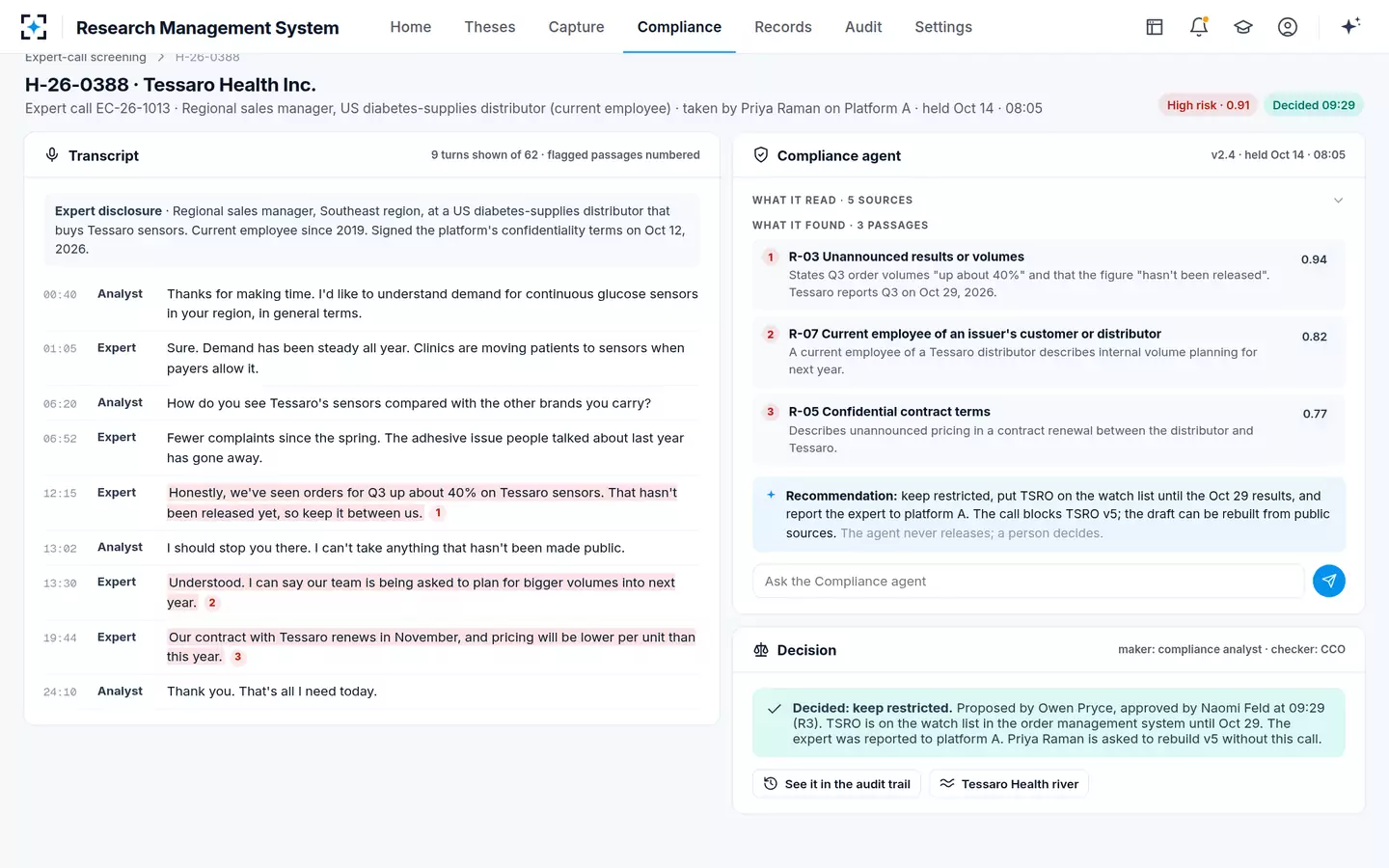
Take a sample call from the solution's fictional firm. An analyst covering a maker of glucose sensors calls a regional sales manager at a US distributor that buys the sensors. Twelve minutes in, the expert says orders for the third quarter are "up about 40%" and that the figure has not been released. The analyst stops him. He goes on to describe his team planning for bigger volumes next year and lower per-unit pricing in a contract renewal. The screening agent read all of it before anyone else could, and scored each passage against the firm's rules.
Research Management System's scores for the three flagged passages, against the 0.50 hold line
Run the passages through the five questions and they fail at every step a reviewer would expect. The order figure is precise, about one issuer, unreleased, the kind of figure the CFA Institute's list of material information puts first, and given by a current employee of a customer who had signed the expert network's confidentiality terms the day before. The compliance analyst proposed keeping the call restricted, putting the issuer on the watch list in the order management system until its results, and reporting the expert to the network; the chief compliance officer approved, and the analyst's draft upgrade, which cited the call, stays blocked until it is rebuilt without it.
The held call, decided: kept restricted, issuer on the watch list until results
Questions people ask
What are examples of MNPI?
Unreleased earnings, revenue or order figures; a merger or financing before announcement; clinical trial or product test results before release; a regulator's unpublished decision; a contract won or lost; a management change; and what a lender or creditors' committee is told about a borrower. The CFA Institute's Standard II(A) lists most of these as typical material information.
Is a rumor material nonpublic information?
A rumor circulating in the market is not usually inside information, because it is neither precise nor from a source owing a duty. A specific statement from a person in a position to know, passed privately, is different even if it sounds like gossip. The CFA Institute treats reliability and specificity as two of the factors that decide materiality.
Does MNPI apply to private companies?
The insider trading rules apply to trading in securities, so information about a private company matters when it is material to a public issuer or to a traded instrument, such as a private supplier's news about a listed customer or a private borrower's loans held in a traded vehicle. Sound Point's case concerned exactly that: information from lender groups about loans held in collateralized loan obligations.
How long does information stay MNPI?
Until it is disseminated to the market in general or stops being material, for example when the event it concerns is abandoned or superseded. Firms usually restrict the issuer until the information is published, such as the issuer's next results, which is why the sample firm's watch-list entry runs until the results date.
Who decides whether information is MNPI at an investment firm?
Compliance, under the firm's Section 204A policies, usually with legal counsel for hard cases. The analyst's job is to stop, report and hold; a firm that leaves the call to the person who wants to use the information has the control the SEC faulted at Deerfield, where employees were left to police themselves.