A good investment memo template has eight parts: the call (rating, target and action), what changed since the last version, the reasons, the numbers that moved, what would prove the call wrong, the portfolio effect, the sources and their compliance status, and the decision with who made it. What separates a template that serves the firm from one that only fills a committee pack is the rule behind the third part: every reason ends in a citation to the note, call, filing page or model cell it rests on. Without that rule, a portfolio manager asking "why did we cut this to Hold?" two years later gets a document that states conclusions, and the real answer sits with the analyst who made the call, until the analyst leaves. Botminds' Research Management System files each memo, model version and expert call to the thesis version it supported, so the memo's citations still resolve after its author has gone.
The worked example uses the solution's fictional sample firm, Quillfield Capital, and its cut of a fictional medical-device maker, Tessaro Health, to Hold in May 2025.
An investment memo template in eight parts, and what each part must link to
1. The call
What to writeRating, target and action, in one line: "Cut to Hold, target $96 to $71; trim the position." The version number and the date.
What it must link toThe previous version it replaces
2. What changed
What to writeThe one or two facts that moved since the last version. If nothing moved, say so: a review that keeps the rating is a decision too.
What it must link toThe new evidence, each item cited
3. The reasons
What to writeThree to five reasons, one sentence each, every sentence ending in a citation.
What it must link toMemo page, call minute, filing page, model cell
4. The numbers
What to writeThe model inputs that moved and the outputs they drive: yield, margin, earnings, target.
What it must link toThe model version and the changed cells
5. What would prove us wrong
What to writeThe observable facts that would reverse the call, and when each will be known.
What it must link toThe calendar: results dates, trial readouts, contract renewals
6. Risks and the portfolio
What to writePosition size before and after, liquidity, correlation with the rest of the book.
What it must link toPositions and the order record
7. Sources cleared
What to writeEvery expert call and private meeting cited, with its compliance status; anything held is named, not used.
What it must link toThe call log and compliance decisions
8. Decision
What to writeWho proposed, who approved, when, and any dissent.
What it must link toThe approval, with both names
What should an investment memo include?
An investment memo should include the recommendation and its terms, the reasons with their evidence, the valuation and the inputs behind it, the conditions that would reverse it, the effect on the portfolio, and the record of who decided. Most templates in circulation cover the first four well, because they are the parts a committee reads on the day. They are weak on the last three, which are the parts a portfolio manager, an auditor or an examiner reads later.
The profession's standards describe what the file behind a memo should hold. The CFA Institute's Standard V(C) asks members to keep records that support their analyses and recommendations, and lists examples: notes from meetings with the company, its press releases and presentations, model outputs and the input parameters behind them, risk analyses and outside research reports (CFA Institute, Standard V(C)). A template that links to those items, rather than summarising them, is a memo and its file in one.
The template, section by section
The call comes first and fits in a line, because a reader scanning a decade of memos needs the verdict before the argument. Give it a version number: a thesis is a series of versions, and "version 3, cut to Hold" says more than a date. What changed is the section most templates omit and the one later readers need most. A memo that restates the whole thesis hides the one fact that moved the rating.
The reasons carry the rule that makes the template work: one sentence each, each ending in a citation to a specific page, minute or cell. A reason without a citation is an opinion and should be labelled as one, as the CFA Institute's Standard V(B) expects members to separate fact from opinion. The numbers name the model version and the cells that changed, not the whole model; the sibling guide on writing a thesis you can test each quarter shows how to tie each pillar to the cell that measures it.
What would prove us wrong turns the thesis into something the firm can check: a yield back above 90%, shipments up again, a contract renewed. Each condition should carry the date it will be known. Risks and the portfolio record the position before and after. Sources cleared lists every expert call and private meeting the memo relies on, with its compliance status; a memo that cites a call still under review should not reach the committee. Decision records who proposed, who approved, and any dissent.
What is an investment committee memo?
An investment committee memo is the version of the memo a committee decides on: the analyst's recommendation, put formally to the people with authority to approve it, with the committee's decision recorded on it or in the minutes. At a buy-side research firm it may approve a new position, a rating change or a model portfolio change; in private markets it approves a deal. The format matters less than two facts about it. It is the document most likely to be asked for later, and it is usually the one most cut off from its evidence, because committee packs are assembled as PDFs from documents that keep changing.
Examiners ask for committees directly. The SEC's typical initial request list for investment advisers includes "Committees (e.g., responsibilities, members, meeting frequency, meeting minutes)" (SEC risk alert, Sept. 6, 2023). A committee memo that links to the version of each model and note it relied on lets the firm answer the follow-up question, which is always what the committee saw.
How long should an investment memo be?
As short as the decision allows, with the depth in the links. No rule sets a length, and committees differ. Our view is that the body of a rating-change memo, sections 2 to 7, fits in one to two pages, and an initiation memo in three to five, because a memo that cites its evidence no longer needs to reproduce it. The length that hurts is the long memo with no citations: it reads as thorough on the day and becomes unverifiable within a year.
A one-page investment memo template works well for reviews that keep a rating. The CFA Institute's Standard V(C) extends the retention duty to reviews that change nothing, as well as to purchases and sales, so the review that changes nothing still deserves a short memo: what was checked, what was found, why the call stands.
How do you document an investment decision?
Write the memo, version it, record who approved it, and keep the evidence it cites in a form that cannot drift. For an SEC-registered adviser three paragraphs of Rule 204-2 make parts of that a legal duty. Communications relating to a recommendation are required records under paragraph (a)(7). Each order memorandum must name the person at the adviser who recommended the trade and the person who placed it, under (a)(3). And where a communication sent to ten or more people recommends a specific security "and does not state the reasons for such recommendation", the adviser must keep "a memorandum of the investment adviser indicating the reasons therefor", under (a)(11)(i)(C) (17 CFR 275.204-2). The reasons, in other words, are a record the rule expects to exist; the full list of what a research desk must keep, and for how long, is in investment adviser recordkeeping requirements, applied to research.
The record that is hardest to keep is the evidence at the time of the decision. A memo that links to "the model" points to whatever the model says today. A memo that links to model version 3.2, saved the evening before the committee, points to what the firm believed. That difference decides whether "why did we?" can be answered, and it is the reason recordkeeping for research has to keep versions, not files.
A worked example: the memo behind a cut to Hold
Take the sample firm's cut of Tessaro Health from Buy to Hold on May 14, 2025, with the target lowered from $96 to $71. The analyst who wrote it left the firm three months later. Seventeen months on, before a committee hears a draft upgrade, the portfolio manager asks why the firm cut the stock. Because the memo cited its evidence, every reason still resolves.
The sample firm's cut to Hold, reason by reason, with the evidence each cites
| Reason in the memo | Evidence | Citation |
|---|---|---|
| Yields on the main supplier's second-generation sensor-film line had fallen to about 70% | Expert call with a former quality director at a film maker: yields "in the low seventies most of the first quarter" | Call of May 9, 2025; cleared by compliance on May 12 with one passage redacted |
| The supplier confirmed the problem in its own results | Shipments of sensor film to its major US customer down 31% year on year | Supplier's earnings summary, page 3 of 18, read in the Japanese original |
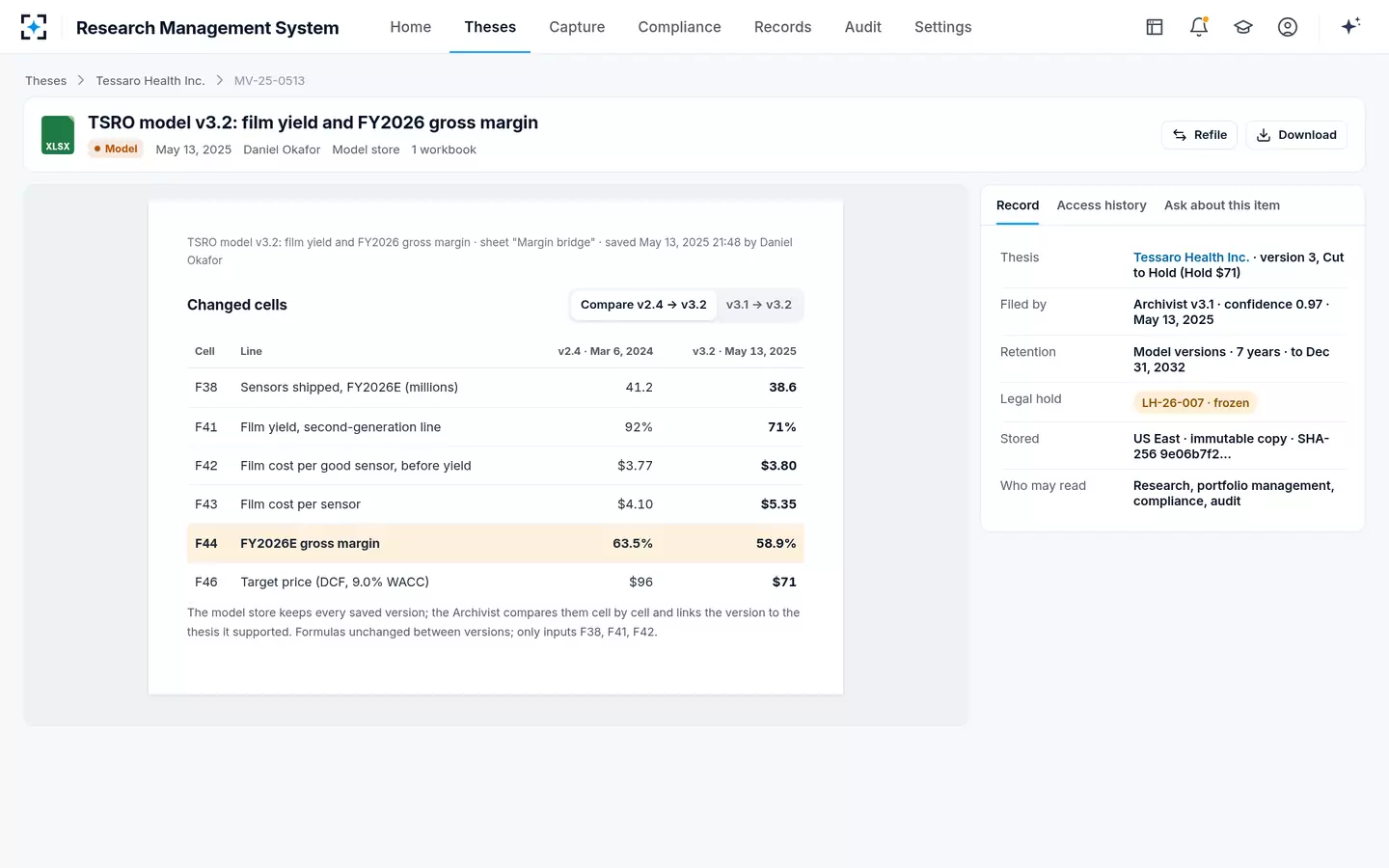
| FY2026 gross margin falls from 63.5% to 58.9% | Film yield input cut from 92% to 71%; film cost per sensor from $4.10 to $5.35 | Model version 3.2, cells F41, F43 and F44 |
| Target cut from $96 to $71 | Discounted cash flow at a 9.0% cost of capital | Model version 3.2, cell F46 |
| The portfolio acted on it | Position trimmed from 4.6% to 3.1% of the fund the next day | Order record, May 15, 2025 |
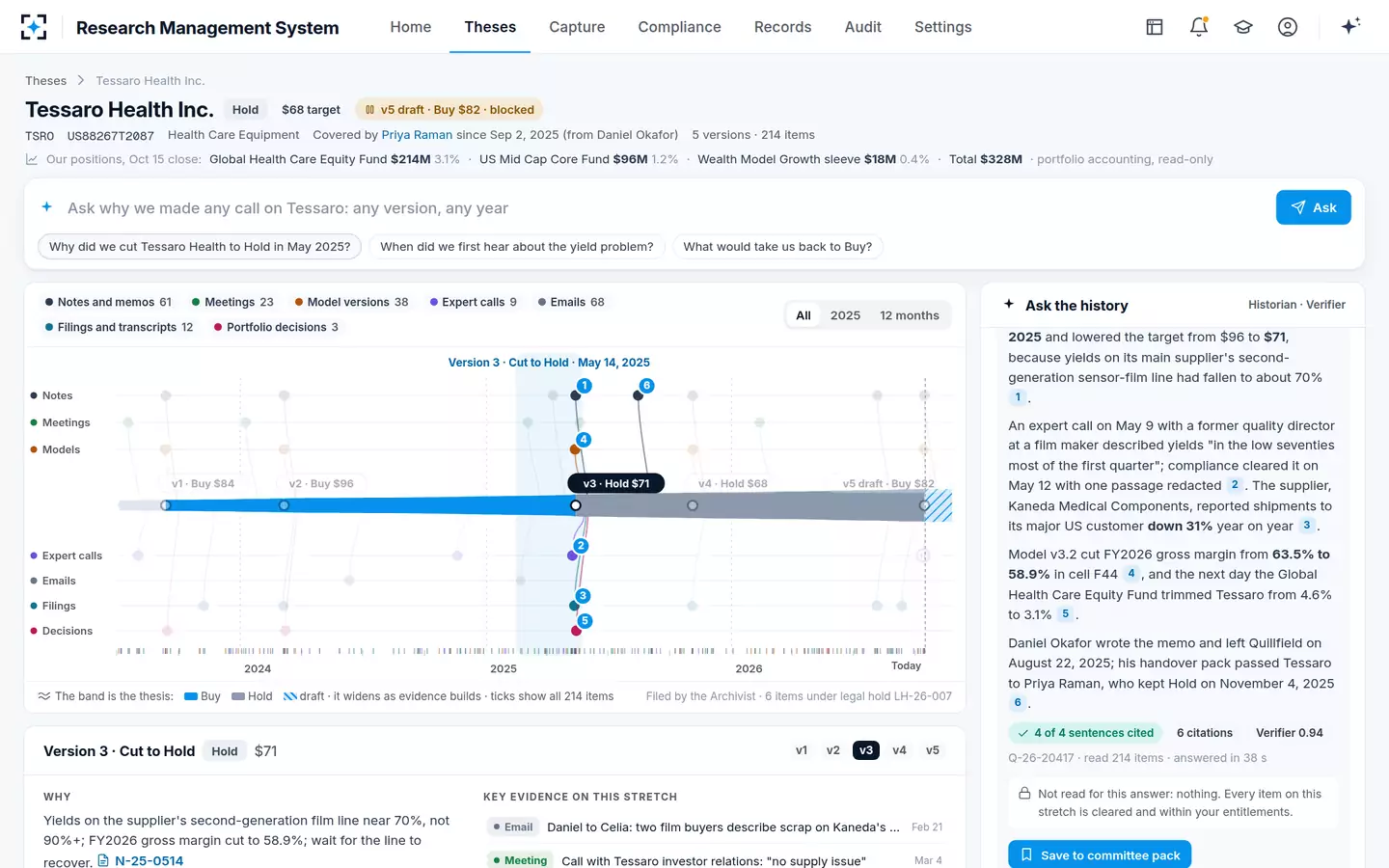
Asked "why did we cut Tessaro Health to Hold in May 2025?", the solution's Historian read the 214 items on the name's research history and answered in four sentences with six citations in 38 seconds; the Verifier checked each citation against its source before the answer appeared. The point is not the speed. It is that the answer is the analyst's own reasoning, in the analyst's own documents, which a template without citations could not have produced.
Research Management System answering “why did we cut it to Hold?” from the memo's own citations
The model version is the citation most memos lose. Here the memo cites version 3.2, and the version shows exactly which inputs moved and which formulas did not, so a reader can tell a change of view from a change of method.
The model version the memo cites: changed cells only
What happens to research when an analyst leaves?
Unless the firm keeps it deliberately, the reasoning goes with the analyst, and the evidence suggests the firm loses more than it thinks. A study of star security analysts found that those who switched employers suffered "an immediate decline in performance that persisted for at least five years", and concluded that "firm-specific skills and firms' capabilities both play important roles" in their performance (Groysberg, Lee and Nanda, Management Science, 2008). Part of an analyst's edge belongs to the firm's information, colleagues and files. The firm keeps that part only if it is written down where the next analyst can find it.
What moves with an analyst, and what stays with the firm
5+years
how long star analysts' performance stayed lower after a move to a new employer
2years
the dip when stars moved between firms of equal capability
0
significant decline for stars who moved with their teams, or to a stronger firm
99.1%
of a departing sample analyst's 4,812 items linked to a thesis version before her last day
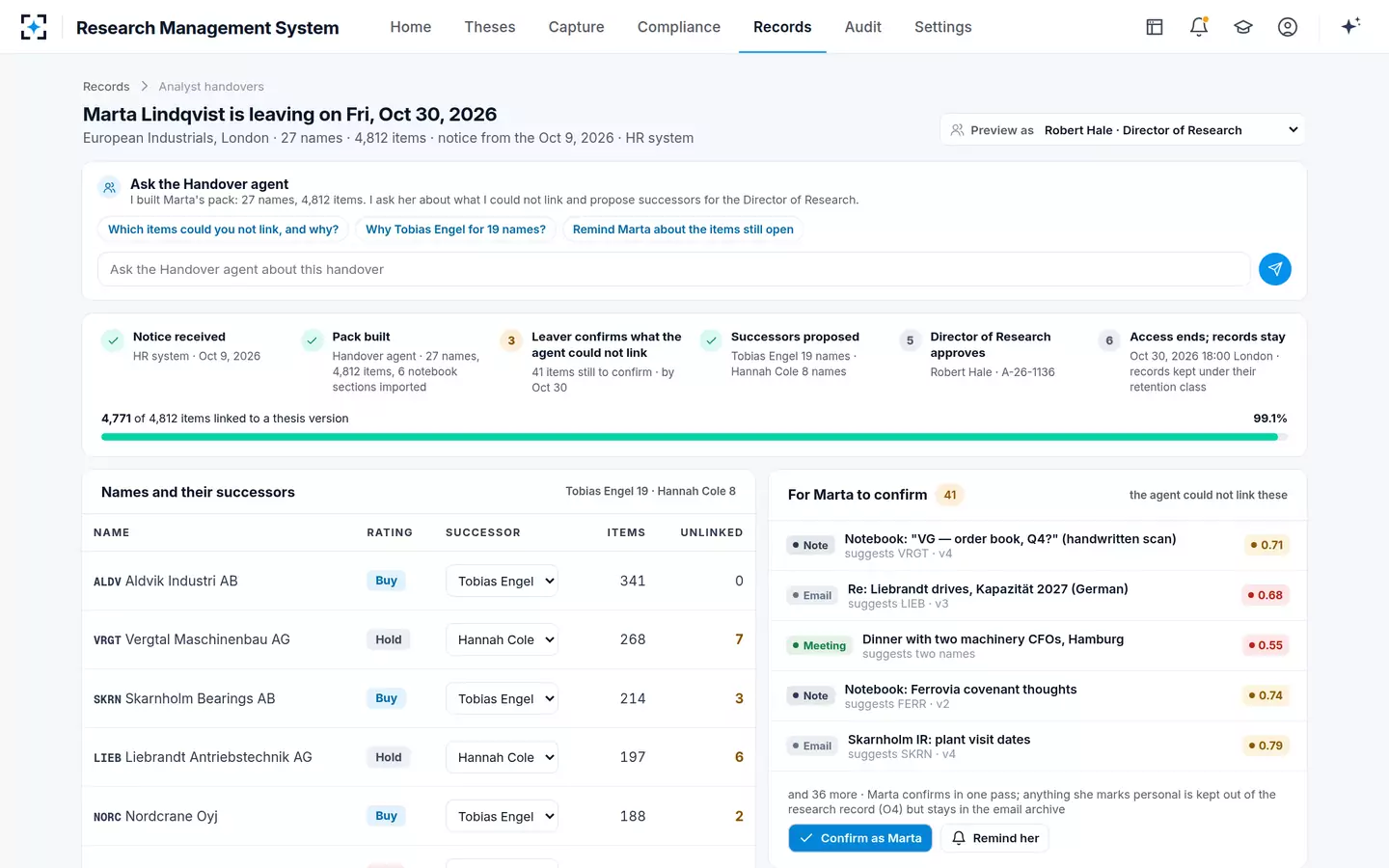
The CFA Institute's Standard V(C) sets the other half of the rule: records an analyst creates for an employer belong to the employer, and a departing analyst may not take them, or reuse old recommendations elsewhere without the supporting documentation. At the sample firm, an analyst leaving on October 30, 2026 had 27 names and 4,812 items; the Handover agent linked 4,771 of them to thesis versions and listed the other 41, such as handwritten notebook pages and meetings with no notes, for her to confirm before she went. Successors were proposed for the Director of Research to approve; her access ends on the last day and her records stay.
A leaver's memos and evidence, linked before the last day
Templates in Word versus memos linked to their evidence
A Word or PowerPoint template is free, flexible and familiar, and with a disciplined team it works. Its weakness is that citations are text: "see model, May" points nowhere precise, and the file it points to keeps changing. A memo written inside a research system that links each citation to a fixed item and version costs more and asks the analyst to work in a new place. Which is right depends on how often the firm needs to answer for old decisions, and how many analysts it loses each year.
An investment memo template in a document, and a memo linked to its evidence
Template in Word or PowerPoint: Typed references to files, emails and models by name and date
Memo linked to its evidence: Links to a specific page, call minute, filing page or model cell and version
Template in Word or PowerPoint: Links point to moved or overwritten files; the model has changed
Memo linked to its evidence: Each citation opens the item as it was on the day
Template in Word or PowerPoint: The memo may cite a call nobody in compliance has read
Memo linked to its evidence: A version citing a held call is blocked until compliance decides
Template in Word or PowerPoint: A PDF assembled by hand, cut off from its sources
Memo linked to its evidence: The memo, its versions and the decision, with both names
Template in Word or PowerPoint: The reasoning is wherever the analyst kept it
Memo linked to its evidence: Items are linked to versions before the last day; the successor inherits the history
Template in Word or PowerPoint: Low; depends on discipline
Memo linked to its evidence: A system to buy and adopt; depends on filing that asks little of analysts
The honest test for a buyer is the question in this guide's title. Pick a rating change from two years ago whose analyst has left, and ask the team to produce the reasons, with the evidence as it stood on the day, within the hour. If they can, the firm's template is working. If they cannot, the next step is choosing research management software analysts will actually use.
Before the memo goes to committee
- The call fits in one line, with a version number
Rating, target, action, and the version it replaces.
- What changed is stated, even if nothing did
A review that keeps the rating names what was checked.
- Every reason ends in a citation
A page, a call minute, a filing page or a model cell; an uncited sentence is marked as opinion.
- The model is cited by version and cell
Not "the model", which will change tomorrow.
- Break conditions carry dates
What would reverse the call, and when each fact will be known.
- Every expert call and private meeting is cleared
Nothing under compliance review is cited; anything held is named and left out.
- The decision records both names
Who proposed, who approved, and any dissent.
Questions people ask
What is the difference between an investment memo and an investment thesis?
The thesis is the argument for owning or avoiding a security, tested over time; the memo is the document that records one decision under it, such as an initiation, a rating change or a review. A thesis runs through many memos, which is why versioning them matters.
How do you write an investment memo?
Start with the call and what changed, then give three to five reasons, each ending in a citation to its evidence; add the numbers that moved, what would prove the call wrong and the portfolio effect; list every expert call and private meeting relied on with its compliance status; and record the decision. Write the body last and short, because the citations carry the detail.
Is there a one-page investment memo template?
Yes: the eight sections above fit on one page for a review or a small rating change if each section is one or two sentences and the citations do the work. Initiations usually need more room for the business, the valuation and the risks.
Do investment advisers have to keep investment memos?
A memo sent to a portfolio manager or committee that relates to a recommendation is a written communication under Rule 204-2(a)(7), kept at least five years from the end of the fiscal year, the first two in an appropriate office. Firms usually keep all memos for longer under their own research retention class.
What happens to an analyst's memos when they leave?
They stay with the firm: the CFA Institute's Standard V(C) treats records created for an employer as the employer's property. The risk is not that the memos leave but that their evidence becomes impossible to find; linking every item to its thesis version before the last day keeps it findable.