Legal hold software is the tool a legal or compliance team uses to place a preservation hold, also called a litigation hold, on the records relevant to a lawsuit, an investigation or a regulator's inquiry: it records the scope, tells the people who hold the data, tracks their acknowledgement and stops the systems that would otherwise delete matching records on schedule. The reason to buy it is that a retention schedule, however well kept, is a machine for deleting records, and once a duty to preserve arises the machine has to stop for exactly the right records and no others. Investment research is a hard case, because the record behind one decision sits in notebooks, model versions, inboxes, chat and an expert network's transcripts. Botminds' Research Management System keeps those items in one store, applies a legal hold to them at the source, and never deletes anything on its own.
The examples come from the solution's fictional sample firm. The law is US federal: the Federal Rules of Civil Procedure and the criminal code, with the SEC's recordkeeping rules alongside. Nothing here is legal advice.
A legal hold on research, from trigger to release
A person decides
General counsel or CCODecides a duty to preserve has arisen, and sets the scope: names, people, dates, sources, and the matter it serves.
Agent
Records KeeperApplies the hold to every item in scope, whatever its retention class, and marks it frozen on the item itself.
Never: Deletes anything
Agent
Records KeeperLeaves held items out of every disposal batch it proposes, including items whose retention period has ended.
Never: Proposes a held item for disposal
A person decides
Records manager and CCOApprove any disposal batch, two signatures, with held items already excluded.
A person decides
Counsel, then a second approverRelease the hold when the matter ends; items return to their retention class and their normal clock.
What is legal hold software?
Legal hold software manages the preservation duty that arises when a firm reasonably anticipates litigation or an investigation. The category typically does four things: it records each hold's matter, scope and dates; it sends preservation notices to the people who hold relevant data (the custodians) and tracks their acknowledgements and reminders; it records interviews about where else data might live; and it connects to the systems that store data, so routine deletion stops for anything in scope. The output that matters in court is not the notice but the proof: who was told what, when, and which records were in fact kept.
A legal hold tool is not an archive, and an archive is not a legal hold. The tool knows what must be kept but holds little of it; the archive holds the data but needs to be told what to freeze. For research, the second half is where holds fail, because the research is spread across systems that were never designed to stop deleting on instruction.
What is the difference between a legal hold and a retention policy?
A retention policy says how long a class of records is kept before it may be destroyed; a legal hold says that particular records may not be destroyed, whatever the policy says, until the hold is released. The retention policy runs on a clock and applies to everyone; the hold runs on an event and applies to a defined scope. When the two conflict, the hold wins.
Legal hold versus retention policy, for a research archive
Retention policy: Regulation and business need: Rule 204-2's five years, the firm's own seven, the audit trail's ten
Legal hold: A duty to preserve: litigation reasonably anticipated or under way, an investigation, a regulator's inquiry
Retention policy: A class of records: research notes, model versions, emails relating to recommendations
Legal hold: A scope: these issuers, these people, these dates, these sources, across every class
Retention policy: A fixed period from a set date, such as the end of the fiscal year of the last entry
Legal hold: Until released, however long the matter takes
Retention policy: Records become eligible for disposal, usually in approved batches
Legal hold: Records return to their retention class and its clock
Retention policy: Keeping too little, or deleting before the period ends
Legal hold: A routine deletion that nobody switched off
When does the duty to preserve start?
When litigation is reasonably anticipated, not when the complaint is served. Rule 37(e) of the Federal Rules of Civil Procedure applies to electronically stored information "that should have been preserved in the anticipation or conduct of litigation" (FRCP 37(e)). The Advisory Committee's note to the 2015 amendment tells courts to "consider the extent to which a party was on notice that litigation was likely and that the information would be relevant", and warns that the events which alert a party often give "only limited information" about the eventual case. A demand letter, a regulator's request, an internal complaint or a sharp loss on a position can each start the clock.
The note also says what a court may weigh besides the lawsuit itself. Courts "may sometimes consider whether there was an independent requirement that the lost information be preserved", arising from "statutes, administrative regulations, an order in another case, or a party's own information-retention protocols". For an investment adviser that list includes Rule 204-2, so research records the rule required the firm to keep are records whose loss is hard to explain in any forum.
What happens if you delete records under a legal hold?
In civil litigation, a court that finds lost electronically stored information prejudiced the other side may order "measures no greater than necessary to cure the prejudice"; if it finds the party "acted with the intent to deprive another party of the information's use", it may presume the information was unfavourable, instruct the jury that it may or must presume so, or dismiss the action or enter a default judgment (FRCP 37(e)(1)–(2)). The rule applies only if the information cannot be restored or replaced through other discovery, which is why a duplicate copy is often what saves a party.
In a federal investigation the stakes are criminal. Since the Sarbanes-Oxley Act of 2002, anyone who knowingly destroys or alters a record "with the intent to impede, obstruct, or influence the investigation or proper administration of any matter within the jurisdiction of any department or agency of the United States", or in contemplation of one, can be imprisoned for up to 20 years (18 U.S.C. 1519). An SEC inquiry is such a matter. The routine deletion that ran after a hold should have stopped is the case every legal team fears, because intent is argued from what the firm knew and did not do.
What holds look like on the sample firm's research records
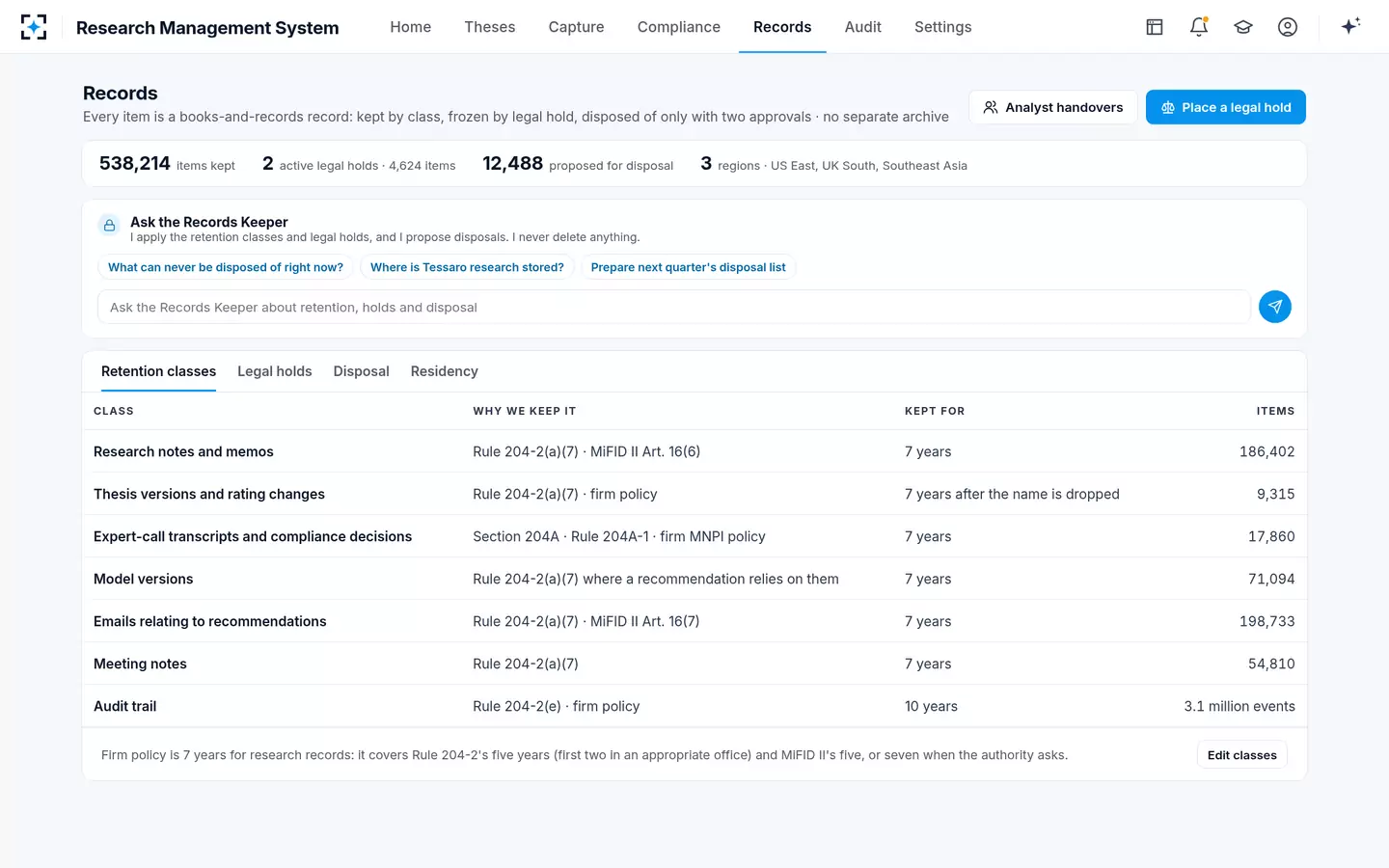
2
active legal holds on research
4,624
items frozen by those holds, across notes, models, mail and calls
12,488
items proposed for disposal, none of them under a hold
0
items the Records Keeper has deleted: disposal needs two people
Why research records are the hard case
Research is hard to hold for three reasons a general legal hold tool does not see. The first is versions. A model saved over itself every week holds only its latest state; a hold placed today cannot recover what the model said on the day the rating changed. Preserving research means preserving each saved version, which the firm should be doing anyway as part of versioning its own models.
The second is the channels that delete by design. The SEC's examination staff, in a December 2018 risk alert, described firms that prohibited business use of apps that allow "automatic destruction of messages", and required staff to move messages received on prohibited channels to a system that meets the books and records rules (SEC risk alert, Dec. 14, 2018). A hold cannot freeze what a disappearing-message app has already erased. The third is the third parties: expert-call transcripts often live first on the expert network's platform, notebooks in a synced application, and data with vendors. The 2015 committee note accepts that reasonable steps, not perfection, are required, but says courts may assess "the extent to which a party knew of and protected against" risks such as a failed cloud service.
Leavers make all three worse. An analyst's departure usually triggers account deletion on a schedule, and the analyst's notebooks, mailbox and model folders go with it unless someone intervenes. The committee note puts it in one line: the prospect of litigation "may call for reasonable steps to preserve information by intervening in that routine operation". A research system that keeps a leaver's records while ending their access removes the most common routine deletion of all.
How long does a legal hold last, and who can release it?
A legal hold lasts until the duty to preserve ends: the litigation is over and any appeal or related matter resolved, the investigation closed, or counsel otherwise decides the records are no longer needed for the matter. There is no fixed term, and a hold routinely outlasts the retention period of the records it covers; a research memo whose seven-year class expires in 2032 stays as long as the hold does. When a hold is released, the records return to their retention class, and those already past their period become eligible for disposal under the normal approvals.
Release belongs to legal counsel, because only counsel can judge whether related claims or inquiries are still possible. Good practice requires a second approver and a record of the reason, for the same reason a disposal needs two people: the step cannot be undone. At the sample firm legal holds, like disposals, are decided by one person and approved by another, and the decision is on the audit trail with both names. Keeping that trail is itself part of what the SEC expected when it said, adopting the compliance rule in 2003, that an adviser's policies should address records' protection "from untimely destruction" (Release IA-2204).
Research Management System: books and records, with holds and disposal in one place
What to ask of legal hold software
The best legal hold software is the one that can prove, after the fact, that every relevant record survived. For a firm whose exposure runs through research, ten questions separate a tool that tracks notices from a set-up that actually preserves.
Legal hold software: ten questions for a research-heavy firm
- Does the hold reach the data, or only the custodians?
A notice asks people to keep things; a hold applied in the archive keeps them whatever people do.
- Which of our research sources does it reach?
Notebooks, model stores, email, chat, calendar and CRM notes, expert-network transcripts, document management. Name the ones it cannot.
- Does it keep every version?
A hold on the latest workbook is a hold on the wrong record.
- Does it stop scheduled disposal by scope?
By issuer, person, date range and source, across every retention class, with held items excluded from every batch automatically.
- What happens when an employee leaves?
Access ends; records stay. Account deletion must not run on a held custodian.
- Can it see its own gaps?
A failed sync with a third-party platform should be reported as a gap in the record, with the time it started.
- Who can place and release a hold?
Named roles, two people for release, a reason code, and the attempt by anyone else refused and logged.
- Can it show what was frozen, when?
An item-level history: placed, frozen, released, by whom, with hashes that prove the record did not change.
- Does it respect information barriers?
A hold must not make restricted research readable to people outside the wall, including the legal team's reviewers, without a decision.
- Can we export a defensible set?
Items, versions, access history and decisions, with a manifest, in a form counsel or an examiner can use.
Where Research Management System fits, and where it does not
Research Management System is not a firm-wide legal hold tool, and a firm that needs custodian notices across trading, operations and HR should keep or buy one. What it does is make the research half of a hold reliable. Every note, meeting, model version, email and expert call it captures is a record in one store; a hold freezes the items in scope at the source; the Records Keeper never deletes and never proposes a held item for disposal; and an export pack, built for an examiner and usable by counsel, carries items, versions, access events and decisions with a SHA-256 manifest. The table sets the division of labour out plainly.
Who does what in a legal hold on research
| Task | Legal hold tool | E-discovery review platform | Research Management System |
|---|---|---|---|
| Decide scope, issue notices, track acknowledgements | Built for it | Sometimes | No; the legal team's tool |
| Freeze research items and every saved version at the source | Through connectors, where they exist | After collection | Yes, for the research it captures |
| Stop scheduled disposal for held items | By instruction to each system | No | Yes; held items are never proposed for disposal |
| Keep a leaver's research while ending access | Through HR and IT workflows | No | Yes, through the handover |
| Report gaps, such as a failed sync with a platform | Varies | No | Yes, on the capture screen |
| Review, redact and produce to the other side | No | Built for it | Exports a hashed pack for counsel's platform |
| Hold mail, chat and files outside research | Through connectors | After collection | No; outside its scope |
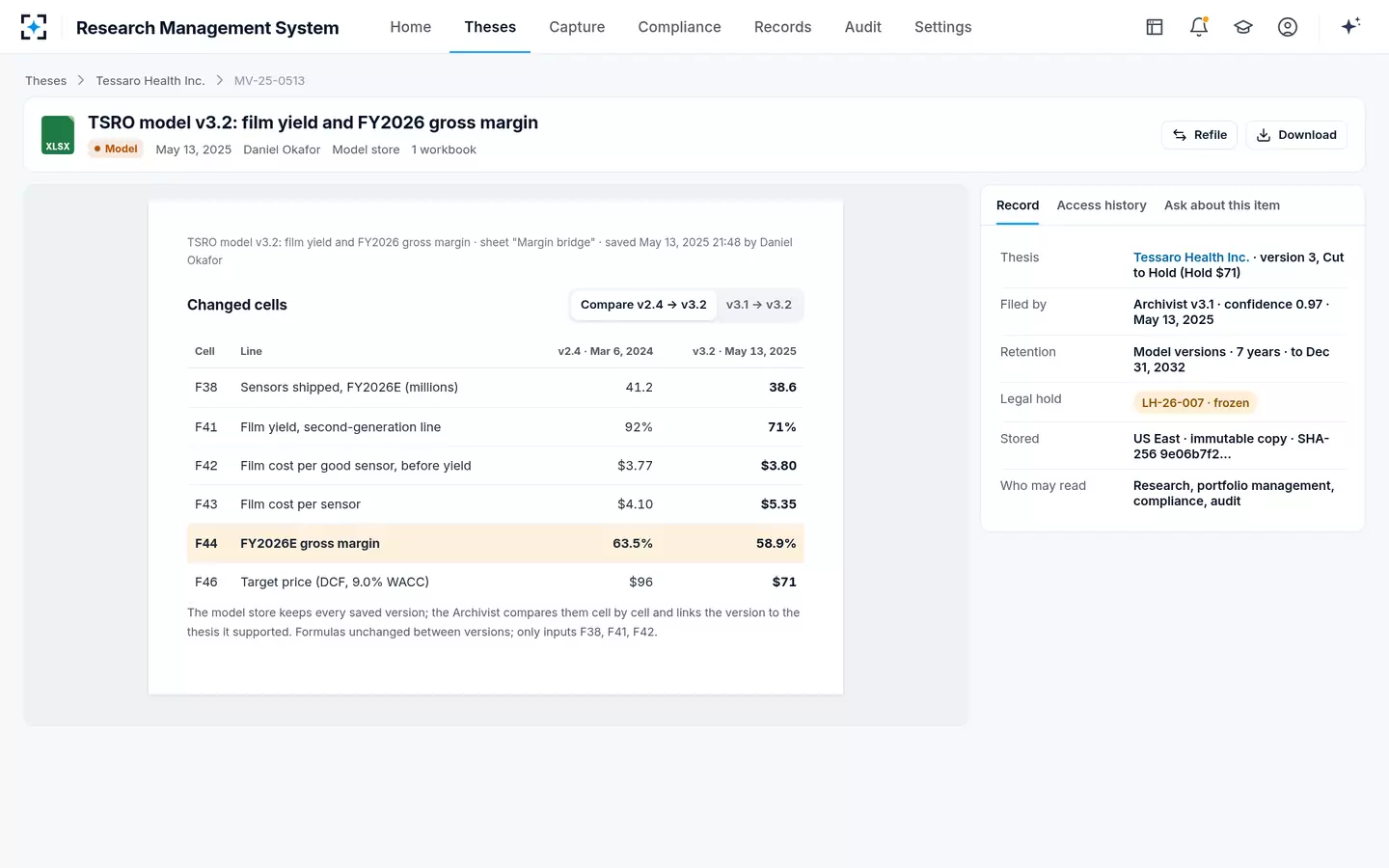
The fit is narrow and deliberate. The solution keeps research and its decisions; it does not replace the firm's mail archive for the rest of the business, its trade surveillance, or counsel's review platform. Where it helps most is the place holds most often fail in an investment firm: the model version, the expert call and the analyst who left. A held item shows its status on its own page, so an analyst opening the model behind a rating change sees that it is frozen and why.
A held model version: frozen by the hold, past or not past its retention date
The adviser's books and records duties and a legal hold meet in the same records, which is why the investment adviser recordkeeping requirements and the hold should be run from one schedule. When the request comes from the SEC rather than a court, the exam request list sets what the firm must produce and how fast.
Questions people ask
Does a legal hold apply to research notes?
Yes, if they are within the hold's scope: a hold covers relevant information in any form, including analysts' notebooks, drafts, model versions and chat, whether or not Rule 204-2 required the firm to keep them. Research notes are often the most relevant records in a dispute about an investment decision, because they show why it was made.
What is a legal hold notice?
A written instruction from legal counsel to the people who hold relevant data, telling them that a duty to preserve applies, what it covers and what not to delete, and asking them to confirm. A notice is necessary but not sufficient: courts look at whether the firm also took reasonable steps to stop routine deletion in its systems.
Is a legal hold the same as a litigation hold?
Yes. The terms are used interchangeably, and preservation hold is a third name. Some firms reserve "litigation hold" for court cases and use "legal hold" for any matter, including regulatory inquiries and internal investigations.
Does an SEC investigation require a legal hold?
A firm that learns of an SEC investigation or receives a subpoena should preserve the relevant records at once, because destroying records in contemplation of a federal investigation can be a crime under 18 U.S.C. 1519. In practice, firms place a hold as soon as they receive an inquiry and widen it as the scope becomes clear.
Can records under a legal hold be deleted when their retention period ends?
No. The hold overrides the retention period until it is released, and a well-built archive leaves held items out of every disposal batch automatically. After release, the records return to their retention class and are disposed of only through the normal approvals.
What does Rule 17a-4 have to do with legal holds?
Rule 17a-4(f) sets broker-dealers' electronic records standard: storage that cannot be rewritten or erased, or a time-stamped audit trail that can re-create an original after any change (17 CFR 240.17a-4). Either makes a hold easier to prove, because the record's integrity does not depend on people following the notice. Advisers are not bound by it but often use it as their benchmark.