Expert network compliance is the part of an investment adviser's Section 204A program that governs paid conversations with industry experts: who may be called, what may be discussed, how each call is logged, who reads what was said, and what happens when an expert says something that may be material nonpublic information. The SEC's Division of Examinations named the gaps in its April 26, 2022 risk alert: advisers that did not track and log calls with expert network consultants, did not review detailed notes from the calls, and did not review their people's trading in related securities. The method that answers those findings has four verbs, log, read, hold and decide, and the hard one is read, because a team taking dozens of calls a week cannot read every transcript by hand. Botminds' Research Management System reads every expert-call transcript before it reaches the shared research library, holds the risky ones, and leaves the decision to two people in compliance.
The figures in the worked example come from the solution's fictional sample firm over twelve months; the rules and findings are the SEC's, the CFA Institute's and the courts', linked where they appear.
Expert network compliance in one flow: log, read, hold, decide
A person decides
AnalystTakes the call on an approved expert-network platform; the expert's disclosed employment and the transcript arrive with it.
Never: Files a transcript to the shared library unscreened
Agent
Compliance agentReads the full transcript first, against the expert's employment, the lists and the issuer's results calendar; any flag at 0.50 or above holds the call.
Never: Releases a held call
A person decides
Compliance analystReads the flagged passages and the rule each hit, and proposes a decision with a reason code: release, release with redaction, or keep restricted.
Never: Approves his own proposal
A person decides
Chief compliance officerApproves or returns the proposal; may put the issuer on the watch list until results and report the expert to the network.
Agent
Thesis TrackerBlocks any thesis version that cites a held call until compliance decides, and tells the analyst to rebuild without it.
Never: Publishes a rating change
What is expert network compliance?
Expert network compliance is the set of written policies, pre-call checks, monitoring and records that keeps paid expert consultations from becoming a channel for material nonpublic information. The SEC's examination staff describe an expert network simply as "a group of professionals who are paid for their specialized information and research services" (SEC risk alert, April 26, 2022). The legal duty behind the program is Section 204A of the Advisers Act, which requires every adviser to have written policies and procedures, fitted to the nature of its business, to prevent the misuse of material nonpublic information by the firm or anyone associated with it (15 U.S.C. 80b-4a).
For a firm that uses expert networks, that duty turns into four practical questions. Is every call known to compliance before or when it happens? Does someone who understands MNPI read what was said? Can a risky call be stopped before its content spreads into notes, models and committee papers? And is each decision recorded with who made it and why? A program that answers yes to the first and no to the other three is a log, not a control.
Do expert network calls create MNPI risk?
Yes, because the people most worth calling are often the people closest to the information. A former procurement lead knows how buyers think; a current employee of a customer or distributor may know next quarter's orders. The CFA Institute's Standard II(A) allows members to pay experts for their insights, but says members "are ultimately responsible for ensuring that they are not requesting or acting on confidential information received from external experts" (CFA Institute, Standard II(A)). Its two worked examples draw the line: an analyst who learns about cancer therapies from treating physicians is using the network properly; an analyst who hears a scientist's disappointment with a semiconductor still under test, and passes it on before the fund sells, has violated the standard.
The SEC's largest insider trading settlement turned on the same line. In March 2013 CR Intrinsic agreed to pay more than $600 million, including disgorgement of $274,972,541 and a penalty of the same amount, over trading ahead of results from a clinical trial for an Alzheimer's drug. The SEC said the doctor who passed the information was selected by the drug companies to present the final trial results, and tipped the portfolio manager through calls arranged by "a New York-based expert network firm for which Dr. Gilman moonlighted as a medical consultant" (SEC press release 2013-41). The CFA Institute's standard draws the lesson for analysts: an analyst cannot rely on the agreements experts sign, and must judge what was actually said.
What does the SEC say about expert networks?
The clearest statement is the Division of Examinations' risk alert of April 26, 2022, on investment adviser MNPI compliance issues. It said deficiencies under Section 204A and the code of ethics rule "have been among the most commonly observed" by the examination staff, and listed three expert-network gaps: advisers that did not appear to have or implement adequate policies on "tracking and logging calls with expert network consultants", on "reviewing detailed notes from expert network calls", and on "reviewing relevant trading activity of supervised persons in the securities of publicly traded companies that are in similar industries as those discussed during calls" (SEC risk alert, April 26, 2022).
The same alert reported parallel gaps for alternative data, where advisers "could not demonstrate, such as by producing documentation" that their policies had been consistently implemented, and for "value-add investors" such as executives and fund managers who invest with the adviser. A risk alert is a staff statement, not a rule, and says so. It is also the closest thing to a checklist an examiner will bring, which is why the research file an examiner asks for should be able to show each call, each review and each decision.
Twelve months of expert-call screening at the sample firm
2,140
expert-call transcripts screened, every one, before the shared library
63
held for compliance: 2.9% of calls
1.4days
median business days from hold to decision
0.50
confidence at which any single flag holds a call
What is Section 204A, and what does it ask of a call program?
Section 204A is the Advisers Act provision, added in 1988, that obliges every adviser to establish, maintain and enforce written policies against the misuse of material nonpublic information, taking into account the nature of its business. The SEC's examiners read it as applying to "all investment advisers, registered and unregistered" (SEC risk alert, 2022). It does not mention expert networks. It asks instead that the policies fit the business, which is why an adviser that relies on experts has to address them and an adviser that never calls one need not.
The SEC has brought Section 204A cases without alleging that anyone traded on inside information: the charge is that the policies did not fit the ways information reached the firm, through political-intelligence consultants, lender groups or creditors' committees. Those cases, and how a restricted list turns 204A into a working control, are covered in a sibling guide. The code of ethics rule, Rule 204A-1, adds the personal side: analysts who make or see nonpublic recommendations are access persons who report their holdings and transactions (17 CFR 275.204A-1), which is what makes the trading look-back possible.
The method: before, during and after a call
A method that answers the examiners' three findings works in three phases. Before the call, the firm knows who the expert is and whether the topic is safe. During the call, the analyst knows where the line is and stops the expert who crosses it. After the call, someone other than the analyst reads what was said before it travels, and decides.
Before. Calls go only through approved networks, under the firm's written terms. Each request names the issuer or industry and the expert's current and recent employers, so compliance can refuse a current employee of a covered company, a consultant on a pending deal or an expert at a customer of an issuer in its quiet period. Many firms also block calls about an issuer in the weeks before its results; the sample firm flags any call within 15 days of an issuer's results.
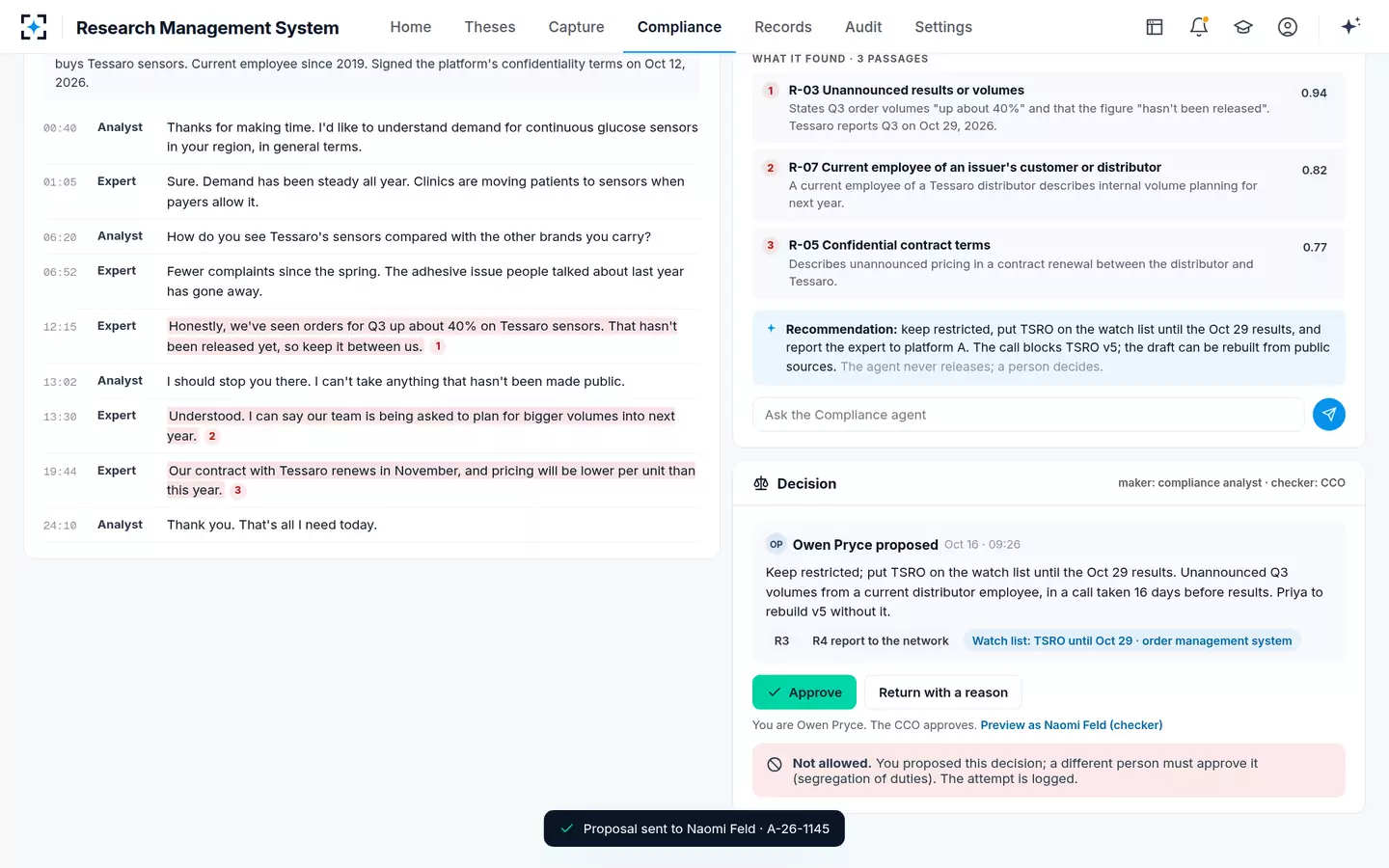
During. The analyst opens with the firm's reminder that the expert must not disclose confidential information, and stops a call that drifts. In the sample firm's held call, the analyst did exactly that ("I should stop you there. I can't take anything that hasn't been made public"), and the expert went on to describe internal volume planning and unannounced contract pricing anyway. A good analyst is a control; a transcript shows whether the control held.
After. Every transcript is read before it reaches the shared library, notes and models that depend on it are traceable, a risky call is held so that nothing built on it moves forward, and the decision is made by compliance with a reason. The firm's surveillance then compares access persons' trading and the fund's trading in the issuer and its industry against the call dates, which is the third finding in the 2022 alert.
Sampling transcripts versus reading every one
Sampling is how most compliance teams have managed volume, and it leaves a gap the examiners named: a call no one reviewed is a call the firm cannot show it controlled. If a team samples one transcript in ten, nine of every ten risky calls reach the library unread, and the one the firm later has to explain is rarely the one it sampled. Reading every transcript by hand is the alternative, and at two to three thousand calls a year it is a full-time job for several people.
Expert network compliance by sampling, and by screening every call
Sampling transcripts by hand: A share of calls, chosen by rule or at random; the rest reach the library unread.
Every transcript screened before the library: All calls; a call cannot be filed to the shared library until it has been screened.
Sampling transcripts by hand: Often days or weeks after the call, when notes and models already use it.
Every transcript screened before the library: Before anyone but the analyst who took it sees the content.
Sampling transcripts by hand: The whole transcript, read from the top.
Every transcript screened before the library: The flagged passages, the rule each hit, the expert's disclosed employment and the issuer's results date.
Sampling transcripts by hand: Usually nothing until someone notices.
Every transcript screened before the library: Any thesis version citing a held call is blocked until compliance decides.
Sampling transcripts by hand: A sampling log, and the calls that were read.
Every transcript screened before the library: Every call, its screening result, the decision, both names and the reason code.
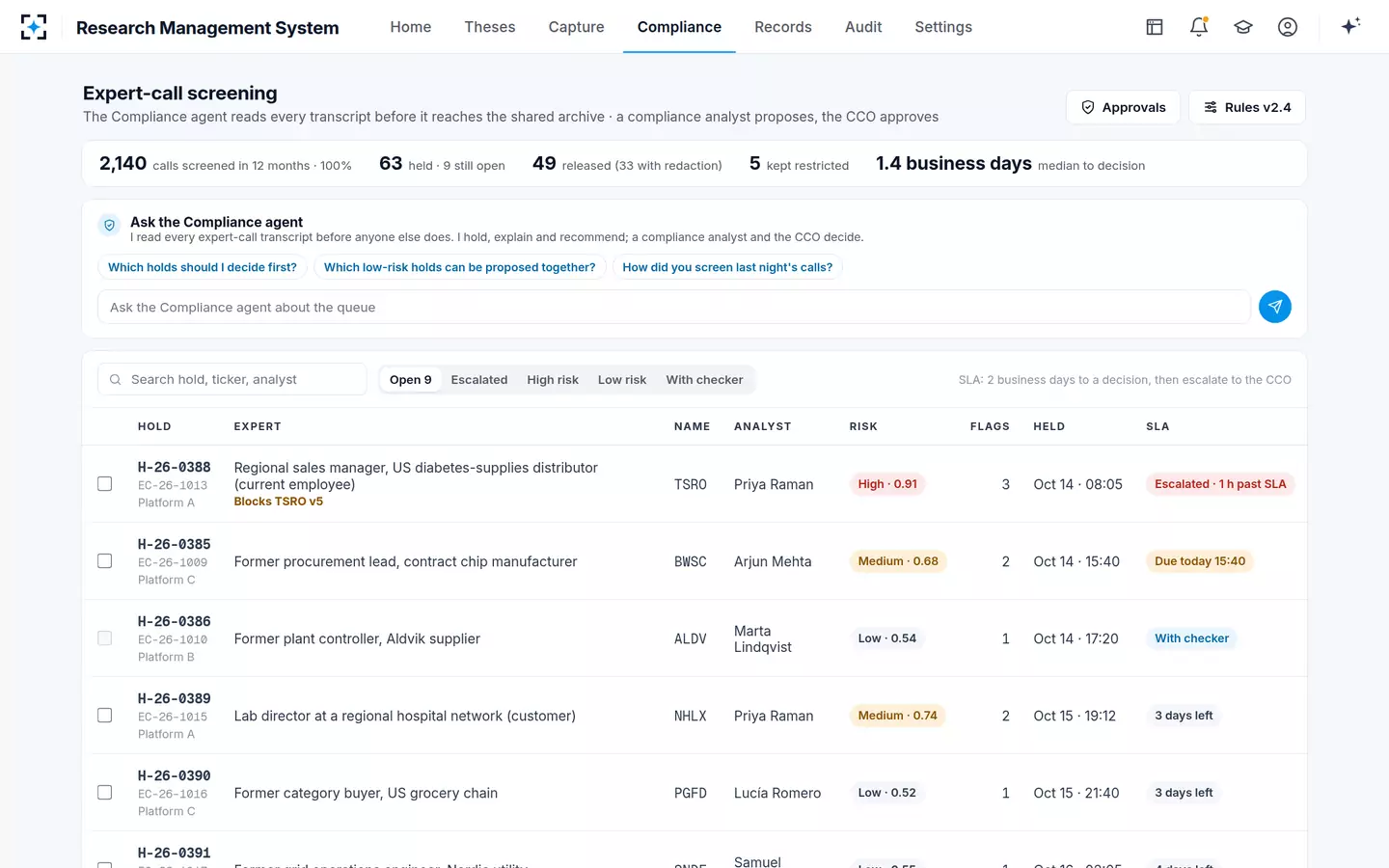
The cost of screening every call by machine is false alarms, and the threshold is how a firm trades them off. At the sample firm a single flag at 0.50 holds the call. Over twelve months that held 63 of 2,140 calls; compliance released 49 of them, 33 after redacting a passage, kept 5 restricted and still had 9 open. A firm that finds the release rate too high can raise the threshold; one that would rather read more can lower it. Either way the setting is versioned and the change needs the chief compliance officer.
What happened to the 63 held calls
Who reviews expert call notes, and who decides a hold?
Compliance reviews them, and the decision should take two people. The analyst who took the call is the worst-placed reviewer: the information is already in their head, and they want to use the call. At the sample firm a research compliance analyst reads each held call and proposes a decision with a reason code; the chief compliance officer approves or returns it, and the screen refuses a proposer who tries to approve his own proposal and logs the attempt. A hold that goes unanswered for two business days escalates to the chief compliance officer. The compliance officer's role in that decision is the subject of its own guide.
Expert-call screening in Research Management System: every call, open holds by risk and deadline
The decision screen is where the four verbs meet. The compliance analyst sees the transcript with the flagged passages numbered, the rule each passage hit and its confidence, and the agent's recommendation; he proposes, and the screen will not let him approve. The chief compliance officer then reads the same evidence and decides.
The proposal, and the refusal when the proposer tries to approve it
Should expert calls be recorded?
No rule requires an adviser to record or transcribe expert calls, but a firm that cannot show what was said cannot show its review worked, and the 2022 alert faulted advisers for not reviewing "detailed notes". Most expert networks now offer transcripts, and a transcript is far better evidence than an analyst's summary written after the fact. Where a transcript is received and relied on for a recommendation, it is a written communication received relating to advice, the plainest home for it in Rule 204-2(a)(7) (17 CFR 275.204-2), and the firm should keep it for at least five years from the end of the fiscal year.
Two cautions apply. A held transcript should be readable by compliance only, so that keeping it does not spread what it contains; and the firm needs to know when a transcript is missing. At the sample firm one expert-network platform failed to sync overnight, and the capture screen says so plainly: until the retry, any call taken on that platform since 05:40 is not in the firm's research history. A program that cannot see a gap will report full coverage it does not have.
Measuring an expert network compliance program
Four numbers tell a chief compliance officer whether the program works, and each is easy to produce if every call is logged and screened. Coverage: the share of calls screened before any use, which should be all of them. Hold rate: the share held, watched for drift after any change to the rules. Time to decision: the median and the tail, because a hold that sits for a week blocks research and tempts people around it. And outcome mix: released, redacted, restricted, which shows whether the threshold is set where the firm wants it. The sample firm's figures above, 100%, 2.9%, 1.4 business days and 49 released to 5 restricted, are the kind of line an annual compliance review can test, and a guide to what counts as material nonpublic information helps a reviewer judge the passages that drive them.
Expert network compliance policy: what it should cover
- Approved networks and written terms
Calls only through networks the firm has diligenced, with terms that forbid sharing confidential information.
- Pre-call checks
The expert's current and recent employers against the restricted and watch lists, the issuer's results calendar, and any deal or litigation the expert is close to.
- A log of every call
Who, when, which expert, which issuer or industry, on which platform, with a check that each platform's calls actually arrived.
- Every transcript read before it travels
By compliance or a screen compliance owns, before the call reaches notes, models or the shared library.
- Holds that stop dependent research
A held call blocks any thesis, memo or model that cites it until compliance decides.
- Two people on every decision
One proposes with a reason code, another approves; nobody approves their own proposal.
- A trading look-back
Access persons' and client trading in the issuer and its industry around the call dates, as the 2022 risk alert asked.
- Reporting and training
Report experts who disclose confidential information to the network; train analysts to stop a call, and keep the attendance record.
Questions people ask
Is using an expert network legal?
Yes. Paying an expert for knowledge of an industry is lawful and, under the CFA Institute's Standard II(A), consistent with professional standards. What is unlawful is trading on, or tipping, material nonpublic information obtained in breach of a duty, and an adviser must have policies reasonably designed to prevent that under Section 204A.
Can an analyst talk to a current employee of a company they cover?
Many firms forbid it outright, because a current employee is the expert most likely to hold confidential information and to owe the company a duty of confidence. Firms that allow calls with current employees of customers, suppliers or competitors usually require pre-clearance and a full transcript review, which is why the sample firm's screen flags a current employee of an issuer's customer or distributor as a rule of its own.
What should happen if an expert discloses MNPI on a call?
The analyst stops the call and tells compliance, and nobody trades or writes on the information. Compliance decides whether to restrict the issuer, puts it on the watch or restricted list as needed, and may report the expert to the network. The CFA Institute's standard adds that the information should be communicated only to designated supervisory and compliance staff.
Does expert network compliance software replace the compliance team?
No. Software can log calls, read every transcript and route the risky ones, but the decision to release, redact or restrict is a judgment the firm's policies assign to compliance. At the sample firm the screening agent never releases a held call; a compliance analyst proposes and the chief compliance officer approves.
How long should expert call transcripts be kept?
A transcript relied on for a recommendation is best kept at least as long as Rule 204-2 requires for written communications about advice: five years from the end of the fiscal year, the first two in an appropriate office. Many firms keep them with their research for seven years, and a held transcript stays restricted to compliance for its whole life.