Off-channel communications fines are the civil penalties the SEC imposed on broker-dealers and investment advisers whose employees discussed business on personal texting and messaging apps that the firms did not capture or keep, in breach of the recordkeeping rules. By the Commission's own count, it brought 95 such actions with $2.3 billion in penalties from fiscal 2022 through early fiscal 2025; the largest single announcement, in September 2022, came to more than $1.1 billion across sixteen firms. In April 2026 the current Commission called those cases a misallocation of its resources. It did not change the rules: an adviser must still keep written communications relating to its recommendations, whatever the channel. For a research team that means the analyst's chat with a portfolio manager about a rating is a record, and Botminds' Research Management System captures it with the rest of the research and keeps it under the firm's retention classes.
Every figure on this page is from SEC press releases, orders and its fiscal 2025 enforcement results, linked where used. The screens show the solution's fictional sample firm.
Off-channel communications fines in four numbers
$2.3bn
in SEC penalties across 95 off-channel recordkeeping actions, fiscal 2022 to early fiscal 2025
$1.1bn
the largest single announcement: sixteen firms, September 27, 2022
9
investment advisers in the last group settlement, January 13, 2025, of twelve firms
$0
penalty for one firm that self-reported, September 2024
What are off-channel communications?
Off-channel communications are business communications sent or received on channels the firm has not approved and does not capture: personal text messages, WhatsApp, Signal and similar apps, personal email, often on personal phones. The term is the SEC's shorthand. The violation is not using a phone; it is failing to keep a record the rules require, and failing to supervise staff so that the records are kept.
The SEC's first case set the pattern. In December 2021 J.P. Morgan Securities admitted that "from at least January 2018 through November 2020" its employees "often communicated about securities business matters on their personal devices", using text messages, WhatsApp and personal email, and agreed to a $125 million penalty (SEC press release 2021-262). In the sixteen-firm case of September 2022 the SEC said the failures "likely deprived the Commission of these off-channel communications in various Commission investigations", which explains why the agency treated recordkeeping as more than paperwork (SEC press release 2022-174).
How much were the SEC off-channel fines?
The SEC puts the total at $2.3 billion in penalties across 95 actions from fiscal 2022 through the early part of fiscal 2025, of which $71 million was ordered in early fiscal 2025 (SEC, fiscal 2025 enforcement addendum). The group announcements below account for about $2.2 billion of it; the rest came from smaller cases announced separately. The Commodity Futures Trading Commission brought parallel cases against several of the same firms, which are not in these totals.
The SEC's off-channel recordkeeping announcements, by penalties
The size of each penalty followed the size of the firm and of the failure, not a formula the SEC published. Eight firms in 2022 paid $125 million each, with their affiliates. By January 2025 the largest penalty in the group was $12 million. The trend reflects who was being charged, as the sweeps moved from the largest Wall Street dealers to regional firms, asset managers and private fund advisers.
Do off-channel rules apply to investment advisers?
Yes. Advisers keep their records under Advisers Act Rule 204-2, broker-dealers under Exchange Act Rule 17a-4, and the SEC charged both. The 2022 case included one affiliated investment adviser, charged under the Advisers Act's recordkeeping provisions and for failing to supervise. The September 2023 case named five firms charged under the Advisers Act; the February 2024 case covered "five broker-dealers, seven dually registered broker-dealers and investment advisers, and four affiliated investment advisers" (SEC 2024-18). The last group settlement, in January 2025, was mostly advisers: nine investment advisers and three broker-dealers, including private fund managers that paid $12 million and $8.5 million with their affiliates (SEC 2025-6).
Who the off-channel sweeps charged, and under which rule
| Announcement | Firms | Charged under | Combined penalties |
|---|---|---|---|
| Sept. 27, 2022 | 15 broker-dealers and 1 affiliated investment adviser | Exchange Act recordkeeping; Advisers Act for the adviser; failure to supervise | More than $1.1 billion |
| Aug. 8, 2023 | 10 broker-dealers and 1 dual registrant | Exchange Act; Advisers Act for the dual registrant | $289 million |
| Sept. 29, 2023 | 5 broker-dealers, 3 dual registrants, 2 affiliated advisers | Exchange Act and Advisers Act | $79 million |
| Feb. 9, 2024 | 5 broker-dealers, 7 dual registrants, 4 affiliated advisers | Exchange Act and Advisers Act; one self-reporter paid less | More than $81 million |
| Aug. 14, 2024 | 26 broker-dealers, advisers and dual registrants | Exchange Act, Advisers Act or both; three self-reporters paid less | $392.75 million |
| Sept. 24, 2024 | 12 broker-dealers, advisers and one dual registrant | Exchange Act, Advisers Act or both; one self-reporter paid nothing | $88,225,000 |
| Jan. 13, 2025 | 9 investment advisers and 3 broker-dealers | Advisers Act or Exchange Act; one self-reporter paid less | $63.1 million |
What records does Rule 204-2 cover?
For off-channel purposes the key paragraph is (a)(7): an adviser must keep written communications it receives and sends relating to any recommendation made or proposed and any advice given or proposed, any receipt, disbursement or delivery of funds or securities, the placing or execution of orders, and performance (17 CFR 275.204-2(a)(7)). The rule is neutral about the medium. The SEC's examination staff said in December 2018 that its review of electronic messaging covered "text/SMS messaging, instant messaging, personal email, and personal or private messaging", on firm or personal devices (SEC risk alert, Dec. 14, 2018).
Broker-dealers' duty is broader: Rule 17a-4(b)(4) keeps all communications "relating to its business as such", including inter-office memoranda (17 CFR 240.17a-4), and FINRA's Rule 4511 requires members to preserve their books and records "in a format and media that complies with SEA Rule 17a-4" (FINRA Rule 4511). An adviser's duty is narrower but reaches the core of research: anything written about what to recommend. How the rest of an adviser's research fits the rule is set out in the guide to investment adviser recordkeeping requirements.
Can firms reduce off-channel penalties?
Self-reporting did. In February 2024 the SEC said one firm "self-reported and was ordered to pay lower civil penalty than other firms"; in August 2024 three firms that self-reported paid "significantly lower civil penalties than they would have otherwise"; and in September 2024 one firm "will not pay a penalty because it self-reported its recordkeeping violations" (SEC 2024-144). The SEC's 2001 cooperation statement, cited in its later orders, makes clear that self-reporting is one factor among several and that the Commission keeps its discretion in each case.
What firms could not do was renegotiate afterwards. In April 2025 respondents to sixteen earlier orders asked the Commission to replace their requirement to engage an independent compliance consultant "for an iterative process over approximately two years" with "a one-time internal audit", to drop a two-year duty to report employee discipline, and to remove the order to comply with their undertakings, arguing that firms settling in January 2025 got better terms. The Commission refused: a later party's better terms are not a reason to reopen a settlement (SEC Release 34-102860, April 14, 2025). It refused a second group in June 2025 for the same reasons, with Commissioner Peirce dissenting (SEC Release 34-103330).
What happened to off-channel settlements in 2025 and 2026?
The campaign stopped and the rule stayed. In its fiscal 2025 enforcement results of April 7, 2026, the Commission said that "the prior Commission brought 95 actions and $2.3 billion in penalties against firms for book-and-record violations, specifically failing to maintain and preserve off-channel communications", and that, with two other groups of cases, they "identified no direct investor harm" and showed what "the current Commission views as a misinterpretation of the federal securities laws, a misallocation of Commission resources" (SEC press release 2026-34). The addendum calls them "an inappropriate use of enforcement resources by the prior Commission that did little to advance investor protection".
The SEC on off-channel recordkeeping, 2022 and 2026
September 2022: Recordkeeping requirements are "sacrosanct": if there are allegations of wrongdoing, "we must be able to examine a firm's books and records"
April 2026: The 95 actions "identified no direct investor harm" and were "a misallocation of Commission resources"
September 2022: Continue the sweep; other firms "would be well-served to self-report and self-remediate"
April 2026: The program "deliberately refocused" on matters of fraud
September 2022: Penalties, censure, cease-and-desist orders and compliance consultants
April 2026: Requests to soften earlier undertakings refused in April and June 2025
September 2022: Rule 204-2 for advisers, Rule 17a-4 for broker-dealers
April 2026: Unchanged: Rule 204-2 and Rule 17a-4 as they stood
For a chief compliance officer the practical reading is simple. A sweep that charged firms by the dozen is unlikely now. A missing record still costs what it always did in an examination, an investigation or a lawsuit: the firm cannot show what was said, and the examiner, the enforcement staff or the court draws its own conclusion. The SEC's examiners still begin with a firm's books and records, as the SEC exam request list shows, and a court can still sanction a party that lost relevant electronic records.
The cost that outlasts the penalty
The penalty was the cheapest part for many firms. The settled orders required compliance consultants to review the firms' policies on electronic communications for about two years, reports to the SEC on employees disciplined for using unapproved channels, and in some cases, by the firms' own account in their April 2025 motions, heightened FINRA supervision for six years. Each of those is a cost in staff time and management attention that a fine does not capture.
The deeper cost is the one the SEC named in 2022: records that should have existed did not, in investigations where they were needed. A research team's version of that is a rating change no one can explain. If the analyst and the portfolio manager discussed the cut on a messaging app, the firm's file shows a memo with no debate behind it, and the firm cannot show the reasoning an examiner or a client will ask about. The fix for both is the same: keep business conversations on channels the firm captures, and make those channels the easy ones.
Off-channel controls the SEC's examiners described in 2018
- Permit only channels the firm can keep
Allow for business only the forms of electronic communication the firm can use in compliance with its books and records duties.
- Ban apps built to forget
Prohibit business use of apps that allow anonymous messages, automatic destruction of messages, or no third-party viewing or back-up.
- Move stray messages
If a business message arrives on a prohibited channel, require staff to move it to a system the firm keeps, with instructions on how.
- Cover personal devices
Where personal phones are allowed for business, adopt policies for social media, messaging, texting, personal email and information security.
- Train, attest and discipline
Train staff on the limits, collect attestations, and state that violations may lead to discipline or dismissal.
- Test that it works
Examiners saw advisers that "did not conduct any testing or monitoring" of their own policies.
Why a research team's chat is a record
Because research is mostly conversation about recommendations. The analyst who messages the portfolio manager "cutting to Hold tomorrow, margins are going to 59" has sent a written communication relating to a recommendation proposed; the broker who emails a revised estimate has sent one relating to advice. Under Rule 204-2(a)(7) both are required records, and both are routinely lost when research is done on phones and in personal notebooks.
Research Management System's answer is to make the firm's own channels the place where research is kept, not an archive bolted on after. Its overnight capture reads the research mailboxes, notebooks, model store, calendar and CRM notes, document management and expert-network platforms, and files each item to the name and thesis version it supported; anything that fails to arrive is reported as a gap. Messaging apps the firm has not approved stay outside it, which is the point of approving channels in the first place.
Research Management System's overnight capture from the firm's own channels
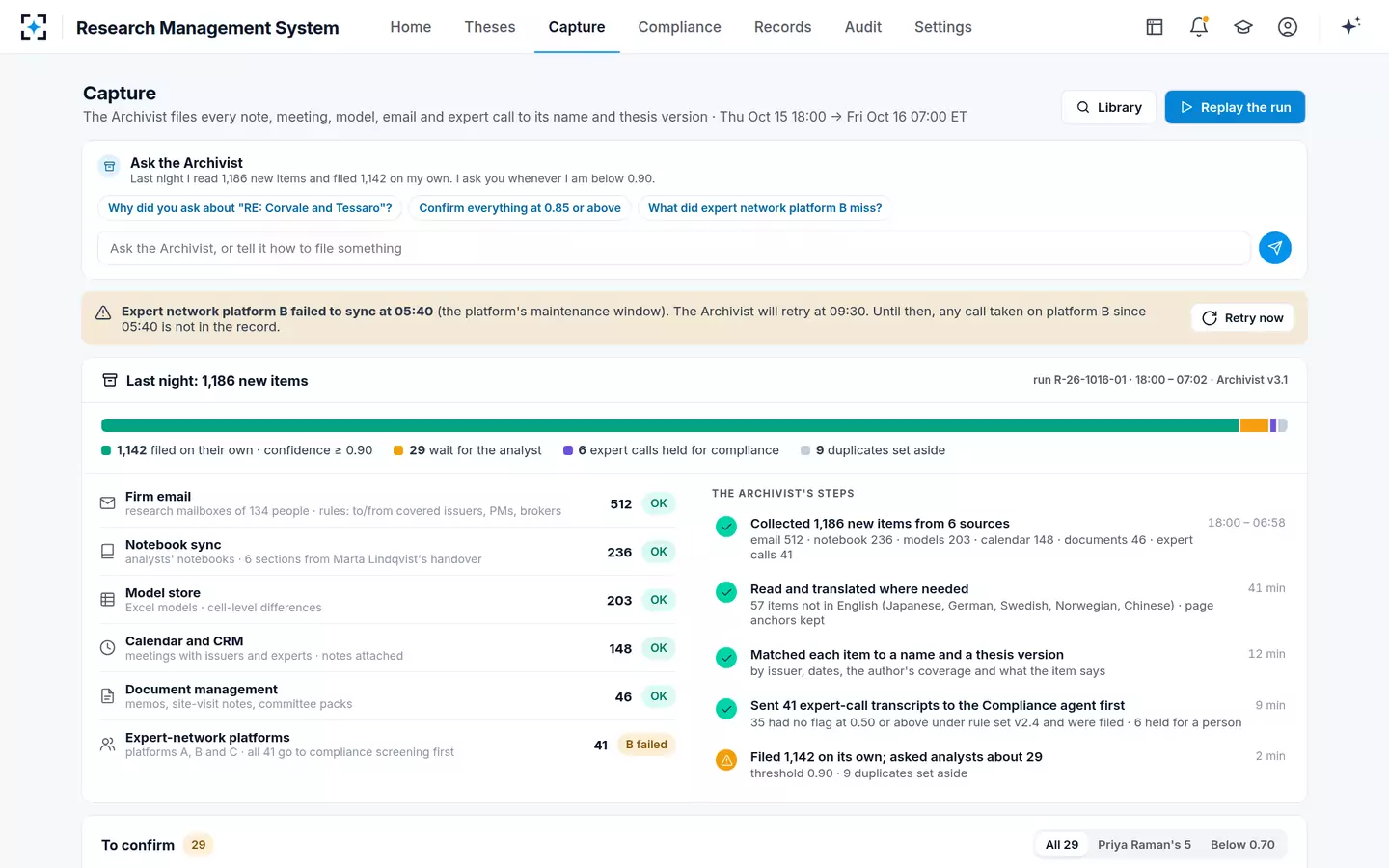
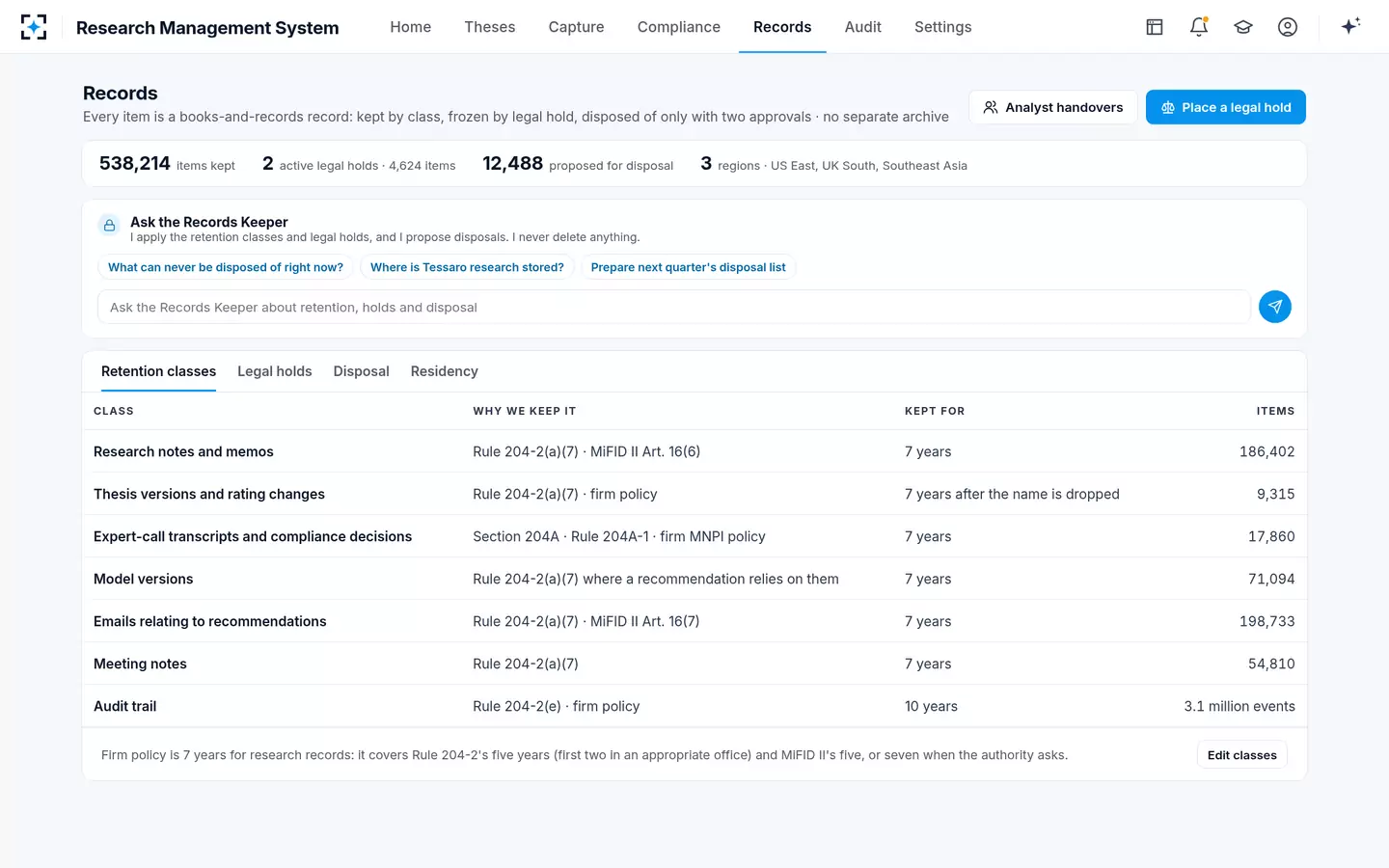
Once captured, each item is a books-and-records item kept by class, frozen by any legal hold and disposed of only with two approvals. The firm can then answer the question that sank many off-channel respondents, "where are the communications about this decision?", from one place.
Emails relating to recommendations, kept as a retention class of their own
Questions people ask
How much did the SEC fine firms for off-channel communications in total?
$2.3 billion in penalties across 95 actions from fiscal 2022 through early fiscal 2025, according to the SEC's own fiscal 2025 enforcement results. The CFTC brought separate cases with its own penalties against several of the same firms.
Did FINRA fine firms for off-channel communications too?
FINRA brings its own books-and-records cases against member firms under its Rule 4511, which requires members to preserve records in a format that complies with SEC Rule 17a-4. Those cases and their penalties are separate from the SEC's totals above.
Are WhatsApp messages with clients a record?
For an adviser, yes when they relate to a recommendation, advice, an order or the other subjects in Rule 204-2(a)(7), whatever the app. If the firm cannot capture the app, the SEC's 2018 risk alert describes firms that banned it for business and required staff to move any business message to a channel the firm keeps.
Is the SEC still bringing off-channel cases?
The current Commission has said it regards the off-channel sweep as a misallocation of resources and has refocused enforcement on fraud. The recordkeeping rules have not changed, and examiners still test them, so a firm that cannot produce required records still faces deficiency findings and, where records are missing in an investigation, worse.
Do off-channel rules apply to analysts' personal notebooks?
A notebook the analyst never shares is not a communication, so Rule 204-2(a)(7) does not reach it until its content is sent. Firms usually keep research notebooks anyway, under policy and the CFA Institute's Standard V(C), because the reasoning they hold is what a portfolio manager or examiner later asks for.