The SEC exam request list is the initial request for documents and information that the SEC's Division of Examinations sends an investment adviser at the start of an examination. The Division published its typical list in a risk alert of September 6, 2023: general information about the business, information about the compliance program and its testing, information to test advisory trading, and information for the staff's own compliance tests. Research shows up across it, in committee minutes, the code of ethics and insider trading policies, access persons' trading, creditors' committees, soft-dollar research and the monitoring of electronic communications, and follow-up requests can ask for the research behind particular decisions. The SEC expects records to be available within 24 hours in most circumstances and in practice usually allows two weeks for the initial request. Botminds' Research Management System is built for the research part of that answer: every item, version, access event and decision linked, and an exam pack with a hashed manifest produced in seconds once a person has reviewed the scope.
Quotations are from the SEC's risk alerts, the SEC Exam Handbook published on October 1, 2026, and the eCFR. The exam pack shown is from the solution's fictional sample firm.
The SEC's typical initial exam request list for advisers, and where research sits in it
| Part of the request | Typical items | Where research appears |
|---|---|---|
| General information | Organisation, affiliations and control persons; current and former supervised persons; committees with their members and minutes; client agreements; Form ADV and Form CRS; litigation | Investment committee minutes and members |
| Compliance program, risk management and internal controls | Policies in effect; tests performed; consultant reports; annual and interim reviews; record of compliance exceptions; complaints and correspondence, including how electronic communication is monitored; inventory of compliance risks; training | Monitoring of research communications; tests of MNPI controls; the risk inventory's entries for expert networks and alternative data |
| Testing of advisory trading | Client accounts and holdings; companies where employees serve as officers or directors or on creditors' committees; trade blotter; best execution; soft dollar budget and products bought with client commissions; code of ethics, attestations, exemptions and access persons' transactions | Creditors' committees; research paid with client commissions; access persons' trading in covered names |
| Testing for compliance | Advertisements and marketing; performance and composites; due diligence questionnaires; financial records; custody | Research cited in marketing; the working papers behind any performance figure |
What is on an SEC exam request list?
Four groups of material, according to the Division's own description: "(1) general information, which provides the staff with an understanding of the adviser's business and investment activities; (2) information about the compliance risks that the adviser has identified and the written policies and procedures the firm has adopted and implemented to address each of those risks; (3) information to facilitate testing with respect to advisory trading activities; and (4) information for the staff to perform its own testing for compliance in various areas" (SEC risk alert, Sept. 6, 2023). The attachment replaced a 2008 sample list the SEC had removed from its site.
The list is a starting point, not a script. The Division says the scope of each exam, and therefore the documents requested, "will vary from examination to examination depending on the firm's business model, associated risks, and the reason for conducting the examination", and that some items may come in supplemental requests rather than the first one. Requests usually arrive by secure email and are answered electronically; records that cannot be produced electronically may have to be made available in person.
What does the SEC ask investment advisers for?
Beyond the initial list, examinations "typically include reviewing advisers' operations, disclosures, conflicts of interest, and compliance practices" in core areas: custody and safekeeping of client assets, valuation, portfolio management, fees and expenses, and brokerage and best execution (SEC risk alert, 2023). The annual examination priorities add the year's themes. The Division selects firms by risk, considering prior exam findings, tips and referrals, conflicts, the time since the last exam, changes in leadership and news coverage, among other factors.
The scale of SEC adviser examinations
16,300+
investment advisers the SEC oversees, per its fiscal 2027 budget request
~15%
of advisers examined each year, as the Division reported in 2023
24hours
when the Commission expects records to be available to staff in most circumstances
2weeks
what staff usually allow for the initial request in practice
How long do you have to respond to an SEC document request?
For the initial request, usually about two weeks; for records the rules require, the Commission's stated expectation is much faster. The SEC Exam Handbook, which replaced the Division's examination brochure on October 1, 2026 (SEC press release 2026-99), says "the Commission expects that in most circumstances records should be available to staff within 24 hours. In practice, the staff usually provides two weeks to produce records in response to the initial information request" (SEC Exam Handbook). Supplemental requests come throughout the exam, with response times that vary with the request, and staff will grant reasonable extensions or rolling productions where appropriate.
The 24-hour expectation is not a courtesy. Rule 204-2(g) requires an adviser keeping records electronically to provide promptly what examiners request: a true and complete copy in the stored format, a printout, and the means to view and print (17 CFR 275.204-2(g)(2)(ii)). A firm whose research lives in five systems can usually meet two weeks and rarely meet a day.
What research records do examiners ask for?
The initial list does not ask for "research" by name; it asks for the policies, logs and minutes that govern it, and examiners follow the thread. The SEC's 2022 risk alert on MNPI shows where the thread leads: examiners reviewed whether advisers tracked and logged expert network calls, reviewed detailed notes from those calls, and reviewed staff trading in related securities, and they faulted advisers that had no documents to show their alternative-data policies were applied consistently (SEC risk alert, April 26, 2022; the call-by-call method that answers it is in expert network compliance). A supplemental request for the research behind a particular trade or rating change is one way examiners test those reviews.
In practice that means a research team should be ready to produce, for a named issuer and period, the notes, memos, emails and meeting notes behind each decision; the model versions; the expert calls with their compliance decisions; the committee papers and minutes; and who saw what. Each is either a required record under Rule 204-2 or the evidence that the firm's Section 204A policies work, which is why expert network compliance and research recordkeeping meet in the same file.
How an SEC exam runs, from call to closing letter
Most exams begin "with a brief call from staff to the chief compliance officer (CCO) or other regulatory contact", followed by a letter and the initial request; interviews and perhaps an on-site visit; supplemental requests; staff analysis; an exit conference; and a disposition letter (SEC Exam Handbook). The disposition letter comes within 180 days of the later of the end of any on-site work and the receipt of all requested records, under 15 U.S.C. 78d-5(b). It says the exam has concluded, concluded without findings, or that the staff requests corrective action; the Handbook notes that "most examinations conclude with such a letter", meaning a deficiency letter.
The SEC exam's clocks, in days, as the Exam Handbook states them
- Initial request, in practice (records the rules require: 24 hours expected)14 days
- After on-site work ends and all records arrivewithin 180 days
- Written response to a deficiency letterwithin 30 days
- Further comments on the responsestaff strives for 60 days
Two more lines in the Handbook matter to a research team. Staff generally do not return records produced during an exam, and "the staff does not consent to the use of recording, transcription, super intelligence notetaking tools, or other similar technologies" in exam meetings, in the Handbook's own words.
Among those laws – and foundational to the work of the Division – are requirements to make and preserve books and records and requirements to make accurate filings with the Commission and keep those filings current.
The SEC Exam Handbook, October 1, 2026
What makes a research file defensible?
A research file holds up when it can answer the examiner's second question, not only the first. The first is "show me the research behind this decision". The second is one of: what did the model say before it changed, who read this transcript, was this call reviewed before the trade, has this file changed since? A pile of documents answers the first. A file that keeps the item, its versions, its access history, the decisions made on it and proof of integrity answers all of them.
Five things a research file needs to survive an examiner's follow-up
1
The item
The original, in the format it was stored: the memo, the email, the transcript, the workbook.
Rule 204-2(g)(2)(ii)(A): a legible, true and complete copy, in the format the firm stores it in
2
Every version
Each saved model and draft, with what changed, so the file shows what the firm believed on the day.
Rule 17a-4(f) benchmark: an audit trail that can re-create the original
3
Who read it
An access log for the item, which is the evidence that information barriers and holds worked.
Rule 204-2(g)(3)(ii): access limited to authorised personnel
4
What was decided
Each compliance and investment decision touching the item, with both names and the reason.
Rule 204-2(a)(13)(iii) and (a)(17)(ii): decisions and reasons kept
5
Proof it did not change
A hash of each item and a manifest for the set, checked against a separately stored copy.
Rule 204-2(g)(2)(iii): a duplicate copy stored separately
The weakest of the five at most firms is the version. A model saved over itself and a memo edited after the committee both destroy the evidence of what the firm believed on the day, and no amount of email archiving recovers it. The second weakest is the access log, because research systems are usually open to the whole team and log nothing; yet the access log is how a firm shows that a held call stayed with compliance and that an information barrier held.
What is an exam pack?
An exam pack is the set of records a firm produces in answer to one request, assembled with a manifest that lists every file and, ideally, a hash of each so the examiner can confirm nothing changed between the archive and the production. Firms build them by hand from each system, which is where the days go. At the sample firm, a request for "research supporting TSRO decisions, May 2025" was scoped by a person to one issuer and February 1 to May 31, 2025; Research Management System collected 386 files, checked every hash against the immutable store and wrote the manifest and chain-of-custody sheet in under three seconds.
Research Management System building an exam pack for an SEC examination request
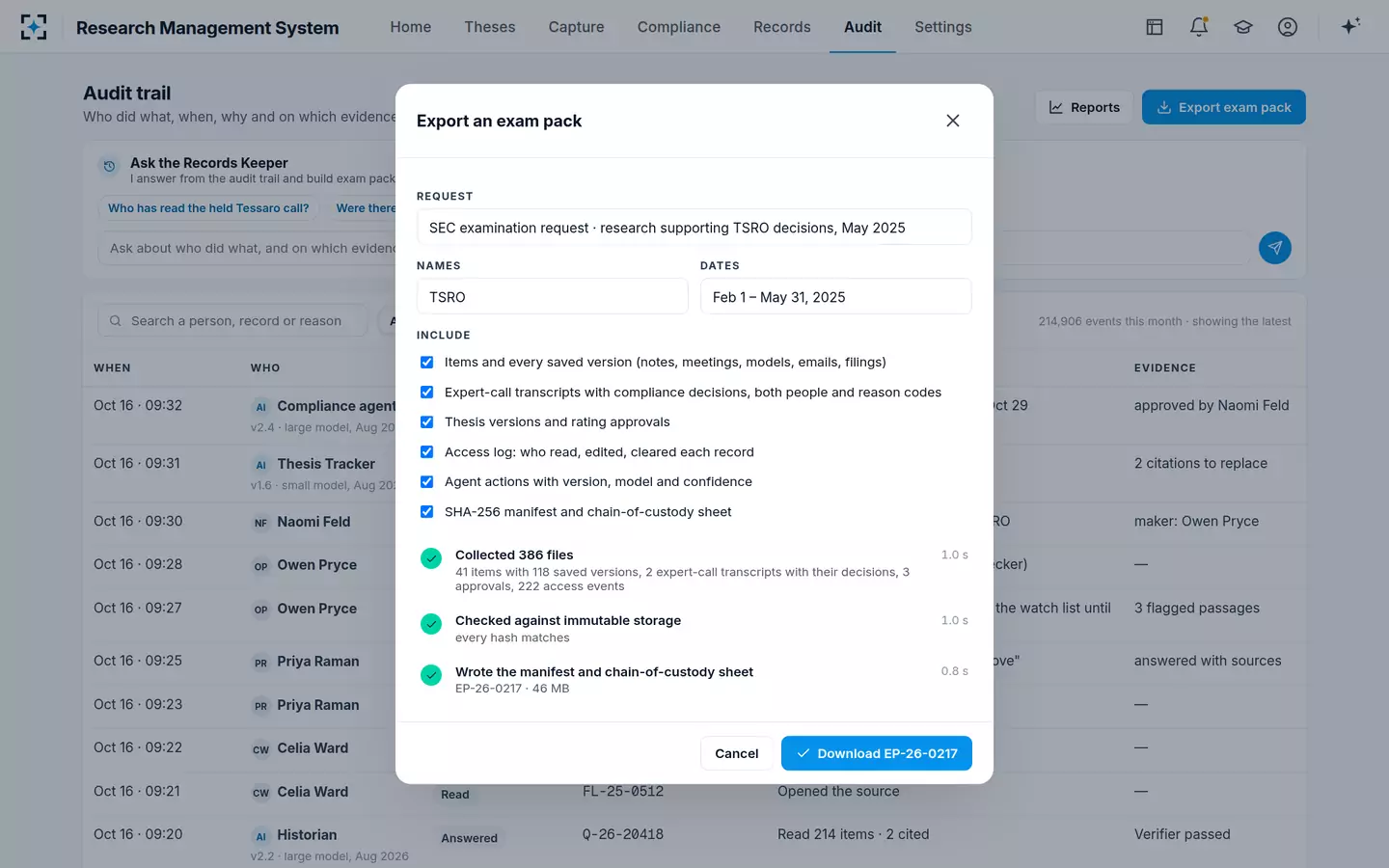
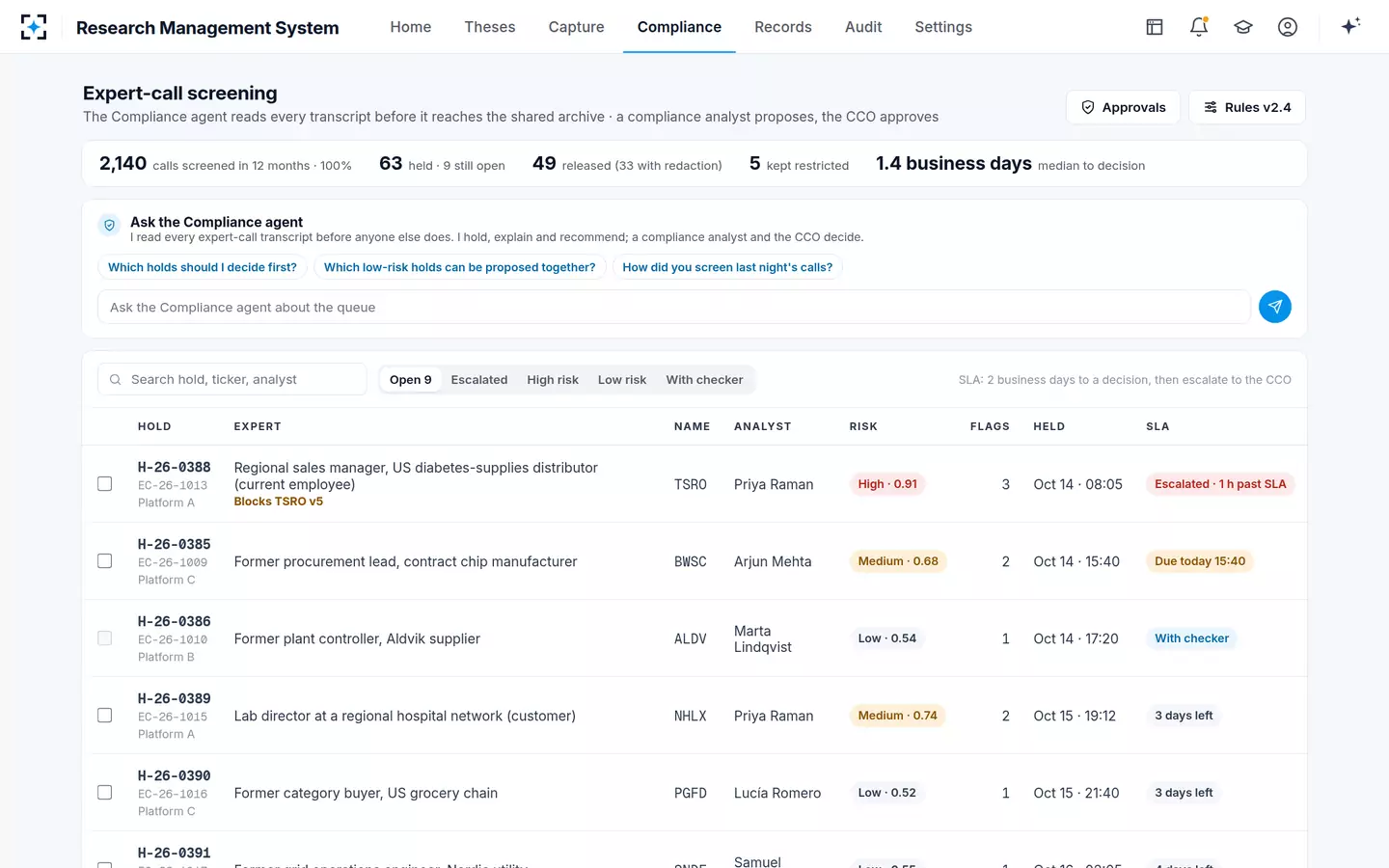
The pack answers the follow-up questions because it was built from a file that already held the answers. The 118 saved versions show what the research said at each point; the 222 access events show who read it; the two expert-call transcripts carry their compliance decisions, with both names and the reason codes. The same file serves a portfolio manager asking why the firm cut the stock, which is the point of writing memos that cite their evidence.
The compliance evidence behind the pack: every expert call screened, with its decision
How do you prepare for an SEC exam?
Prepare the answers before the call, not the documents after it. The SEC published its typical request list "so that advisers may prepare themselves for an examination", and the Exam Handbook asks firms to keep filings current, make knowledgeable staff available and raise misunderstandings early. For the research part, the preparation is a dry run.
Preparing the research file for an SEC exam request
- Run a mock request on a real decision
Pick a rating change from last year and produce the research behind it, with versions and access history, against a 24-hour clock.
- Map the request list to your systems
For each item that touches research, name the system, the owner and the export.
- Keep committee minutes linked to what the committee saw
Minutes plus the versions of the memo and model on the table.
- Have the expert-call log and decisions ready
Every call, its review, any hold, who decided and why; and the trading look-back.
- Check the annual review covers research controls
Expert networks, alternative data, restricted lists, research recordkeeping.
- Prepare a privilege log process
The Handbook lists what a log must show for each document withheld.
- Hash what you produce
A manifest with a hash per file lets you prove later what you gave and when.
- Brief the people examiners will interview
The Handbook asks for knowledgeable staff; for research, that is the director of research and the research compliance analyst.
The examiners' request is one of three that test the same file. A litigant's discovery request and a court's preservation order test it too, which is why the legal hold on research and the exam pack should come from the same store.
Questions people ask
Does the SEC announce exams in advance?
Usually. The Exam Handbook says most exams begin with a call to the chief compliance officer, followed by a letter and the initial request. Unannounced exams still happen; in those, staff provide a request for information on arrival and conduct an initial interview then.
What is the SEC's document request letter?
It is the formal notice of the exam, made under the examination authority that applies to the firm, such as section 204(a) of the Advisers Act for registered advisers, with the initial request list and instructions on how to format and send the records. Staff usually allow two weeks for the initial production.
Can a firm withhold privileged documents from SEC examiners?
A firm that believes a responsive document is privileged should provide a privilege log. The Exam Handbook lists what it should show: the document's creator and recipients with their positions, the date, a brief description, the privilege claimed and the request it relates to.
What happens after an SEC exam?
The staff hold an exit conference to discuss issues, then send a disposition letter within 180 days of the later of the end of on-site work and receipt of all records. If it is a deficiency letter, the firm responds in writing, typically within 30 days, and the staff may comment further; serious issues can be referred to the Division of Enforcement.
Do examiners ask for expert network call records?
They can, and the Division's April 2022 risk alert on MNPI compliance shows what they look for: whether calls with expert network consultants were tracked and logged, whether detailed notes were reviewed, and whether related trading was checked. A firm that keeps the call, the transcript, the review and the decision together can answer all three.