An investment research database, in the sense a buy-side team means it, is the firm's own store of research: analysts' notes and memos, meeting notes, emails with issuers and brokers, model versions, filings and expert-call transcripts, organised so that the reasoning behind any rating or position can be found again. It is different from an equity research database of third-party reports or market data, which a firm licenses. The firm's own database lives or dies on filing: a note tagged only to a ticker can be found but not understood, and a note filed nowhere is gone. Most research notes software tags a note to a ticker and stops there. Botminds' Research Management System files each item to the name and the thesis version it supported, using an agent that files on its own only when it is confident and asks the analyst when it is not.
The worked example is one night of filing at the solution's fictional sample firm, Quillfield Capital. The regulators' findings are linked where they appear.
One night of filing in the investment research database, step by step
Agent
ArchivistCollects new items from email, notebooks, the model store, calendar and CRM, document management and three expert-network platforms; reports any source that failed.
Never: Edits an author's text
Agent
ArchivistReads each item in its original language, keeps page anchors, and sets aside duplicates.
Agent
Compliance agentScreens every expert-call transcript first; a held call goes to compliance, not to the library.
Never: Releases a held call
Agent
ArchivistMatches each item to a name and a thesis version; files it on its own at confidence 0.90 or above.
Never: Files on its own below 0.90
A person decides
AnalystConfirms or corrects the items the Archivist was unsure of, one by one or with an instruction; can refile any item later, with a reason.
What is an investment research database?
An investment research database is the system where a research team keeps the material its decisions rest on, organised for retrieval. For a buy-side firm that material is mostly its own: notes, memos, models, emails, meeting notes and transcripts, plus the filings and third-party reports analysts relied on. People also use the phrase for licensed databases of broker research, fundamentals or ratings, sometimes called equity research databases. Those answer "what does the market think?". The firm's own database answers "what did we think, and why?", which no vendor can supply.
The firm's own database is also part of its books and records. An SEC-registered adviser must keep written communications relating to recommendations and advice, and if it keeps them electronically must "arrange and index the records in a way that permits easy location, access, and retrieval of any particular record" (17 CFR 275.204-2(g)(2)(i)). A research database indexed by date and author satisfies a librarian. Indexed by name and decision, it satisfies an examiner and a portfolio manager.
How do you organize investment research?
By name, then by thesis version, then by evidence. The name is the obvious first key and the one every system has. The thesis version is the key most systems lack: the firm's view on a name at a point in time, with its rating, target and reasons, from initiation through each change. Every item of evidence belongs to the version it supported, so the history of a name reads as a sequence of decisions with their reasons, not a pile of documents sorted by date.
The sample firm's research on one medical-device name shows why. Across five thesis versions it holds 214 items: 61 notes and memos, 23 meetings, 38 model versions, 9 expert calls, 68 emails, 12 filings and transcripts and 3 portfolio decisions. Sorted by date, finding the reason for the cut to Hold in May 2025 means reading most of them. Filed to versions, the reason is the stretch around version 3. How that history is then queried is the subject of the memo that answers "why did we?".
How should research notes be tagged?
With the name, the thesis version, the type and the retention class, and with as little of that left to the analyst as possible. A ticker tag is necessary but not sufficient: it says what a note is about, not what it was for. The thesis version says which decision the note fed. The type (memo, meeting, model, email, filing, call) lets a reader filter. The retention class says how long the note is kept and whether a hold applies.
Tags fail for a human reason: they are work the analyst does for someone else's benefit, at the end of a long day. Research teams that depend on analysts tagging consistently get consistent tagging from a few analysts and none from the rest. The answer is not stricter rules but less tagging: an agent proposes the name and version, files the items it is sure of, and asks only about the ones it is not.
Can AI file research notes?
Yes, for most items, if it is allowed to say when it is unsure. Matching a note to a name is usually easy; matching it to a thesis version is harder, because it depends on the date, the author's coverage and what the note actually says. A filing agent that reads the content, the dates and the coverage can place most items correctly; the ones it cannot place are the ones a person must look at anyway. Regulators treat such tools under existing rules: FINRA said in June 2024 that its rules are technology-neutral and continue to apply when firms use generative AI (Regulatory Notice 24-09), and its 2026 oversight report names summarisation and information extraction as the leading use among member firms, while warning that agents can act beyond the scope a user intended and that multi-step agent work can be hard to trace (FINRA, 2026 Regulatory Oversight Report).
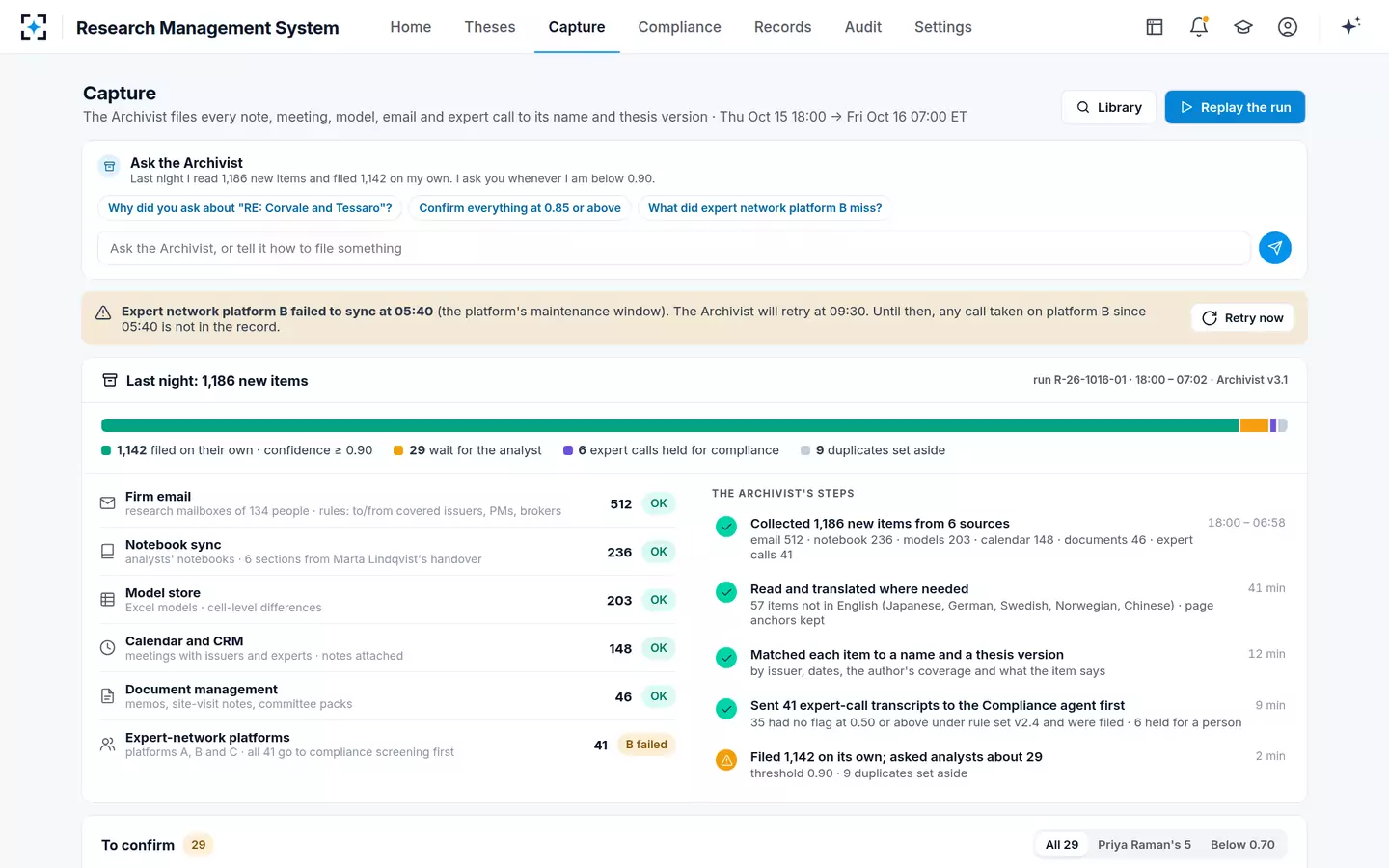
The sample firm's overnight run shows the proportions. The Archivist collected 1,186 new items from six sources, read 57 that were not in English (Japanese, German, Swedish, Norwegian and Chinese) in their original language, sent all 41 expert-call transcripts to the screening agent first, and set aside 9 duplicates.
1,186 new items in one night, by source
What happens when AI is unsure?
It should ask the person who knows, with its best guess and its reason, and do nothing until that person answers. At the sample firm the Archivist filed 1,142 of the 1,186 items on its own, each at confidence 0.90 or above, and asked the analysts about 29. Six expert calls were held by compliance and nine duplicates set aside. An unsure item waits in the analyst's queue with the version the agent suggests; nothing below the line is filed silently.
Where the night's 1,186 items went
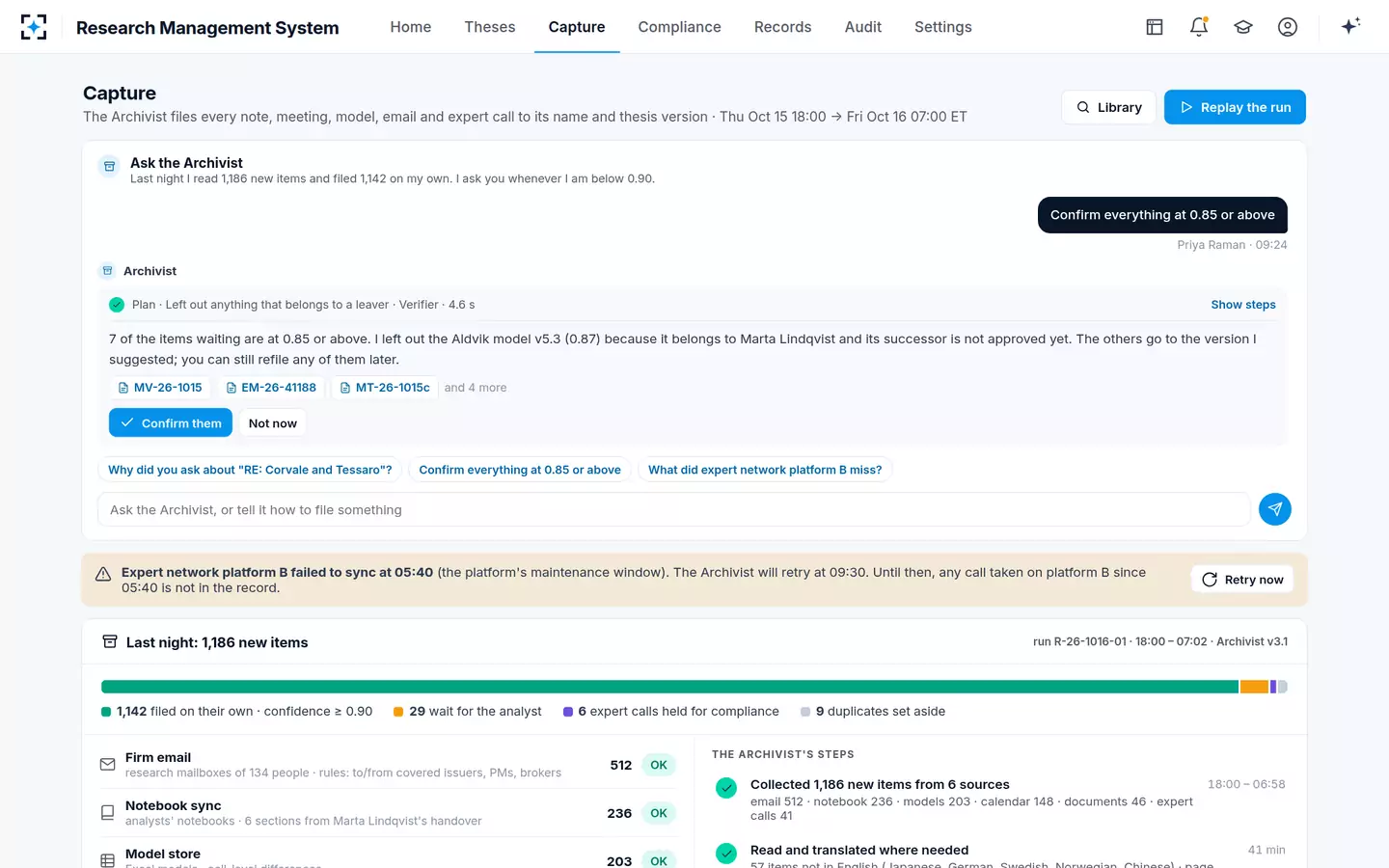
Asking well is a skill of its own. The agent's question should carry its suggestion, its confidence and its reason, so the analyst confirms in a second rather than investigating. And the analyst should be able to answer many questions at once. In the sample, an analyst types "Confirm everything at 0.85 or above"; the Archivist finds seven waiting items at that confidence, confirms nothing until she presses a button, and explains the one it left out: a model at 0.87 that belongs to an analyst who is leaving and whose successor has not yet been approved.
An analyst instructs the Archivist in plain words; it says what it left out, and waits
Setting the threshold: asking too often, or too rarely
The confidence line is the most important setting in an investment research database with agents, and it is a business decision, not a technical one. Set it too low and the agent files wrong items quietly; each error is invisible until someone needs the item and finds it under the wrong thesis. Set it too high and the agent asks about everything, the analysts stop answering, and the queue becomes a second inbox. The right line is where the cost of a wrong filing, found late, balances the cost of a question, asked now.
Three things make the line easier to set. Measure both errors: the share asked, and the share of auto-filed items later refiled by a person, which is the agent's real error rate. Treat some items differently whatever the score: at the sample firm a leaver's items wait for the approved successor, and expert calls go to compliance before filing at all. And let the firm change the line through its normal approvals, with the change versioned, so a reviewer can see which line applied to any item. At the sample firm the line is 0.90, and on this night it sent 2.4% of items to people.
How do you link notes to a thesis?
By deciding first what a thesis version is, then letting every item point to one. A version starts when the firm's view on a name changes or is reaffirmed: an initiation, a rating or target change, a formal review. The memo or ratings feed that records it marks the version; the items dated before it, by the covering analyst or about that name, are its candidate evidence; the content decides which version each supports. Model versions are the strongest links, because a saved workbook either was or was not the model behind a decision, and versioning the firm's own models makes that link precise.
The CFA Institute's Standard V(C) gives the reason to keep the links even for decisions that changed nothing: it extends the record-keeping duty beyond buy and sell decisions to reviews that leave a position unchanged (CFA Institute, Standard V(C)). A thesis that was reviewed and kept is a version too, and the evidence for the review belongs to it.
Overnight capture in Research Management System: sources, steps and a gap reported
Agents recommend, people decide
The operating rule regulators keep returning to is that an agent may recommend and prepare, and a named person decides. The Bank of England and FCA's 2026 survey of UK financial firms, with 196 responses, found 86% using AI and 80% running AI agents in production that provided decision support, in which agents recommend actions and humans decide and execute; human approval, pre-deployment review and vendor due diligence were each reported by more than 90% (Bank of England and FCA, October 2026). FINRA's 2026 report asks firms to consider where to keep humans in the loop on agents.
How UK financial firms run AI agents, 2026
86%
of respondents using AI, up from 75% in 2024
80%
with AI agents in production for decision support: agents recommend, humans decide
>90%
reporting human approval, pre-deployment review and vendor due diligence as controls
≤9%
expecting agents to execute trades or place orders, even including the next 12 months' plans
A filing agent fits that rule well because its actions are reversible and its decisions small. The Archivist never edits an author's text, files on its own only above the firm's line, and leaves every item open to refiling with a reason; the analyst remains the author of the research and the judge of where it belongs. How the same principle runs through the rest of a research process, from notes to published views, is covered in the sibling guide on the equity research process with agents and analysts.
How to test a filing agent before you rely on it
Test it on your own history, where the right answers are known. Take a year of a covered name's research that analysts have already organised, let the agent file it blind, and compare. The results tell a head of research how far to trust the agent and where to set the line.
Testing a filing agent for an investment research database
- Wrong-version rate on auto-filed items
Of the items filed on their own, how many went to the wrong thesis version? This is the error that hides.
- Ask rate at the proposed line
What share goes to analysts, and how long would the queue be each morning?
- Refile rate in the first months
Every correction an analyst makes later, with its reason, is free evaluation data.
- Original-language items
Notes and filings not in English, read without translation loss in names and numbers.
- Model versions
Does each saved version land on the decision it supported, with the changed cells visible?
- Hard cases held back
Leavers' items, emails naming several issuers, handwritten pages, held expert calls.
- Gaps reported
A source that fails to sync must show as a gap with its start time.
- Every action on the audit trail
Agent version, model, confidence, and the person who confirmed or corrected it.
Questions people ask
What is the difference between an investment research database and an equity research database?
In common use, an equity research database usually means licensed third-party research or data, such as broker reports and fundamentals. An investment research database can mean that too, but at a buy-side firm it more often means the firm's own research store: its notes, models, calls and decisions, which no vendor holds.
Can ChatGPT organise my investment research?
A general chatbot can summarise and suggest tags for documents you paste into it, but it does not see the firm's email, models or call transcripts, keep versions, apply retention or respect information barriers, and the firm remains responsible for what staff put into it. A research database needs filing inside the firm's own systems, with an audit trail.
How do you stop analysts keeping research in personal notebooks?
Make the firm's system the easier place to work: capture from the notebook application rather than replacing it, file automatically, and give analysts something back, such as answers from their own history. Policy helps, because the CFA Institute's Standard V(C) treats research created for the firm as the firm's property, but convenience decides.
How many research notes does a buy-side firm produce?
It depends on coverage and team size, and no regulator or independent study publishes a standard figure. The fictional sample firm, with about 1,240 names that have a research history, captures about 62,000 items a year; on the night shown here it captured 1,186, most of them email and notebook pages.
What should happen to research notes when an analyst leaves?
They stay, linked to their thesis versions, and pass to approved successors; access ends on the last day. At the sample firm the Handover agent links a leaver's items before the last day and lists the ones it could not link for the leaver to confirm.