A hedge fund compliance officer runs the fund manager's compliance program as an SEC-registered investment adviser: writing and testing the policies Rule 206(4)-7 requires, reviewing them at least once a year, administering the code of ethics and access persons' personal trading, keeping the books and records, reviewing marketing, managing examinations and, in a research-driven fund, deciding what to do with information that may be material and nonpublic. The chief compliance officer (CCO) holds the title the rule requires; at larger funds a team of compliance analysts does much of the daily work and proposes decisions for the CCO to approve. The seat that decides whether an expert call, a note or a source is held is where a fund's MNPI risk is actually controlled. Botminds' Research Management System is built to put that decision, and its evidence, in front of the right two people.
The rules and findings are the SEC's; the pay figures the US Bureau of Labor Statistics'. The worked example uses the solution's fictional sample firm, Quillfield Capital, a global asset manager whose research process is a hedge fund's in miniature.
What a hedge fund compliance officer does, and the rule behind each duty
Run the compliance program and its annual review
Rule 206(4)-7: written policies, a review "no less frequently than annually", a designated CCO
Prevent misuse of material nonpublic information
Advisers Act Section 204A: expert networks, restricted and watch lists, wall crossings, alternative data
Administer the code of ethics and personal trading
Rule 204A-1: access persons' holdings and transaction reports, pre-approval of IPOs and private placements
Keep the books and records
Rule 204-2: communications about recommendations, code of ethics records, the annual review itself
Review marketing and performance claims
The marketing rule, Rule 206(4)-1, and the records Rule 204-2(a)(16) keeps behind any performance figure
Answer the examiners
Most SEC exams begin with a call to the CCO; the initial request usually allows two weeks
What does a hedge fund compliance officer do?
Day to day, a hedge fund compliance officer approves or refuses things before they happen and tests whether the controls worked afterwards. Before: pre-clearing employees' personal trades, approving expert-network calls and new alternative-data sources, deciding whether an analyst who has been brought over the wall may keep covering a name, reviewing investor presentations. After: reviewing access persons' holdings and transaction reports, sampling or screening expert-call transcripts, testing trading against the restricted and watch lists, and writing up the annual review. Around both sits the regulatory calendar: Form ADV amendments, Form PF filings and the next SEC examination.
The research desk generates much of that work. Every expert call, every private meeting with management, every alternative-data trial and every analyst who sits on a creditors' committee is a channel through which material nonpublic information can reach the fund, and Section 204A of the Advisers Act requires written policies to prevent its misuse, designed with the adviser's own business in mind (15 U.S.C. 80b-4a). A research-heavy fund needs a compliance officer who understands research well enough to tell a channel check from a tip.
What the SEC expects of a chief compliance officer
The SEC expects the CCO to know the law, to have real authority and to be senior enough to use it. When it adopted the compliance rule in December 2003 it wrote that an adviser's chief compliance officer "should be competent and knowledgeable regarding the Advisers Act and should be empowered with full responsibility and authority to develop and enforce appropriate policies and procedures for the firm", and should have "a position of sufficient seniority and authority within the organization to compel others to adhere to the compliance policies and procedures" (Release IA-2204, 68 FR 74714).
Two footnotes in the same release shape the job. The rule does not require an adviser "to hire an additional executive to serve as compliance officer, but rather to designate an individual", so at a small fund the CCO is often also the chief operating officer or general counsel. And the title "does not, in and of itself, carry supervisory responsibilities", so a CCO is not automatically liable for failing to supervise the portfolio managers. The seniority and the authority are what the SEC looks for; a CCO who cannot stop a trade has the title and not the job.
What is the difference between a CCO and a compliance analyst?
The CCO is the one person the adviser designates under Rule 206(4)-7(c) to administer the compliance program, and is named on Form ADV; compliance analysts and associates work under the CCO, run the daily reviews and propose decisions. In a well-run function the difference is also one of authority: an analyst proposes, the CCO, or a delegate the policy names, approves. That split matters most where the decision cannot easily be undone, such as releasing an expert call that may contain inside information.
The split also protects the CCO from reviewing themselves. The SEC's examiners reported in April 2022 that some advisers "did not have policies and procedures in place to assign the CCO's reporting to another member of the adviser – effectively permitting the CCO to self-review his/her own holding and transaction reports" (SEC risk alert, April 26, 2022). The same principle, that no one approves their own proposal, is how the sample firm runs every expert-call hold.
The research compliance seat, and the four people it works with
Today
Approves hold decisions, legal-hold releases and disposals, and answers to the SEC.
With agents
Approves or returns each proposal, never her own; holds past their deadline come to her, and every read and decision is on the audit trail.
Still theirs: The final decision, and the conversation with the examiner
Today
Screens expert-call transcripts and proposes the decision on each hold: "Show me the passage and the rule it hit, and I'll make the call."
With agents
Sees every held call with its flagged passages, the rule each hit and the screen's confidence, and proposes with a reason code.
Still theirs: The judgment on each passage
Today
Writes memos, rebuilds models and takes three or four expert calls a week.
With agents
Has every call screened before it reaches the library; a draft that cites a held call is blocked, and she is told to rebuild it.
Still theirs: Stopping the expert who crosses the line
Today
Asks why the firm owns a name before every committee, and has inherited three analysts' views in two years.
With agents
Sees that a draft upgrade is blocked by a held call, and why, before the committee meets.
Still theirs: The investment decision
Today
Approves rating changes and handovers.
With agents
Receives no thesis version that cites a held call until compliance decides.
Still theirs: Rating changes and coverage
What is an access person?
An access person is a supervised person of the adviser who has access to nonpublic information about clients' purchases or sales of securities or about a reportable fund's holdings, or who is involved in making securities recommendations to clients or has access to recommendations that are nonpublic (17 CFR 275.204A-1(e)(1)). For most advisers, directors, officers and partners are presumed to be access persons too. In a hedge fund, that usually means every analyst, trader and portfolio manager, and many operations staff.
Access persons report their holdings within 10 days of becoming access persons and at least once every twelve months after, and their transactions quarterly, and they need pre-approval to buy into an initial public offering or a private placement. The code of ethics, its violations, the list of access persons over five years and each pre-approval decision with its reasons are books and records under Rule 204-2(a)(12) and (a)(13) (17 CFR 275.204-2; retention periods for each are tabled in the recordkeeping guide). The 2022 risk alert found advisers that had not identified some employees as access persons at all, which is the failure that makes the rest of the code impossible to test.
How often must compliance policies be reviewed?
At least once a year. Rule 206(4)-7(b) makes it unlawful to give advice unless the adviser reviews, "no less frequently than annually", the adequacy of its policies and procedures and the effectiveness of their implementation (17 CFR 275.206(4)-7), and Rule 204-2(a)(17)(ii) keeps the records documenting each review. The SEC's 2003 release added that advisers should consider interim reviews after significant compliance events, changes in the business and new regulation.
The SEC's Division of Examinations published its observations on annual reviews on September 14, 2026, and they read like a list of what goes wrong when the seat is stretched. Examiners saw gaps in the cycle, such as reviews for 2021 and 2023 with 2022 omitted; reviews covering more than twelve months, including "extended intervals due to business, operational, and personnel changes (e.g., Chief Compliance Officer ('CCO') departures)"; firms that treated training or staff attestations as a substitute for a review; and reviews whose working papers were never kept, or whose recommended corrective actions were never taken (SEC risk alert, Sept. 14, 2026).
The annual review: what the SEC's examiners found missing in 2026
- A review every year, with no gaps
Not every other year, and not stretched past twelve months when the CCO leaves.
- A review, not a substitute
Training and attestations do not assess the adequacy and effectiveness of the policies.
- Written procedures for the review itself
What to test, how to judge the results, what documentation to keep.
- The current policies, not superseded ones
Examiners saw reviews that assessed outdated versions.
- Policies that match practice
Business changes reported to the CCO, so new risk areas are in scope.
- Incidents of the year inside the review
Known non-compliance recorded and addressed, not left out.
- The working papers kept
Testing, issues found and corrective actions, as books and records.
- Corrective actions finished
Not reported as done while the issue persists.
The week in the seat: calls, lists, trades and exams
The research compliance week has a rhythm. Expert calls and their transcripts arrive daily; holds need a decision within a set time or they block research. Restricted and watch lists change as analysts are brought over walls and issuers approach results. Personal trading requests and the quarterly transaction reports land in waves. And an examination can start with a phone call: the SEC's Exam Handbook says most exams open with a short call from the staff to the CCO or another regulatory contact (SEC Exam Handbook, Oct. 1, 2026).
Volume is what breaks the rhythm. At the sample firm, the screening agent read 2,140 expert-call transcripts in twelve months and held 63, so the compliance analyst's work became deciding 63 calls with the passages already found, rather than reading two thousand. The restricted list and how it is checked before research begins are covered in the sibling guide on restricted list compliance; the screening method in the expert network compliance guide.
What compliance decided on the 63 expert calls held in twelve months
The 63 held calls
- Released, with or without redaction: 49 · 77.8%
- Kept restricted (5) or still open (9) · 22.2%
The 49 released
- After redacting a passage: 33 · 67.3%
- As screened: 16 · 32.7%
Who approves holds on expert calls?
In a well-designed program, a compliance analyst proposes and the CCO approves, and the system will not let one person do both. At the sample firm the screening agent holds any call with a flag at 0.50 or above and recommends a decision, but it never releases a call. A research compliance analyst reads the flagged passages and proposes release, release with redaction, or keep restricted, with a reason code; the chief compliance officer approves or returns it. If the analyst tries to approve his own proposal, the screen refuses and logs the attempt. A hold not decided within two business days escalates to the CCO.
The compliance analyst proposes; Research Management System refuses his own approval
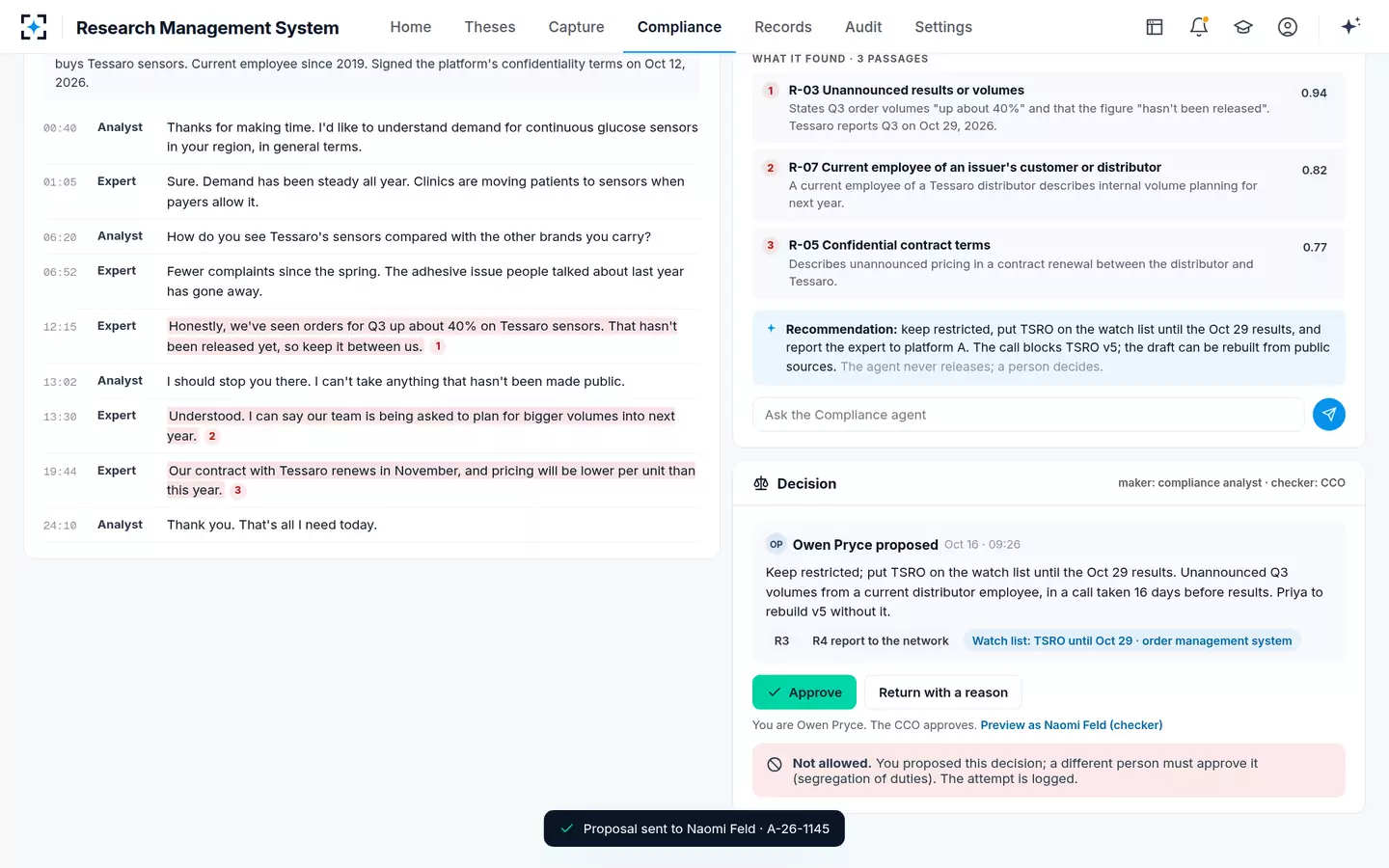
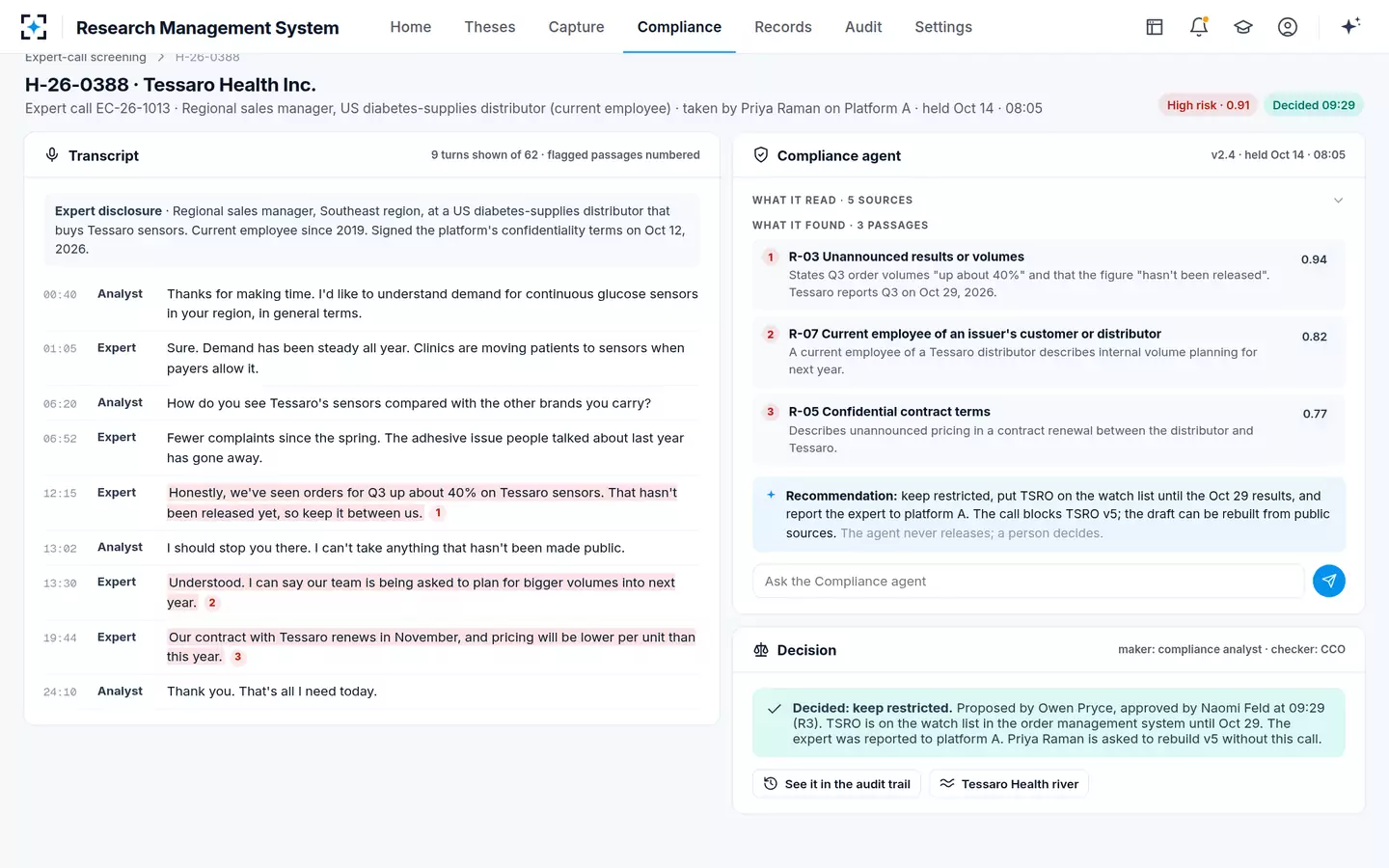
The approval is the moment the CCO's authority, the thing the SEC's 2003 release asked for, becomes visible. Three minutes after the proposal, the chief compliance officer reads the same transcript, flags and recommendation, and approves: the call stays restricted, the issuer goes on the watch list in the order management system until its results, the expert is reported to the network, and the analyst is told to rebuild her draft upgrade without the call.
A different person approves: the decision, both names and the reason
Hedge fund compliance officer salary: what public data shows
No regulator or independent study publishes pay for compliance officers at hedge funds alone; the closest public figures are the US Bureau of Labor Statistics' for compliance officers in the securities and investment industry, which includes hedge fund managers alongside brokers, asset managers and exchanges. In May 2025 that industry employed 6,030 compliance officers, at a median annual wage of $100,160, against $80,730 for compliance officers across the whole economy.
Compliance officers in securities and investments, May 2025
$100,160
median annual wage in securities, commodities and other financial investments (NAICS 523)
$131,980
the industry's 75th percentile; the 25th is $78,660
$80,730
median for compliance officers in all industries
6,030
compliance officers employed in NAICS 523, of 417,070 nationally
The occupation code is broad: it covers compliance work in every industry, from licensing examiners to environmental inspectors, and a fund's chief compliance officer may be counted under a management or legal occupation instead. The industry figures therefore say most about analysts and associates in compliance teams, and least about the person who holds the title.
What skills the seat needs
The SEC's description reduces to three: knowledge of the Advisers Act, the authority to enforce policies, and the seniority to make people follow them. A research-heavy fund adds two more. The first is fluency in research: knowing what a channel check is, why an analyst wants a call with a distributor, and where a supplier's comment stops being colour and starts being an order book. The second is a habit of evidence. The examiners' findings in 2022 and 2026 are mostly about firms that could not show what they did: calls not logged, notes not reviewed, review papers not kept. The seat is judged on what it can produce, which is why what an SEC exam request asks for is the best job description the role has.
Questions people ask
What is a hedge fund compliance officer's job description?
To design, run and test the fund manager's compliance program under the Advisers Act: policies and the annual review, the code of ethics and personal trading, MNPI controls including expert networks and restricted lists, books and records, marketing review, regulatory filings and examinations. In research-driven funds the role also decides on held expert calls and wall crossings.
Does a hedge fund need a chief compliance officer?
A hedge fund manager registered with the SEC as an investment adviser must designate a chief compliance officer under Rule 206(4)-7(c). The rule does not require a dedicated hire: a small manager can designate an existing executive, provided the person is competent, knowledgeable and has the authority the SEC expects.
Can the CCO also be the general counsel or COO?
Yes. The SEC's 2003 release says the rule requires advisers to designate an individual rather than hire an additional executive, and many small managers combine the roles. The risk is conflict and time: examiners in 2026 reported annual reviews that slipped when CCOs left or were stretched.
What does a research compliance analyst do at a hedge fund?
Reviews expert-call requests and transcripts, maintains the restricted and watch lists, reviews research for MNPI and proposes decisions on held calls for the CCO to approve. At the sample firm the analyst decides from the flagged passages and proposes with a reason code; he cannot approve his own proposal.
How do you become a hedge fund compliance officer?
Common routes are from law, from SEC or FINRA examination staff, from a broker-dealer or asset manager compliance team, or from operations or audit. The work rewards knowledge of the Advisers Act and its rules, and an understanding of how research and trading actually happen at the fund.