Month end close checklist software holds the list of tasks a finance team must finish at each period end, with an owner, a due date and a status for each, so the controller can see what is done and what is not. For an insurer the list is long and specific: premium, claims and ceded extracts, third-party administrators' bordereaux, broker and reinsurer accounts, the actuary's indication, the reserve committee, reconciliations, journals, consolidation, tax and sign-offs. The question that separates one product from another is what makes a task "done". In most checklists, done means a person ticked it. In a defensible close, done means the evidence exists: the journal is posted, the account reconciles under its threshold, the review is signed by someone other than the preparer. Botminds' Financial Close Management is built on the second definition. Its task evidence checker marks a task done only when its evidence exists, and it ignores ticks that arrive without it.
The checklist examples below come from a fictional sample insurance group, Northvale Casualty Group, in its third-quarter 2026 close. The auditing rules quoted come from the PCAOB's standards for audits of public companies, which set out what an auditor does with the kind of evidence a close produces.
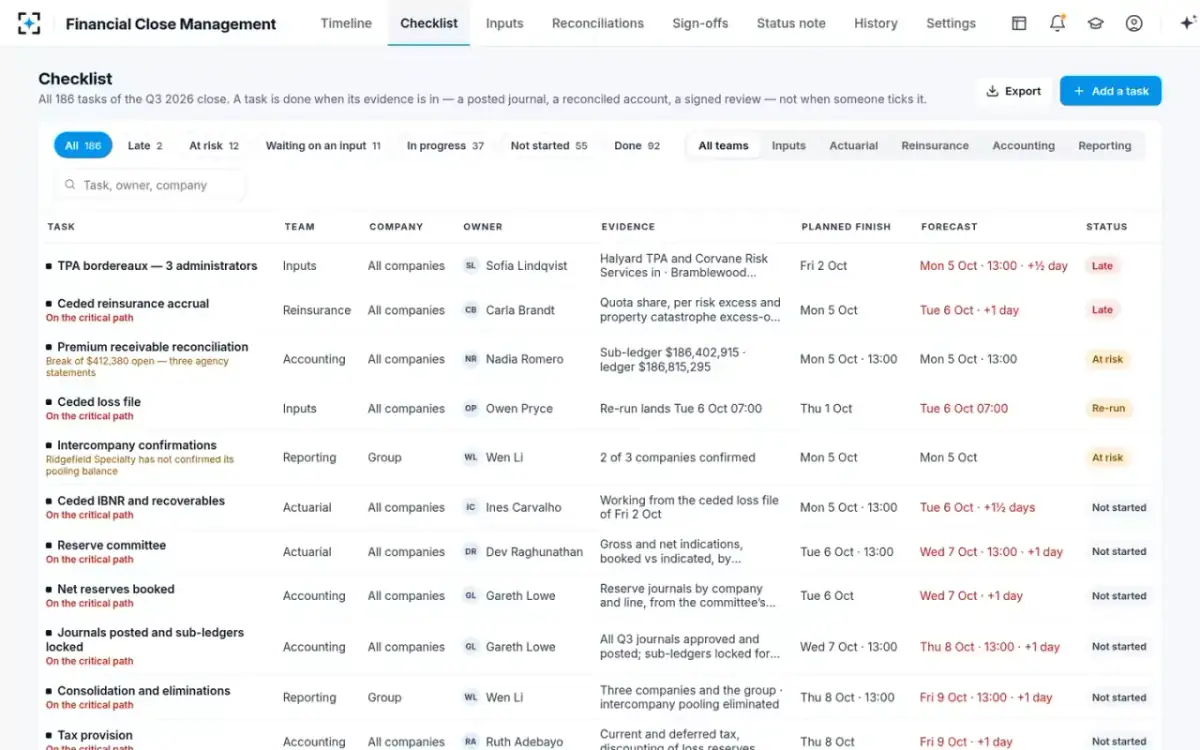
One insurer's close checklist on the morning of day +3
186
tasks across three statutory companies and the group
92
done, each on its evidence
11
waiting on an input from another team or an outside party
14
late or at risk: 2 late, 12 at risk
What is month end close checklist software, and what should it check?
At its simplest it is a shared task list for the period-end close: tasks, owners, due dates and status, often with a template copied from the previous period. At its most useful it checks the status for itself. The difference is whether the software reads the systems where the work happens or waits for people to report on it.
The reason this matters is the shape of the close. Most of an insurer's close tasks depend on another task's output. The reserve committee cannot meet until the actuary's indication and the ceded view are in; net reserves cannot be booked until the committee has met; the journals cannot be locked until net reserves are booked. A status that is wrong at one point in that chain is wrong everywhere after it. A checklist that relies on ticks is right only as often as every owner remembers to update it, and a dependency that lives in someone's head is invisible to everyone else.
Can a checklist be a control? Why a tick is not evidence
A checklist can support a control, but a tick on its own is not one. A tick is a person saying the work is done. Auditors treat that kind of statement with care. In the PCAOB's evidence standard, "Inquiry of company personnel, by itself, does not provide sufficient audit evidence" to support a conclusion about whether a control is effective. A ticked checklist is inquiry written down.
What turns a checklist into evidence is that each item points to something an auditor can inspect: a journal with its preparer, approver and posting date; a reconciliation with both balances, the difference, the threshold and the reconciling items; a signed review with its date and reviewer. Once each task names its evidence, the checklist can refuse to call a task done until the evidence exists. That is the rule the solution applies, and it is a setting the controller can see: "Done only on evidence", on by default, with ticks that arrive without evidence ignored.
A ticked checklist is inquiry written down. A checklist that names its evidence, and waits for it, is something an auditor can test.
What should be on an insurance month end close checklist? Task by task, with its evidence
An insurer's close checklist differs from a general one in its inputs and in its estimates. Much of the data arrives from outside the general ledger: policy and claims systems, third-party administrators, brokers, reinsurers, custodians. The largest balances, the loss and loss adjustment expense reserves, are estimates that pass through an actuarial review and a committee. The table lists the tasks that hold up others in a property and casualty group's quarter close, the evidence that should make each one done, and who should review it.
An insurer's month end close checklist, with the evidence that makes each task done
| Task | Done when this evidence exists | Reviewed by |
|---|---|---|
| Premium and billing extract | Arrived, with its row count and a control total that ties to the policy system | Data owner |
| Claims paid and case reserve extract | Arrived, and its totals tie to the claims system | Data owner |
| Ceded loss file | Arrived for the period; any re-run logged, with the tasks that used the old version | Reinsurance accounting |
| TPA bordereaux | Each administrator’s bordereau in, with paid amounts that tie to its funding account | Claims finance |
| Broker and reinsurer accounts | Read, with balances agreed to the treaty terms or the query recorded | Reinsurance accounting |
| Gross reserve indication | The actuary’s indication by segment, signed | Chief reserving actuary |
| Ceded reinsurance accrual | Recoveries by treaty from the current ceded loss file, prepared and reviewed | A reviewer who did not prepare it |
| Reserve committee | Minutes with booked against indicated, by company and line | Committee chair |
| Premium receivable and bank reconciliations | Each account reconciled, with any difference under its threshold or explained item by item | A reviewer who did not prepare it |
| Net reserves booked; journals posted | Reserve journals posted by company and line; all period journals approved and posted | Controller or delegate |
| Intercompany and pooling | Each company’s confirmation of its balance | Consolidation lead |
| Consolidation, tax, flux review | Eliminations posted; provision prepared and reviewed; variances explained | Controller |
| Key controls attested | Each key control’s preparer and a different reviewer recorded | Internal audit reads |
| Controller review and CFO sign-off | Opens only when everything it rests on is done; signed | Controller, then CFO |
Three of those rows carry most of the risk in an insurer's close. The ceded reinsurance accrual depends on a file that can be re-run after the work starts, as the sample close shows below. The reserve committee is where an estimate becomes the number management books. And the premium receivable reconciliation is where agency statements and policy changes that have not reached the policy system surface as a break. The three-way agreement of ceded premium between cedant, broker and reinsurer is its own discipline, covered in premium reconciliation in reinsurance.
The checklist, filtered to what holds up others, each task with its evidence
How do you prove a close task is complete?
By pointing to the output the task was meant to produce, in the system that holds it, with the person who prepared it and the person who reviewed it. The proof is not a statement about the work; it is the work's own artefact. For a journal, that is the posting with its preparer and approver. For a reconciliation, both balances, the difference, the threshold and the items that explain it. For an estimate, the signed indication or the committee's minutes. For an input, its arrival with a row count and a control total.
That is also how auditors approach the period-end process. In an audit of internal control, the PCAOB standard directs the auditor to assess, among other things, the "Inputs, procedures performed, and outputs of the processes the company uses to produce its annual and quarterly financial statements". A checklist that records inputs, procedures and outputs task by task is a map of exactly that, kept as the close happens rather than rebuilt for the auditor afterwards.
One property is easy to miss: evidence can go stale. A task completed on a file that is later replaced is no longer done, whatever its status says. A checklist that only ever moves forward cannot represent that, and it is precisely what happened in the sample close.
How do you handle late files in the close? When evidence goes stale
Record every arrival and re-run with the tasks that used it, so that a late or replaced file sets back exactly the work that depended on it. On Friday 2 October the sample group's reinsurance accounting lead, Carla Brandt, started the ceded accrual from that morning's ceded loss file and had worked out the quota share and per risk cessions by the afternoon. On Monday at 08:40 the reinsurance system re-ran the file after 41 claims from an August hail event were re-coded to the catastrophe code. Friday's file was void.
A tick-based checklist would still have shown the accrual as half done. The solution's evidence checker set Friday's work on the ceded accrual and the ceded IBNR back to not started at 08:41, because both used the void file. The planner then re-planned everything downstream. The point is not the speed. It is that the status reflected the evidence, including evidence that had been withdrawn.
Late inputs work the same way. One of the sample group's three third-party administrators, Bramblewood Claims Services, had a commercial auto bordereau due Friday at 17:00 that had not arrived by Monday morning; another arrived half a day late. Each shows on the inputs view with when it was expected, when it arrived and whether it ties, and each task waiting on it shows "waiting on an input" rather than "in progress". That distinction tells the controller whom to chase.
A reconciliation break, explained to the dollar, before anyone ticks it
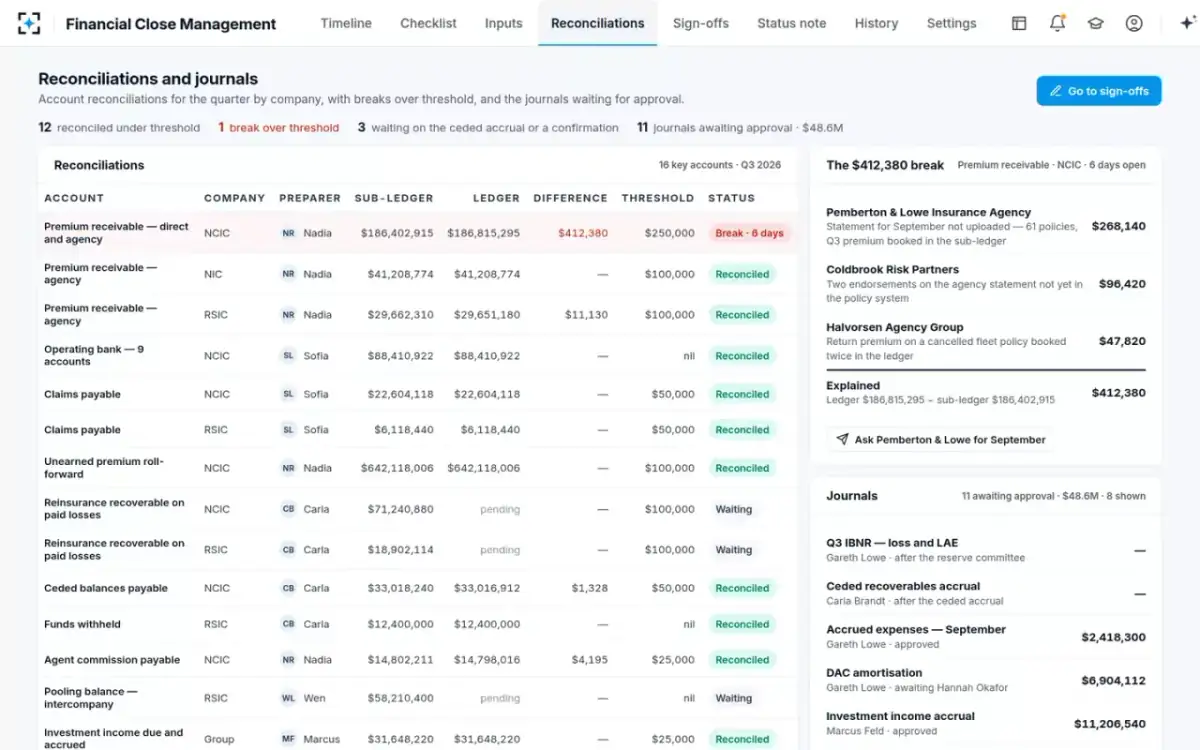
The reconciliation screen shows the other half of the rule. Northvale Casualty's premium receivable shows $186,815,295 in the general ledger against $186,402,915 in the premium sub-ledger, a break of $412,380 against a $250,000 threshold, open for six days. Three agency items explain all of it: a September statement not yet uploaded ($268,140), two endorsements not yet in the policy system ($96,420) and a return premium booked twice ($47,820). Until those are cleared, the task is at risk, not done, whoever would like to tick it.
Who signs off the close checklist?
No single person signs the whole list; each task has a preparer and, for key controls, a reviewer who is not the preparer, and the controller and CFO sign at the end. The solution enforces the order. The controller's review opens only when the flux review, tax provision and key controls it rests on are in; the CFO's sign-off follows the controller's. A sign-off that tries to open early shows what it is still waiting for.
The separation of preparer and reviewer is easy to state and easy to lose in a small team at quarter-end. A checklist that stores both names, and will not accept a review from the person who prepared the work, keeps it without anyone having to police it. In the sample group the sign-off matrix carries reserves, reinsurance, reconciliations, journals, tax, key controls, controller and CFO for each of the three companies and the group, and internal audit reads every sign-off with its evidence. How those sign-offs feed the internal control report that larger insurers file is covered in SOX controls for insurance companies.
Checklist or close management software: what is the difference?
A checklist records status; close management software computes it, and computes what it means for the close date. The table compares the three ways insurers commonly run the list.
Three ways to run an insurer's close checklist
Spreadsheet or task-list checklist: The owner ticks it.
Evidence-based close management: Its evidence exists: a posted journal, a reconciliation under threshold, a signed review.
Spreadsheet or task-list checklist: In people’s heads, or a column nobody maintains.
Evidence-based close management: Each task names what it waits for; a slip moves everything after it.
Spreadsheet or task-list checklist: Found when the next person asks where their input is.
Evidence-based close management: Logged on arrival with row counts; tasks that used a replaced file are set back.
Spreadsheet or task-list checklist: Two names typed in, if anyone remembers.
Evidence-based close management: Both stored; a review by the preparer is refused.
Spreadsheet or task-list checklist: The planned date, until someone re-plans by hand.
Evidence-based close management: A projected date, recomputed on every arrival and change.
Spreadsheet or task-list checklist: A list rebuilt after the close from emails and folders.
Evidence-based close management: Each task’s history: who, when, on what evidence.
The middle ground matters because it is where many insurers are. A general ledger with a close task list adds owners, due dates and reminders. What it rarely adds is the reading of inputs from systems outside the general ledger, such as reinsurance files, administrators' bordereaux and the actuary's indication, which is where an insurer's close usually slips. If the software can only see tasks inside the general ledger, it cannot see the tasks that set the date.
What to ask of month end close checklist software, before you buy it
- What makes a task done?
Ask for a demonstration of a task that refuses a tick because its evidence is missing.
- Can a status go backwards?
When an input is re-run or withdrawn, the tasks that used it should be set back, with the reason on their history.
- Does it read inputs from outside the general ledger?
Policy, claims and reinsurance systems, bordereaux and broker accounts are where an insurer’s close waits.
- Does it hold dependencies, and recompute the close date?
A due date per task is not a plan. The projected close should move when a task on the critical path slips.
- Does it enforce preparer and reviewer?
For key controls, a review by the preparer should be impossible, not just discouraged.
- What will the auditor see?
Each task’s history with who, when and on what evidence, without anyone rebuilding it.
- Who can change the rules?
Thresholds and the evidence each task needs should be the controller’s settings, with every change versioned.
Where the solution fits is the insurer whose close is long, interdependent and fed from outside the general ledger. It reads arrivals and statuses from the systems the close already runs on and does not replace them: it does not perform reconciliations, compute reserves or post journals. If your close lives entirely inside one ERP's task list and finishes in a few days, a checklist inside that ERP may be enough. If your close slips on files that arrive from reinsurers and administrators, the checklist needs to see them. How the software's agents divide the work with people is set out in AI financial close software.
Questions people ask
What is month end close checklist software?
Software that holds the period-end close tasks with owners, due dates and status, so the controller can see what is done. The better products check status against evidence, such as posted journals and reconciliations under threshold, rather than relying on ticks, and recompute the close date when a task slips.
Can a checklist be a control?
A ticked checklist on its own is not much of one: it records what people say, and the PCAOB's evidence standard says inquiry by itself does not support a conclusion that a control works. A checklist that names each task's evidence and waits for it supports the controls behind each task.
What evidence do auditors want from the close?
The artefacts of the work: journals with their preparer and approver, reconciliations with balances and reconciling items, signed reviews, and the inputs the statements were built from. In an audit of internal control, the PCAOB standard has the auditor assess the inputs, procedures and outputs of the period-end process.
How do you handle a file that is re-run after work has started?
Log the re-run with the tasks that used the old version, set that work back, and re-plan everything downstream. In the sample close, the ceded accrual and ceded IBNR were set back one minute after a ceded loss file re-run, and every moved task and owner was listed a minute later.
Who should sign off the close checklist?
Each task's preparer, a different reviewer for each key control, then the controller and the CFO. The controller's review should open only when everything it rests on is in, so the order of sign-offs is enforced rather than remembered.